
JEE NEET Chemistry
Atomic Structure
Very Important Practice Questions
Q.1. The radius of the second Bohr orbit for hydrogen atom is:
(Plank's const. h = 6.6262 × 10⁻³⁴ Js; mass of electron= 9.1091 × 10⁻³¹ kg; charge of electron e = 1.60210 × 10⁻¹⁹ C; permittivity of vacuum εo = 8.854185 × 10⁻¹² kg−1 m−3 A2)
(a) l.65 Å
(b) 4.76 Å
(c) 0.529 Å
(d) 2.12 Å
Q.2. If the shortest wavelength in Lyman series of hydrogen atom is A, then the longest wavelength in Paschen series of He+ is:
(a) 
(b) 
(c) 
(d) 
Q.3. The electron in the hydrogen atom undergoes transition from higher orbitals to orbital of radius 211.6 pm. This transition is associated with:
(a) Lyman series
(b) Balmer series
(c) Pasch en series
(d) Brackett series
Q.4. Which of the following is the energy of a: possible excited state of hydrogen?
(a) −3.4 eV
(b) +6.8 eV
(c) +13.6 eV
(d) −6.8 eV
Q.5. The energy of an electron in first Bohr orbit of H−atom is −13.6 eV. The energy value of electron in the excited state of Li2+ is
(a) −27.2 eV
(b) 30.6 eV
(c) −30.6 eV
(d) 27.2 eV
Q.6. A stream of electrons from a heated filament was passed two charged plates kept at a potential difference V esu. If e and m are charge and mass of an electron, respectively, then the value of h/l, (where l is wavelength associated with electron wave) is given by:
(a) 
(b) 
(c) meV
(d) 2meV
Q.7. If lo and l, be threshold wavelength and wavelength of incident light, the velocity of photoelectron ejected from the metal surface is:
(a) 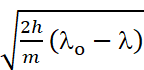
(b) 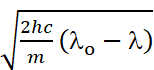
(c) 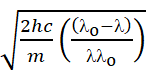
(d) 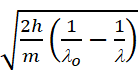
Q.8. The energy required to break one mole of Cl−Cl bonds in Cl2 is 242 kJ mol−1. The longest wavelength of light capable of breaking a single Cl−Cl bond is (c = 3 × 10⁸ ms−1 and NA = 6.02 × 10²³ mo1−1).
(a) 594 nm
(b) 640 nm
(c) 700 nm
(d) 494 nm
Q.9. Calculate the wavelength (in nanometer) associated with a proton moving at 1.0 × 10³ ms−l. (Mass of proton = 1.67 × l 0−27 kg and h = 6.63 × 10⁻³⁴ Js)
(a) 0.40 nm
(b) 2.5 nm
(c) 14.0 nm
(d) 0.32 nm
Q.10. The
orbital angular momentum for an electron revolving in an orbit is given by 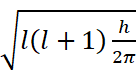 .
This momentum for an s−electron will be given by
.
This momentum for an s−electron will be given by
(a) 0
(b) 
(c) 
(d) 
Q.11. Based on the equation:

the wavelength of the light that must be absorbed to excite hydrogen electron from level n = 1 to level n = 2 will be:
(h = 6.625 × 10⁻³⁴ Js, C = 3 × 10⁸ ms−1)
(a) 1.325 × 10⁻⁷ m
(b) 1.325 × 10⁻¹⁰ m
(c) 2.650 × 10⁻⁷ m
(d) 5.300 × 10⁻¹⁰ m
Q.12. If m and e are the mass and charge of the revolving electron in the orbit of radius r for hydrogen atom, the total energy of the revolving electron will be:
(a) 
(b) 
(c) 
(d) 
Q.13. Excited hydrogen atom emits light in the ultraviolet region at 2.47 × 10¹⁵ Hz. With this frequency, the energy of a single photon is: (h = 6.63 × 10⁻³⁴ Js)
(a) 8.041 × 10−40 J
(b) 2.680 × 10⁻¹⁹ J
(c) 1.640 × 10⁻¹⁸ J
(d) 6.111 × 10⁻¹⁷ J
Q.14. Ionization energy of gaseous Na atoms is 495 .5 kJ mo1−1. The lowest possible frequency of light that ionizes a sodium atom is
(h = 6.626 × 10⁻³⁴ Js, NA = 6.022 × l023 mo1−1)
(a) 7.50 × 10⁴ s−1
(b) 4.76 × 10¹⁴ s−1
(c) 3.15 × 10¹⁵ s−1
(d) 1.24 × 10¹⁵ s−1
Q.15. Energy of an
electron is given by  .
Wavelength of light required to excite an electron in a hydrogen atom from
level n = 1 to n= 2 will be (h = 6.62 × 10⁻³⁴ Js and c = 3.0 ×
108 ms−1)
.
Wavelength of light required to excite an electron in a hydrogen atom from
level n = 1 to n= 2 will be (h = 6.62 × 10⁻³⁴ Js and c = 3.0 ×
108 ms−1)
(a) 1.214 × 10⁻⁷ m
(b) 2.8 16 × 10−7 m
(c) 6.500 × 10⁻⁷ m
(d) 8.500 × 10⁻⁷ m
Q.16. The wave number of the first emission line in the Balmer series of H−Spectrum is (R = Rydberg constant)
(a) 
(b) 
(c) 
(d) 
Q.17. The limiting line in Balmer series will have a frequency of
(Rydberg constant, R∞ = 3.29 × 10¹⁵ cycles/s)
(a) 8.22 × 10¹⁴ s−1
(b) 3.29 × 10¹⁵ s−1
(c) 3.65 × 10¹⁴ s−1
(d) 5.26 × 10¹³ s−1
Q.18. The frequency of light emitted for the transition n = 4 to n = 2 of the He+ is equal to the transition in H atom corresponding to which of the following?
(a) n = 2 to n = 1
(b) n = 3 to n = 2
(c) n = 4 to n = 3
(d) n = 3 to n = l
Q.19. Ionisation energy of He+ is 19.6 × 10⁻¹⁸ J atom−1. The energy of the first stationary state (n = 1) of Li2+ is
(a) 4.41 × 10⁻¹⁶ J atom−1
(b) −4.41 × 10⁻¹⁷ J atom−1
(c) −2.2 × 10⁻¹⁵ J atom−1
(d) 8.82 × 10⁻¹⁷ J atom−1
Q.20. The ionization enthalpy of hydrogen atom is 1.312 × 10⁶ J mo1−1. The energy required to excite the electron in the atom from n = 1 to n = 2 is
(a) 8.51 × 10⁵ J mol−1
(b) 6.56 × 10⁵ J mo1−1
(c) 7.56 × l05 J mol−1
(d) 9.84 × l05 J mo1−1
Q.21. According to Bohr's theory, the angular momentum of an electron in 5th orbit is
(a) 10 h/π
(b) 2.5 h/π
(c) 25 h/π
(d) 1.0 h/π
Q.22. The wavelength of the radiation emitted, when in a hydrogen atom electron falls from infinity to stationary state 1, would be
(Rydberg constant = 1.097 × 10⁷ m−1)
(a) 406 nm
(b) 192 nm
(c) 91 nm
(d) 9.l ×10−8 nm
Q.23. In Bohr series of lines of hydrogen spectrum, the third line from the red end corresponds to which one of the following inter−orbit jumps of the electron for Bohr orbits in an atom of hydrogen
(a) 5 → 2
(b) 4 → 1
(c) 2 → 5
(d) 3 → 2
Q.24. In a hydrogen atom, if energy of an electron in ground state is 13.6 eV, then that in the 2nd excited state is
(a) 1.51 eV
(b) 3.4 eV
(c) 6.04 eV
(d) 13.6 eV
Q.25. At
temperature T, the average kinetic energy of any particle is  .
The de Broglie wavelength follows the order
.
The de Broglie wavelength follows the order
(a) Visible photon > Thermal neutron > Thermal electron
(b) Thermal proton > Thermal electron > Visible photon
(c) Thermal proton > Visible photon > Thermal electron
(d) Visible photon > Thermal electron > Thermal neutron
Q.26. The de−Broglie wavelength of a particle of mass 6.63 g moving with a velocity of 100 ms−1 is
(a) 10−33 m
(b) 10−35 m
(c) 10−31 m
(d) 10−25 m
Q.27. The de Broglie wavelength of a car of mass 1000 kg and velocity 36 km/hr is
(a) 6.626 × 10⁻³⁴ m
(b) 6.626 × 10−38 m
(c) 6.626 × 10⁻³¹ m
(d) 6.626 × 10⁻³⁰ m
Q.28. If the radius of first orbit of H atom is ao, the de−Broglie wavelength of an electron in the third orbit is
(a) 4πao
(b) 8πao
(c) 6πao
(d) 2πao
Q.29. If the kinetic energy of an electron is increased four times, the wavelength of the de−Broglie wave associated with it would become
(a) one fourth
(b) half
(c) four times
(d) two times
Q.30. In an atom, an electron is moving with a speed of 600 m/s with an accuracy of 0.005%. Certainty with which the position of the electron can be located is (h = 6.6 × 10⁻³⁴ kg m2 s−1, mass of electron, em = 9.1 × 10⁻³¹ kg)
(a) 5.10 × 10⁻³ m
(b) 1.92 × 10⁻³ m
(c) 3.84 × 10⁻³ m
(d) 1.52 × 10⁻⁴ m
Q.31. Uncertainty in the position of an electron ( mass = 9.1 × 10⁻³¹ kg) moving with a velocity 300 ms−1, accurate upto 0.001 % will be (h = 6.63 × 10⁻³⁴ Js)
(a) l .92 × 10−2 m
(b) 3.84 × 10⁻² m
(c) 19.2 × 10⁻² m
(d) 5.76 × 10⁻² m
Q.32. The de Broglie wavelength of a tennis ball of mass 60 g moving with a· velocity of 10 metres per second is approximately
(a) 10−31 metres
(b) 10−16 metres
(c) 10−25 metres
(d) 10−33 metres
Planck's constant, h = 6.63 × 10⁻³⁴ Js
Q.33. Uncertainty in position of a minute particle of mass 25 g in space is 10−5 m. What is the uncertainty in its velocity (in ms−1)? (h = 6.6 × 10⁻³⁴ Js)
(a) 2.1 × 10⁻³⁴
(b) 0.5 × 10⁻³⁴
(c) 2.1 × 10⁻²⁸
(d) 0.5 × 10⁻²³
Q.34. The total number of orbitals associated with the principal quantum number 5 is:
(a) 20
(b) 25
(c) 10
(d) 5
Q.35. If the principal quantum number n = 6, the correct sequence of filling of electrons will be:
(a) ns → (n − 2)f → np → (n − 1)d
(b) ns → (n − 2)f → (n − 1)d → np
(c) ns → np → (n − 1)d → (n − 2)f
(d) ns → (n − 1)d → (n − 2)f → np
Q.36. The correct set of four quantum numbers for the valence electrons of rubidium atom (Z = 37) is:
(a) 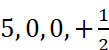
(b) 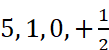
(c) 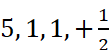
(d) 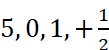
Q.37. In an atom how many orbital(s) will have the quantum numbers; n = 3, l = 2 and ml = +2 ?
(a) 5
(b) 3
(c) 1
(d) 7
Q.38. Given
(A) n = 5, ml = + l
(B) n = 2, l = 1, ml = −l, ms = −1/2
The maximum number of electron(s) in an atom that can have the quantum numbers as given in (A) and (B) are respectively
(a) 25 and 1
(b) 8 and 1
(c) 2 and 4
(d) 4 and 1
Q.39. The electrons identified by quantum numbers n and l :
(A) n = 4, l = 1
(B) n = 4, l = 0
(C) n = 3, l = 2
(D) n =3, l = 1
can be placed in order of increasing energy as :
(a) (C) < (D) < (B) < (A)
(b) (D) < (B) < (C) < (A)
(c) (B) < (D) < (A) < (C)
(d) (A) < (C) < (B) < (D)
Q.40. The increasing order of the ionic radii of the given isoelectronic species is:
(a) Cl−, Ca2+, K+, S2−
(b) S2−, Cl−, Ca2+, K+
(c) Ca2+, K+, C1−, S2−
(d) K+, S2−, Ca2+, C1−
Q.41. In a multi−electron atom, which of the following orbitals described by the three quantum members will have the same energy in the absence of magnetic and electric fields?
(A) n = 1, l = 0, m = 0
(B) n = 2, l = 0, m = 0
(C) n = 2, l = l, m = l
(D) n = 3, l = 2, m = 1
(E) n = 3, l = 2, m = 0
(a) (D) and (E)
(b) (C) and (D)
(c) (B) and (C)
(d) (A) and(B)
Q.42. Which of the following sets of quantum numbers is correct for an electron in 4f orbital ?
(a) n = 4, l = 3, m = +1, s = +1/2
(b) n = 4, l = 4, m = −4, s = −1/2
(c) n = 4, l = 3, m = +4, s = +1/2
(d) n = 3, l = 2, m = −2, s = +1/2
Q.43. Consider the ground state of Cr atom (X = 24). The number of electrons with the azimuthal quantum numbers, l = 1 and 2 are, respectively
(a) 16 and 4
(b) 12 and 5
(c) 12 and 4
(d) 16 and 5
Q.44. Which one of the following sets of ions represents the collection of isoelectronic species?
(a) K+, Cl−, Mg2+, Sc3+
(b) Na+, Ca2+, Sc3+, F−
(c) K+, Ca2+, Sc3+, Cl−
(d) Na+, Mg2+, Al3+, Cl−
(Atomic nos.: F = 9, Cl = 17, Na = 11, Mg = 12, Al = 13, K = 19, Ca = 20, Sc = 21)
Q.45. The number of d−electrons retained in Fe2+ (At. no. of Fe = 26) ion is
(a) 4
(b) 5
(c) 6
(d) 3
Q.46. Which one of the following groupings represents a collection of isoelectronic species ? (At. nos.: Cs = 55, Br = 35)
(a) N3−, F−, Na+
(b) Be, Al3+, Cl−
(c) Ca2+, Cs+, Br
(d) Na+, Ca2+, Mg2+
Q.47. The following sets of quantum numbers represent four electrons in an atom.
(i) n = 4, l = 1
(ii) n = 4, l = 0
(iii) n = 3, l = 2
(iv) n = 3, l = 1
The sequence representing increasing order of energy, is
(a) (iii) < (i) < (iv) < (ii)
(b) (iv) < (ii) < (iii) < (i)
(c) (i) < (iii) < (ii) < (iv)
(d) (ii) < (iv) < (i) < (iii)
Q.48. Which one of the following constitutes a group of the isoelectronic species?
(a) C22−, O2−, CO, NO
(b) NO+, C22−, CN−, N2
(c) CN−, N2, O22− , C22−
(d) N2, O2−, NO+, CO
Q.49. Which of the following sets of quantum numbers represents the highest energy of an atom?
(a) n = 3, l = 0, m = 0, s = +l/2
(b) n = 3, l = 1, m = 1, s = +l/2
(c) n = 3, l = 2, m = 1, s = +l/2
(d) n = 4, l = 0, m = 0, s = + 1/2
Q.50. Of the following sets which one does NOT contain isoelectronic species?
(a) BO33−, CO32−, NO3−
(b) SO32−, CO32−, NO3−
(c) CN−, N2 , C22−
(d) PO43−, SO42−, ClO4−
Online Tuitions & Self-Study Courses for Grade 6 to 12 & JEE / NEET