
Class 6 Science Important Questions
Chapter 16 Garbage in Garbage out
Q.1: (a) Name the two kinds of waste that need to be separated from each other in two different waste bins.
(b) Name two items of waste each that need to be sent to a (i) landfill (ii) for composting.
Ans:
(a) Two kinds of waste that needs to be separated are biodegradable and non-biodegradable wastes.
(b) (i) Landfill - Any metal items
(ii) For composting - Kitchen waste, animal waste.
Q.2: 3R's are used as efficient means to reduce waste. What is meant by three R's in terms of waste disposal?
Ans: It means reduce the waste generation, reuse the substances which can be used again and recycle the materials which are non-biodegradable and cannot be reused.
Q.3: Why should we not. burn plastic items?
Ans: We should not burn plastic items because
(i) they do not burn easily.
(ii) they produce toxic gases when burned and left-over ashes are also toxic.
(iii) they add to soil pollution.
(iv) burnt pieces may be eaten by cows which may choke them to death.
(v) toxic gases lead to many respiratory diseases.
Q.4: List some differentiating features between composting and vermicomposting.
Ans: Composting It is a natural process by which biodegradable waste like leaves can be turned into manures by the use of microbes only.
Vermicomposting In this process, manure is formed from the waste by use of redworms along with the microbes.
Q.5: Why should containers used for storing poisonous substances be recycled separately?
Ans: Containers used for storing poisonous substances contain residues of chemicals in them.
These containers will contaminate other recycling substances thereby, making every product recycled in them harmful.
Q.6: Suggest any two ways to minimise the harmful effects of plastics.
Ans: The two ways to minimise the harmful effects of plastics are
(i) Reuse of plastic bags and containers will minimise the number of plastic bags.
(ii) Avoid burning of plastics as they release harmful gases in the atmosphere.
Q.7: Correct the definitions of certain terms given below by changing only one word.
(a) Compost: Substances converted into manure for use in industries.
(b) Landfill: Garbage buried under water in an area.
(c) Recycling: Reuse of unused material in the same or another form.
Ans:
(a) Compost is a substance converted into manure for use in agricultural fields.
(b) Landfill is the place where garbage is buried under soil in an area.
(c) Recycling is a process of using used material in the same or another form.
Q.8: Recently, a ban on plastic bags has been imposed in many places. Is the ban justified? Give reasons in three sentences.
Ans: The recent ban on plastic bags is justified as due to this
(i) Local people had started taking proper care of plastic disposal.
(ii) Ban on plastic bags had made people shift to paper bags for their day-to-day routine use.
(iii) Disposal of plastic bags had come under control due to this ban.
Q.9: Waste of which material is more polluting, a polythene bag or paper? Give reasons.
Ans: Polythene is more polluting than paper because it cannot be decomposed naturally by worms and microbes. So, these polythenes create problem and pose environmental threat on the other hand, papers are easily decomposed.
Q.10: Garbage is collection of various substances considered unusable. Name any three substances that constitute garbage.
Ans: The following wastes constitute garbage:
(i) Kitchen waste (ii) Domestic waste (iii) Plastic bags
Q.11: To what use can you put the following kinds of garbage and how?
(a) Rotting smelly garbage
(b) Dry leaves collected in a garbage
(c) Old newspapers
Ans: (a) Rotting smelly garbage can be converted into compost.
(b) Dry leaves collected in a garbage can be used as manure.
(c) Old newspapers can be recycled to make paper bags or paper pulp for handicrafts.
Q.12: Geeta was writing a letter to her friend. She crumpled and threw the first draft of her letter on the floor as it had become untidy. Similarly, she crumpled and threw 6 more papers on the ground. In the end, she picked them up and put them in a polythene bag and threw it on the road outside her house.
Was Geeta's action responsible?
What would you have done if you were in her place?
Ans: No, in my opinion, Geeta's action was not responsible.
If I would have been in her place, I would have used the paper for doing rough work or convert it into paper pulp to make a handicraft item.
Q.13: Two different pits A and B are dug in soil which are 40 cm deep. Material C is placed in pit A whereas material D is placed in pit B. Both the pits were covered with soil. After a month, when pits were dug, it was found that material C remained as such whereas material D was rotten up completely.
(a) Identify materials C and D
(b) Which factor is responsible for causing rotting of material D?
Ans: (a) C is polythene bag and D is newspaper.
(b) The material D was rotten by the action of microbes present in the soil.
Q.14: Kishan, a farmer would clear his field everyday and burn dry leaves fallen on the ground.
After some time, he found that those people living in huts near his field were suffering from cough and breathing problems.
(a) Can you explain, why?
(b) Also suggest an environment friendly way to dispose the dry leaves.
Ans: (a) Fumes and gases produced from burning materials caused cough and breathing problems in the nearby area.
(b) An environment friendly way to dispose the dry leaves is to convert them into manure.
Q.15: A is a very useful material used in our daily life in one form or other. Production of A requires cutting down of forest trees. This material is biodegradable and it can be recycled to make useful products like cardboard, bags, etc.
(a) Identify material A.
(b) List any three things made from A used in our everyday life.
Ans: (a) Paper (b) Books, notebooks and newspapers.
Q.16: Our government has provided us with two types of dustbins for waste disposal. Why is there a need to separate the two types of wastes?
Ans: The two types of wastes, i.e. biodegradable and non-biodegradable wastes require different methods of disposal.
Non-biodegradable wastes cannot be treated by methods used to dispose biodegradable wastes. Thus, our government has provided two types of dustbin for waste disposal.
Q.17: Provide a suitable term that expresses the meaning of each of the following statements.
(a) Greeting cards made from newspaper.
(b) Contents of the waste bins.
(c) Worms converting certain kinds of waste into manure.
(d) An area where a lot of garbage is collected, spread out and covered with soil.
Ans: A suitable term describing/expressing the meaning of the above given statements is as follows:
(a) Recycling (b) Garbage (c) Vermicomposting (d) Landfill
Q.18: (a) Which kind of garbage is not converted into compost by the redworms?
(b) Have you seen any other organism besides redworms in your pit? If yes, try to find out their names. Draw a figure of these.
Ans: (a) Non-biodegradable wastes such as broken glass, aluminium wrappers, plastic, polythene bags, etc cannot be converted into compost by the redworms.
(b) Yes, saprophytic organisms such as moulds and bacteria, are also helpful in the decomposition of biodegradable substances. Saprophytic organisms feed on dead and decaying matter.
Q.19: Discuss.
(a) Is garbage disposal the responsibility only of the government?
(b) Is it possible to reduce the problems relating to disposal of garbage?
Ans: (a) In most of the cities, the responsibility of garbage disposal is on municipal corporation and most of the people think they have no responsibility. We should realise that garbage disposal is collective responsibility of both the people and the government.
We must ensure ways to reduce production of garbage.
(b) Yes, it is possible to reduce the problems related to disposal of garbage by following 3R's rule:
(i) Reduce: We should minimise the use of things that produce wastes, e.g. by using public transport for travelling.
(ii) Recycle: Things such as plastic, paper, glass and metals should be separated from garbage and recycled to make new articles instead of dumping them with other wastes, e.g. recycling of paper.
(iii) Reuse: We can reuse many things which we generally throw after one use, e.g. plastic bottle of jam or pickle can be used for storing things in the kitchen. If we sincerely follow these rules, the problem of garbage disposal can be minimised.
Q.20: (a) What do you do with the left-over food at home?
(b) If you and your friends are given the choice of eating in a plastic plate or a banana leaf platter at a party, which one would you prefer and why?
Ans: (a) We usually throw the left-over food at home. But it is a biodegradable waste which can be converted into useful products by microorganisms. So, left-over food at home should be dumped into compost pits to convert them into manure. This manure can be used for growing plants.
(b) We will prefer a banana leaf platter because it is biodegradable and can be disposed easily. By the process of composting, it can be converted into manure, while a plastic plate is non-biodegradable and has a lot of difficulty in disposal. It also causes pollution.
Q.21: (a) Collect pieces of different kinds of paper. Find out, which of these can be recycled?
(b) With the help of a lens, look at the pieces of paper you collected for the above. Do you see any difference in the material of recycled paper and a new sheet of paper?
Ans: (a) Pieces of papers can be obtained from newspapers, notebooks, magazines, etc. All of these can be recycled whereas shiny plastic-coated papers cannot be recycled. Because plastic is non-biodegradable. The paper which cannot be recycled can be reused to make paper bags; envelopes, etc.
(b) Yes, there is a difference as surface of recycled paper is rough, while that of new sheet of paper is smooth. Recycled sheets are prepared from used papers. This type of paper can be used for making carry bags and other packaging materials.
Q.22: (a) Collect different kinds of packaging materials. What was the purpose for which each one was used?
(b) Give an example in which packaging could have been reduced.
(c) Write a story on how packaging increases the amount of garbage.
Ans: (a) Different kinds of packaging materials used commonly are:
Plastic bags - for carrying eatables or other household things.
Cardboard - used as shoe boxes, etc.
Jute bags - school bags and shopping bags.
(b) The packaging in plastic bags must be reduced as these are non-recyclable and harmful. Instead, paper bags can be used.
(c) Packaging materials increase the amount of garbage as it is being thrown carelessly on the roads, etc.
Also, they are non-biodegradable wastes. Therefore, they cause harm to the nature through pollution.
Q.23: Do you think, it is better to use compost instead of chemical fertilisers? Why?
Ans: Yes, it is better to use compost instead of chemical fertilisers. The reasons are as follows:
(i) Compost is eco-friendly, while chemical fertilisers destroy the natural composition of soil by adding unwanted chemicals into the soil.
(ii) Production of compost is easy and harmless whereas production of chemical fertilisers is a costly process.
(iii) Chemical fertilisers cannot be decomposed by natural methods hence, create pollution of soil and water.
Q.24: Beautiful handcrafted articles like boxes and toys are made up of paper pulp in our country. Can you explain how paper pulp which is made from paper can be used to make hard boxes and other articles?
Ans: By following these simple steps, we can make hard gifting boxes or other articles from the recycled paper pulp:
Step I: Create a stencil by unfolding a small, one-piece cardboard box and trace it on a piece of cardboard that is the same size as your mould. Then, cut out that shape with scissors.
Step II: Place the box stencil between your mould and deckle.
Step III: Raise the mould, deckle and stencil to the surface in one continuous motion and then remove them from the pulp.
Step IV: Remove the box from the stencil and let the paper dry.
Step V: Assemble the box by folding and gluing or taping the edges. Decorate it as your need.
Q.25: What happens when
(a) cooking medium is made to flow down a drain?
(b) insecticides, motor oil, paints are poured down the drain?
(c) tea leaves, cotton swabs and old soft toys are thrown into the drain?
Ans: (a) If cooking medium is made to flow down a drain, it may clog pores in soil and can block pipes also.
(b) If insecticides, motor oil, paints are poured down the drain, this may kill useful microbes which help to purify water.
(c) If tea leaves, cotton swabs and old soft toys are thrown into the drain, it can choke the drains and block the water supply of the area.
Q.26: Some waste materials can be reused in different forms. Can you make something useful with these waste materials, powder container, cold drink cans, plastic bottles, shoe boxes.
Ans: (i) Powder container: The elongated metallic powder container can be used as pen-pencil stand or to grow money plant, etc. The plastic containers should be sent to plastic industries for recycling.
(ii) Cold drink cans: For storing liquids, growing herbaceous plants like tulsi, money plant, small flowering plants.
(iii) Plastic bottles: These can also be used for growing plants, storing liquids, etc.
(iv) Shoe box: For making small red cross box, storing pen-pencils and other small articles.
Q.27: Write three sentences on what comes to your mind when you get a chance to see:
(a) A rag picker
(b) A cow eating a polythene bag.
(c) Foul odour emanating from garbage at the entrance of your house.
Ans: Following things come to our mind when we see
(a) A rag picker
(i) Poor people working due to poverty.
(ii) He removes the garbage generated by others.
(iii) He is exposing himself to harmful substances, generated due to toxic waste.
(b) A cow eating a polythene bag
(i) Cow is getting exposed to hazardous materials.
(ii) There may be a possibility of polythene choking the animal lead to death.
(iii) Incorrect/Improper disposal of polythene by us.
(c) Foul odour emanating from garbage at the entrance of our house
(i) There must be a large quantity of waste generated in the house.
(ii) Unhealthy surroundings due to this.
(iii) Unpleasant sight.
Q.28: Precautions should be taken while storing cooked food items in plastic bags. Why?
Ans: Plastic bags are not considered suitable for storing cooked food because
(i) these bags may have been used earlier for some other purposes. The residue left behind can be harmful.
(ii) food can mix with chemicals present in plastic bags.
(iii) sometimes bags collected by rag pickers are washed and used which is not a healthy practice.
(iv) plastic bags are not recommended for recycle and reuse as it can harm our health.
Q.29: Answer the following questions in one or two words or sentences
(a) Why should we prefer to use paper bags rather than polythene bags?
(b) Who out of the following, should properly dispose of the garbage-father, mother, elder brother, younger sister?
(c) Which one out of beetles, roundworm and earthworm are used for vermicomposting and why?
Ans:
(a) We should prefer using paper bags rather than polythene bags as paper can be decomposed whereas polythene bags do not degrade.
(b) Every member of the society or family is responsible to dispose off garbage properly.
(c) Earthworms are. the best organisms to be used for vermicomposting as they convert the waste from plants, animals or their products into compost.
Q.30: Ranveer's friend has his birthday tomorrow. Since, he was busy so he could not buy a present for him. He looked around and found papers not in usable condition.
He used them and prepared a card, a diary of colourful pages and a photoframe as gifts for his friend.
(a) Papers are which type of waste?
(b) What is the name of the process used by Ranveer?
(c) List a few benefits of this process.
(d) Can all types of paper be treated by this method?
Ans: (a) Papers are biodegradable wastes.
(b) Ranveer used recycling of paper by making paper mash.
(c) Recycle helps to
(i) use the materials again. (ii) reduce wastage.
(d) No, shiny paper contains plastic, hence they cannot be recycled.
Q.31: Burning of leaves is harmful. Why? Is burning of leaves considered illegal in India. If no, do you suggest it should be made illegal?
Ans: Burning of leaves leads to air pollution and release of toxic gases which can cause diseases in living organisms.
No, burning of leaves is not illegal but it should be because leaves can be disposed in a very useful manner like compost.
It also releases harmful components in air on burning which leads to respiratory diseases and cancer in all.
Q.32: Vermicompost produced from kitchen waste is far better than chemical fertilisers. Why?
Ans: The manure produced from vermicomposting is of high quality Vermicompost is better because
(i) it is cheap and easy to produce while chemical fertilisers are very expensive.
(ii) vermicompost is a natural manure which does not harm the soil or the plants they are added to while chemical fertilisers have adverse effect on both.
Q.33: The pie charts A and B shown in the figure are based on waste segregation method adopted by two families X and Y, respectively.
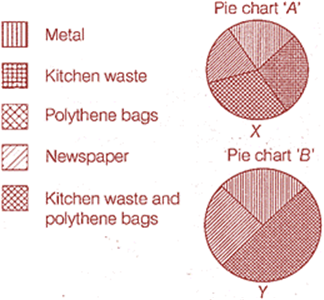
Which of the two families X or Y, do you think is more environmentally conscious and why?
Ans: The family X is more environment friendly/conscious because they dispose off their kitchen waste and polythene bags separately.
Disposing them separately has an advantage as kitchen waste is biodegradable and can be converted into compost. Polythene bags on the contrary are non-biodegradable.
Q.34: Use of plastic bags should be reduced as they cause problems. Write some of these problems caused by excessive use of plastic bags.
Ans: Harmful Effects of Plastics
(i) Plastics do not rot (or decompose) in nature on their own. So, the plastic bags (polythene bags) thrown away on roads and other places get into drains and sewers (sewers are underground dirty water pipes). These plastic bags block the drains and sewers causing the dirty drain water to spill on the roads. During heavy rains, the choked drains and sewers are not able to carry away all the rainwater quickly and hence a flood like situation is created in the city areas.
(ii) Some people fill household garbage in plastic bags and throw it away. When stray cattle look for food in this thrown garbage, they also eat up plastic bags alongwith the garbage food (such as fruit and vegetable peels, left-over cooked food, etc.). Sometimes the cattle even die because of eating plastic bags.
(iii) Sometimes the plastic bags which have been used earlier for storing poisonous substances and then thrown in garbage dumps are picked up by ragpickers, washed and sold to shopkeepers in the market. The use of such plastic bags for packing and storing cooked food materials can harm our health.
(iv) The burning of plastic materials gives out extremely harmful gases which can cause health problems. The gases given out during the burning of plastics can even cause cancer.
Q.35: Municipality provides two types of dustbins for garbage collection. One blue coloured and one green coloured. Among the following wastes provided which, waste will you put in which dustbin?
Plastic materials, metal and glass items, waste of plants and animals, peels of fruits and vegetables, dried leaves and twigs, remains of meat like flesh and bones.
Ans: The above mentioned wastes can be categorised into two categories:
(i) Green bins Wastes which can be decomposed is put in green dustbins, e.g. plants and animals waste, peels of vegetables and fruits, dried leaves, twigs, remains of meat like flesh and bones.
(ii) Blue bins Wastes which cannot be decomposed but can be recycled is put in blue dustbins, e.g. plastic materials, glass, metals, etc.
Q.36: Andrew was in the habit of making aeroplanes with his notebook papers. He used to tear off notebook pages and make paper aeroplanes. One day, his mom objected to this action. He collected all the waste papers and packed them in polybag and threw it outside through the window. Now, answer the following questions:
(a) Do you think Andrew 's action was responsible?
(b) What would you have done if. you were in his place?
Ans:
(a) Andrew's action is not at all an action of a responsible person. Firstly, he wastes the paper and does not know the value of paper.
Secondly, his method of disposal of waste papers is wrong.
(b) If I were in his place, I do not pack the papers in polybags, the decomposition of paper become slow in polybags. Paper pieces should be collected and it can be recycled.
Q.37: Burning of plastic waste is not recommended. Why?
Ans: The plastic wastes on burning produce dangerous toxic gases, so these should not be burnt.
Q.38: Dumping kitchen waste in a pit is considered a good practice for waste disposal. Why?
Ans: Kitchen waste commonly consists of biodegradable components which convert into manure/compost beneficial for plant growth after action of microbes when dumped in a pit.
Q.39: We classify some materials as wastes and throw them. How do you categorise these materials as waste?
Ans: Any material which cannot be used in the form in which it is produced is called as waste.
Q.40: If we burn the waste materials in the open, what consequences will be faced by us?
Ans: Burning of waste materials releases harmful gases and other toxic compounds in the environment which can cause health issues in living organisms, e.g. asthma and cancer.
Q.41: Is there a method where biodegradable wastes can be burned with less harmful consequences?
Ans: Yes, we can incinerate these wastes in ovens or incinerators at high temperature. The ashes produced can be more easily disposed.
Q.42: It is important to dispose the garbage produced from day-to-day activities: What consequences will be faced if garbage is not disposed?
Ans: Accumulation of garbage will attract insects, flies and other animals like pigs, cows, etc in search of food. It will spread dirtiness and perpetuate disease in surrounding areas.
Q.43: Vermicompost is very beneficial use of disposed kitchen waste. Action of which organisms aid in the formation of vermicompost?
Ans: Redworms help in decomposition of the waste by digesting/grinding food components present in waste.
Q.44: Reduction in waste can be achieved by applying some principles. List these principles by which we can reduce waste production.
Ans: Minimum garbage will be produced if we apply 3R's in our daily life. 3R's refers to reduce, reuse and recycle.
Q.45: Landfills are used to dispose off the waste. Mention a disadvantage of landfill method.
Ans: The land used to dispose the waste cannot be used for a long time approx 20 years. Leaching of wastes disposed into land is also a cause of worry.
Q.46: Wastes containing salt, pickles, oil, meat and milk products should not be added in vermicomposting pit as a feed for redworms. Why?
Ans: Addition of above mentioned substances cause the growth of disease-causing organisms and these may harm the worms as well. So, in this way, these substances hinder the preparation of vermicompost.
Q.47: Why should we always carry a bag while shopping?
Ans: If we are in habit of carrying a shopping bag, then we will not depend on shopkeeper to give you items bought in polybags. This will reduce the use of polythene bags.
Q.48: Name a kind of fuel which is made by decomposition of organic waste.
Ans: We get biogas which is made from animal waste. We have to set up such plants to generate biogas. It is eco-friendly and best way to manage animal waste.
Q.49: Find out where is the waste materials taken to and who does this work?
Ans: The waste materials are taken to the places/lands which have to be filled and this work is done by municipal corporation of different cities.
Q.50: The waste materials produced after household work are stored at what place in our homes?
Ans: The waste materials at homes are stored in dustbins and polythene bags.
Q.51: All the waste materials produced from different activities are thrown where?
Ans: The waste materials are thrown in selected empty places or waste material bins.
Q.52: Certain wastes are difficult to dispose. Name two such things which create difficulties during disposal.
Ans: Lead batteries and rubber are difficult to dispose.
Q.53: List some items of waste materials which cannot be used for vermicomposting.
Ans: Polybags, broken glass, aluminium wrappers, old shoes, etc cannot be used for vermicomposting.
Q.54: Dustbins of two colours are provided by municipality in some cities to dispose off different types of garbage. Name them.
Ans: Green dustbin for biodegradable waste and blue dustbin for non-biodegradable waste are provided by municipality in some cities.
Q.55: Name the part of the redworms which help them in grinding the food which they feed on.
Ans: Redworms have gizzard (a kind of teeth) in their alimentary canal which can grind the hard particles of garbage.
Q.56: What is paper mash?
Ans: It is a thick paste made up of clay, paper pieces and some rice husk.
Q.57: Plastic bags are said to be harmful for stray animals. Why?
Ans: The stray animals feed on the content of these bags and end up eating plastic. Plastic cannot be digested hence, may lead to death of the stray animals.
Q.58: Give three examples of materials that can be used again.
Ans: Plastics, metals and glasses can be recycled and reused.
****** End of Questions ******
Examium Classes
Online Classes & Self-Study Courses for Grade 6 to 12 & JEE / NEET