
Chapter 9 – Reproduction in Animals
Question Answer Set 1
Q.1. Explain the importance of reproduction in organisms.
Ans: Reproduction is important for continuation of species, generations after generations. It also helps in production of new individuals of same kind and transmission of certain characters from parents to offsprings.
Q.2. Describe the process of fertilisation in human beings.
Ans: In human beings, fertilisation takes place inside the female body. It is the fusion of male and female gamete, i.e. sperm and an ovum. It is the first stage in the process of reproduction. During fertilisation, the nuclei of egg and sperm fuse together to form a single nucleus. This results in the formation of fertilised egg or zygote:
Q.3. Give two differences between a zygote and a foetus.
Ans: Difference between a zygote and a foetus are
|
Zygote |
Foetus |
|
It is formed by the fusion of male and female gamete. |
It is formed by the developing embryo. |
|
It is made up of single cell. |
It is made up of many cells, in which all the body parts can be identified. |
Q.4. Define asexual reproduction. Describe two methods of asexual reproduction in animals.
Ans: The mode of reproduction in which a single organism is able to produce one or more individuals of its kind is called asexual reproduction. It does not require both male and female parent.
The two methods of asexual reproduction in animals are given below:
(i) Budding It is the mode of asexual reproduction in which small bulges called buds develop and get separated from parent to form new individuals, e.g. in Hydra.
(ii) Binary fission It is the division of nucleus into two nuclei followed by the division of cytoplasm body. Each part receiving a nucleus and develops into two new individuals, e.g. in Amoeba.
Q.5. In which female reproductive organ does the embryo get embedded?
Ans: Embryo gets embedded in the uterus of female for further development.
Q.6. What is metamorphosis? Give examples.
Ans: The process of transformation of larva into an adult through drastic changes is called metamorphosis, e.g. development of caterpillar or pupa into silkworm and development of tadpole into frog.
Q.7. Differentiate between internal fertilisation and external fertilisation.
Ans: Difference between internal fertilisation and external fertilisation are
|
Internal fertilisation |
External fertilisation |
|
It is the fertilisation that takes place inside the female body. |
It is the fertilisation that takes place outside the female body, generally in water. |
|
Sperms are released in female body. |
Sperms and ova are released in water outside the female body. |
|
It is common in terrestrial animals, e.g. humans, cats, dogs, etc. |
It is common in aquatic animals, e.g. frogs, fishes, etc. |
Q.8. In humans, which organ produces the sperm?
Ans: Testes produce sperms in humans.
Q.9. X is the reproductive cell produced in a woman's Y while Z is the reproductive cell that is produced in · the testes of a man. What can X, Y and Z be?
Ans: Egg is the reproductive cell produced in a woman's ovary while sperm is the reproductive cell that is produced in the testes of a man.
Q.10. A term is used for the 'bulges' observed on the sides of the body of Hydra. What is it?
Ans: Bud is the term used for the bulges observed on the sides of the body of Hydra.
Q.11. Name the male sex hormone.
Ans: The male sex hormone is testosterone.
Q.12. Explain the term parthenogenesis.
Ans: The phenomenon by which female gametes produce offspring without fertilisation is called parthenogenesis.
Q.13. What is semen?
Ans: The mixture of secretions from various glands like seminal, prostrate and Cowper’s (bulbourethral) gland along with sperms is called semen.
Q.14. Give the name of the organism and the mode of reproduction represented in the given diagram.
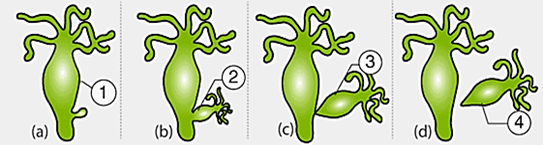
Ans: The name of the organism is Hydra and mode of reproduction is asexual (budding).
Q.15. The eggs of frogs do not have shells for protection, yet they are safe in water, how?
Ans: Frog's eggs are without any external covering or shell but a layer of jelly-like coat hold the eggs together, thus providing them protection.
Q.16. Classify the animals given below as oviparous and viviparous.
Humans, Birds, Frogs, Dogs, Lizards, Cows, Duck.
Ans.
|
Oviparous |
Viviparous |
|
Birds |
Humans |
|
Frogs |
Dogs |
|
Lizards |
Cows |
|
Duck |
|
Q.17. The change from tadpole to frog is given a particular term. What is it?
Ans: Metamorphosis is the term used for the change from tadpole to frog.
Q.18. Give another term for a fertilised egg.
Ans: A fertilised egg is also called zygote.
Q.19. The male and female gamete in human beings are known by which names?
Ans: In human beings, male gamete is known as sperm and female gamete as egg or ova.
Q.20. Name a unicellular and multicellular animal which can reproduce by asexual methods.
Ans: Hydra (multicellular) and Amoeba (unicellular) are two animals which can reproduce by asexual methods.
Q.21. A process by which young ones are formed. What is the process called as?
Ans: Reproduction is the biological process of formation of young ones of their own kind by living organisms.
Q.22. Does the tail in a sperm serve a specific purpose? If yes, what is it?
Ans: Yes, it has a specific function:
The tail in sperm provides motility to it and helps it to reach female gametes for fusion.
Q.23. An organism has both male and female reproductive organs. Is it possible? If yes, name such organism.
Ans: Yes, there are organisms that have both male and female reproductive organs in the same body, e.g., earthworm, leech.
Q.24. Read the statements below made by three children about reproduction.
Rajesh: All living things need an egg and a sperm to reproduce.
Akash: Reproduction is a way to prevent the extinction of a species.
Ankit: The ensure a higher chance of survival, all living things have more than one offspring at a time.
Who made a correct statement?
Ans: The statement made by Akash. is a correct statement about reproduction.
Q.25. Name two main types of reproduction prevalent in animals.
Ans: Two main types of reproduction prevalent in animals are asexual and sexual reproduction.
Q.26. Stages in the life cycle of silkworm are given below. Write them in sequential order.
Pupa, Egg, Silk moth, Caterpillar
Ans: The stages in the life cycle of silkworm occurs in following sequence:
Egg → Caterpillar → Pupa → Silk moth
This drastic change in structure from caterpillar to silk moth is called metamorphosis.
Q.27. Arrange the following stages of development of human body in correct sequence.
Foetus, zygote and embryo.
Ans: Zygote, embryo and foetus.
Q.28. State whether human beings reproduce by sexual methods or asexual methods.
Ans: Human beings reproduce by sexual method.
Q.29. Do humans also undergo metamorphosis?
Ans: No, humans do not undergo metamorphosis.
Q.30. Study the classification structure shown below.
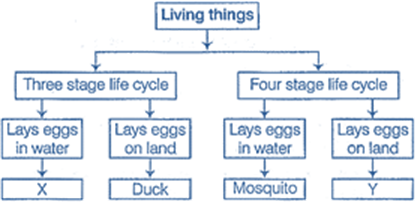
What living things are X and Y likely to be?
Ans: X-Frog; Y-Butterfly
Q.31. Give the other name of oviducts.
Ans: Fallopian tubes is the other name of oviducts.
Q.32. Have you heard of test-tube babies? Define them.
Ans: The babies born through IVF technique are called test-tube babies.
Q.33. A type of reproduction involves gametes. Name it.
Ans: Sexual reproduction involves gametes.
Q.34. In markets, eggs of birds are available but never eggs of dogs, why?
Ans: Birds are oviparous, lay eggs outside the female body, so their eggs are available in market, while dogs are viviparous, i.e. do not lay eggs but give birth to young ones.
Q.35. A fertilisation that takes place outside the body. What is it called as?
Ans: The process of fertilisation that takes place outside the body of the female is called external fertilisation.
Q.36. What do you understand by the term gestation?
Ans: The period between fertilisation and childbirth is called gestation.
Q.37. Hen is an oviparous animal. What type of fertilisation takes place in a hen?
Ans: Internal fertilisation takes place in a hen.
Q.38. Where does an embryo grow in case of external fertilisation?
Ans: Embryo grows outside in open in case of external fertilisation.
Q.39. Name some organisms which are reproduced by parthenogenesis.
Ans: Organisms like honeybees, birds (turkey) and some lizards are reproduced by parthenogenesis.
Q.40. Study the classification structure shown below.
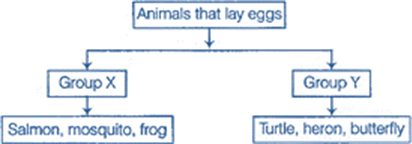
Which of the following are the most suitable headings for the two groups?
|
Group X |
Group Y |
|
Lays one egg at a time |
Lays many eggs |
|
Lays eggs in water |
Lays eggs in land |
|
Eggs with shell |
Eggs without shell |
|
Eggs do mot need to be incubated |
Eggs need to be incubated |
Ans: Group X- Lays eggs in water. Group Y- Lays eggs on land
Q.41. 'Sperms need to have mobility'. Give reason.
Ans: Sperms have to enter the female reproductive passage and fertilise the ovum by travelling through the vagina and uterus to reach the Fallopian tube. This is the reason why sperms need to have mobility.
Q.42. Only male gametes have a tail, Why?
Ans: Male gametes or sperms have tail to facilitate movement of sperms and help them to reach the egg (female gamete) for fertilisation.
Q.43. Write some examples of viviparous and oviparous animals.
Ans.
(i) Examples of viviparous animals Mammals like cat, dog, camel, cow, dog.
(ii) Examples of oviparous animals All birds, fishes, reptiles, amphibians.
Q.44. Explain the following terms: zygote, larva, placenta and foetus.
Ans: Zygote: Single celled structure formed by the fusion of male and female gamete.
Larva: The active form that emerges from the eggs.
Placenta: The specialised tissue that attaches the developing foetus to the uterine wall and provides it nourishment, etc.
Foetus: The multicellular structure formed after the repeated cell divisions in the zygote.
Q.45. Describe the two modes of reproduction.
Ans: Two modes of reproduction are
(i) Asexual reproduction: It does not involve fusion of gametes; it results from multiplication of body cells from a single parent. Daughter organisms are genetically identical to the parent. No fertilisation takes place.
(ii) Sexual reproduction: It is characterised by the union of male and female gametes coming from two parents. Daughter organisms differ from the parents genetically. Fertilisation takes place.
Q.46. It is necessary to produce large number of eggs and sperms by the animals which reproduce by external fertilisation. Why?
Ans: It is necessary to produce large number of eggs and sperms by the animals which reproduce by external fertilisation to enhance the chances of fertilisation.
As the gametes are released in water, many of them may be carried away by movement of water wind, etc. or may be eaten by other aquatic animals, so a large number is released to compensate for the loss.
Q.47. Although two cells called gametes fuse, the product formed is a single cell called zygote. Justify.
Ans: During fertilisation, only the nuclei of male and female gametes fuse, in a way that the sperm reaches to egg and its nucleus enters the egg cell to form a single celled structure which is called zygote. The cell formed consists of only one nucleus but is diploid in nature.
Q.48. Explain the structure of a sperm.
Ans: Sperm is a male reproductive cell. It is also called a male gamete. It is a single cell with all cell components. It is tiny with a head, a middle piece and a tail. The long tail helps to move through the female tract.
Q.49. The term metamorphosis is not used while describing human development. Why?
Ans: The term 'metamorphosis' is not used while describing human development because in human beings, body parts of an adult are present from the time of birth itself, i.e., while beginning of life as a baby and until you are an adult, the basic plan of body does not change. On the contrary, in metamorphosis, the parts of the adult are different from those at the time of birth.
Q.50. Can a woman with a blocked Fallopian tube give birth to a baby? How?
Ans: A woman with a blocked Fallopian tube cannot produce babies in normal way because the eggs released by their ovary cannot meet the sperms and get fertilised in the oviducts. But such women can have babies by using 'in vitro fertilisation' technique.
Q.51. (a) Name the different stages of the cockroach.
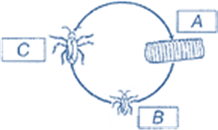
(b) What does a female cockroach lay her eggs in? How many eggs are laid at a time?
Ans. (a) In the given figure,
A-Egg case B-Nymph C-Adult cockroach
(b) A female cockroach lays her eggs in an egg case. Around 15-50 eggs are laid at a time. Number of eggs laid at a time depends on the type of cockroach.
Q.52. A single cell becomes such a big individual. How?
Ans: The zygote becomes ball of cells after cell division and forms embryo. The embryo gets embedded in the wall of uterus and start developing till it grows into fully developed baby inside the female body and becomes an individual.
Q.53. Observe the figure given and answer the questions that follow.
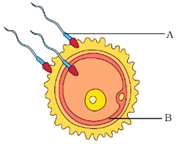
(a) Label A and B.
(b) Identify the process.
(c) What happens during the process and what is formed?
Ans. (a) A-Sperm, B-Ovum (egg).
(b) The process is fertilisation.
(c) During the process, the sperm nucleus fuses with the egg nucleus to form the zygote.
Q.54. A fish and frog lay eggs in hundreds whereas a hen lays only one egg at a time. Suggest a reason.
Ans: Frog and fish lay hundreds of eggs because they lay their eggs in water outside the bodies. Due to water currents, eggs and sperms come in contact with each other. As this process is external, sperms randomly reach to eggs. Thus, production of large number of eggs and sperms is necessary to ensure fertilisation of at least a few of them.
Q.55. How is reproduction in Hydra different from that in Amoeba?
Ans: Both Hydra and Amoeba reproduce asexually involving only single parent but the modes are different. Hydra reproduces from bulges or buds arising from the parent body that grows and matures into another organism, while Amoeba reproduces by binary fission.
Q.56. Differentiate between viviparous and oviparous animals.
Ans: Difference between viviparous and oviparous animals are
|
Viviparous animal |
Oviparous animal |
|
Animals that reproduce by laying eggs |
Animals that give birth to their young ones directly. |
|
Development of zygote takes place outside the female parent, e.g., birds, fishes, crocodiles, snakes and lizards. |
Development of zygote takes place inside the body of female parent, e.g., mammals, including humans. |
Q.57. Mother gives birth to a baby but the baby has characters of both parents. How is this possible?
Ans: Although mother gives birth to a baby but the baby is formed from the fertilisation of male and female gametes involving two parents. The nuclei of both the parent gametes fuse, thus passing their characters to the offspring and this results in the formation of new character combinations. Therefore, the zygote formed from fertilisation have characters of both the parents. This zygote develops inside the female body (uterus) and finally takes birth as baby.
Q.58. The test-tube babies are called so as they grow inside a test tube. Give your opinion.
Ans: The babies born through IVF technique are called test-tube babies because the fertilisation takes place in a glass test tube. This is however, a misleading name as a very brief period is spent in a test tube. After which, entire growth and development of the baby takes place inside the uterus of the woman as in normal pregnancy.
Q.59. What does figure represent?
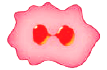
Ans: The figure represents binary fission in Amoeba. The single celled Amoeba divides (both nucleus and cytoplasm) to form two daughter cells that develop into two independent Amoeba.
Q.60. A and B are the two types of animals. The animals like A undergo external fertilisation whereas animals like B undergo internal fertilisation. The animals like A lay eggs from which baby animals are hatched. On the other hand, in animals like B the young one develops inside the uterus of mother which then gives birth to the baby.
(a) What is the general name of animals like A?
(b) Give two examples of animals like A.
(c) What is the general name of animals like B?
(d) Write the names of two animals like B.
Ans. (a) The general name of animals like A is oviparous animals.
(b) Frogs and fishes are examples of A.
(c) The general name of animals like B is viviparous animals.
(d) Cows and dogs are two animals like B.
Online Tuitions & Self-Study Courses for Grade 6 to 12 & JEE / NEET