
Chapter 9 – Reproduction in Animals
Chapter Notes
Reproduction
The process through which living beings produce new young ones of their own kind is called reproduction.
Why Reproduction is Essential?
Reproduction is essential for
(i) the continuation of a species.
(ii) addition of new species.
(iii) replacement of dead organisms.
(iv) transfer of variations from one generation to another.
Young Ones of Different Animals
The young ones or offsprings of different animals are distinct from each other and are known by different names as well.
|
Animal |
Young |
Animal |
Young One |
|
Human |
Baby |
Cow |
Calf |
|
Cat |
Kitten |
Frog |
Tadpole |
|
Dog |
Puppy |
Horse |
Colt(male)/Filly(female) |
|
Butterfly |
Caterpillar |
Hen |
Chick |
Various organisms use different modes of reproduction depending on their body design, habitat and environmental conditions. Depending upon the number of parents involved in the process, phenomenon of reproduction is divided into following two main types:
(i) Asexual reproduction
(ii) Sexual reproduction
It is the type of reproduction which involves the union of one male and one female to produce on offspring reproductive cell similar to its parents.
The special reproductive cells formed by male and female individuals that take part in sexual reproduction are called gametes. They are haploid in nature (having half the number of chromosomes as in parents). Male gamete is called sperm while female gamete is called ovum or egg.
In animals such as frogs, fishes, birds, reptiles and humans, an individual carries only one kind of gamete, either sperm (in the male) or the o\rum (in the female), i.e., they are unisexual. However, in some organisms, both male and female gametes are present in the same individual. Such organisms are called hermaphrodite or bisexual. Earthworms and leeches are hermaphrodites. This means that each earthworm or leech is both male and female.
Significance of Sexual Reproduction
(i) It provides diversity of characters in offsprings through genetic variation.
(ii) It plays an important role in evolution of new species.
In sexual reproduction, the first step is the fusion of a male gamete with a female gamete. This process of fusion of a male gamete and a female gamete to form a zygote is called fertilisation. The zygote is the first cell of the new organism. It is actually a fertilised egg.
There are various methods by which fertilisation takes place. These are
1. Internal Fertilisation
In higher animals such as reptiles, birds and mammals, fertilisation occurs inside the female body. This is known as internal fertilisation.
2. External Fertilisation
In aquatic animals such as fishes and frogs, fertilisation takes place outside the body of a female. This is known as external fertilisation. In these animals, fertilisation takes place in water. They lay their eggs and sperms together on the surface of the water. The sperms fuse with the egg in water to form zygotes. The zygotes develop into new individuals in water. Animals living in or near ponds and lakes also have external fertilisation.
During spring (or rainy) season, frogs and toads move to the water in ponds and slow-flowing streams. When the male and female come together in water, the female lays hundreds of eggs. The eggs are delicate and do not have a shell, unlike the hen's eggs. A layer of jelly-like substance holds the eggs together and provides them protection.
As the eggs are laid, the male ejects millions of sperms directly on them. Each sperm swims randomly in water with the help of its long tail. The sperms come in contact with the eggs floating in water. This results in fertilisation.
The animals which undergo external fertilisation lay hundreds of eggs (to enhance the chances of fertilisation) whereas a hen (undergo internal fertilisation) lays only one egg at a time. As the gametes are released in water, many of them may be carried away by movement of water, wind, etc. or may be eaten by other aquatic animals, so a large number is released to compensate for the loss.
In some organisms such as honeybees, birds (turkey) and even some lizards, the female gametes form new organisms without fertilisation. This phenomenon is called parthenogenesis.
Activity 1: To observe frog's eggs
Visit a pond or a slow-flowing stream during the rainy season. Try to find out clusters of frog's eggs floating in water. Study them carefully.
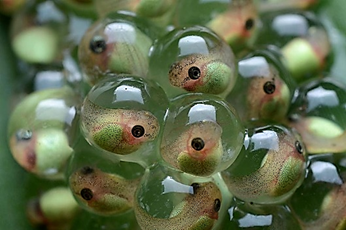
The colour of the eggs is transparent if unfertilised but if fertilised, a tiny black tadpole in middle appears. These measure in size about 2-3 mm (varies with the frog species).
In human beings, reproduction involves two sexes, i.e., male and female. Each sex has a different reproductive system with. distinct organs performing variant functions.
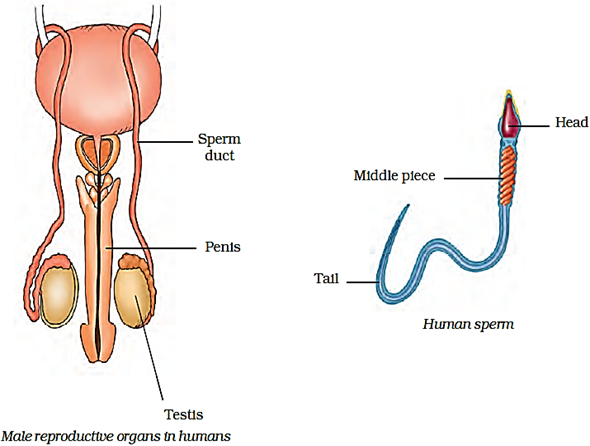
(i) Testes: These are paired, oval-shaped, located outside the abdominal cavity in scrotal sac, which produce the male gamete, sperm and male sex hormone, testosterone.
(ii) Sperm (male gamete): It is tiny, motile single cell with a head, a middle piece and a tail. The long tail helps it to move through the female tract.
(iii) Epididymis: It is a coiled tube attached to the testis, which serves as the storehouse of sperms for their maturation.
(iv) Sperm ducts (vas deferens): These connect testes to the urethra in order to allow the passage of semen.
(v) Semen: Secretions from various glands (prostate, seminal vesicles and Cowper's) pours in sperms as it travels through the sperm duct. This mixture is called semen.
(vi) Urethra: It is common passage of sperms and urine.
(vii) Penis: It is external male genital organ which transfers sperms into the vagina of female.
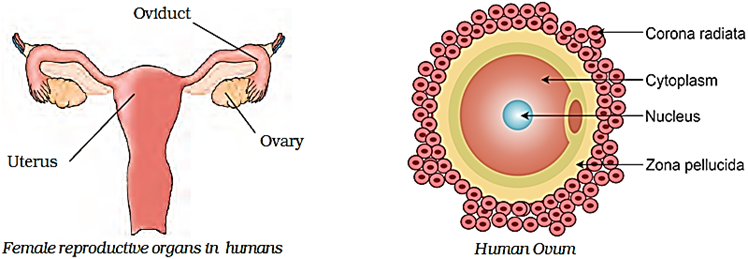
(i) Ovaries: These are paired, oval-shaped organs located in the lower part of abdominal cavity. It produces female gametes, ova or egg and secrete female· sex hormones. Either of the ovaries produces one ovum every month.
(ii) Ova/Egg (female gamete): It is microscopic, round, single cell with nucleus, cytoplasm and a cell membrane.
(iii) Oviduct (or Fallopian tube): It has a funnel-shaped opening near the ovary that carries ova from ovary to uterus. It is the site of fertilisation.
(iv) Uterus (womb): It is hollow, bag-like structure, where growth and development of foetus takes place. Its lower narrower end cervix opens into vagina.
(v) vagina: It receives the sperms from male, serves as a birth canal.
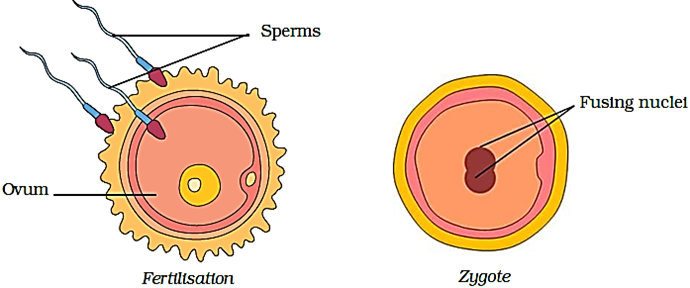
Humans undergo internal fertilisation during reproduction. The sperms from the male are introduced into the vagina of female by the penis, during intercourse. These travel up the vagina and uterus into the Fallopian tube. It is here that usually one of the sperms fuses with the ovum, i.e., fertilisation occurs.
During fertilisation, the nuclei of the sperm and the egg fuse to form a single nucleus. This results in the formation of a fertilised egg or zygote. The zygote marks the beginning of a new individual.
As the process involves the meeting of an egg cell from the mother and a sperm cell from the father, the new individual inherits some characteristics from the mother and some from the father.
Some women are unable to have babies because their oviducts are blocked and sperms cannot reach the egg for fertilisation. This prevents the ova from being fertilised. This problem can be overcome through test-tube baby technology. In this technique, freshly matured ova are collected from a woman's ovaries by using a special syringe and semen from the man are kept in an incubator (in vitro).
The sperms fertilise the ova to form an embryo. After a week, the embryo thus formed is then inserted into the woman's womb where the embryo gets implanted and develops into a baby in about nine months. The baby thus produced is called a test-tube baby. This technique is called In Vitro Fertilisation (IVF). The success rate is about 30-40%.
In human beings after fertilisation, the zygote travels down the oviduct. It divides repeatedly to form a ball of cells by cell division. The cells then begin to form groups that finally develop into different tissues and organs of the body. This developing structure is called the embryo. It gets embedded in the wall of the uterus for further development. This is called implantation.
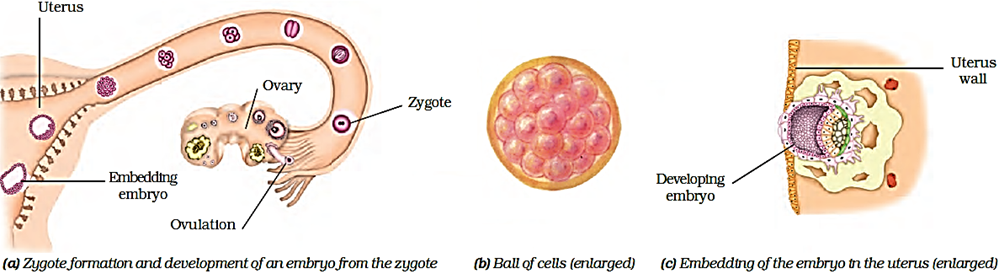
During the development, the different groups of cells change their size and shape, i.e., differentiate into various types to form tissues. The tissues form organs. Gradually, different body parts such as head, hands, legs, etc. develop. The stage of the embryo at which all body parts can be recognised is called a foetus. This stage is reached after about 8 weeks of fertilisation in humans.
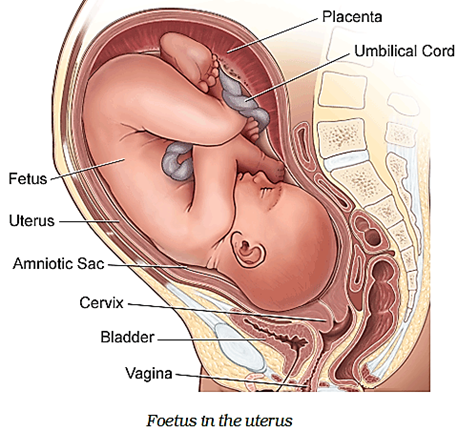
The foetus keeps developing further by taking nourishment from the mother through placenta.
The development is complete when all body parts assume right size and form. It is then, that the mother gives birth to a baby.
The period between fertilisation and child birth is called gestation. The expectant mother is called pregnant. In humans, it lasts for about 40 weeks or around nine months.
Hen is a bird that also undergoes internal fertilisation as humans. But it does not give birth to a young one. The process of reproduction in hens is given below:
(i) Just after fertilisation inside the female hen, the zygote divides repeatedly and travels down the oviduct.
(ii) Many protective layers are formed around it as it makes its way down. The hard shell that we see in a hen's egg is one such protective layer (outermost).
(iii) After the hard shell is formed around the developing embryo, the hen finally lays the egg.
(iv) During development, the embryo gets its food from the egg yolk and the albumin in egg helps in protection.
(v) The hen then sits on the eggs to provide sufficient warmth for the development of eggs. The embryo takes about 3 weeks to develop into a complete chick. The development of the chick takes place inside the egg shell during this period.
(vi) After the chick is completely developed, it bursts open the egg shell and comes out of it.
The embryos of all the birds, reptiles, etc. develop in the same way. In animals (such as frogs, fish, etc.) which undergo external fertilisation, development of the embryo takes place outside the female body. The embryos continue to grow within their egg coverings. After the embryos develop, the eggs hatch and the young ones come out.
Viviparous and Oviparous Animals
Based on whether the development of zygote takes place outside or inside the body of the female parent, animals are divided into two categories, i.e., viviparous and oviparous.
The difference between Viviparous and Oviparous Animals are tabulated below:
|
Viviparous animal |
Oviparous animal |
|
Animals that give birth to their young ones directly. |
Animals that reproduce by laying eggs. |
|
Development of zygote takes place inside the body of female parent. e.g., mammals, including humans. |
Development of zygote takes place outside the female parent. e.g., birds, fishes, crocodiles, snakes and lizards. |
Mammals like the Platypus and Echidna are exceptional mammals as they lay eggs. Viviparous animals nurse their young ones properly.
Activity 2: To compare the eggs of different oviparous animals.
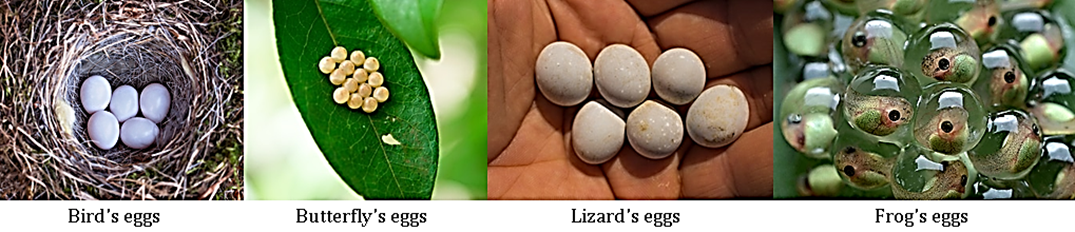
Collect the eggs of oviparous organisms e.g., hen, butterfly, lizard, frog, etc.).
These eggs can be collected easily as these animals lay them outside their bodies
The size of egg in animal varies. It may be very small as in humans, larger as in hen or largest as in ostrich.
Metamorphosis (Young Ones to Adults)
During development from a new individual (born or hatched from the egg) to an adult, continuous growth occurs with considerable changes in body structure.
In some animals such as amphibians (e.g., frog) and certain insects (e.g., silkworm), the young one may look very different from the adults.
In the life cycle of a silkworm, it passes through different stages of growth
eggs → larvae/caterpillar → pupa → adult
The pupa looks very different from the adult moth.
A frog is another such example in which a tadpole looks so different from the adult.
A frog lays eggs in large numbers (spawning). The baby that hatches out of the frog's eggs is called tadpole. The tadpole undergoes several changes before it becomes an adult frog (in the same way, as a caterpillar that hatches out of the cocoons of silkworm becomes an adult moth).
egg → tadpole → adult
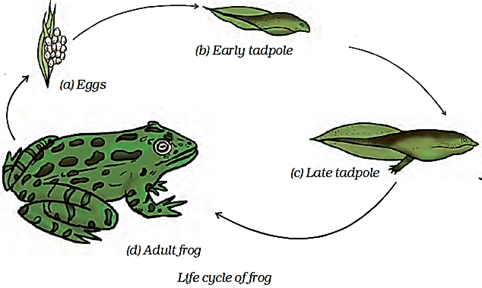
This process of change by which a larva is transformed into an adult is called metamorphosis. Thus, a caterpillar and a tadpole undergo metamorphosis to become a beautiful moth and adult frog respectively.
Difference between tad pole and frog
|
Tadpole |
Frog |
|
It has a long tail and fins to swim in water. |
It has webbed feet to swim in water and hop on land. |
|
It breathes through gills. |
It has lungs for breathing. |
Human beings also exhibit changes in body appearance as they grow but these changes are not drastic changes. In human beings, the body parts in adults are similar to those which are present in babies from the time of birth. So, human beings do not undergo metamorphosis. The common animals such as cats, dogs, hens, tiger, lion, deer, horse, cow, etc. also do not undergo metamorphosis during their life cycle.
In this method, a new organism is produced from a single parent without fusion of gametes. The offsprings produced are genetically identical to the parents.
Types of asexual reproduction
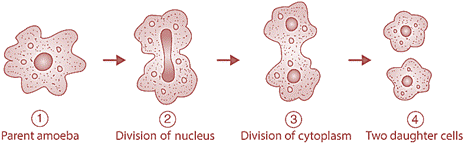
The process of reproduction in which a parent organism divides into two daughter cells (both nucleus and cytoplasm divide), each of which grow and mature into two separate new individuals is called binary fission, e.g., Amoeba, Paramecium.
Fission in Amoeba
Amoeba reproduces by this method under favourable conditions. Firstly, the nucleus divides into two, it is followed by the division of the cytoplasm. A constriction develops in the body which gradually deepens to form two daughter Amoebae which grow into full size.
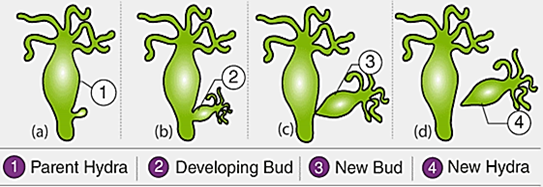
It is a type of asexual reproduction in which a bulge or Bud develops from the parent body. This bud enlarges, gets detached from parent and develops into a similar / identical organism and can live independently when separated from the parent, e.g., Hydra, yeast, etc.
Budding in Hydra
Hydra is a multicellular animal that reproduces by budding. In the animal, one or more small bulb-like outgrowths called buds are formed on the side of its body by repeated division of cell. The nucleus of the parent body divides and one goes into the bud. The bud grows and finally gets detached from the parent body of Hydra. It begins to live as an independent individual.
There are other methods of asexual reproduction (such as fragmentation, spore formation, vegetative propagation). These methods will be studied in higher classes.
Significance of Asexual Reproduction
It is an easy and quicker method of reproduction. As only single parent is involved, the genetic constitution of the species is preserved.
Activity 3: To study budding in Hydra with the help of permanent slides.
Take a permanent slide of Hydra and observe them using a microscope. Look out carefully for any bulges from the parent body and draw the diagram as seen.
A small single outgrowth or protuberance is seen on the parent body. This bud develops into tiny individual when fully mature and detaches from parent body.
Difference between sexual and asexual reproduction
|
Sexual reproduction |
Asexual reproduction |
|
It is characterised by the union of male and female gametes coming from two parents. |
It does not involve fusion of gametes. It results from multiplication of body cells from a single parent. |
|
Daughter organisms differ from the parents genetically. |
Daughter organisms are genetically identical to the parent. |
|
Fertilisation takes place. |
No fertilisation. |
|
It leads to variations and thus, contributes to evolution of species. |
Since there is no variation, so it does not contribute to evolution of species. |
Cloning is the production of an exact copy of a cell or any other living part or a complete organism (it is the process of producing similar populations of genetically identical individuals asexually).
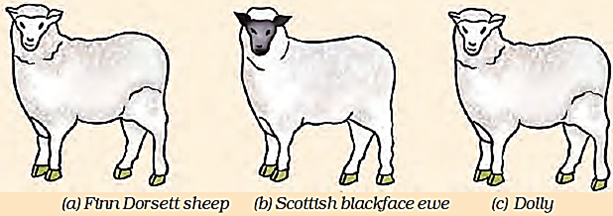
Cloning of an animal was successfully performed for the first time by Ian Wilmut and his colleagues at the Roslin Institute in Edinburgh, Scotland. They successfully cloned a sheep named Dolly. Dolly was born on 5th July, 1996 and was the first mammal to be cloned.
During the process of cloning Dolly, a cell was collected from the mammary gland of a female Finn Dorsett sheep. Simultaneously, an egg was obtained from a Scottish blackface ewe. The nucleus was removed from the egg. Then the nucleus of the mammary gland cell from the Finn Dorsett sheep was inserted into the egg of the Scottish blackface ewe whose nucleus had been removed. The egg thus produced was implanted into the Scottish blackface ewe. Development of this egg followed normally and finally Dolly was born.
Though Dolly was given birth by the Scottish blackface ewe, it was found to be absolutely identical to the Finn Dorsett sheep from which the nucleus was taken. Since, the nucleus from the egg of the Scottish blackface ewe was removed, Dolly did not show any character of the Scottish blackface ewe. Dolly was a healthy clone of the Finn Dorsett sheep and produced several offspring of her own through normal sexual means. Dolly died on 14th February, 2003 due to a certain lung disease.
Since Dolly, several attempts have been made to produce cloned mammals. However, many died before birth or died soon after birth. The cloned animals are many-a-time found to be born with severe abnormalities.
Online Tuitions & Self-Study Courses for Grade 6 to 12 & JEE / NEET