
Chapter 2 – Microorganisms
Very Important Questions Answers – Set 3
Q.1. Which of the following cannot be classified as either living or non-living?
(a) fungi
(b) bacteria
(c) viruses
(d) protozoa
Ans: (c) viruses
Viruses have the characteristics of both living and non-living organisms. Therefore, they cannot be classified as either living or non-living.
Q.2. Amoeba is a
(a) bacterium.
(b) virus.
(c) fungus.
(d) protozoa.
Ans: (d) protozoa
Amoeba is a unicellular organism which has animal-like characteristics. Thus, it is grouped under protozoa.
Q.3. Which of the following make their own food by photosynthesis?
(a) algae
(b) viruses
(c) fungi
(d) protozoa
Ans: (a) algae
Algae have chlorophyll in them. So, they can make their own food by photosynthesis.
Q.4. The unicellular organisms that sour milk to make curd are
(a) bacteria.
(b) viruses.
(c) fungi.
(d) protozoa.
Ans: (a) bacteria
A bacterium known as lactobacillus converts milk into curd and make it sour.
Q.5. Which of the following is responsible for making bread soft and fluffy?
(a) finely ground flour
(b) sugar
(c) alcohol given off during fermentation of sugar
(d) carbon dioxide gas given off during fermentation of sugar
Ans: (d) carbon dioxide gas given off during fermentation of sugar
Carbon dioxide gas escapes during baking and a free space is formed in the bread. Thus, the bread becomes soft and fluffy.
Q.6. Which of these do not have a regular cell structure?
(a) bacteria
(b) viruses
(c) algae
(d) protozoa
Ans: (b) viruses
Bacteria, algae and protozoa have a regular cell structure but viruses lack it.
Q.7. Which of these are found as both unicellular and multicellular organisms?
(a) bacteria
(b) viruses
(c) algae
(d) protozoa
Ans: (c) algae
Algae are found as both unicellular and multicellular organisms.
Q.8. The bacterium Lactobacillus is useful in making
(a) cheese.
(b) cake.
(c) alcohol.
(d) all of these
Ans: (a) cheese
The bacterium known as Lactobacillus is useful in making cheese, whereas cake and alcohol are made with the help of yeast, which is a fungus.
Q.9. Microorganisms spread through
(a) air.
(b) cuts.
(c) water.
(d) all of these
Ans: (d) all of these
Microorganisms are found everywhere in the environment and they spread through air, cuts and water.
Q.10. Which of these does not prevent growth of bacteria?
(a) salt
(b) sugar
(c) water
(d) oil
Ans: (c) water
Salt, sugar and oil are used as preservatives for food and they prevent the growth of bacteria. However, water acts as a medium for bacterial growth.
Q.11. Name the types of microorganism that:
a. have chlorophyll:_________
b. do not have a cellular structure:___________
Ans:
a. Algae are microorganisms that contain chlorophyll.
b. Viruses do not have a cellular structure.
Q.12. Under unfavourable conditions, microorganisms form a __________ around themselves.
Ans: Under unfavourable conditions, microorganisms form a cyst around themselves.
Q.13. The female Aedes mosquito is a carrier of the ________ virus.
Ans: The female Aedes mosquito is a carrier of the dengue virus.
Q.14. The foot and mouth disease is caused by a __________
Ans: The foot and mouth disease is caused by a virus.
Q.15. Microbes are disease-causing microorganisms. True or False?
Ans: False. Disease-causing microorganisms are known as pathogens or germs.
Q.16. All fungi are unicellular. True or False?
Ans: False. Some fungi are multicellular. Example of a multicellular fungus is bread mould.
Q.17. A virus can reproduce on its own. True or False?
Ans: False. A virus needs to enter a living cell to reproduce.
Q.18. Food poisoning is caused by a toxin getting accidentally mixed with food. True or False?
Ans: True. When microorganisms like fungi or bacteria that produce toxins, sometimes grow on food, due to which food gets spoilt. If such spoilt food is consumed, it may cause food poisoning.
Q.19. Salt forces microbes to lose water. True or False?
Ans: True. When salt is added to a food substance for its preservation, it forces the microorganisms to lose water by the process of osmosis.
Q.20. All microbes are harmful. Do you agree? Give reasons.
Ans: Not all microbes are harmful. Some of the microbes produce antibiotics which is used for the treatment of many diseases. Moreover, certain microbes such as Yeast are used for food production. Thus, all microbes are not harmful.
Q.21. Give one property because of which viruses are regarded as being on the borderline of living and non−living.
Ans: Viruses do not reproduce outside their host cell. However, when viruses enter into living cells, they are able to reproduce. This ability of viruses to selectively reproduce within the host cell allows viruses to behave as living as well as non-living organisms.
Q.22. Which of these are closer to plants−algae or protozoa? In what aspect?
Ans: Algae are more closely related to plants. This is because both plants and algae possess chlorophyll and have the ability to produce their food by the process of photosynthesis. Protozoa, on the other hand, are more related to animals.
Q.23. Where do you normally expect to find algae−in the soil, in a pond or in the air?
Ans: Algae are primarily found in the aquatic environments such as lakes, ponds and seawater.
Q.24. While making cake or dhokla, the dough rises because of a substance that is produced during fermentation. What substance is this? Why does it cause the dough to rise?
Ans: During the preparation of dhokla or cake, the fermentation process releases carbon dioxide gas, which causes the dough to rise. The carbon dioxide gas is released in the form of bubbles. This causes the dough to rise.
Q.25. To prevent a disease caused by a certain microbe, doctors inject the same microbes in a person's blood. How is it ensured that this prevents the disease instead of causing it? What is this process of injecting microbes called?
Ans: The microbes that are injected in a person's blood to treat a disease are either killed or weakened prior to their administration. This ensures that the microbe do not cause any harmful effects in the body. The process of injecting microbes in the body to prevent diseases is called vaccination or immunization.
Q.26. Microbes that live inside the bodies of animals normally cause diseases. However some of them also help animals. Give an example to prove this point
Ans: In digestive system of certain herbivorous animals such as goats and cows, houses certain beneficial protozoa and bacteria. These microbes help herbivorous to digest plant materials by breaking down cellulose.
Q.27. Pasteurization means boiling the milk to kill germs. Do you agree? Give reasons.
Ans: Pasteurization is a food preservation technique, in which the milk is firstly heated to a temperature of 70ºC. Afterwards, the milk is rapidly cooled down to prevent the growth of microbes. Thus, pasteurization is not just boiling the milk to get rid of germs.
Q.28. What is the study of microorganisms known as?
Ans: The study of microorganisms is known as microbiology.
Q.29. What are spherical bacteria called?
Ans: Spherical bacteria are called cocci.
Q.30. Where are algae mostly found−in water or on land?
Ans: Algae are mostly found in water bodies like ponds, lakes, rivers and seas.
Q.31. Is the decomposition of the bodies of dead plants and animals by microorganisms desirable or undesirable?
Ans: The decomposition of dead plants and animals by microorganisms is desirable as it helps in recycling nutrients.
Q.32. Name the class of medicines usually made from fungi or bacteria that can cure dangerous diseases.
Ans: Antibiotics is the class of medicines usually made from fungi or bacteria. Antibiotics can cure dangerous diseases.
Q.33. Is yeast a bacterium or a fungus?
Ans: Yeast is a fungus.
Q.34. What is heating milk to a high remperature and then cooling it quickly called?
Ans: The process of heating milk to a high temperature and then cooling it quickly is called pasteurisation.
Q.35. What is a microorganism?
Ans: A microorganism is a tiny organism which can only be seen through a microscope. Example: bacteria, virus, protozoa, algae and fungi.
Q.36. Name the five groups into which microorganisms are divided. Which of these have only unicellular organisms?
Ans: The five groups into which microorganisms are divided are bacteria, virus, protozoa, algae and fungi.
Bacteria and protozoa have only unicellular organisms.
Q.37. Name the three types of bacteria shown in this figure.
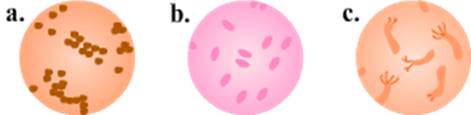
Ans: The three types of bacteria shown in this figure are:
a) cocci
b) bacilli
c) spirilla
Q.38. What kind of living organisms are classified as algae? Give two examples.
Ans: Simple plant-like organisms that have cell walls and chlorophyll are classified as algae. They lack roots, stems or leaves, but are able to make their own food through the process of photosynthesis.
Two examples of algae are Spirogyra and Fucus.
Q.39. Under what circumstances can viruses reproduce?
Ans: Viruses can reproduce only when they are inside the living cell of an organism. They multiply with the help of resources from the host cell.
Q.40. Give one important use of algae.
Ans: Algae produce oxygen during photosynthesis that animals and humans use during respiration.
Q.41. How does cooling help in food preservation?
Ans: Cooling helps in food preservation as microorganisms are not able to grow and reproduce at lower temperatures. Thus, food is preserved and microbial growth is prevented.
Q.42. What causes food poisoning?
Ans: Microorganisms grow on food substances and produce toxins, turning food poisonous. Such spoilt food, when consumed, causes food poisoning.
Q.43. What is pasteurization?
Ans: Heating milk to a high temperature of 70 degree celcius for about 30 seconds and then cooling it quickly is known as pasteurisation. This method kills most of the bacteria present in the milk and preserves it.
Q.44. How does mosquito help in spreading viruses/microorganisms?
Ans: Mosquitoes such as female Anopheles and Aedes are carriers of germs that cause malaria and dengue fever, respectively. When these mosquitoes bite a healthy person, they inject the germs into his body. Thus mosquitoes spread viruses and other disease-causing microorganisms.
Q.45. Microorganisms are found even in places where no other life forms can exist. What makes microorganisms so hardy?
Ans: Microorganisms are found even in places where no other life forms can exist. They form a hard outer covering called a cyst around themselves that makes them hardy. Under unfavourable circumstances, they survive by remaining inside the cyst in an inactive form.
Q.46. Which microorganism is used to make bread soft and fluffy? Discuss how this happens.
Ans: Yeast is used to make bread soft and fluffy. When yeast is mixed with the flour for making bread, it breaks down sugar and produces alcohol and carbon dioxide gas. When the bread is being baked, carbon dioxide gas escapes due to the heat, causing the bread to become soft and fluffy.
Q.47. What is fermentation? Discuss its use in making alcoholic beverages.
Ans: The conversion of sugar into alcohol by yeast is known as fermentation. This process is used in the preparation of alcoholic beverages like beer and wine. Beer is produced by the fermentation of sugar in germinating barley and wine is prepared by fermentation of sugar in grapes.
Q.48. How do viruses cause diseases?
Ans: A virus enters the living cell of an organism and uses the resources inside the host cell for its reproduction. It duplicates itself and then the host cell dies and finally bursts. The newly formed virus released from that cell starts invading the other cells. This process is repeated and in this way, many cells of the host organism are destroyed. As large numbers of host cells are destroyed, the person becomes ill.
Q.49. How does a vaccine work?
Ans: Vaccines are produced from dead or weakened microorganisms such as bacteria or a virus. When vaccines are administered to a person, his body produces antibodies which fight against pathogens. These antibodies remain inside the body and provide protection from any future attack by that particular microorganism.
Q.50. How does salt prevent food spoilage?
Ans: When salt is added to food, it forces the microorganisms to lose water by the process of osmosis. Thus, microorganisms are not able to grow in the food. In this way, salt prevents food spoilage.
Q.51. What is 'dehydration' of food? In what way is this technique useful?
Ans: Dehydration of food means the removal of water from food. It is done by drying the food. Water is a medium required for the growth of microorganisms. Thus, this technique is useful as it stops the growth of microorganisms in the food.
Q.52. Which microorganisms act as decomposers? How is this activity useful to us?
Ans: Bacteria, protozoa and fungi act as decomposers. These decomposers break down organic matter present in the bodies of dead plants and animals into simple substances and mix them in the soil. A plant growing in this soil absorbs the nutrients and passes them to the animals that consume the plant products. Thus, these microorganisms act as decomposers and help in recycling the nutrients in the soil.
Q.53. Why are viruses considered to be on the borderline of the living and non-living?
Ans: Viruses do not grow or reproduce by themselves, which makes them non-living. However, when a virus enters the living cell of an organism, it makes use of the resources in the host cell and starts reproducing. This makes viruses living, as reproduction is an important characteristic of a living organism. Due to this, viruses are considered to be on the borderline of the living and non-living.
Q.54. Why do you think:
(a) curd sets faster in summer than in winter?
(b) curd turns sour faster in summer than in winter?
Ans:
(a) Bacteria grow faster in summer, as they require warm temperatures to grow. Thus, they set curd faster in summer than in winter.
(b) Curd turns sour faster in summer than in winter because during summer, the temperature is high, which allows the bacteria to grow and multiply faster.
Q.55. The sealed packets in which food items such as chips are sold are usually filled with nitrogen. How do you think that helps?
Ans: The sealed packets in which food items such as chips are sold are usually filled with nitrogen as nitrogen prevents the growth of microorganisms. Microorganisms need oxygen for their growth and survival. Nitrogen replaces all the oxygen in the packets, thus preventing the growth of microorganisms. In this way, the food items are prevented from being spoilt by microorganisms.
Q.56. Why should you always wash your hands before handling food and after coming from the toilet?
Ans: We should always wash our hands before handling food and after using the toilet to remove the germs from our hands. If we eat food without washing our hands, there is a chance that the germs may enter our body, causing infections.
Q.57. Evolution i.e. changes in an organism to adjust to the environment, as suggested by Charles Darwin, is a very slow process that takes place over tens of thousands of generations, over millions of years. However, in bacteria, development of resistance to antibiotics, which is a type of evolution, takes place within our own lifetime. Can you say why it occurs so quickly in bacteria?
Ans: Evolution occurs quickly in bacteria, as bacteria reproduce faster than other organisms. Some bacteria may reproduce as fast as every 20 minutes, which is half-a-million times faster than humans. This is the reason why bacteria become resistant to antibiotics within our own life time.
Q.58. Ancient Egyptians applied mouldy bread on infected cuts and wounds to heal them. Why do you think this helped in healing the wounds? Nowadays we do not use mouldy bread to cure infection. What do we use instead?
Ans: We are aware that some of the moulds or fungi are used to produce antibiotics. Antibiotics are chemicals which kill or stop the growth of disease causing microbes. Although, the ancient Egyptians were not aware of the concept of antibiotics but they were well aware about the wound healing properties of these moulds. These chemicals produced by the moulds helped in the healing of wounds by restricting the growth of microorganisms or by killing them.
Nowadays, we can culture these fungi and extract antibiotics from them or we can synthesise the antibiotics artificially.
Q.59. Discuss three important ways in which bacteria are useful to us and two ways in which they are harmful.
Ans: The three important ways in which bacteria are useful to us are:
(i) Formation of curd: When a small amount of curd (known as starter) is added to milk, the bacteria known as Lactobacillus, convert the milk into curd.
(ii) Nitrogen fixation: The bacteria known as Rhizobium live in the root nodules of leguminous plants. These bacteria fix the atmospheric nitrogen and converts it into nitrates that can be used by the plants.
(iii) Retting of jute: Bacteria help in separating jute fibres from the rest of the tissues of the jute plant. These fibres are used in making various articles.
Two ways in which bacteria are harmful to us are:
(i) Diseases: Bacteria cause many diseases in humans like cholera and typhoid.
(ii) Food spoilage: Bacteria spoil food. Examples: putrefaction of meat and rotting of fruits and vegetables.
Q.60. Discuss the different ways in which communicable diseases spread from person to person.
Ans: Communicable diseases spread from one person to another through various means. These are:
(i) Through air: When a person suffering from cold or flu sneezes or coughs, germs are released that spread through the air.
(ii) Through contaminated food and water: When houseflies sit on garbage, germs stick to their bodies. When these houseflies sit on uncovered food or water, they contaminate the food or water by transferring the germs.
(iii) Through mosquitoes: Mosquitoes such as the female Aedes carry germs that cause dengue fever.
(iv) Through cuts and wounds: Microbes also enter our body through cuts or wounds.
(v) Through direct contact: Diseases such as chickenpox can spread through direct contact from an infected person.
Q.61. Discuss five methods of food preservation.
Ans: The following are the five methods of food preservation:
(i) Heating: When food is heated at high temperature, all the microorganisms present in it are destroyed.
(ii) Pasteurisation: In this method, milk is heated at a high temperature for 30 seconds and then quickly cooled. This process kills the microorganisms present in milk.
(iii) Cooling: It prevents the growth and reproduction of microorganisms because microorganisms are not able to reproduce at low temperatures.
(iv) Drying: This process removes water from food. Since, microorganisms need water for their growth, drying food prevents the growth of microorganisms.
(v) Canning: In this method, food is sterilised and then canned in airtight containers. This prevents the growth of microorganisms.
Online Tuitions & Self-Study Courses for Grade 6 to 12 & JEE / NEET