
Chapter 2 – Micro-organisms
Very Important Questions Answers – Set 2
Q.1. Food can become poisonous if left-uncovered for long periods. How does this happen?
Ans: Food could become poisonous by the action of some microorganisms. Sometimes, they grow on food and produce toxic substances, thus spoiling the food and making it unfit for consumption.
Q.2. Give the different forms by which atmospheric nitrogen can be fixed.
Ans: Nitrogen can be fixed by
(i) lightning
(ii) certain nitrogen fixing bacteria in soil, e.g. Azotobacter.
(iii) Rhizobium bacteria which is involved in the fixation of nitrogen in leguminous plants. Rhizobium lives in the root nodules of leguminous plants such as beans and peas with which it has a symbiotic relationship.
(iv) blue-green algae, e.g. Anabaena, Nostoc.
Q.3. While returning from the school, Boojho ate chaat from a street hawker. When he reached home, he felt ill and complained of stomach ache and fell ill. What could be the reason?
Ans: The reason could be that the chaat was contaminated by pathogenic microorganisms. It can be due to unhygienic conditions near the shop or the utensil used for serving could have been contaminated.
Q.4. Cooling helps in food preservation. How?
Ans: Cooling helps in food preservation by inhibiting the growth of microbes. This is because most of the microorganisms are able to multiply only under warm conditions.
Q.5. A microorganism Z spreads malaria, that is transmitted by another microorganism Y to humans.
(a) Give the class to which microorganism Z belongs?
(b) Identify Y. Also, mention its sex.
(c) Give a preventive measure for control of this disease.
Ans: (a) Z is a Protozoa.
(b) Y is Anopheles mosquito. It is a female.
(c) Preventive measure: Use mosquito nets and repellents.
Q.6. Paheli watched her grandmother making mango pickle. After she bottled the pickle, her grandmother poured oil on top of the pickle before closing the lid. Paheli wanted to know why oil was poured? Can you help her understand why?
Ans: Oil has been poured on the pickle to form a barrier. This prevents the bacteria from attacking the pickle and spoiling it. Thus, increasing its shelf life.
Q.7. Give an account of two important discoveries in the past that proved 'microorganisms can be useful to humans'.
Ans: Two important discoveries in the past that proved usefulness of microorganisms are
(i) In 1857, Louis Pasteur discovered fermentation.
(ii) In 1924, Alexander Fleming prepared antibiotic penicillin from mould.
Q.8. Give some points to show that bacteria have beneficial effects.
Ans: Beneficial effects of bacteria are as follows:
(i) They give us various milk products like curd and cheese.
(ii) They cause immunity enhancement and prevent intestinal disorders.
(iii) They decompose organic matter to give nutrients to plants.
Q.9. Packed milk bought from the market does not get spoiled. Justify with appropriate reason.
Ans: The milk that comes in packets does not get spoiled because it is pasteurised. Pasteurised milk can be consumed without boiling as it is free from harmful microbes. The milk was heated to about 70°C for 15-30 second and then cooled suddenly and finally packed. By doing so, the growth of microbes was prevented. This process is called pasteurisation.
Q.10. Prakhar came back from school and ate the rice that was kept outside on the dining table. After few hours, he complained of diarrhoea and abdominal pain. His mother took him to the doctor who explained why this happened and asked them to preserve their food properly.
(a) What must have happened to Prakhar?
(b) Give the probable cause for his condition.
(c) Mention the values shown by the doctor. (Value Based Question)
Ans:
(a) Prakhar had food poisoning.
(b) It could be due to microorganisms like fungi and bacteria that were present in uncovered rice.
(c) The doctor is helpful, considerate and intelligent.
Q.11. Explain food preservatives with examples.
Ans: Food preservatives prevent spoilage of food. Some of the methods by which foods can be preserved are given below:
(i) Drying or dehydration It means removal of water from food materials. In the absence of moisture, the food microorganisms stop growing. Vegetables (spinach, peas, etc.), pulses, spices and dry-fruits are preserved by this method.
(ii) Special preservatives Sodium benzoate and sodium metabisulphite are common preservatives used to check the growth of microbes. They are added to pickles and also used in jams and squashes to check their spoilage.
(iii) Preservation by common salt Common salt has been used to preserve meat and fish for ages. Salting is also used to preserve amla, raw mangoes, tamarind, etc.
(iv) Preservation by sugar Jams, jellies and squashes are preserved by sugar. Sugar reduces the moisture content which inhibits the growth of bacteria which spoil food.
(v) Preservation by oil and vinegar Use of oil and vinegar prevents spoilage of pickles because bacteria cannot live in such an environment.
(vi) Hot and cold treatments Boiling kills many microorganisms. Similarly, we keep our food in the refrigerator, low temperature inhibits the growth of microbes.
(vii) Pasteurisation It is used for the preservation of milk. It involves the process of heating milk to about 70°C for 15 to 30 seconds (killing most of bacteria) and then cooling quickly to a very. low temperature. This milk is then stored in cold. Pasteurised milk can be consumed without boiling as it is free from harmful microbes. The milk that comes in packets does not get spoiled as it is pasteurised. Pasteurisation was discovered by Louis Pasteur.
(viii) Irradiation It is a modern method of food preservation. The food is exposed to high energy gamma rays or X-rays. These powerful radiations completely destroy the harmful microorganisms. The food can be preserved for longer periods.
(ix) Vacuum drying Milk can be preserved by this process. Milk is converted into milk powder by removing the moisture content from it.
(x) Proper storage and packing Dry-fruits and vegetables are sold in sealed and air tight packets to prevent the attack of microbes.
Q.12. Discuss the different ways in which communicable diseases spread from person to person.
Ans: Communicable diseases can spread from person to person:
(i) When a person suffering from common cold or flu sneezes, coughs or spits, fine droplets of moisture carrying virus spread in the air. These viruses may enter a healthy person while breathing, e.g. tuberculosis.
(ii) Through direct contact with infected person, e.g. chickenpox, ringworm.
(iii) Through food we eat or water we drink, e.g. cholera, typhoid.
(iv) Through vectors or carriers like some insects and animals. The organisms, that transmit pathogens from an infected individual to a healthy one, are known as carriers.
Q.13. Give reasons for the following.
(a) Fresh milk is boiled before consumption while processed milk is stored in packets and can be consumed without boiling.
(b) Raw vegetables and fruits are kept in refrigerators, whereas jams and pickles can be kept outside.
(c) Farmers prefer to grow beans and peas in nitrogen deficient soils.
(d) Mosquitoes can be controlled by preventing stagnation of water though they do not live in water. Why?
Ans:
(a) Fresh milk is boiled before consumption to kill the microorganisms in it. But packed milk is pasteurised and does not contain any microorganisms. Thus, it can be consumed without boiling.
(b) Raw vegetables and fruits get easily infected by microorganisms and get spoiled. They are kept in refrigerator as low temperature inhibits growth of microbes. Jams and pickles contain sugar and salt as preservatives. They do not get infected by microbes as these preservatives do not allow the growth of microbes.
(c) Beans and peas are leguminous plants and have Rhizobium in their root nodules. These bacteria can fix atmospheric nitrogen to enrich · the soil with nitrogen and increase its fertility.
(d) Though mosquitoes live on land, their larvae grow in water. If water stagnation is prevented, their larvae cannot survive, thus reducing mosquito population.
Q.14. During biology class, teacher was telling about microbes and how they are useful to humans. Hearing this, Jay got confused as he knew the TB caused to his uncle is due to a microbe. He asked his teacher about it. The teacher appreciated him for the question and explained the whole class. (Value Based Question)
(a) What are microbes?
(b) How are microbes helpful to humans?
(c) Name one microbe
(i) used in household products.
(ii) used in antibiotics.
(d) Mention two diseases other than TB caused by microbes.
(e) Identify the values shown by Jay.
Ans:
(a) Organisms that cannot be seen with eyes alone are called microbes.
(b) Microbes are useful to humans in many ways. They help in the production of curd, cheese, in cleaning the environment, etc.
(c) (i) Lactobacillus bacteria. (ii) Penicillium
(d) Diseases caused by microbes are polio, malaria, etc.
(e) Jay is attentive, intelligent and curious.
Q.15. Arya and Unnati are discussing vaccination. Unnati came up with her fear that vaccines can be dangerous as it contains microbes itself. Arya explained and removed her fear.
(a) What is a vaccine?
(b) Suggest what could be Arya's explanation
(c) Identify values shown by Arya.
(Value Based Question)
Ans:
(a) A vaccine is a biological preparation that provides immunity against a particular disease. It consists of dead or weakened microbes.
(b) Arya would have explained that vaccines on entering the body produces suitable antibodies. These antibodies remain in the body and fight any encounter with the microbe in future. Moreover, vaccines contain dead or weakened microbes, thus they are not harmful.
(c) Arya is an intelligent, helpful and well aware person.
Q.16. Observe the figure and answer the following questions.
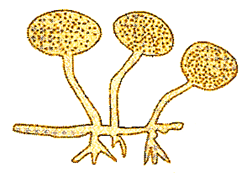
(a) Name the microorganism and the group to which it belongs.
(b) Name the food item on which the organism grows.
(c) Does it grow well in dry or in moist conditions?
(d) Is it safe to eat infected bread?
Ans:
(a) Microorganism is bread mould (Rhizopus) and the group is fungi.
(b) Organism grows on moist and stale bread.
(c) It grows well in moist condition.
(d) No, the fungus spoils the bread by producing poisonous substances (toxins).
Q.17. How can we prevent the following diseases?
(a) Cholera (b) Typhoid (c) Hepatitis-A
Ans:
(a) Cholera can be prevented by maintaining personal hygiene and good sanitation practices.
(b) Typhoid can be prevented by eating properly cooked food, drinking boiled water and by getting vaccinated against the disease.
(c) Hepatitis-A can be prevented by drinking boiled water and getting vaccinated against the disease.
Q.18. Give causative microorganism, mode of transmission and one preventive measure of human diseases like Polio, Cholera and Hepatitis-B.
Ans:
|
Disease |
Causative microorganism |
Mode of transmission |
Preventive measure |
|
Polio |
Virus |
Air/Water |
Vaccination should be given at suitable age |
|
Cholera |
Bacteria |
Water/Food |
Maintain personal hygiene and good sanitary habits |
|
Hepatitis-B |
Virus |
Water |
Drink boiled drinking water and proper vaccination should be taken. |
Q.19. Name the disease-causing microorganism of the following
(a) swine flu (b) rust of wheat (c) anthrax
Ans: (a) Virus (b) Fungi (c) Bacteria
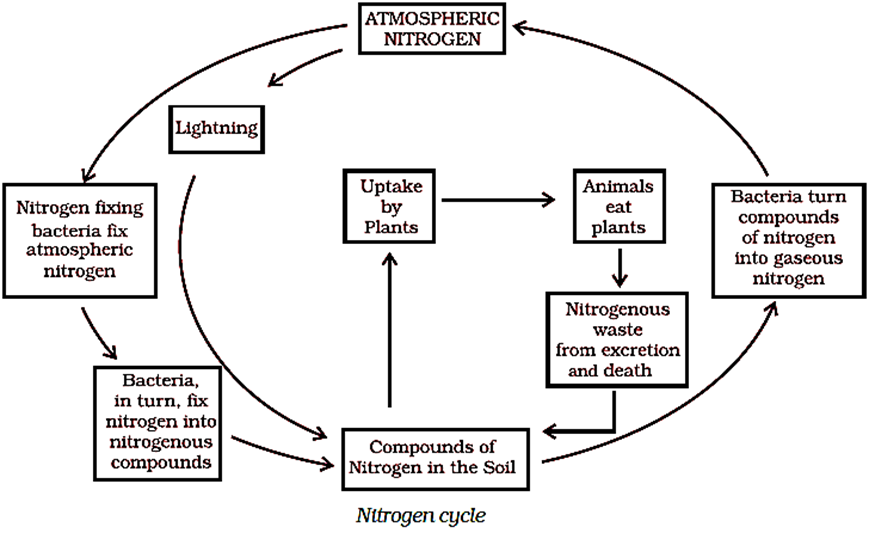
Q.20. Explain the main steps of nitrogen cycle with the help of a diagram.
Ans: The main steps in this cycle are as follows:
(i) The atmospheric nitrogen is fixed to be converted into usable compounds.
(ii) These compounds are utilised by plants through their root system. Nitrogen is used for synthesis of plant proteins and other compounds.
(iii) Animals taking these plants as food, get these proteins and other nitrogen compounds.
(iv) When these plants and animals die, certain bacteria and fungi convert these complex nitrogenous compounds present in their bodies into simple nitrogen compounds.
(v) Some of the simple nitrogenous compounds are again absorbed by the plants for their growth. Remaining simple nitrogenous compounds are converted to nitrogen gas by certain other bacteria.
(vi) The nitrogen gas goes back into the atmosphere.
As a result of this cycle, the percentage of nitrogen in atmosphere remains nearly constant.
Online Tuitions & Self-Study Courses for Grade 6 to 12 & JEE / NEET