
Chapter 18 – Pollution of Air and Water
Chapter Notes
Pollutant
A pollutant may be defined as a physical, chemical or biological substance released into the environment which is harmful to living organisms and non-living things.
The presence of unusually high concentration of harmful or poisonous substances (pollutants) in the environment (air and water) is called pollution.
All living things need air for breathing. It is a mixture of various gases. Nitrogen makes up about 78% of air, whereas oxygen makes up about 21% of air by volume. Carbon dioxide, argon, methane, ozone and water vapour are also present in very small quantities. We cannot survive even for a few minutes without air.
The contamination of air by the addition of unwanted and harmful substances called air pollutant which interfere with normal environmental processes and pose health hazards is called air pollution.
Air pollutants are of two types:
(i) Gaseous air pollutants: Pollutants in gaseous state, e.g. SO2, CO2, NO2, CO.
(ii) Particulate air pollutants: Pollutants in the form of tiny solid or liquid particles. Remain suspended in air, also called as Suspended Particulate Matter (SPM), e.g. smoke dust, fly ash, smog.
Smog
Smog is made up of smoke and fog. Smoke may contain oxides of nitrogen or sulphur which combine with other air pollutants and fog to form smog. The smog causes breathing difficulties such as asthma, cough and wheezing in children.
Acid Rain
Pollutants like sulphur dioxide and nitrogen dioxide which are produced by industries, (rubber processing, automobile, chemical, etc.) react with the water vapour in the atmosphere and form sulphuric acid and nitric acid respectively. Precipitation carries these acids back to the earth as acid rain.
Acid rain causes great damage to both living as well as non-living things in the environment.
Some of the effects of acid rain are as follows:
(i) The water of lakes and rivers becomes acidic and thus unsuitable for aquatic plants and animals. It leads to death of fishes and other organisms.
(ii) The soil becomes acidic due to decrease in pH and therefore, unsuitable for cultivation.
(iii) Sculptures, monuments and buildings get corroded and damaged.
All the sources of air pollution can, be classified into two groups as follows:
(i) Natural sources: Dust storms, forest fires, volcanoes and pollen grains are natural sources of air pollution.
(ii) Man-made (Anthropogenic) sources: It includes human activities that add pollutants to the atmosphere. It encompasses burning of fossil fuels, exhaust gases emitted by vehicles, industries, nuclear power plants, etc.
Causes of Air Pollution and their Harmful Effects
There are numerous sources around us that contribute to air pollution and cause detrimental effects.
Some of them are discussed below:
1. Carbon Monoxide (CO)
It is produced in high levels by incomplete combustion of fuels such as petrol, diesel, coal and kerosene in homes, vehicles and thermal power plants. It is a poisonous gas that interferes with the oxygen carrying capacity of the blood. Haemoglobin of the blood combines with oxygen of the air to form oxyhaemoglobin, that gives up O2 to cells. CO displaces O2 from oxyhaemoglobin to form carboxyhaemoglobin, that cuts off O2 supply and may even lead to death.
2. Sulphur and Nitrogen Oxides
These are produced by combustion of fuels like coal in power plants petrol and diesel in vehicles and volcanic eruptions, etc. These oxides attack breathing system and lead to lung congestion and can cause respiratory problems, including permanent lung damage.
They also produce acid rain and contributes to formation of smog. Petroleum refineries are a major source of sulphur dioxide and nitrogen dioxide.
3. Chlorofluorocarbons (CFCs)
These are industrially useful gases but behave as air pollutants because of their damaging effect on ozone layer in the stratosphere. These are used in refrigerators, air conditioners and aerosol sprays. CFCs released into the air go up and react with the ozone destroying it gradually.
Ozone layer prevents the harmful ultraviolet radiations of the sun from reaching the earth. The destruction of ozone layer by CFCs will allow the extremely harmful ultraviolet radiations of the sun to reach the earth. This causes skin cancer, cataract and destruction of plants including crops. In fact, the destruction of ozone layer over Antarctica (South pole of the earth) has led to the thinning of this layer. It is called 'ozone hole'. The good news is that less harmful chemicals are now being used in place of CFCs such as hydrochlorofluorocarbons, hydrocarbons, etc.
4. Suspended Particulate Matter (SPM)
These are mainly released from automobiles which burn diesel and petrol, or during industrial processes like steel making, mining and power plants. These reduce visibility and when inhaled, these particles irritate and damage lungs. They cause frequent attacks of asthma and bronchitis.
Agra is home to one of the seven wonders of the modern world, the Taj Mahal. It is India's largest attraction known for its exquisite craftsmanship, immense size and the white marble, it surely deserves all the distinctions it had.
But over the past 2 decades, it has become a matter of concern. The experts have warned that pollution is turning it yellow and also corroding it slowly. So, it is not only living organisms that get affected by polluted air but non-living things like building, monuments and statues also.
The survey found that it is due to the risen pollution levels in and around Agra, as a result of growth in industry, traffic and population.
The industries like rubber processing, automobile, chemicals and especially the Mathura oil refinery, have been responsible for producing pollutants like SO2 and NO2 that lead to acid rain.
Acid rain corrodes the marble of the monument. This phenomenon is also called marble cancer.
Suspended particulate matter such as the soot particles emitted by Mathura oil refinery, has contributed towards the yellowing of the marble.
The Supreme Court of India has taken several steps to save Taj Mahal from the damage being caused by air pollution. It has ordered industries to switch to cleaner fuels like CNG (Compressed Natural Gas) and LPG (Liquefied Petroleum Gas). Moreover, the automobiles should switch over to unleaded petrol in the Taj zone.
The greenhouse effect is a naturally occurring phenomenon where the atmosphere traps part of the sun's energy for heating the earth's surface. Without the natural greenhouse effect, the average temperature of the earth's surface would be below freezing point of water. Thus, natural greenhouse effect makes life possible.
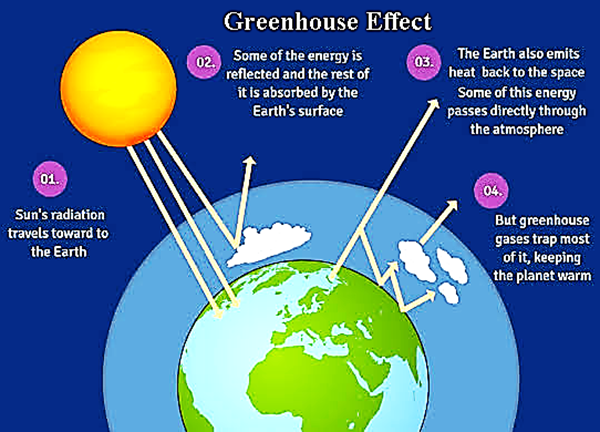
Clouds and gases reflect about one-fourth of the incoming solar radiation and absorb some of it. But almost half of incoming solar radiation falls on earth's surface heating it, while a small proportion is reflected back.
Earth's surface re-emits heat in the form of infrared radiation but part of this does not escape into space (similar to a greenhouse, where sun's heat is allowed to get in but is not allowed to go out) and atmospheric gases (e.g. carbon dioxide, methane, etc.) absorb a major fraction of it. These gases radiate heat energy and a major part of which again comes to earth's surface, thus heating it up once again. This cycle is repeated again and again. The gases like carbon dioxide and methane, etc. are commonly known as greenhouse gases because they are responsible for the greenhouse effect.
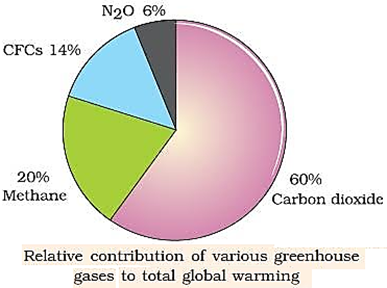
The problem arises when the amount of CO2 gas in the atmosphere increases leading to excessive heating of the earth and its atmosphere. This is primarily due to human activities such as burning of fossil fuels and clearing of forests.
Carbon dioxide (CO2) is one of the components of air. If there is excess of CO2 in the air, it acts as a pollutant. Plants utilise CO2 from the atmosphere for photosynthesis, thereby decreasing the amount of CO2 in the air. Deforestation leads to an increase in the amount of CO2 in the air because the number of trees which consume CO2 is reduced. It is responsible for greenhouse effect also. This contributes to accumulation of CO2 in the atmosphere. It greatly intensifies the natural greenhouse effect, causing global warming.
(i) The high temperature will result in melting of polar ice caps which will lead to rise in sea level and many coastal areas will be submerged (e.g. the Gangotri glacier in Himalayas has started melting).
(ii) The high levels of temperature lead to increased weed growth, eruption of diseases and pests. Thus, the crop productivity will decrease.
(iii) It could result in wide ranging effects on rainfall patterns, agriculture, forests, plants and animals.
Global warming has become a major concern for all the governments of the world because an increase in the earth's atmospheric temperature by even as little as 0.5°C can have serious consequences for all. Many countries have already reached an agreement to reduce the emissions of greenhouse gases. The Kyoto Protocol is one such agreement. It was adopted in Kyoto, Japan in 1997 and enforced in 2005.
Air pollution can be prevented or minimised by adopting following measures:
(i) By switching to CNG (Compressed Natural Gas) in motor vehicles in place of petrol and diesel. CNG is cheaper, burns more efficiently and cannot be adulterated.
The success has been achieved in Delhi. In 1990s, Delhi ranked 4th among the 41 most polluted cities of the world. A directive by Supreme Court was passed to switch to CNG by the end of 2002, after which pollution levels have gone down considerably.
(ii) By using alternative fuels such as solar energy, biogas, hydropower and wind energy in place of fossil fuels.
(iii) By using catalytic converters in vehicles. It changes harmful exhaust gases like CO and NO2 into CO2, N2 and H2O. Using unleaded petrol also reduces release of harmful pollutants into air.
(iv) By generating awareness about air pollution and its harmful effects. This can be done by utilising data given by government and other agencies on quality of air at various locations.
(v) By taking steps at individual level. Some of-these can be
(a) Join 'say no to crackers' campaign.
(b) Use public transport for commuting.
(c) Use bicycles for short distances.
(d) Save electricity by turning off lights during daytime and when not needed.
(e) Do not burn dry leaves, paper, etc. Put them in a compost pit.
(f) Grow more trees and nurture the one already present. Participate more in events such as Van Mahotsav which is an annual tree planting festival in India celebrated in first week of July. started in 1950.
The contamination of water by the addition of unwanted and harmful substances, is called water pollution.
Whenever harmful substances such as sewage, toxic chemicals, silt, etc. get mixed with water, the water becomes polluted. The substances that pollute water are called water pollutants.
Activity to compare smell, acidity and colour of different samples of water
Try to collect samples of water from a tap, pond, river, well and lake pour each into separate glass containers. Compare these for smell, acidity and colour. Make a table for the comparison.
|
Water sample |
Smell |
Acidity |
Colour |
|
Pond water |
Strong scent of mud |
Close to 7.4 |
Brown (muddy) |
|
River water |
Pungent |
7.0 - 7.5 |
Greenish |
|
Well water |
Smell of plants, mud, etc. |
6.5 - 7.0 |
Brownish |
|
Lake water |
Smell of mud |
7.0 - 7.5 |
Clear |
Water pollutants can be classified into following three categories:
(i) Physical water pollutants These include heat and oil spills. High temperature of water reduces its oxygen content.
(ii) Biological water pollutants These include pathogens e.g. viruses, Protozoa, fungi, etc.
(iii) Chemical water pollutants include organic wastes, e.g. sewage detergents, fertilisers, etc.
Hot water from powerplants and industries is also considered a pollutant. When released into the rivers it raises the temperature of the water body, adversely affecting the animals and plants living in it.
There are various sources that pollute water. These can be categorised as
(i) Point sources It refers to the pollutants that enter the water body from a single identifiable source, i.e. factories, powerplants, coal mines and oil wells. It is always easy to treat the pollution caused by them.
(ii) Non-point sources These sources are scattered and do not have any specific location to discharge pollutants, e.g. run-off from fields, lawns and gardens, construction sites, etc.
Causes of Water Pollution and their Harmful Effects
1. Industrial Waste
Industries produce toxic chemicals that are often discharged into rivers or streams, thereby polluting the water, e.g. oil refineries, paper factories, textile and sugar mills, etc. The chemicals include pollutants such as arsenic, lead, fluorides, mercury, etc.
The water polluted with toxic industrial wastes can kill fish and other aquatic animals which live in river of lake. The water can enter the human body and damage our nervous system and cause diseases such as blood poisoning and cancer. Soil is also affected by impure water causing changes in acidity, growth of worms, etc.
2. Pesticides
These are used by farmers to protect crops. However, these chemicals dissolve in water and are washed into water bodies from the fields. They also seep into the ground to pollute groundwater. Pesticides such as DDT that cannot be metabolised get accumulated in an organism and pass onto higher trophic levels, e.g. if it gets into the bodies of fishes through water, other animals including humans get poisoned if they eat these fishes.
3. Fertilisers
Farmers use large amount of chemical fertilisers to increase crop yield. The excess fertilisers get washed from the fields and run into various water bodies. They act as nutrients for algae causing rapid growth of these tiny green water plants. This is known as algal bloom. It causes deterioration of water quality.
When these algae die, they become food for decomposers like bacteria. The dissolved oxygen of the water is used for the decomposition reducing the amount of dissolved oxygen for aquatic organisms, leading to their death (eutrophication).
4. Untreated Sewage
It contains food wastes, detergents, microorganisms, etc. Sometimes the untreated sewage is directly dumped into the rivers, also in areas where there is lack of proper sanitation facilities, people defecate in the open. Rain washes off the human excreta and animal dung into nearby water resources. This leads to pollution of water.
The drinking of river water contaminated with sewage can cause water-borne diseases such as cholera, typhoid, jaundice and dysentery. The bacteria present in the faeces of mammals are indicators of the quality of water. If water has these bacteria, it means that it has been contaminated by faecal matter. If such water is used by us, it can cause various infections.
Case Study – Pollution of the Ganga River
Ganga is the largest and the most famous river of India. Rising in the Himalayas and emptying into the Bay of Bengal, it drains a quarter of the Indian territory, while its basin supports hundreds of billions of people.
The water of this river has been highly polluted because the towns and cities through which the river flows, throw huge quantities of garbage, untreated sewage, dead bodies and many other harmful things directly into the river. In fact, the river is dead at many places where the pollution levels are so high that aquatic life cannot survive. e.g. The Ganga at Kanpur in Uttar Pradesh has one of the most polluted stretches of the river. At Kanpur, the amount of water is comparatively small and the flow of the river is very slow. This is due to the human activities (such as bathing, washing, defecating, etc.).
In addition, Kanpur has more than 5,000 industries (including fertiliser, detergent, leather and paint industries) which discharge toxic chemical wastes into the river.
A report by the World Wide Fund for Nature (WWF) has found that Gang a is one of the ten most endangered rivers in the world.
Activity to study the collection of sewage and the procedure thereafter
There are two sets of pipes in home, one set of pipes (A) brings clean drinking water and the other set (B) takes away sewage.
'A' are narrow whereas 'B' are wider. Pipes B are buried under the ground. Such arrangement of pipes which carries away wastewater underground is called a sewer.
All such pipes interconnected together forms the sewerage. Sewerage is an underground interconnected pipe network that carries the sewage from its point of production to the point of disposal (treatment plant).
At the treatment plant, wastes are treated and contaminants are removed to make it clean for use again.
This ambitious plan to save the river was launched by Shri Rajeev Gandhi, the Prime Minister of India in 1986. Its main objective was to improve the water quality by -Interception, Diversion and Treatment of water entering into river. However, the increasing industrialisation and population led to the failure of this plan.
On July 10, 2014 an integrated Ganga development project titled Namami Ganga had been announced by the then Union Finance Minister, Arun Jaitley. 48 industrial units around Ganga have been closed as part of the programme by Government of India.
The water which is suitable for drinking is called potable water. It is not necessary that the water which looks clear and has no smell will be potable. This is because such water may have disease carrying microorganisms and dissolved impurities making it unfit for drinking. As a fact, 25% of the world's population is without safe drinking water.
Water has to be treated to make it suitable for drinking. Various methods that can be used are
(i) Boiling Many households use boiling as a method for obtaining safe drinking water. Boiling kills the germs present in the water. Boiling water for 15-20 min kills all germs.
(ii) Filtration It is a physical method of removing impurities. A popular household filter is a candle type filter.
(iii) Ultraviolet light It is used in several water purifiers available in the market today. It kills all the germs.
(iv) Reverse Osmosis (RO) Water is passed through a special membrane called a semipermeable membrane. It has very fine pores through which water can pass through but not the impurities. RO water filters are commonly available in the market, they remove solid impurities as well as germs.
(v) Chlorination It is a commonly used chemical method for purifying water. It is done by adding chlorine tablets or bleaching powder to the water. We should not use more chlorine tablets than specified.
Activity to construct a water filter with simple everyday materials
Take a plastic bottle and cut it into 2 halves at the centre. Use the upper half as a funnel by putting it upside down in the lower half. Make layers in it with paper napkin or a fine cloth followed by cotton, sand and then gravel.
Now, pour dirty water through the filter and observe the filtered water.
We will see that clear water collects in the lower half of plastic bottle slowly. The suspended impurities of dirty water have been removed which would be visible on taking out the paper napkin and cotton particles.
Preventions of Water Pollution
Water pollution can be prevented or minimised by adopting measures as suggested below:
(i) Sewage should be treated properly before discharging it into nearby rivers.
(ii) Laws for industrial units should be strictly implemented. (Industries are supposed to treat the waste produced before discharging it into water, but queue often the rules are not followed).
(iii) Water treatment plants should be installed in all industrial areas.
(iv) The use of excessive fertilisers and pesticides should be avoided.
(v) We should consciously make efforts at individual level to conserve water. Some of the steps that can be taken are
(a) Adopt the mantra of reduce, reuse and recycle (3R).
(b) Turn off the tap immediately after use. Get the leaking taps repaired. (A tap that drips once every second wastes a few thousand litres of water every year).
(c) Use water, used for washing vegetables may be used to water plants in the garden.
(d) Create awareness among people.
Activity to study the level of awareness about water pollution and its control measures.
(i) Investigate the level of awareness about water pollution in your area.
(ii) Collect data on the sources of drinking water and the methods of sewage disposal.
(iii) Know the common water-borne diseases in community.
(iv) Know which governmental and non-governmental organisations are working in this field.
(v) Understand the measures being taken by them for generating awareness.
Answers
(i) People are well aware about water pollution in. our area. They understand the importance of water and the criticality for the need of its conservation.
(ii) The source of drinking water is tap water supplied by the water board of city. Sewage disposal is done through sewerage. The underground network of small and big pipes carries the sewage from the point of production to the point of disposal.
(iii) The common water-borne diseases in the community are cholera, dysentery, typhoid and diarrhoea.
(iv) Government organisations as Central water commission, ministry of water resources, etc and NGOs such as Water Literary Foundation, water for people are working in this field.
(v) Measures being taken by them for generating awareness are
(a) Performing street plays
(b) Advertisements in newspapers, etc
(c) Hoardings and posters depicting importance of water.
(d) Actively involving people of social networking sites.
Online Tuitions & Self-Study Courses for Grade 6 to 12 & JEE / NEET