
Class 8 Science
Chapter 10 – Reaching the Age of Adolescence
Chapter Notes
Human beings can do some activities, e.g., reproduction, only after a ‘certain age’. This is because the reproductive system starts working only after a certain age.
At the age of 11-12 years, there is a sudden increase in growth of human individuals. This period of transition from childhood to adulthood is called adolescence. In this period of life, the body undergoes changes leading to reproductive maturity.
The World Health Organisation (WHO) defines adolescence as the period of life between 11 and 19 years of age. Since, adolescence period covers the teens period, i.e. 13 (thirteen) – 19 (nineteen) years of age, adolescents are also called teenagers.
The period of adolescence varies from person to person. In girls, it may begin a year or two earlier than in boys.
The human body undergoes several changes during adolescence. These changes mark the onset of puberty. It is the age at which reproductive organs become functionally active (i.e. boys and girls become capable of reproduction). Puberty ends when an adolescent reaches reproductive maturity.
Growth of the body is an important character during puberty. The rapid growth is due to the two main types of hormones, i.e. sex hormones and growth hormones. Some of the conspicuous changes which take place during puberty are given below:
Sudden increase in height is the most prominent change during puberty. The long bones, i.e. the bones of the arms and the legs elongate at this time, making a person tall. The rate of growth in height varies from person to person. Some may grow rapidly at the start of puberty and then slow down whereas others may grow gradually.
Girls grow faster than boys initially but by about 18 years of age, both reach their maximum height.
Sometimes the arms and legs or hands and feet of adolescent boys and girls look oversized and out of proportion with the body. But soon the other parts catch up with them in growth. This results in a more proportionate body.
The average rate of growth in height of boys and girls with age is given in the table.
|
Age in Years |
% of Full Height |
||
|
|
Boy |
Girl |
|
|
8 |
72% |
77% |
|
|
9 |
75% |
81% |
|
|
10 |
78% |
84% |
|
|
11 |
81% |
88% |
|
|
12 |
84% |
91% |
|
|
13 |
88% |
95% |
|
|
14 |
92% |
98% |
|
|
15 |
95% |
99% |
|
|
16 |
98% |
99.5% |
|
|
17 |
99% |
100% |
|
|
18 |
100% |
100% |
|
Previous table gives the percentage of maximum or full height a person has achieved at a particular age, e.g. by the age 11, a boy has reached 81% of his probable full height, while a girl has reached 88% of her full height. These figures are only representative and there may be individual variations.
This information can be used to calculate the maximum height by the following formula

e.g., a boy is 9 years old and 120 cm tall. At the end of the growth period, he is likely to be
 cm
cm
Activity 1: To determine the maximum height that would be achieved at the end of growth period
We can use the data, given in table above, to draw a graph. Take a graph paper.
Consider age along X-axis and per cent growth in height along the Y-axis.
Highlight the point representing your age on the graph.
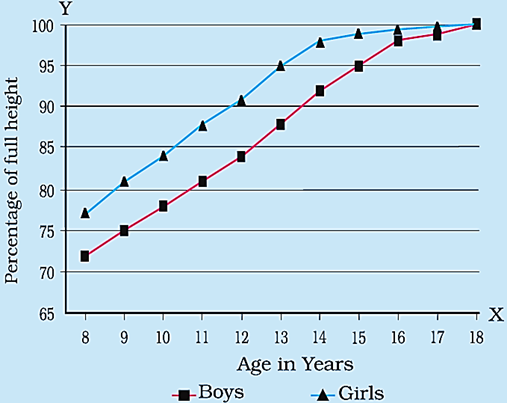
Find out the percentage of height you have already reached.
Calculate the height you might eventually reach. Let age be 11 years of girl and the point of age touches the 88% mark on height axis. So, the maximum height that will eventually be reached


During adolescence, change in body shape takes place. ‘These changes are different in boys and girls as follows:
(i) In boys, the shoulders become broader and the chest becomes wider. The muscles of the body grow more prominently.
(ii) In girls, the pelvic region (region below the waist) widens, hips broaden, breasts develop and increase in size.
The voice box or the larynx produces sound when we talk. At puberty, it begins to grow. It is bigger in boys and can be seen as a protruding part of the throat called Adam’s apple. In girls, the larynx is smaller and hardly visible from outside. This is the reason why boys develop a deep voice, whereas girls have a high-pitched voice.
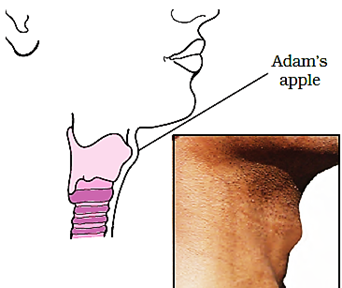
In adolescent boys; sometimes, the muscles of the growing voice box go out of control and the voice becomes hoarse. This state may remain for a few days or weeks after which the voice becomes normal.
Increased Activity of Sweat and Sebaceous Glands
There is an increase in the activity of sweat and sebaceous (oil) glands. This. leads to increased sweating often resulting in body odour.
The excess oil and sweat get collected in the tiny pores of the skin, blocking them, so that the bacteria can grow in it. This causes the formation of pimples and acne on the face of boys and girls at this time.
The reproductive system starts functioning at puberty due to complete growth and development of sex organs in boys and girls.
(i) In boys, the male sex organs like the testes and penis develop completely. The testes start producing sperms.
(ii) In girls, the ovaries enlarge and eggs begin to mature. Ovaries start releasing mature eggs (only one egg is released per month by either ovary).
Reaching Mental, Intellectual and Emotional Maturity
Adolescence is a period which brings about development in a person’s way of thinking. The person becomes more independent and self-conscious.
Intellectual development also occurs and considerable time is spent on thinking, planning, analysing, exchanging views and ideas with others. It is the time in one’s life when the brain has the highest capacity of learning.
There are a lot of emotional changes during puberty. One has to deal with the rapid physical change. The fast physical growth and other changes in the body can lead to confusion and insecurity in the minds of adolescents.
Sexual characteristics are physical or behavioural traits of an organism which indicates its biological sex. These can include
(i) Primary sexual characteristics or sex organs: Organs used for reproduction, with which a person is born, e.g. testes in male and ovaries in female.
(ii) Secondary sexual characteristics: Characteristics which distinguish the two sexes of a species and develop during puberty.
Some of the secondary sexual characters that develop in boys and girls are as follows:
In boys
(i) Facial hairs, such as beard and moustaches develop.
(ii) Muscles develop and shoulders becomes broad.
(iii) Increase in weight.
(iv) Voice becomes deeper.
(v) Hair develop under the armpit, on the chest and in the pubic regions.
In girls
(i) Development and enlargement of breast.
(ii) Hips broader and pelvic region widens.
(iii) Initiation of menstrual cycle.
(iv) Voice becomes high-pitched.
(v) Hair develop under the armpit and in the pubic regions.
The changes which occur at adolescence are controlled by hormones, i.e. testosterone in males and oestrogen in females.
Hormones are the chemical substances, secreted by the endocrine glands, for control and coordinating the functions of many organs of the body. These are released into the bloodstream to reach the target site (i.e. a particular body part), which responds to the hormone.
Our body also has other type of glands called the exocrine glands which secrete its product into ducts, e.g. sweat glands, oil glands, etc.
Role of Hormones in Initiating Reproductive Function
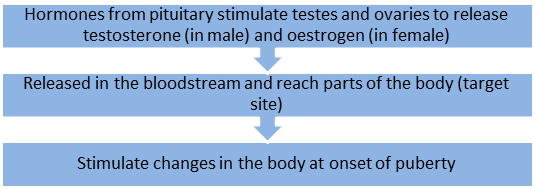
Puberty begins with a sudden increase in the production of hormones. Apart from being reproductive organs, the testes (in males) and ovaries (in female) are also endocrine glands which secrete sex hormones that brings about changes at puberty and make their reproductive systems functional.
The testes make male sex hormone, called testosterone. The ovaries make female sex hormone called oestrogen. The production of these sex hormones is under the control of another hormone (gonadotropic hormone) secreted by pituitary gland.
The pituitary gland secretes many hormones. One of these hormones (FSH-Follicle Stimulating Hormone) stimulates the formation of sperms in testes and maturation of egg cells (or ova) in ovaries. Another hormone prolactin develops the mammary glands (milk producing glands) inside the breasts in females.
Reproductive Phase of Life in Humans
Adolescents become capable of reproduction at puberty, when their testes and ovaries being to produce gametes.
In men, the capacity to produce male gametes (or sperms) usually lasts longer than in women.
In females, the reproductive phase of life begins at puberty (10 - 12 years of age) and generally continues till they reach the age of approximately 45 - 50 years.
With the onset of puberty, the ova begin to mature in the ovaries of a woman. One mature ovum is released by one of the ovaries once in about 28 - 30 days. The process of releasing an egg by an ovary is called ovulation. The fertilised egg gets implanted in the thick wall of uterus for further development resulting in pregnancy.
If fertilisation does not occur, then the released egg and the thickened lining of uterus along with the blood vessels are discharged out by the vagina. This flow of blood and other materials is termed as menstruation.
The first menstrual flow begins at puberty and is termed as menarche. The cycle of menstruation is repeated in a woman after every 28 - 30 days till an ovum gets fertilised.
At 45 - 50 years, the menstrual cycle stops and a woman loses her ability to bear children. This is called menopause. Reproductive life of a woman starts at menarche and ends at menopause.
The process of ovulation and menstruation in women is called menstrual cycle. This cycle is controlled by hormones. The cycle includes the maturation of the egg, its release, thickening of uterine wall and its breakdown if pregnancy does not occur.
In case the egg is fertilised, it begins to divide and then gets embedded in the uterus for further development. Initially, the menstrual cycle may be irregular, it becomes regular after sometime.
Determination of Sex of the Baby
The sex of the baby is determined by the nature of the sex chromosomes present in the fertilised egg. Thread-like structures called chromosomes, are present inside the nucleus of the cell.
The nucleus of each human cell contains 23 pairs of chromosomes. One pair, out of these are the sex chromosomes which are of two types named as X and Y.
A female has two X-chromosomes, while a male has one X and one Y-chromosome.
The gametes have only one set of chromosomes.
The unfertilised egg always has one X-chromosome. But sperms are of two kinds, i.e. X-chromosome and Y-chromosome.
The sex of a child depends on what happens at fertilisation.
(i) If a sperm carrying X-chromosome, fertilises an egg cell (or ovum) which carries X-chromosome, then the zygote formed will have XX combination of sex chromosomes due to which the child born will be a girl (or female).
(ii) If a sperm carrying Y-chromosome, fertilises an egg cell (or ovum) which carries X-chromosome, then the zygote formed will have XY combination of sex chromosomes due to which the child born will be a boy (or male).
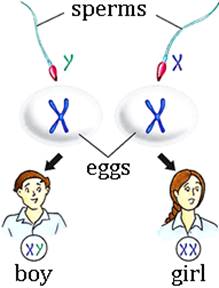
Hence, sex chromosome of the father determines the sex of the baby. Traditionally, it is believed that a mother is responsible for the sex of the baby. This belief is completely wrong and unjustified.
Hormones Other than Sex Hormones
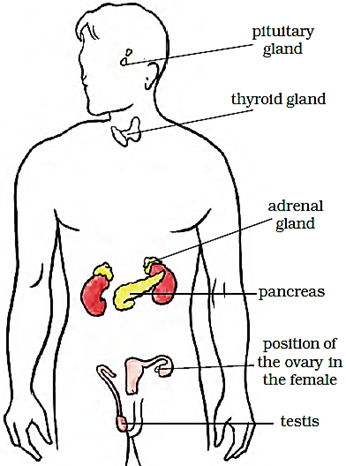
Hormones are secreted by endocrine glands. These are required in extremely small quantities and control growth, development, behaviour and reproduction.
Some endocrine glands and their functions are given below in the table:
|
Gland |
Location |
Hormones secreted |
Function |
|
Pituitary (master gland) |
Base of the brain |
Growth hormone and several other hormones |
Regulates growth and the functioning of the other endocrine glands. |
|
Thyroid |
Near the larynx |
Thyroxine |
Controls many activities of the body including the rate at which energy is produced. |
|
Parathyroids (4 glands) |
Behind the thyroid |
Parathormone |
Control the balance of calcium in the body. |
|
Adrenals (2 glands) |
Attached to each kidney |
Adrenaline |
Regulate heartbeat, respiration rate and blood pressure. |
|
Pancreas |
Below the stomach |
Insulin |
Controls glucose level in blood. |
|
Testes |
Outside abdominal cavity |
Testosterone |
Promote development of secondary sexual character |
|
Ovaries |
Lower part of abdominal cavity |
Oestrogen |
Control secondary sexual characters and changes related to pregnancy. |
Hormones are required in a proper amount.
A less (hypo) secretion or more (hyper) secretion of a particular hormone may lead to disorders in body.
|
Gland |
Disorder |
|
Pituitary (growth hormone) |
Hypersecretion-in adults, acromegaly (thickening of bones and soft tissues) and in adolescents, gigantism. Hyposecretion causes dwarfism). |
|
Thyroid (thyroxine) |
Hyposecretion-goitre (neck appears to be swollen) due to deficiency of iodine in the diet. |
|
Pancreas (insulin) |
Hyposecretion-diabetes (large quantities of sugar in blood and urine). |
Importance of Consuming Iodised Salt
Iodised salt is table salt mixed with a minute amount of various salts of the element iodine. Iodine deficiency is the world’s leading cause of preventable intellectual disability in children. Thyroid gland makes thyroxine hormone that regulates the body’s metabolic rate and promote growth and development. Iodine is essential to make thyroxine and to prevent mental retardation and goitre. If in a person’s diet, iodine is too low, the thyroid gets enlarged, making the neck of the person appears to be swollen. This is called goitre.
Role of Hormones in Completing the Life History of Insects and Frogs
The caterpillar goes through various stages to become an adult. Similarly, the tadpole passes through certain stages to become a frog. These changes from larva to adult is called metamorphosis. The process of metamorphosis in insects is controlled by insect hormones.
In a frog, the process is regulated by thyroxine hormone produced by thyroid gland.
A tadpole cannot become an adult if there is deficiency of iodine in the water where it is growing.
The World Health Organisation (WHO) defines health as a state of complete physical, mental and social well-being and not merely the absence of disease.
Reproductive health addresses the reproductive processes, functions and systems at all stages of life. During adolescence, there is rapid mental and physical growth. Therefore, growing children need special attention towards proper health.
Nutritional Needs of the Adolescents
Each individual should take balanced diet to stay healthy. It is more important for adolescent to plan their diet carefully. A typical balanced diet includes carbohydrates, fats, proteins, vitamins, minerals, roughage and water in adequate proportions.
The various types of food items which should be included in the diet of adolescent to meet their nutritional needs are as follows:
(i) Cereals (like wheat and rice) which provide carbohydrates for energy, e.g. chapati, dosa, cooked rice, etc.
(ii) Milk, meat, nuts and pulses which provide protein for growth, e.g. dal, paneer, fish, etc.
(iii) Fats and sugars which give energy, e.g. butter, ghee, groundnuts, etc.
(iv) Fruits and vegetables which are protective food and provide many vitamins and minerals, e.g. citrus fruits like oranges (vitamin-C), carrot (vitamin-A).
The iron-rich foods such as leafy vegetables, Indian gooseberry (amla), meat and jaggery are good for adolescents as they help in making blood.
Milk contains a lot of calcium mineral which is necessary for making healthy bones of the growing adolescents. Milk is a balanced food in itself.
Avoid consuming junk foods such as burgers, noodles, etc.
Our Indian meal of roti, rice, pulses and vegetables is a balanced meal.
For infants (small babies), mother’s milk provides all the necessary nourishment which they need. Chips and packed (or tinned) snacks, though very tasty, should never be taken in place of regular meals because chips and other such snacks do not have adequate nutritional value.
Good personal hygiene is one of the most effective ways to protect ourselves and others from illness. The adolescents should adopt following practices to maintain personal hygiene.
(i) Keep all the parts of body clean by taking bath daily. It is more necessary for teenagers because, the increased activity of sweat glands sometimes makes the body smelly. Bathing removes the sweat, oil and dirt, etc and cleans the body.
(ii) Always wash hand before and after meals.
(iii) Do not defecate in open field.
(iv) Girls should take special care of cleanliness during the time of menstrual flow.
If personal hygiene is not maintained by adolescent boys and girls, there are chances of catching bacterial infections. These infections can make a person ill and spoil good health.
All young boys and girls should include brisk walking, running, jogging, cycling, swimming, skipping and dancing in their routine to keep themselves fit and healthy.
Adolescence is a period of transition between childhood and adulthood. It is a period of hyperactivity in the body and mind which is a normal process of growing up.
Some adolescents feel confused or insecure about these changes. We should not worry about these changes as there is nothing abnormal in it.
If somebody suggests that you will get relief from confusion, tension, worries, etc. and feel better by taking some drugs, just say ‘No’. Drugs are very powerful chemical substances and should be used only under a doctor’s supervision.
Harmful effects of taking drugs
(i) Drugs are addictive. If you take drugs once, you feel like taking them again and again. Soon the person feels he (or she) cannot live without drugs and becomes a drug-addict.
(ii) Drug addicts become irritable and loose interest in their studies or jobs.
(iii) Drugs do physical harm to the body. Drugs can damage brain, liver, lungs and kidney.
(iv) The sharing of syringes for injecting drugs spreads AIDS disease among the drug addicts.
AIDS (Acquired Immuno Deficiency Syndrome)
AIDS is a disease which is caused by HIV (Human Immunodeficiency Virus). This virus destroys the natural defence mechanism of the body and makes it susceptible to diseases.
AIDS virus can pass from an infected person to a healthy person through ways given below:
(i) Sharing the syringes for injecting drugs.
(ii) Unprotected sex with an infected person.
(iii) Transfusion of blood into a healthy person from an infected person.
(iv) Through milk from an infected mother to an infant.
|
Myth |
Fact |
|
A girl becomes pregnant if she looks at boys during menstruation. |
A physical contact with a boy is necessary for a girl to be pregnant. |
|
The mother is responsible for the sex of her child. |
It is the sperm that comes from the father which is responsible for the sex of the child. |
|
A girl should not be allowed to work in the kitchen during menstruation. |
Having your period does not make you dirty/unclean and you are at no risk of spoiling the food items by touching them. |
|
A girl should always rest during menstruation (no exercise). |
Exercise is actually good, if you have cramps during menstruation. It increases the supply of oxygen to muscles. |
|
If you don't get your menstruation period, you are definitely pregnant. |
There are various factors that can delay menstruation period such as stress, illness, drastic weight change, etc. |
In India, the legal age for marriage is 18 years for girls and 21 years for boys. This is because teenage mothers are not prepared mentally or physically for motherhood.
Early marriage and motherhood cause health problems in the mother and the child.
It also curtails employment opportunities for the young woman and may cause mental agony as she is not ready for responsibilities of motherhood.
Online Tuitions & Self-Study Courses for Grade 6 to 12 & JEE / NEET