
Chapter 1 – Crop Production and Management
Questions Answers – Set 2
Q.1. (a) Name the practice followed for large scale rearing of farm animals.
(b) What facilities are provided to farm animals?
Ans:
(a) The practice of rearing of farm animals on a large scale is called animal husbandry.
(b) In animal husbandry, animals are provided with proper food, shelter and care.
Q.2. The levelling of ploughed field is beneficial. Give reasons to support your answer.
Ans: The levelling of ploughed field is beneficial because of following reasons:
(i) It prevents the top fertile soil from being carried away by strong winds or water.
(ii) It helps in uniform distribution of water in the fields during irrigation.
(iii) It also prevents loss of moisture from the ploughed soil.
Q.3. State two advantages of using chemical fertilisers over manures. What would happen if fertilisers are used in excess?
Ans: Advantages of using chemical fertilisers over manures are
(i) Fertilisers are nutrient-specific and provide specific nutrient to soil in desired quantity.
(ii) These, being readily soluble in water, can be absorbed easily by the crop plants.
If fertilisers are used in excess, then it will cause tremendous changes in the chemical nature of soil and will make it less fertile.
Q.4. Classify the following crops into kharif and rabi crops and write in the tabular column: Maize, paddy, mustard, pea, gram, wheat, groundnut, cotton.
Ans: From the above given crop list, the kharif and rabi crops can be grouped as
|
Kharif |
Rabi |
|
Maize |
Mustard |
|
Paddy |
Pea |
|
Groundnut |
Wheat |
|
Cotton |
Gram |
Q.5. Tanya went to his village during vacations. While on his way to a crop field, he saw a person with covered mouth spraying something on crops. He got worried about the crops and asked the person to stop. The person who was his neighbour smiled and explained him the purpose of his act. Tanya was happy to learn a new fact about farming.
(a) According to you, what was the person doing?
(b) His mouth was covered. Why?
(c) Identify the values shown by Tanya.
Ans:
(a) The person was spraying special chemicals called weedicides on his crops to kill unwanted plants (weeds) in his field.
(b) The mouth of the person was covered to prevent the inhaling of poisonous weedicide.
(c) Tanya is observant, attentive, cautious and an intelligent boy.
Q.6. Write the functions of (a) leveller (b) hoe (c) combine (d) thresher
Ans:
|
Tool |
Function |
|
Leveller |
Levelling of ploughed soil so as to prevent soil erosion. |
|
Hoe |
Tilling the soil. |
|
Combine |
Harvesting and Threshing. |
|
Thresher |
Separation of grains from Chaff. |
Q.7. List a precaution to be taken so that plants do not dry and die in summer season.
Ans: Water is necessary for all physiological functions and growth of all living organisms including plants. In summer, due to high temperatures, water evaporates from the soil as well as from plant surfaces thus making it deficient. This water deficiency is overcome by adequately supplying water to plants and taking care of them during summer season.
Q.8. Unwanted plants (weeds) grow with the crops. How?
Ans: The unwanted plants (weeds) grow on the land alongside the main field. Their seeds get disseminated by various agencies like water, air, insects, birds and reach to the main field and lie there. These seeds germinate and crop up as a weed plants along with our main crop.
Q.9. (a) Name the tool used with a tractor for sowing seeds in a field.
(b) What are the advantages of using this tool?
Ans:
(a) Seed Drill
(b) The advantage of sowing seeds with seed drill are:
(i) seeds are sown at appropriate distance and depth
(ii) prevents overcrowding of plants and each plant gets sufficient sunlight, nutrients and water from soil.
(iii) The seeds are get covered by the soil after sowing, hence protected from damage caused by birds.
(iv) saves time and labour.
Q.10. Agricultural practices are done by farmers in a field. What are they? Name them.
Ans: The various agricultural practices of crop production involve:
• Preparation of soil
• Sowing
• Adding manure and fertilisers
• Irrigation
• Protection from weeds
• Harvesting
• Storage
Q.11. Mention the tools commonly used in a field or garden and which purpose do they solve?
Ans: Some of the common tools Used by a gardener or farmer in a field are
(i) Khurpi is used for the manual: removal of unwanted plants.
(ii) Sickle is used in manual harvesting of crop.
(iii) Shovel is a tool for digging, lifting and moving soil, sand, gravels, etc.
(iv) Plough is used for tilling soil, adding fertilisers to crops, removal of weeds and scrapping of soil.
Q.12. Give an appropriate term for each of the following.
(a) Chemical substance rich in particular nutrient.
(b) Plants of same kind grown in a field on large scale.
(c) Process of loosening and turning the soil.
(d) Rearing of fishes for its various products.
Ans:
(a) Fertiliser
(b) Crop
(c) Ploughing or Tilling
(d) Pisciculture
Q.13. Sowing of seeds is also done by hands. What is it known as? Mention its disadvantages.
Ans: The method in which seeds are sown in the soil by hand or manually is called broadcasting.
Disadvantages of broadcasting: This method is not good because there is uneven distribution of seeds and the seeds can be picked up by birds from the soil surface.
Q.14. Despite favourable climatic conditions, a farmer's crop failed to give good yield. Give the possible reasons for this.
Ans: If despite favourable climatic conditions, farmer's crop failed to give good yield, the possibilities may be
(i) he did not use good quality and healthy seeds.
(ii) his field was not well irrigated.
(iii) manures/fertilisers were not timely and properly applied.
(iv) weeds were not removed.
(v) seeds were not sown at appropriate distance.
(vi) the soil was not ploughed and levelled properly.
Q.15. (a) Draw a diagram of a plough and label the following parts
(i) Plough-shaft (ii) Ploughshare
(b) Write the function of plough.
(c) Name the animals used to draw the plough.
Ans: (a)
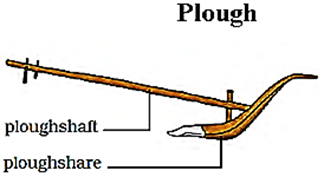
(b) Main functions of plough are tilling the soil, adding manures and fertilisers, removing weeds, scraping of soil, etc.
(c) Normally bulls are used to draw the plough.
Q.16. Vandana saw her mother keeping the wheat grains on the terrace, before storing them. She was confused to see this as she thought 'the grains will get dirty if kept in open and approached her mother for clearing her doubts. Her mother explained Vandana the reason behind her act. Vandana then helped her mother carry the grains to the terrace happily.
(a) The grains were kept on the terrace. Can you suggest a reason?
(b) Is it necessary to keep the grains in the sun? Why or why not?
(c) Mention the values shown by Vandana.
Ans: (a) The grains were kept on the terrace to get them dried in the sunshine before storing. It reduces their moisture.
(b) Yes, it is necessary. Because the higher moisture content in the food grains promote the growth of fungus and moulds on the stored grains which damages them.
(c) Vandana is observant, intelligent, a thinker and Cheerful girl.
Q.17. As a part of eco-club activity, students were asked to raise a kitchen garden in the school premises. They were provided with some materials given in the box. List the other materials you would require. How will you plan the garden? Write the steps.
Khurpi, water-can, spade, shovel
Ans: Besides the given tools, the other items required for raising a garden are seeds and seedling of vegetables, plants from nursery, kitchen waste, manure, water, soil.
Steps for raising the garden:
(i) Kitchen waste will be collected and composted in a pit.
(ii) A patch of land will be identified for the garden.
(iii) Soil will be dug up and levelled with the help of a spade.
(iv) Sowing of seeds/ transplanting of seedlings will be done.
(v) Select seeds/seedlings as per the season. Water the plants regularly.
(vi) Compost will be applied.
(vii) Weeds will be removed periodically with the help of khurpi.
Q.18. Explain various agricultural practices in sequential manner.
Ans: Various agricultural practices are as follows:
(i) Preparation of soil: The first step is preparation of soil. The soil is loosened and turned up. It helps the plants to grow and develop. The process of loosening and turning of the soil is called tilling or ploughing. Sometimes manure is added to soil before tilling.
(ii) Sowing: After preparation of soil, the second step called sowing takes place. Before sowing, good quality seeds are selected. The seeds should be clean and healthy.
(iii) Adding manure and fertilisers: Soil supplies minerals and nutrients to the crops. These nutrients are essential for growth of plants. Sometimes these nutrients are lacking, so substances are added to maintain or to replenish the soil. These substances are called manures and fertilisers. Manures and fertilisers are essential to increase crop production.
(iv) Irrigation: The process of watering the crop plants is called irrigation. Plants take all the nutrients and minerals in dissolved form. So, water is most essential for germination of seeds, growth and development of plants.
(v) Harvesting: After maturation of crop, it is cut off. This process is called harvesting. It is done by a sickle or by a machine called harvester.
(vi) Storage: Storage of product i$ one of the most important tasks. To keep the grains for longer time, it should be safe from moisture, pest, insects and other microorganisms.
Q.19. Given below is a conversation between two farmers Manoj and Sanjay.
Manoj: Sanjay, your maize crops look beautiful. They have grown pretty fast.
Sanjay: Yes, I have sprayed urea this time. What about you?
Manoj: I am still relying on good old cow dung. I am saving money for buying a tractor.
Sanjay: That's good. Tractor saves a lot of time and labour.
Manoj: Yes, it's been very labour intensive for me and now these weeds have come up.
Sanjay: Try weedicides, they are very effective.
Now, answer the following questions.
(a) List the practices which are not environment friendly and why?
(b) What is the advantage of modern agricultural implements over traditional ones?
(c) Name one weedicide and the precaution, farmers must take during its application.
Ans: (a) The practices used in field which are not environment friendly are use of fertilisers, pesticides, weedicides these are chemical substances that pose health hazards. Tractor though saves labour and time but contributes to air pollution.
(b) Modern agricultural implements save both time and labour as compared to traditional equipments.
(c) The example of weedicide is 2,4-D. As a precautionary measure, while spraying it on crops farmers should properly cover their nose and mouth, so as to avoid inhaling of these chemicals.
Q.20. Describe the method of transplantation. What are the advantages of transplanting?
Ans: Crops like paddy (rice) and vegetables like tomato and chillies are first grown in nursery and allowed to grow into tiny plants called seedlings by providing them favourable conditions and good nutrients. The healthy seedlings are then transferred or transplanted to the regular field. This process of transferring the seedlings from the nursery to the main field by hand (manually) is called transplantation or transplanting.
Advantages of transplantation:
· It helps to select better and healthy seedlings for the cultivation of crops.
· It helps in better penetration of roots in the soil and promotes better development of shoot system of plants.
· It allows the seedling to be planted at the right spacings so that plants may get uniform light nutrients and water.
· It protects the plant from overcrowding.
Q.21. Paddy is a major cereal crop in our country.
(a) In which season is paddy cultivated?
(b) Discuss the method of sowing.
(c) What measures must be taken to prevent spoilage and insect attack of harvested grains?
Ans: (a) Paddy is cultivated in rainy season as it is a kharif crop.
(b) For sowing paddy, seeds are first grown in a nursery and later seedling are transplanted in the field. This allows us to select only healthy and better seedlings for cultivation.
(c) Measures taken to prevent spoilage or damage of harvested crops from insect attack are
(i) Exposing them in sunlight for drying as freshly harvested crops have moisture.
(ii) Dried neem leaves are added to stored grains to prevent damage from pests.
(iii) Specific chemical treatments are also available for preventing crops.
Q.22. Explain the role of water in the production of crops. Why is it necessary to supply water to the crop plants?
Ans: For healthy crop growth; the role of water is to maintain moisture of the soil. Plants contain nearly 90% water. Water is absorbed by the plant roots along with minerals and fertilisers. Water also protects the crop from both frost and hot air currents.
Water is essential because germination of seeds does not take place under dry conditions.
Q.23. What is soil fertility. Mention some methods by which soil fertility can be replenished.
Ans: The ability of soil to supply all the essential plant nutrients to a crop in adequate quantity is called soil fertility. Repeated growing of crops in the same soil removes various nutrient elements from the soil due to which the soil loses its fertility.
The soil fertility can be replenished or regained by the following methods:
(i) By keeping the field fallow (uncultivated) for one or two seasons.
(ii) By putting manures and fertilisers in the soil.
(iii) By practicing crop rotation.
(iv) By practicing multiple cropping (mixed cropping).
Q.24. A group of students conducted an activity where they took three glasses A, B and C with same amount of soil and planted same sized seedlings.
They added cow dung manure in glass A, little urea in glass 8 and nothing in C. Based on the observations after a week, answer the following:
(a) In which glass, will you find seedling?
(b) Seedlings of which glass shows maximum growth?
(c) Give the inference of the activity.
(d) Name the natural substance obtained from residues of plants.
(e) Mention the role of soil.
Ans: (a) We will find seedlings in all the glasses.
(b) Glass B shows maximum growth as it contained urea which is a rich source of nitrogen.
(c) Manures and fertilisers are essential for better growth of plants.
(d) Manure is a natural substance obtained by the decomposition of animal and plant residues.
(e) Soil fixes up the plant. It also retains water for plant absorption.
Online Tuitions & Self-Study Courses for Grade 6 to 12 & JEE / NEET