
Chapter 1 – Crop Production and Management
NCERT Solutions
Q.1. Select the correct word from the following list and fill in the blanks.
float, water, crop, nutrients, preparation
(a) The same kind of plants grown and cultivated on a large scale at a place is called ................
(b) The first step before growing crops is .............. .of the soil.
(c) Damaged seeds would ............... on top of water.
(d) For growing a crop, sufficient sunlight, ................ and ................. from the soil are essential.
Ans: (a) crop (b) preparation (c) float (d) water, nutrients
Q.2. Match the items in Column I with those in Column II.
|
Column I |
Column II |
|
(a) Kharif crops |
(i) Food for cattle |
|
(b) Rabi crops |
(ii) Urea and super phosphate |
|
(c) Chemical fertilisers |
(iii) Animal excreta, cow dung, urine and plant waste |
|
(d) Organic manure |
(iv) Wheat, gram and pea |
|
|
(v) Paddy and maize |
Ans:
|
Column I |
Column II |
|
(a) Kharif crops |
(v) Paddy and maize |
|
(b) Rabi crops |
(iv) Wheat, gram and pea |
|
(c) Chemical fertilisers |
(ii) Urea and super phosphate |
|
(d) Organic manure |
(iii) Animal excreta, cow dung, urine and plant waste |
Q.3. Give two examples of each.
(a) Kharif crop
(b) Rabi crop
Ans: (a) Soybean and groundnut are two examples of kharif crops.
(b) Pea and mustard are two examples of rabi crops.
Q.4. Write a paragraph in your own words on each of the following.
(a) Preparation of soil
(b) Sowing
(c) Weeding
(d) Threshing
Ans:
(a) Preparation of soil: It is the first step before sowing the crop. In this, the soil is ploughed to loosen it and make it aerated which allows the roots to breathe easily. This also helps earthworms and microbes in the soil that bring the nutrient rich soil to the top. The process of loosening and turning of soil is called tilling or ploughing, which is followed by levelling and manuring.
(b) Sowing: The process in which the seeds are embedded in the soil for crop production is called sowing. Traditionally, funnel-like tools are used for sowing. But now-a-days, seeds are sown by a seed drill implement. It scatters the seeds at regular intervals in the soil.
(c) Weeding: It is the removal of weeds from the field. It is essential as weeds are harmful for the growth of crops because they compete with the crop plants for water, nutrients, space and light.
(d) Threshing: The process in which the grain seeds are separated from chaff is called threshing. This is carried out with the help of a machine called combine that is a combination of a harvester and thresher.
Q.5. Explain how fertilisers are different from manure.
Ans:
|
Manure |
Fertiliser |
|
Manure is a natural substance obtained by the decomposition of animal wastes like cow dung, human waste and plant residues. |
Fertiliser is an inorganic salt which contains necessary plant nutrients. |
|
Manure is relatively less rich in plant nutrients. |
Fertiliser contains a rich amount of nutrients like nitrogen, phosphorus and potassium in concentrated form. |
|
Manures are prepared in the field by decomposing wastes. |
Fertilisers are prepared in the factories. |
|
Manure provides humus to the soil in large amount. |
Fertiliser does not provide humus to the soil. |
|
Manures are not soluble in soil; therefore, absorbed by plants at a very slow rate. |
Fertilisers are highly soluble in water and readily absorbed by the plants. |
Q.6. What is irrigation? Describe two methods of irrigation which conserve water.
Ans:
The process of supplying water to crops at different intervals is called irrigation.
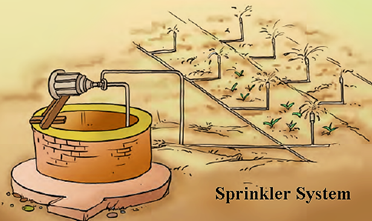
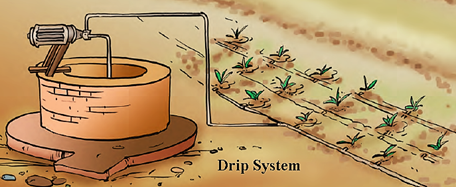
Two methods of irrigation which conserve water are Sprinkler System and Drip System.
(i) Sprinkler system: In this system, there is a main pipeline laid in the field and attached with revolving nozzles at regular intervals. Water from the resources like tubewell escapes from rotating nozzles and ·is sprinkled like rain on the crops. This system of irrigation is useful on uneven land where sufficient water is not available and in sandy soil.
(ii) Drip system: In this system, a network of narrow pipes or tubes is laid down in the field with small holes. When water flows through the narrow pipes, it falls drop by drop just near the roots of plants.
In this method there is no wastage of water as water falls drop by drop, therefore this system of irrigation is very useful in regions where availability of water is poor. It is the best technique for watering fruit plants, gardens and trees.
Q.7. If wheat is sown in the kharif season, what would happen? Discuss.
Ans: Wheat seeds need low temperature and less humidity to grow. If they are sown in kharif season, (i.e. rainy season), the seeds would get destroyed due to excess of water and would not grow.
Q.8. Explain how soil gets affected by the continuous plantation of crops in a field.
Ans: Soil is the source for plants from which they derive their mineral nutrients, essential for their growth. If crops are grown continuously in the same field, for a long period of time, the soil becomes poorer in nutrients. Thus, soil gets deficient in nutrients and the field becomes infertile.
Q.9. What are weeds? How can we control them?
Ans: Weeds are the undesirable (unwanted) plants that may grow naturally along with the crop. They are hazardous to the crops as they compete with the crop for food, nutrients, water and sunlight. Hence, they must be controlled. The process of controlling or removing weeds from the field is known as weeding. There are several methods to remove weeds such as tilling in which weeds are uprooted. They are removed manually by cutting with the help of khurpi. They are also controlled by chemicals known as weedicides which kill the weeds, e.g. 2,4-D.
Online Tuitions & Self-Study Courses for Grade 6 to 12 & JEE / NEET