
Q.1.
Angle of incidence is equal to the angle of reflection:
(a) always (b) sometimes (c) under special conditions (d) never
Q.2. Which of the following is not a planet of the sun?
(a) sirius (b) mercury (c) saturn (d) earth
Q.3. Which one is the example of Kharif crop?
(a) wheat (b) gram (c) pea (d) paddy
Q.4. Least polluting fuel for vehicles is:
(a) petrol (b) diesel (c) CNG (d) kerosene
Q.5. A unit of inheritance in living organisms:
(a) nucleus (b) chromosome (c) gene (d) cell
Q.6. A ball rolling along the ground gradually slows down and finally comes to rest is an example of
(a) muscular force (b) magnetic force
(c) frictional force (d) electrostatic force
Q.7. Four children are asked to arrange forces due to rolling, static and sliding friction in decreasing order. The correct arrangement is:
(a) rolling, static, sliding (b) rolling, sliding, static
(c) static, sliding, rolling (d) sliding, static, rolling
Q.8. Sound can travel through
(a) solids only (b) liquids only (c) gases only (d) solids, liquids and gases
Q.9. The passage of an electric current through a conducting liquid causes
(a) heating effects of current (b) magnetic effects of current
(c) chemical effects of current (d) electric effects of current
Q.10. Which of the following cannot be charged easily by friction?
(a) A plastic scale (b) A copper rod (c) An inflated balloon (d) A woollen cloth
Q.11. Name the bacterium which increases soil fertility by fixing nitrogen.
Q.12. Name the bacterium which promotes the formation of curd.
Q.13. The blue colour of copper sulphate disappears when iron nails are added to it. Give reason.
Q.14. "The production of an exact copy of a cell, any other living part or a complete organism" Identify the process used for it and name one animal which is produced by this process.
Q.15. Define electroplating.
Q.16. What is the angle of incidence of a ray if the reflected ray is at an angle of 90° to the incident ray?
Q.17. "Clear, transparent water is always fit for drinking." Comment.
Q.18. Categorize the following materials as biodegradable and non-biodegradable:
(i) Peels of vegetables and fruits (ii) Tooth paste tubes
(iii) Paper and wood (iv) Plastic bags.
Q.19. Suppose you are asked to purchase a good fuel from the market, what characteristics would you keep in mind at the time of purchasing. Write any four.
Q.20. How paper is prepared? Why should we save and reuse paper?
Q.21. A rocket has been fired upwards to launch a satellite in its orbit. Name two forces acting on the rocket after leaving the launching pad.
Q.22. A pendulum oscillates 40 times in 4 seconds. Find its time period and frequency.
Q.23. Draw sketches to show the relative positions of prominent stars in
(a) Ursa Major (b) Orlon
Q.24. Explain circumstances leading to acid rain. How does it affect us?
Q.25. (i) What is potable water?
(ii) Write two ways in which water gets contaminated?
(iii) Name two diseases which are caused by contaminated water.
Q.26. Observe the following diagram
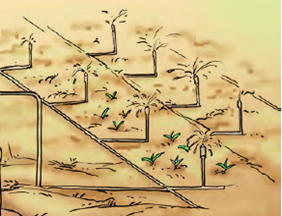
(i) Name the above method. Explain it.
(ii) For what purpose it is used?
Q.27. Identify the metals or non-metals which are:
(i) used in making utensils and machinery parts.
(ii) essential for our life, which all living beings inhale during respiration.
(iii) used in thermometers, present in liquid state.
Q.28. (i) Which part of body:
(a) produces sperm.
(b) produces ova.
(c) helps in development of embryo.
(ii) "Reproduction is an important process for every living being." Explain.
Q.29. What are the three main factors essential to maintain reproductive health? Explain their importance.
Q.30. (i) Why objects moving in fluids must have special shapes? Explain.
(ii) Mention the important factors affecting friction.
Q.31. Give reason
(i) Sportsmen use shoes with spikes.
(ii) Powder is sprinkled on the carrom board before playing.
(iii) Treaded tyres are used in cars, trucks and bulldozers.
Q.32. (i) Draw labelled diagram of an instrument which can be used to detect a charged body.
(ii) A crackling sound is heard while taking off a sweater during winter, why?
Q.33. (i) Name the scale on which the destructive energy of an earthquake is measured.
(ii) An instrument by which seismic waves are recorded.
(iii) Write any two precautions would you take to protect yourself, when you are outside your home and an earthquake strikes.
Q.34. (i) Differentiate between an asteroid and a comet.
(ii) (a) The planet which is farthest from the sun is
(b) The planet which appears reddish in colour
Q.35. (i) Name three liquids, which when teste d in the given circuit, may cause the magnetic needle to deflect. Also label the diagram.
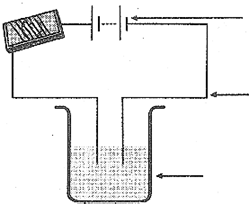
(ii) Is it safe for the electrician to carry out electrical repairs outdoors during heavy downpour? Explain.
Q.36. (i) Draw labelled diagram to show the internal structure of Human eye.
(ii) Write the function of Iris and Retina.
(iii) How will you take proper care of your eyes? Write any two.
Q.37. (i) "Squeezing a piece of lemon between the fingers to extract the juice." In the given situation identify the agent exerting the force, the object on which it acts and the effect of force.
(ii) Define pressure and write its formula.
(iii) Draw diagrams to show:
(a) A liquid exerts pressure on the, walls of container.
(b) Pressure exerted by a liquid at the bottom depends on the height of the column.
Q.38. (i) What are audible and inaudible sounds? Write the range of audible frequency for human ear.
(ii) Explain in what way noise pollution is harmful to humans?
Online Tuitions and Self-Study Courses for Grade 6 to 12 & JEE / NEET