
Chapter 12 – Exponents and Powers
Key Notes
Repeated multiplication of the same number with itself is represented as Exponentials (xn).
A repeated multiplication of the same non-zero integer say ‘x’ with itself is represented in the form of xn, where x is called the base and n, an integer called the exponent or index. This type of representation of a number is called the exponential form of the given number.
e.g. 5 × 5 × 5 = 53
Here, 5 is the base and 3 is the exponent and we read it as “5 raised to the power of 3”.
Multiplicative Inverse or Reciprocal of an exponent
For any non-zero integer a, we have
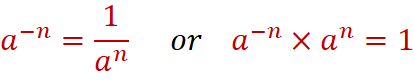
So, a–n is the multiplicative inverse or reciprocal of an and vice-versa.
e.g., 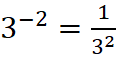
Laws of Exponents
If a and b are non-zero integers and their exponents m, n are integers, then

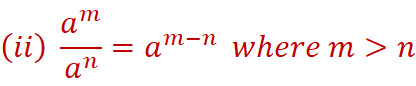


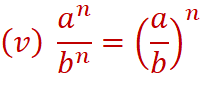
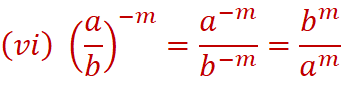



A number of the form xn, where n is an integer, can express very large or very small numbers, depending on whether the value of n is a positive integer or a negative integer.
Standard form
A number is said to be in the standard form, when it is written as k × 10n, where 1 ≤ k < 10 and n is an integer. Standard form is also called scientific notation.
Use of exponents to Express Small Numbers in Standard form.
Steps to write very small numbers in standard form:
Step I: Obtain the number and see whether the number is between 1 and 10 or it is less than 1.
Step II: If the number is between 1 and 10, then write it as the product of the number itself and 10°. e.g. If we have a number 5, then we write it in standard form as 5 × 10°.
Step III: If the number is less than 1, then move the decimal point to the right, so that there is just one-digit on the left side of the decimal point. Write the given number as the product of the number so obtained and 10–n, where n is the number of places the decimal point has been moved to the right. The number so obtained is in the standard form.
e.g. To express 0.4579 in standard form, the decimal point is moved through one place only to the right, so that there is just one-digit on the left of the decimal point.
0.4579 = 4.579 × 10⁻¹ is in the standard form.
Steps to write very large numbers in standard form:
Step I: Obtain the number and see whether the number is between 1 and 10 or it is less than 1.
Step II: If the number is between 1 and 10, then write it as the product of the number itself and 10°. e.g. If we have a number 5, then we write it in standard form as 5 × 10°.
Step III: If the number is greater than 1, then move the decimal point to the left, so that there is just one-digit on the left side of the decimal point. Write the given number as the product of the number so obtained and 10n, where n is the number of places the decimal point has been moved to the right. The number so obtained is in the standard form.
e.g. To express 4579 in standard form, the decimal point is moved through three places to the left, so that there is just one-digit on the left of the decimal point.
4579 = 4.579 × 10³ is in the standard form.
Comparing very large and very small numbers
We can compare very large and very small numbers very easily. This is illustrated with the help of examples given below:
e.g. The diameter of Earth is 1.2756 × 10⁷ m and diameter of Sun is 1.4 × 10⁹ m. Suppose we want to compare the diameter of Sun with the diameter of Earth.
Then, 
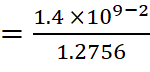
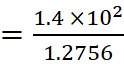
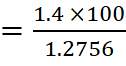
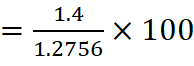
So, the diameter of the Sun is more than 100 times than that of the Earth.
Example:
During solar eclipse, Moon comes in between Earth and Sun. At that time, the distance between Moon and Sun can be calculated, where it is given that distance between Sun and Earth = 1.496 × 10¹¹ m and distance between Earth and Moon = is 3.84 × 10⁸ m.
∴ Distance between Sun and Moon = [ 1.496 × 10¹¹ – 3.84 × 10⁸] m
= [1.496 × 103 × 108 – 3.84 × 10⁸] m When adding numbers in standard form, they are converted into numbers with the same exponents.
= [1496 × 108 – 3.84 × 10⁸] m
= (1496 – 3.84) × 108 m
= 1492.16 × 108 m
= 1.49216 × 10¹¹
Online Tuitions & Self-Study Courses for Grade 6 to 12 & JEE / NEET