
Chapter 4 – Practical Geometry
Study Notes
Constructing a Quadrilateral
A quadrilateral has some measurements like, 4 sides, 4 angles and 2 diagonals.
We can construct a unique quadrilateral if we know the five measurements.
1. If the four sides and a diagonal of the quadrilateral are given.
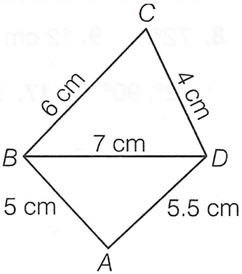
Example: Construct a quadrilateral ABCD, where AB = 5 cm, CD = 4 cm, DB = 7 cm, BC = 6 cm and DA = 5.5 cm.
Solution
Let us draw a rough sketch to visualise the quadrilateral. See the following figure.
Steps of construction
Step 1: From the rough sketch, it is easy to see that a ∆BCD can be constructed using SSS construction condition.
Draw the ∆BCD.
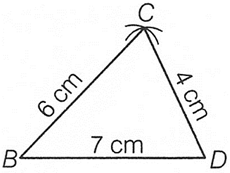
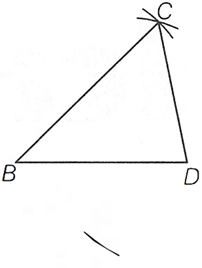
Step 2: Now, we will locate a point A, which would be on the side opposite to C with reference to B.
A is 5.5 cm away from D. So, with D as centre, draw an arc of radius 5.5 cm.
Step 3: A is 5 cm away from B. So, with B as centre, draw an arc of radius 5 cm.
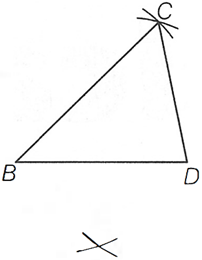
Step 4: A should be the intersection point of both the arcs drawn. Mark A and join BA and DA.
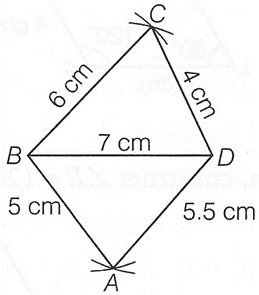
ABCD is the required quadrilateral.
Example: Construct a quadrilateral ABCD in which AB = 5 cm, BC = 7 cm, CD = 6 cm, DA = 6.5 cm and AC = 8 cm.
Solution
Steps of construction
Step 1: ∆ABC can be constructed using SSS criterion of the construction of triangle.
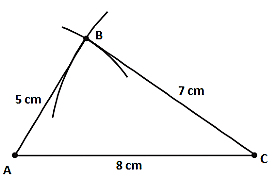
Step 2: Here we can see that AC is diagonal, so D will be somewhere opposite to B with reference to AC.
AD = 6.5 cm so draw an arc from A as the centre with radius 6.5 cm.
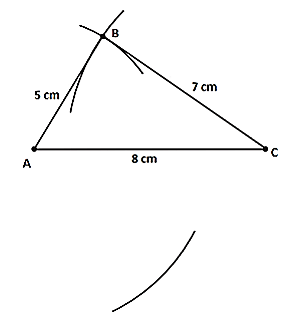
Step 3: Now draw an arc with C as the centre and by taking radius 6 cm so that it intersects the above arc.
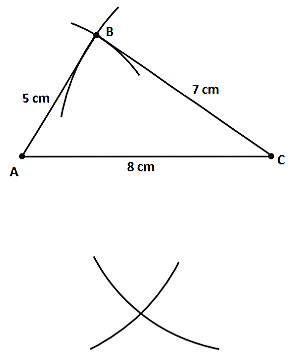
Step 4: The point of intersection of the two arcs is point D. Now join AD and DC to complete the quadrilateral.
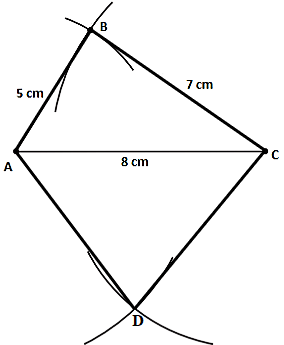
ABCD is the required quadrilateral.
2. If two diagonals and three sides of the quadrilateral are given
Example: Construct a quadrilateral ABCD if the two diagonals are AC = 6.5 cm and BD = 8 cm. The other sides are BC = 5.5 cm, AD = 6.5 cm and CD = 6 cm.
Solution
First of all, draw a rough sketch of the quadrilateral by using the given measurements. Then start constructing the real one.
Steps of construction
Step 1: We can see that AD, AC and DC are given so we can construct a triangle ΔACD by using SSS criterion.
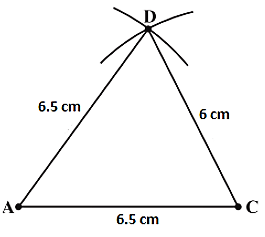
Step 2: Now, we know that BD is given so we can draw the point B keeping D as the centre and draw an arc of radius 8 cm just opposite to the point D with reference to AC.
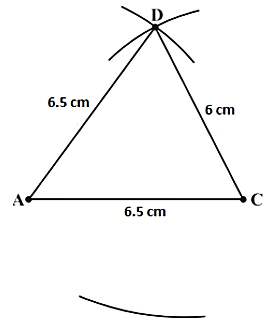
Step 3: BC is given so we can draw an arc keeping C as centre and radius 5.5 cm so that it intersects the other arc.
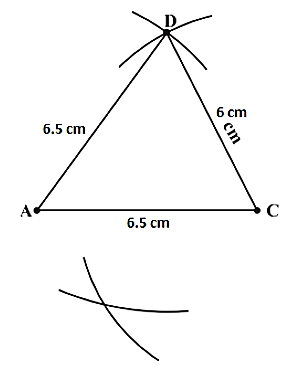
Step 4: That point of intersection of the arcs is point B. Join AB and BC to complete the quadrilateral.
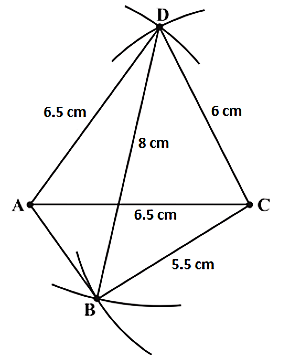
ABCD is the required quadrilateral.
Example: Construct a quadrilateral ABCD, given that AB= 7.5 cm, BC = 5 cm, CD = 6 cm, BD = 6 cm and AC= 10 cm.
Solution
First, we draw a rough sketch of the quadrilateral ABCD, which is given below:
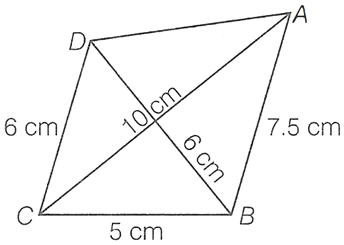
Steps of construction
Step 1: Draw a ∆ACB using SSS construction condition.
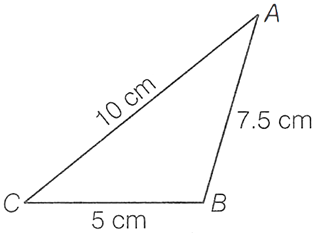
Step 2: Taking Cas centre, draw the arc of 6 cm. Taking B as centre and draw the arc of length 6 cm. Now, by the intersection point of both the arcs we get a point D.
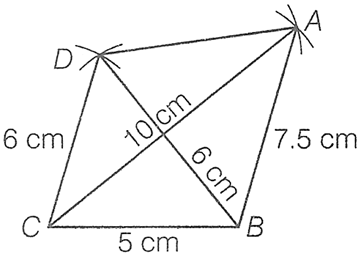
Thus, we get a quadrilateral ABCD.
3. If three angles and two adjacent sides of the quadrilateral are given.
Example: Construct a quadrilateral ABCD in which the two adjacent sides are AB = 4.5 cm and BC = 7.5 cm. The given three angles are ∠A = 75ᵒ, ∠B = 105ᵒ and ∠C = 120ᵒ.
Solution
Draw a rough sketch so that we can construct easily.
Steps of construction
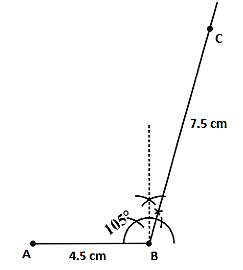
Step 1: Draw AB = 4.5 cm. Then measure ∠B = 105° using protractor and draw BC = 7.5 cm.
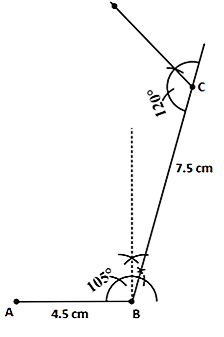
Step 2: Draw ∠C = 120°.
Step 3: Measure ∠A = 75° and make a line until it touches the line coming from point C.
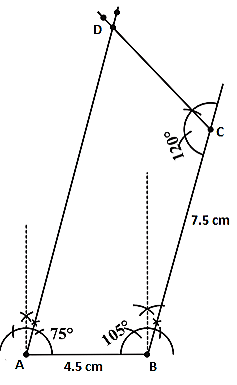
ABCD is the required quadrilateral.
4. If the three sides with two included angles of the quadrilateral are given.
Example: Construct a quadrilateral ABCD in which the three sides are AB = 5 cm, BC = 6 cm and CD = 7.5 cm. The two included angles are ∠B = 105° and ∠C = 80°.
Solution
Draw a rough sketch.
Steps of construction
Step 1: Draw the line BC = 6 cm. Then draw ∠B = 105° and mark the length of AB = 5 cm.
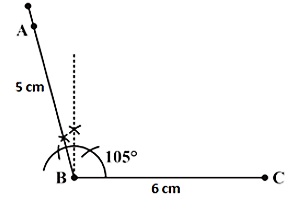
Step 2: Draw ∠C = 80° using protractor towards point B.
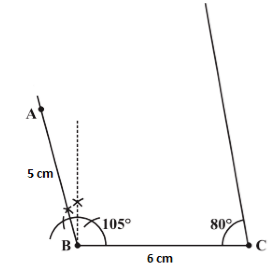
Step 3: Mark the length of CD i.e.,7.5 cm from C to make CD = 7.5 cm.
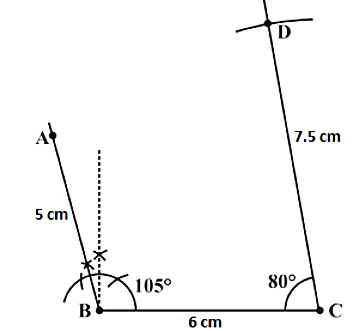
Step 4: Join AD which will complete the quadrilateral ABCD.
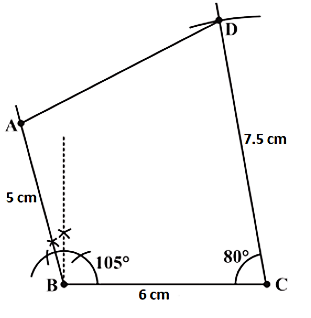
Hence ABCD is the required quadrilateral.
Some Special Cases
There are some special cases in which we can construct the quadrilateral with a smaller number of measurements also.
Example: Construct a square READ with RE = 5.1 cm.
Solution
Given RE = 5.1 cm.
As it is a special quadrilateral called square, we can get more details out of it.
a. All sides of square are equal, so RE = EA = AD = RD = 5.1 cm.
b. All the angles of a square are 90°, so ∠R = ∠E = ∠A = ∠D = 90°
Steps of construction
Step 1: Draw a rough sketch of the square.
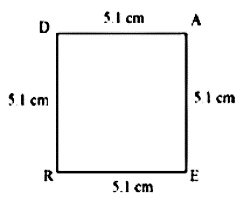
Step 2: To construct a square, draw a line segment RE = 5.1 cm. Then draw the angle of 90° at both ends R and E of the line segment RE.
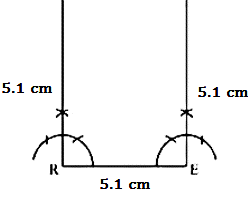
Step 3: As all the sides of the square READ are equal, draw the arc of 5.1 cm from the vertex R and E to cut the lines RD and EA respectively.
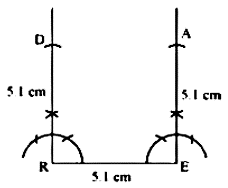
Step 4: Join A and D to make a line segment AD.
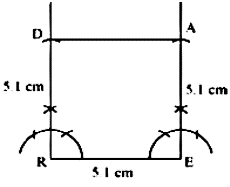
READ is the required square.
Example: Draw a rhombus ABCD having their diagonals of lengths BD = 6 cm and AC = 8 cm.
Solution
Initially, it appears that only two measurements are available, but we know that, in a rhombus diagonals bisect each other at right angle.
Steps of construction
Step 1: First, draw AC = 8 cm.
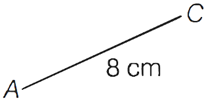
Step 2: Now, construct its perpendicular bisector.
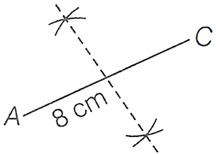
Step 3: Let them meet at 0. Cut-off 3 cm lengths on either side of the drawn bisector. You now get B and D.
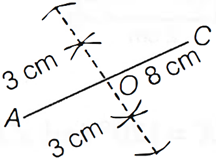
On joining AB, AB, BC and CD, we get the required rhombus.
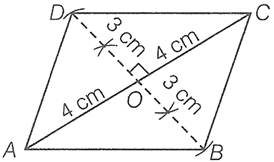
ABCD is the required rhombus.
Online Tuitions & Self-Study Courses for Grade 6 to 12 & JEE / NEET