
Sample Paper 2
Time: 2 hrs Max. Marks : 80
General Instructions
1. The paper is divided into four sections A to D. Each section is compulsory.
2. Questions l to 12 are multiple choice and carry 1 mark each.
3. Questions l3 to 15 are very short answer type and carry 4 mark each.
4. Questions l6 to 21 are short answer type and carry 3 mark each.
5. Questions 22 to 28 are short answer type and carry 4 mark each.
6. Questions 29 to 30 are long answer type and carry 5 mark each.
Q.1. How will you convert the speed given in km/h to m/s?
(a) By multiplying with 
(b) By multiplying with 
(c) By multiplying with 
(d) By multiplying with 
Q.2. A current carrying wire produces
(a) electric field
(b) magnetic field
(c) both electric field and magnetic field
(d) neither electric field nor magnetic field
Q.3. An electric bell works on the principle of
(a) chemical effect of current
(b) heating effect of current
(c) magnetic effect of current
(d) None of these
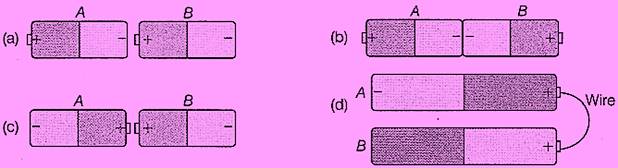
Q.4. The correct way of joining the cells is
Q.5. In which year, it was observed as international year of freshwater?
(a) 2000
(b) 2002
(c) 2003
(d) 2013
Q.6. Which one of the following is a role of forests?
(a) Prevent flood
(b) Prevent soil erosion
(c) Provided food, shelter, water and medicines
(d) All of these
Q.7. Sewage is mainly a
(a) liquid waste
(b) solid waste
(c) gaseous waste
(d) mixture of solid and gaseous waste
Q.8. Cuscuta is an example of
(a) autotroph
(b) parasite
(c) saprotroph
(d) host
Q.9. Which of the following is acidic in nature?
(a) Human blood
(b) Lime juice
(c) Lime water
(d) Antacid
Q.10. The water holding capacity is highest in
(a) clayey soil
(b) sandy soil
(c) loamy soil
(d) mixture of sand and loam
Q.11. Normal range df breathing rate per minute in an average adult person at rest is
(a) 9 – 12
(b) 15 – 18
(c) 21 – 24
(d) 30 - 33
Q.12. The phloem tissue in plants is responsible for the transport of
(a) water
(b) water and minerals
(c) glucose
(d) All of these
Q.13. Fill in the blanks.
(a) No medium is required for transfer of heat by the process of _______ .
(b) The main excretory product in human beings is ________ .
(c) ________ energy is stored by the leaves with the help of chlorophyll.
(d) The combination of two or more cells is called ________ .
Q.14. Correct the following statements by changing one word in each statement.
(a) Tongue is attached to the roof of the mouth cavity at the back.
(b) Formation of manure from leaves is a physical change.
(c) The dependent variable is represented on x-axis.
(d) The polar regions of the earth receive maximum amount of sun's heat.
Q.15. (i) Match the following:
|
Column I |
Column II |
|
(a) Chlorophyll |
(i) Cleaning shaved skin |
|
(b) Carbohydrates |
(ii) Neutralises acidity in stomach |
|
(c) Scouring |
(iii) Compact fluorescent lamp |
|
(d) Antacid |
(iv) Leaf |
|
(e) Sand clock |
(v) Sugar |
|
(f) CFL |
(vi) Compact fluorescent lead |
|
(vii) Regulated flow of sand |
(ii) Find the odd one out.
(a) Stomach, liver, pancreas, salivary gland
(b) Cockroach, grasshopper, snail, ant
Q.16. Why do we get instant energy from glucose?
Q.17. Room heaters have shiny reflectors, why?
Q.18. Describe the process of neutralisation with the help of an example.
Q.19. Formation of clouds is a physical change. Explain.
Q.20. What role is played by the sun in the formation of soil?
Q.21. Show the shape of the distance-time graph for the motion in the following cases.
(a) A car moving with a constant speed.
(b) A car parked on a side road.
Q.22. What is meant by the heating effect of current? Name three appliances based on this effect.
Q.23. Write the precautions to be observed during a thunderstorm, when you are inside your house.
Q.24. Why should oils. and fats not be released in the drain? Explain.
Q.25. (a) Give the name of the respiratory organ of fishes and humans.
(b) How do swimmers breathe inside water?
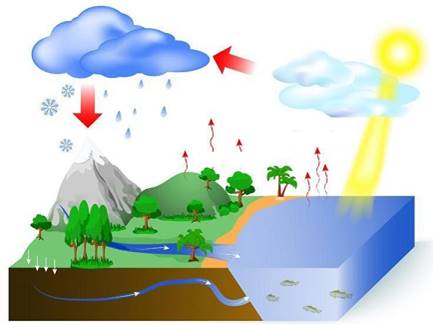
Q.26. Mark the direction on arrows and label the diagram using the following labels.
clouds, rain, atmosphere, carbon dioxide, oxygen, plants, animals, soil.
Q.27. What is the difference between a real image and a virtual image? Give one example of each type of image.
Q.28. What is an electromagnet? Draw a labelled diagram to show how an electromagnet is made?
Q.29. Describe the function of the human heart with the help of labelled diagram.
Q.30. How does the heat travel in water or in gases?
Online Tuitions & Self-Study Courses for Grade 6 to 12 & JEE / NEET