
In a physical change, a substance undergoes changes only in its physical properties such as shape, size, colour and state, and no new substance is formed.
Activity to show that the cutting or tearing of paper is a physical change.Let us take a sheet of paper and cut it into a number of pieces. Now, we cannot join the cut pieces of paper to make the original sheet of paper. But each small piece of paper is still paper, it has not changed into something else.
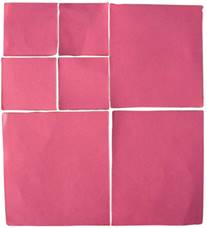
So, during the cutting of a sheet of paper into pieces of paper, only the size and shape of paper has changed but no new substance has been formed. So, cutting of paper is a physical change.
Activity to show that conversion of chalk stick into chalk dust is a physical change.Let us collect the chalk. dust lying on the floor near the blackboard in the classroom or we can crush a small piece of chalk into dust. So, the conversion of chalk stick into chalk dust is a physical change.
Now, we take the chalk dust and add a little water to it to make a thick paste of chalk dust. The thick paste of chalk can be moulded into a chalk stick and then dried. In this way, we can get back the original chalk stick from the chalk dust.
Thus, the physical change from chalk stick to chalk dust is a temporary change. It can be easily reversed by converting chalk dust back into chalk stick.
Activity to show that the melting of ice and freezing of water is a physical changeTake some ice in a glass or beaker. Melt the small portion of ice by placing the tumbler in the sun. We will see that ice melts to form water.

Though, ice and water look different, they both are made up of water molecules. It means that no new substance is formed during the melting of ice. So, it is a physical change.
Let us keep the beaker containing water in the freezer compartment of a refrigerator. After a few hours, the water kept in the freezer of a refrigerator gets cooled too much, freezes to form ice.
Only a change in state (from liquid to solid) takes place during the freezing of water to form ice but no new substance is formed. So, the freezing of water to form ice is a physical change.
Activity to show that the boiling of water and condensation of steam is a physical change.Take some water in a hard glass beaker and heat it by using a burner till it starts boiling. When the water starts boiling, we can see the steam rising from the surface of hot water.
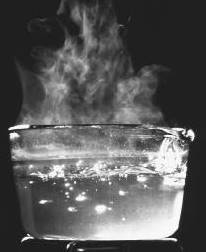
Water is a liquid whereas steam is a gas. So, during the boiling of water, only a change in state from liquid to gas has taken place. Thus, boiling of water to form steam is a physical change.
Hold an inverted frying pan by its handle over the rising steam at some distance above the beaker of boiling water. Now, if we look at the inner surface of the frying pan, we will see drops of water sticking to it.
During the condensation of steam, there is only a change in state from gaseous state to liquid state but no new substance is formed. So, the condensation of steam to form water is a physical change.
Activity to show that the heating of hacksaw blade to the red hot stage is a physical changeTake a used hacksaw blade and hold its one end with a pair of tongs. Keep the other end of hacksaw blade over the flame of a gas burner to heat it. After some time, we will see that the tip of the hacksaw blade gets heated too much and turns red in colour (i.e. becomes red hot). Now, remove the tip of a hacksaw blade from the burner and allow it to cool. On cooling, the tip of the hacksaw blade gets back to its original grey colour.
Now, only a temporary change in colour of hacksaw blade takes place during heating, no new substance is formed. So, the heating of hacksaw blade to the red hot stage is a physical change.
Characteristics of Physical ChangesThe physical changes are temporary changes which can be easily reversed to form the original substance. In such a change, no new substance is formed.
Important characteristics of physical changes are as follows:
(i) No new substance is formed in this change.
(ii) It is a temporary change and is generally reversible.
(iii) A temporary change in colour may take place.
(iv) Very little energy (heat, etc.) is either absorbed or evolved.
Chemical ChangesChemical changes are also called chemical reactions. A chemical change occurs when two substances react chemically to form new substance with different chemical properties. All the new substances which we use in various fields of our life are produced as a result of chemical changes (or chemical reactions).
A change with which we are quite familiar is the rusting of iron. Almost every iron (or steel) object kept in the open gets rusted slowly. It acquires a coating of brownish substance called rust and the process is called rusting. We can usually see iron gates of parks or farmlands, iron benches kept in lawns and gardens, almost every article of iron, kept in the open gets rusted. The agricultural tools such as spades and shovels, also get rusted when exposed to the atmosphere for some time. In the kitchen, a wet iron pan (tawa) often gets rusted if left in that state for some time.
Rust is not iron. It is different from iron on which it gets deposited.
Activity to prepare magnesium hydroxide in the laboratory.Take a small piece of a thin strip of magnesium ribbon. Clean the surface of a magnesium ribbon with a sand paper. Hold the magnesium ribbon at one end with a pair of tongs and bring its other end over the flame of a burner (as shown in the figure). The magnesium ribbon starts burning with a brilliant white light.
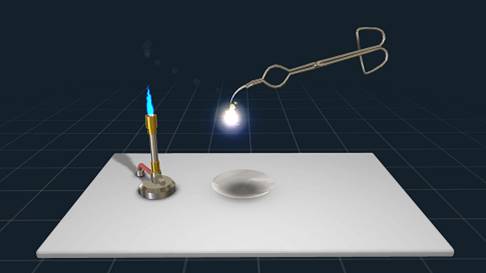
It is the magnesium oxide compound which appears as a white powdery ash. So, magnesium oxide (ash) is different from magnesium ribbon.
The change can be represented by the following equation:
Magnesium (Mg) + Oxygen (O2) → Magnesium oxide (MgO)
Now, collect the ash and mix it with a small amount of water. Stir the mixture carefully with a glass rod to obtain aqueous solution of magnesium oxide. Test the mixture with blue and red litmus papers as follows:
(i) Take a strip of blue litmus paper and put a drop of magnesium oxide solution on it. The blue colour of litmus paper does not turn to red showing· that magnesium oxide is not acidic in nature.
(ii) Now, take a strip of red litmus paper and put a drop of magnesium oxide solution on it. The red litmus paper turns blue showing that magnesium oxide solution is basic in nature.
Thus, on dissolving magnesium oxide in water, it forms a new substance. This change can be written in the form of the following equation:
Magnesium oxide(MgO) + Water (H2O) → Magnesium hydroxide [Mg(OH)2]
The new substance, magnesium hydroxide formed during this change is a base which turns red litmus paper to blue.
Therefore, the burning of magnesium ribbon is a chemical change because a new substance, magnesium oxide is formed during this change. The dissolving of magnesium oxide in water is also a chemical change because a new substance, magnesium hydroxide is produced during this change.
Activity to study the reaction between copper sulphate and iron.Dissolve about a teaspoonful of copper sulphate (blue vitriol) in about half a cup of water in a glass tumbler or a beaker. Add a few drops of dilute sulphuric acid to obtain a clear solution. This will give us a blue coloured copper sulphate solution. Save a small sample of the solution in a test tube or a small glass bottle.
Drop a nail or a used shaving blade into the remaining solution. Keep the beaker for half an hour. We will see the colour of the solution and compare it with the colour of the solution saved separately.
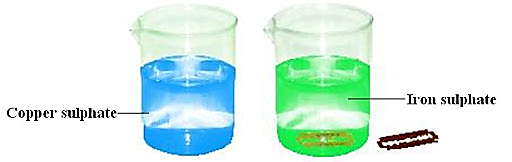
We will see that the blue colour of copper sulphate solution fades gradually and ultimately changes to light green colour and a brown deposit is formed on the iron blade. We can take out the iron blade from the beaker to see the brown deposit on it clearly.
These changes are due to the chemical reaction between- copper sulphate solution and iron blade which produces two new substances, i.e. iron sulphate and copper. The green colour of the solution is due to iron sulphate and brown deposit on the iron blade is due to copper. We can write the reaction as
Copper sulphate solution + Iron → Iron sulphate solution + Copper
(Blue) (Green) (Brown deposit)
Activity to study the reaction between baking soda and vinegar.Take about a teaspoonful of vinegar in a glass or test tube. Add a pinch of baking soda to it. We will hear a hissing sound and see the bubbles of carbon dioxide gas coming out and rising in the glass (as in figure).
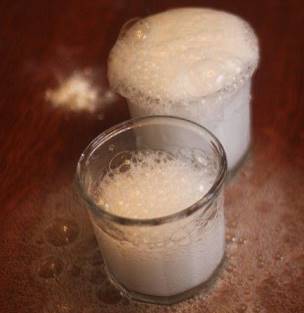
When baking soda (sodium hydrogen carbonate) and vinegar (acetic acid) are mixed together, then a chemical change, takes place between sodium hydrogen carbonate and acetic acid to form three new substances.
The change in the test tube is as follows:
Sodium hydrogen carbonate + Acetic acid → Sodium acetate + Carbon dioxide + Water
Carbon dioxide gas produced in the reaction is passed through freshly prepared lime water as shown in figure.
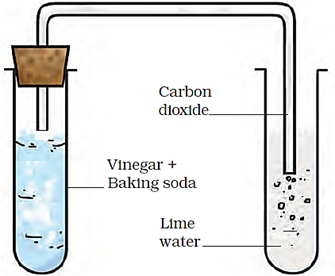
Lime water is calcium hydroxide solution. When carbon dioxide gas is passed through lime water, then calcium hydroxide combines with carbon dioxide to form a white solid substance, calcium carbonate which makes lime water milky. This chemical change can be written in the form of word equation as follows:
Calcium hydroxide + Carbon dioxide → Calcium carbonate + Water
Ca(OH)2 CO2 CaCO3 H2O
(Lime water) (Makes lime water milky)
The reaction between lime water and carbon dioxide gas is a chemical change because a new substance calcium carbonate is formed during this change. The turning of lime water into milky is a standard test of carbon dioxide.
When baking soda (NaHCO3) reacts with vinegar which contains acetic acid carbon dioxide comes out, which turns lime water milky, therefore it is a chemical change. In all these activities, we saw that in each change, one or more new substances are formed. When magnesium ribbon was burnt, the ash was the new substance formed.
The reaction of copper sulphate with iron produced two new substances, i.e. iron sulphate and copper. Vinegar and baking soda together produced carbon dioxide which turned lime water milky. So, all those changes in which one or more new substances formed, are called chemical changes. These are permanent changes which can usually not be reversed to form the original substance.
In addition to new products, the following may accompany a chemical change:
(i) Heat, light or any other radiation (e.g. ultraviolet) may be given off or absorbed.
(ii) Sound may be produced.
(iii) A change in smell may take place or a new smell may be given off.
(iv) A colour change may take place.
(v) A gas may be formed.
Chemical Changes in Our Daily LifeChemical changes are very important in our lives. Indeed, every new material is discovered by studying chemical changes. e.g. If a metal is to be extracted from an ore such as iron from an iron ore, we need to carry out a series of chemical changes. A medicine is the end product of a chain of chemical reactions. Important and useful new materials such as plastics and detergents are produced by chemical reactions.
Burning of coal, wood or leaves is also a chemical change. Infact, burning of any substance is a chemical change. Burning is always accompanied in the production of heat and light.
(i) Explosion of a firework (or crackers) is also a chemical change which produces heat, light, sound and unpleasant gases that pollute the atmosphere.
(ii) When food gets spoiled, it produces a foul smell. This shows that new substances have been formed in the spoiled food which have foul smell. So, the spoilage of food is a chemical change.
(iii) If we cut an apple into slices and kept in the open for some time, we will find that the cut surface of apple acquires a brown colour. This change in colour is due to the formation of new substance by the action of oxygen (or air). So, this change in colour is a chemical change.
(iv) Similarly, the cut surface of potato or brinjal turns black on keeping in air for some time due to the chemical change.
(v) When an acid reacts with a base, then a neutralisation reaction takes place in which two new substances, salt and water, are formed. So, neutralisation is a chemical change.
(vi) During photosynthesis, the plants intake carbon dioxide and water in the presence of chlorophyll and sunlight to form two new substances, glucose (food) and oxygen. So, photosynthesis is a chemical change.
(vii) In the process of digestion, the various food materials break down to form new substances which can be absorbed by the body, so the process of digestion is a chemical change.
Rusting of IronWhen an iron object is left exposed to moist air, it chemically reacts with oxygen and water in the air to form a red brown flaky substance called rust. The process of rusting can be represented by the following equation:
Iron + Oxygen (From air) + Water → Rust (Iron oxide)
(Fe) (O2) (H2O) (Fe2O3)
Rusting occurs in the presence of both oxygen and water. The more humid the air, faster the rusting occurs. The rust slowly eats away or corrodes the iron, leading to considerable loss. Since, iron is used in making bridges, ships, cars, truck bodies and many other articles, the monetary loss due to the rusting is huge.
Preventions of RustingRusting can be prevented by not allowing the iron to come in contact with moisture and air. The simplest method is to coat the iron with oil, grease or paint. These coats should be applied regularly to prevent rusting.
A more efficient method is to coat the iron with another metal such as zinc or chromium. The process of depositing a layer of zinc on iron is called galvanisation. The iron pipes we use in our homes to carry water are galvanized to prevent rusting.
Rusting of ships is a major problem in the shipping industry as the body of a ship is always in contact with water and the air around it is also very humid. The salt in water speeds up the process of rusting. This leads to huge monetary loss to the shipping industry. Rusting of iron can be prevented by alloying it to make stainless steel. Stainless steel is made by mixing iron with carbon and metals like chromium, nickel and manganese. It does not rust.
A Protective ShieldThere is a layer of ozone gas high up in the atmosphere. It protects us from the harmful ultraviolet radiations which come from the sun. Ozone absorbs this radiation and breaks down to oxygen.
Oxygen is different from ozone. In this way, ozone layer prevents them from reaching the earth.
The breaking down of ozone into oxygen is a chemical change. If ultraviolet radiations were not absorbed by ozone layer, they would reach the earth's surface and cause harm to us and other living things.
CrystallisationSea water contains salts dissolved in it which makes it salty. Salt can be obtained from sea water by the process of evaporation. The salt obtained in this manner is not pure and its crystals are small.
The shape of the crystals cannot be seen clearly. Large crystals of pure substances can, however, be obtained from their solutions by the process of crystallisation. It is an example of a physical change. The process of cooling a hot concentrated solution of a substance to obtain crystals is called crystallisation. The process of crystallisation is used to obtain crystals of a pure solid substance from the impure solid substance.
Impure copper sulphate powder can be purified by the process of crystallisation to obtain large crystals of pure copper sulphate.
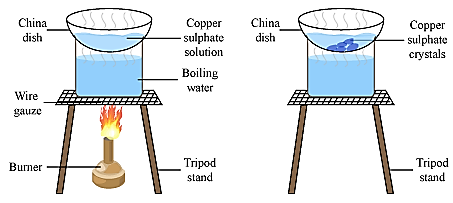
Activity to obtain pure copper sulphate crystals from an impure sample.Take a cup full of water in a beaker and add a few drops of dilute sulphuric acid. Heat the water. When it starts boiling, add copper sulphate powder slowly. Continue to add copper sulphate powder till no more powder can be dissolved. During this process, continuously stir the solution. Filter the solution, leave it for cooling. Look it after some time, we can see the crystals of copper sulphate.
Online Tuitions and Self-Study Courses for Grade 6 to 12 & JEE / NEET