
Chapter 2 – Nutrition in Animals
Chapter Notes
Animals are heterotrophs. They feed on other living organisms like plants and other animals. They can be broadly classified as herbivores, carnivores and omnivores based on their feeding habits.
Herbivores eat plants and therefore depend directly on plants for their food.
Carnivores eat herbivores and so are indirectly dependent on plants.
Omnivores eat both plants and animals.
Saprophytes are organisms that feed on dead organic matter.
Nutrition in Humans
Nutrition is the process by which nutrients from food are absorbed and processed by the body to grow, to reproduce and to maintain good health.
In humans, the mode of nutrition is called holozoic (feeding on complex organic matter).
Most of the food that is eaten by humans is in insoluble form. Therefore, this food has to be first broken down and converted into simple soluble forms. This process is carried out by the digestive system.
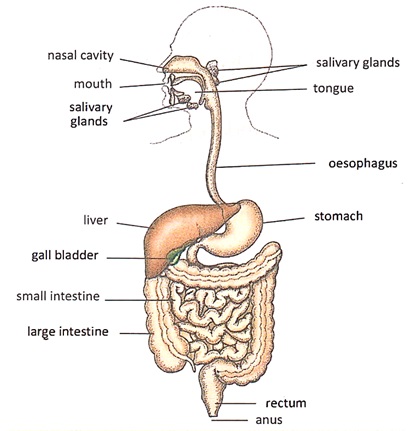
The digestive system of the human body consists of a series of organs:
Mouth
Oesophagus
Stomach
Small Intestine
Large Intestine
Rectum and
Anus.
These organs together form the long tubular alimentary canal through which the food we eat passes.
The salivary glands, pancreas and the liver are the digestive glands that secrete digestive juices into the alimentary canal.
Human Digestive System
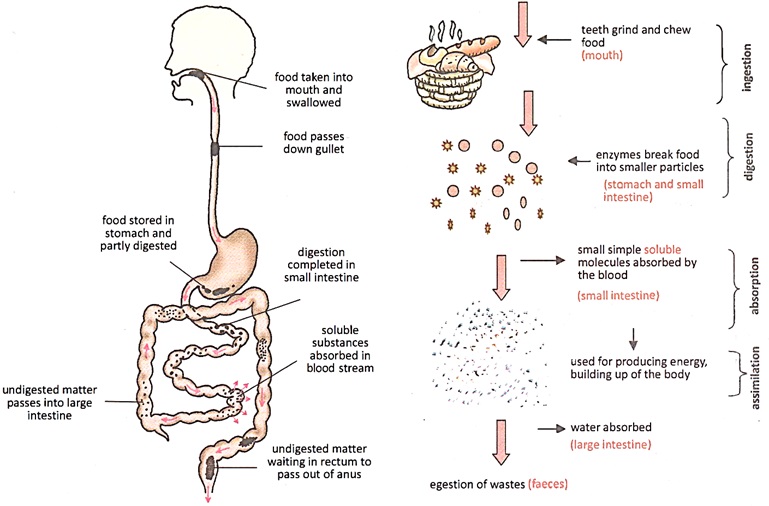
The processes involved in nutrition are:
Ingestion
Digestion
Absorption
Assimilation and
Egestion.
Ingestion
Ingestion is the actual taking in of food from the external environment.
We ingest food through our mouth.
The mouth is situated at the beginning of the alimentary canal.
The mouth is also used for other functions like talking.
Tongue
The tongue is a muscular organ that helps you taste food. It has taste buds to help you differentiate between sweet, salty, sour and bitter foods.
Teeth
The teeth present in the mouth help in biting and chewing different types of food.
While eating, the teeth cut and grind food to break it down into smaller particles.
The teeth are coated with enamel which is the hardest substance in the body.
Beneath this is the dentine, which is softer than enamel.
Teeth are of four types: incisors, canines, premolars and molars.
• Incisors are found in the front of the mouth. They are chisel-shaped and mainly used for biting and cutting.
• Canines are pointed and used for piercing and tearing food.
• Premolars have a flattened surface and are used for grinding food into small pieces.
• Molars are like premolars but are larger. They are used to grind food.
Milk teeth and Permanent teeth
Humans have milk teeth during childhood.
Milk teeth begin to appear when the child is just a few months old.
There are 20 milk teeth (10 in each jaw, consisting of 4 incisors, 2 canines and 4 molars).
From the age of five, the roots of the milk teeth gradually loosen, and the teeth fall off.
They are replaced by the larger permanent teeth.
This permanent set consists of 32 teeth, (16 in each jaw).
On each side of the jaw (counting from the midline of the jaw) there are 2 incisors, 1 canine, 2 premolars and 3 molars.
The upper molars generally have three roots, and the lower molars have two roots. All the other teeth have one root.
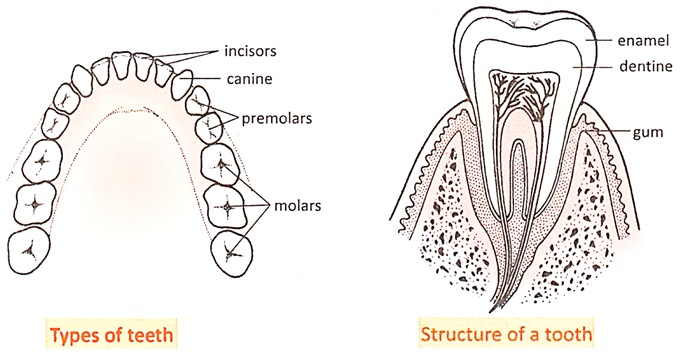
Enamel: The hard substance which covers and protects the other parts of the tooth.
Molars: Teeth with a broad crown located behind the premolars.
Premolars: Teeth which are located between canine and molars.
Taking care of teeth
Teeth are a very important part of our body.
With proper care, our set of teeth can last a lifetime.
If not cared for properly; several problems may occur including tooth decay; cavities and destruction of the tooth enamel.
Tooth decay is caused by bacteria present in the mouth.
These bacteria act on small bits of food left in the mouth after a meal to form a soft sticky tissue called plaque, which sticks to our teeth and gums.
These bacteria in the mouth also change sugar into acids which destroy the tooth enamel.
Plaque and increased acids in the mouth results in tooth decay and sometimes gum problems.
Bacteria get into the space between the teeth and damage the fibres which hold the teeth in place. This loosens the teeth which may result in it falling out.
We can reduce both tooth decay and occurrence of gum diseases by:
• reducing the intake of sweets, sugary foods and aerated drinks such as colas
• brushing our teeth regularly and after every meal
• changing our toothbrush when the bristles become soft
• not sharing our toothbrush with anyone
• using fluoride toothpaste as it not only helps to strengthen the enamel but also to resist the effect of acids released by bacteria.
• visiting a dentist regularly once in every six months to get the teeth and gums examined.
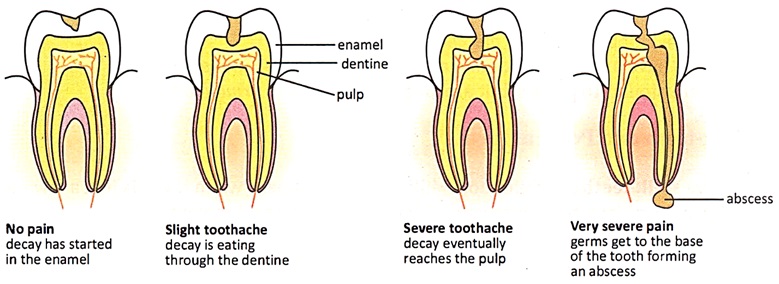
The process of tooth decay
Digestion
To be of any value to the body, the food taken in through the mouth must enter the blood and be distributed to the different parts of the body.
Digestion is the breaking down of food into simpler soluble compounds by enzymes, which are manufactured by various cells of the digestive system.
During this process, large insoluble pieces of food are broken down into soluble substances which are small enough to be absorbed through the walls of the intestine and into the blood stream. This involves both physical and chemical actions.
The physical actions involve:
• chewing to break the solid food into smaller pieces
• churning by the stomach to help mix the food with the digestive juices
The chemical actions involve the use of enzymes (digestive juices) to break down:
• carbohydrates to simple sugars
• fats to fatty acids and glycerol
• proteins to amino acids
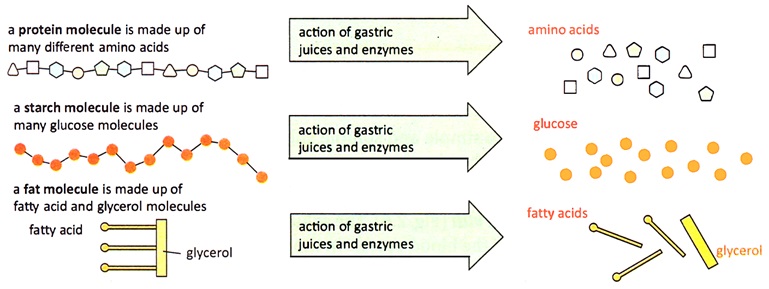
Action of gastric juices and enzymes on carbohydrates, fats and proteins.
Carbohydrates: Organic compounds (starch and sugar) that have carbon, hydrogen and oxygen in the ratio of 1 : 2 : 1.
Digestion in the mouth
Digestion starts as soon as food is put in the mouth.
The food is chewed and mixed with saliva.
The process of chewing food, during which it is mixed with saliva, is known as mastication.
• Saliva is a digestive juice made by the salivary glands in the mouth. It moistens the food, making it easier to swallow. It also converts starch into sugar.
• The tongue helps to mix food with saliva. It aids chewing and swallowing of food. The tongue also rolls the food into a bolus which is easy to swallow. The bolus is pushed down the gullet or oesophagus (food pipe).
While swallowing, a flap called the epiglottis prevents the food from entering the lungs and choking.
It takes about six seconds for solid food to reach the stomach after it is swallowed.
Liquids travel down the oesophagus more rapidly than solids.
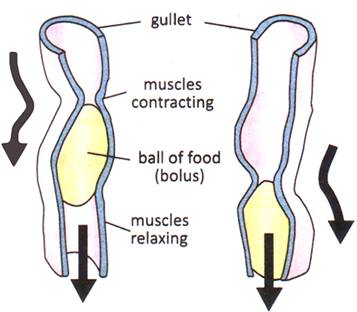
The walls throughout the alimentary canal push the food in a wave-like action called peristalsis.
Peristalsis
Peristalsis: The pushing of food through the walls of the alimentary canal in a wave-like action.
Digestion in the stomach
Although digestion starts in the mouth, most of our food is digested in the stomach and the intestines.
• The enzymes present in the digestive juices start the digestion of proteins into amino acids.
• The hydrochloric acid in the stomach kills germs and helps the enzymes to work.
Gentle movements of the stomach wall churn the food along with the digestive juices, to convert it into a semi-solid substance called chyme.
Then, the food is passed through into the small intestine at intervals.
Digestion in the small intestine
The greater part of digestion takes place in the small intestine which is about 7.5 metres long.
The food is mixed well with enzymes produced in the walls of the small intestines, bile from the liver and pancreatic juice from the pancreas.
• Bile breaks down fat into tiny droplets which can be easily acted on by enzymes.
• Enzymes break down fats into fatty acids and glycerol.
• Pancreatic juice breaks down starch into simple sugars, and proteins into amino acids.
Absorption
Absorption is the uptake of the soluble digested food into the blood stream of the animal.
The food which has now been reduced to simple and soluble substance is absorbed from the small intestine into the blood.
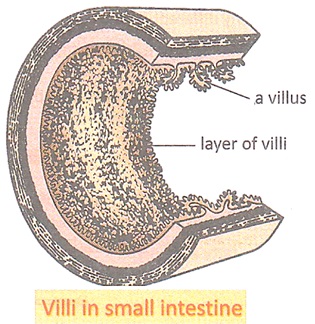
The absorption of food occurs through millions of small projections in the inner walls of the small intestine known as villi.
The soluble food enters the blood through the thin walls of the blood vessels in the villi.
Assimilation
Assimilation is the final stage when the digested food is used up by the body as fuel.
The soluble food absorbed into the blood stream is used to produce energy and provide materials for growth and repair.
• Glucose provides energy.
• Fatty acids and glycerol act as energy reserves. They are stored under the skin.
• Amino acids are used to repair the damaged parts of the body, in the formation of proteins, enzymes and hormones, and for growth.
Egestion
Egestion is the process by which the body gets rid of the undigested solid parts of the food.
Some substances cannot be digested by humans. This undigested food reaches the large intestine where water is absorbed from it, making it semi-solid.
This is known as faeces. It is stored in the lower part of the large intestine (rectum) and is sent out of the body through the anus by a process called de cation.
The large intestine is thicker, but smaller in length (about 1.5 metre) than the small intestine.
Bile: A greenish yellow fluid secreted by the liver that emulsifies fats and is stored in the gall bladder.
Faeces: The waste product from an animal or human digestive tract expelled through the anus.
Nutrition in Ruminants
Animals like goats, cows, sheep and bison eat grass, leaves and hay. But they cannot digest this plant material directly because they do not have the required enzymes to break down the cellulose found in the cell walls. However, they have a very special way of digesting their food.
These animals have four stomachs. The food is chewed and swallowed quickly. It passes into the first stomach called the rumen. Here microorganisms help to break down the food.
This partially digested food is called cud. After some time, the cud stored in the rumen is sent back in small amounts to the mouth to be chewed further. This process is called rumination or chewing the cud. These animals are therefore called ruminants.
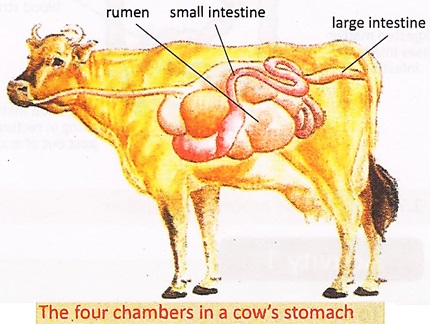
The chewed food is then swallowed and sent to the remaining chambers of the stomach to be acted upon by digestive enzymes and broken down into even smaller pieces. The food then travels through the small and the large intestines where the water and nutrients are absorbed, and the undigested part is sent out of the body as waste.
Nutrition in Amoeba
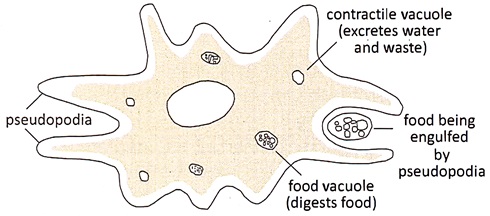
Amoeba feeds on bacteria, microscopic algae and small unicellular organisms.
The amoeba surrounds its food with its false feet or pseudopodia. It then forms a food vacuole around its food and digests it. Wastes and excess water are transported outside the cell by the contractile vacuoles.
Many animals have mouthparts that are suitable to catch their prey or to procure food. Frogs use their long tongues to catch prey. Butterflies and houseflies have long sucking tubes called proboscis to suck their food.
Paramecia use hair-like projections on their body called cilia to sweep food into a mouth-like structure. Hydras use their tentacles to take in food.
Online Tuitions & Self-Study Courses for Grade 6 to 12 & JEE / NEET