
Class 7 Science
Chapter 2 – Nutrition in Animals
Important Questions Answers – Set 3
Q.1. During digestion, fats are changed into
(a) amino acids
(b) fatty acids and glycerol
(c) sugar
(d) glucose
Ans: (b) fatty acids and glycerol
During digestion, fats are converted to fatty acids and glycerol.
Q.2. Bile is produced in the
(a) stomach
(b) small intestine
(c) pancreas
(d) liver
Ans: (d) Liver
Bile is a digestive juice which is produced in the liver.
Q.3. The teeth that are used for biting an apple are
(a) incisors
(b) canines
(c) pre-molars
(d) molars
Ans: (a) incisors
Incisors are the front teeth that are used to bite the food. Hence, we use incisors to bite an apple.
Q.4. What kind of teeth do you think are especially developed in carnivores?
(a) incisors
(b) canines
(c) pre-molars
(d) molars
Ans: (b) canines
Carnivores have specially developed canines which help them to tear the meat.
Q.5. Which of these is not a part of nutrition?
(a) digestion
(b) absorption
(c) egestion
(d) excretion
Ans: (d) excretion
Ingestion, digestion, absorption, assimilation and egestion are the five steps of nutrition. Excretion is not a part of nutrition.
Q.6. The pointed teeth in your mouth are
(a) permolars
(b) incisors
(c) molars
(d) canines
Ans: (d) canines
The pointed teeth in our mouth are called canines. They help us in piercing and tearing the food.
Q.7. The last part of digestion of food takes place in the
(a) stomach
(b) small intestine
(c) large intestine
(d) oesophagus
Ans: (b) small intestine
The last step of digestion of food takes place in the small intestine.
Q.8. Which of the following organs does not secrete digestive juices?
(a) stomach
(b) small intestine
(c) liver
(d) oesophagus
Ans: (d) oesophagus
Oesophagus does not secrete any digestive juice. The stomach, small intestine and liver secrete digestive juices.
Q.9. The greatest amount of digestion of food in humans takes place in the
(a) mouth
(b) stomach
(c) small intestine
(d) large intestine
Ans: (c) small intestine
Mostly, the digestion of food takes place in our small intestine.
Q.10. Breaking down of food into simple soluble compounds is called
(a) ingestion
(b) digestion
(c) nutrition
(d) egestion
Ans: (b) digestion
Through the process of digestion, food is broken down into simple soluble compounds.
Q.11. The function of the villi is to hold the food in the spaces between them so that food can be absorbed by the walls of the intestine. True or false?
Ans: True. Villi are finger-like projections that hold the food in the spaces between them so that the food can be easily absorbed by the walls of the intestine.
Q.12. Digestion begins in the stomach. True of false?
Ans: It is a false statement, as the digestion of food begins in the mouth.
Q.13. Saliva helps by making the food wet. It does not have any other function. True or false?
Ans: False, saliva not just makes the food wet but also breaks down the starch into sugar which is easier to digest.
Q.14. The semi-digested food that is chewed again by ruminants is called __________
Ans: The semi-digested food that is chewed again by ruminants is called cud.
Q.15. The white hard substance that covers the teeth is called ___________
Ans: The white hard substance that covers the teeth is called enamel.
Q.16. Digestion is the process of breaking down of food into simple, _________ form.
Ans: Digestion is the process of breaking down food into simple soluble form.
Q.17. Why does food need to be digested?
Ans: The food needs to be digested so that it can be converted into simple soluble forms. These simple soluble forms can provide energy to the body.
Q.18. Digestion of food in all animals occurs inside the body. Do you agree? Justify your answer.
Ans: No, digestion does not occur inside the body in all organisms. Certain animals such as spiders inject their digestive juices in the body of their prey. These juices digest the different body parts of the insect and it is then consumed by spider. This process is called external digestion. Thus, all animals do not show digestion inside their bodies.
Q.19. Name two animals that live on liquid food only.
Ans: Animals that live only on liquid food include housefly and mosquito.
Q.20. In which two organs does digestion of food in humans mainly occur?
Ans: Most of the digestion in humans occur in stomach and small intestine. The stomach performs digestion by peristalsis and with the help of digestive juices. Small intestine, on the other hand, digests food primarily with the help of digestive juices.
Q.21. Absorption of digested food occurs in the stomach. Do you agree? Justify your answer.
Ans: No, the absorption of food does not occur in the stomach. The food that has been digested in the stomach is further digested into absorptive form in the small intestine. The completely digested food is absorbed by the inner lining (villi) of the small intestine.
Q.22. All digestive juices are secreted by cells in the stomach and small intestine. Do you agree? Give reasons.
Ans: No, all digestive juices are not secreted by the cells of small intestine and stomach. Certain organs such as liver and pancreas also secrete digestive juices. The liver secretes bile juice which is used for the digestion of fats. Pancreas, on the other hand, produces pancreatic juice which digests starch and proteins into their simpler constituents.
Q.23. What happens to food after it is digested, and absorbed by the blood?
Ans: The food that has been digested and absorbed is assimilated by the body. The absorbed food is transported by the blood to different parts of the body. This absorbed food is used by the cell for growth, reproduction and obtaining energy. Some of the absorbed food is also stored for future use.
Q.24. In what way is the basic structure of the stomach of a cow different from the stomach of a human?
Ans: The stomach of cows is composed of four chambers unlike human stomach which has a single chamber. The food in cows is firstly introduced in the first chamber of the stomach called rumen. In rumen, partial digestion of food occurs and the partially digested food is called cud. Thereafter, it is passed to the second chamber, from where it is reintroduced into the mouth for proper chewing. Followed by proper chewing, the remaining chambers of the stomach carry out complete digestion of food.
Q.25. What is the name given to the process by which absorbed nutrients are utilized by the body?
Ans: Assimilation is the process through which absorbed nutrients are utilized by the body.
Q.26. Name the cavity in unicellular animals in which food in present.
Ans: In unicellular animals, food is present in the cavity called food vacuole.
Q.27. Where does initial digestion of proteins take place?
Ans: The initial digestion of proteins takes place in the stomach.
Q.28. In which part of the digestive system is water absorbed from undigested food?
Ans: Most of the water from the undigested food is absorbed in the large intestine.
Q.29. How does a frog catch its prey?
Ans: A frog catches its prey using its long and sticky tongue.
Q.30. How does a spider digest its food?
Ans: A spider injects digestive juices into the body of its prey, which digest their body parts. Thus, a spider digests its food.
Q.31. Name the organs that make up the human alimentary canal.
Ans: Organs that make up the human alimentary canal are mouth, pharynx, oesophagus, stomach, small intestine, large intestine and anus.
Q.32. What is the difference between milk teeth and permanent teeth?
Ans:
|
Milk teeth |
Permanent teeth |
|
Milk teeth are twenty in number. |
Permanent teeth are 32 in number. |
|
Milk teeth start falling out by the age of 6 years. |
Permanent teeth do not fall throughout the life until there is any deficiency. |
Q.33. What is saliva and where is it produced?
Ans: Saliva is the watery and slippery secretion produced inside the mouth.
Q.34. What is the function of taste buds?
Ans: The function of taste buds is to detect the various tastes like sweetness, saltiness, sourness and bitterness of food.
Q.35. How long does food stay in the stomach?
Ans: Food can stay in the stomach from a few minutes to a few hours, depending on its type. Solid food stays in the stomach for 4-5 hours, but liquid food remains only for a few minutes.
Q.36. How does the presence of acid in the stomach help?
Ans: The acid in the stomach helps in digesting proteins. It also kills the bacteria that enter the stomach through food.
Q.37. List and explain in one sentence each, the various process involved in nutrition in animals.
Ans: The various process involved in obtaining nutrition in animals are as follows:-
1) Ingestion- The process of taking food inside our mouth is known as ingestion.
2) Digestion- The process of breaking down food into molecules is known as digestion.
3) Absorption- The process of absorbing the digested food through the villi of small intestine is known as absorption.
4) Assimilation- The process of producing energy from the absorbed food is known as assimilation.
5) Egestion- The process of removing the wastes from our body through the anus is known as egestion.
Q.38. Explain the ingestion of food in amoeba through diagram.
Ans:
Ingestion of food in Amoeba:
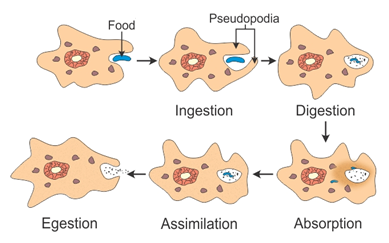
1. Ingestion: Amoeba ingests the food by encircling it by forming pseudopodia. When the food is completely encircled , the food is engulfed in the form of a bag called food vacuole.
2. Digestion: In amoeba, digestive enzymes react on the food present in the food vacuole and break it down into simple and soluble molecules.
3. Absorption: The food digested by digestive enzymes is then absorbed in the cytoplasm by the process of diffusion. The undigested food remains in the food vacuole. If a large amount of food is absorbed by amoeba, the excess food is stored in the cytoplasm in the form of glycogen and lipids.
4. Assimilation: The food absorbed by the cytoplasm is used to obtain energy, growth and repair. This process of utilizing absorbed food for obtaining energy, repair and growth is called assimilation.
5. Egestion: The undigested food left in the food vacuole is thrown out of the body by rupturing cell membrane. This process of removal of undigested food from the body is called egestion.
Q.39. Name the four types of teeth in human mouth. What are their functions?
Ans: The four types of teeth in our mouth are:
1) Incisors- They help us in biting and cutting the food.
2) Canines- They help us in piercing and tearing the pieces of meat.
3) Premolars- They assist the molars by holding the food with their cusps and also crushing them.
4) Molars- They help us in chewing and grinding the food so that it can be swallowed easily.
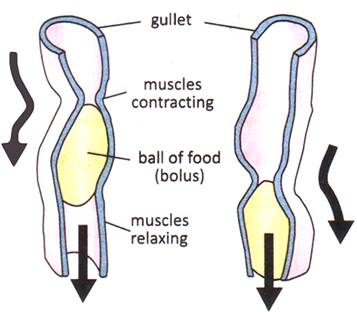
Q.40. What is peristalsis? Explain with the help of a diagram.
Ans: Peristalsis can be defined as the wave like action of the muscles of the organs present in the alimentary canal to push the food forward or downward.
Q.41. What is the function of
(a) saliva
(b) bile juice
(c) pancreatic juice
Ans:
(a) Saliva- It helps in breaking down the starch, present in food, into sugar. It also makes the food wet and slippery, thereby making it easier to swallow.
(b) Bile juice- It is secreted by the liver and helps in breaking down the fats, present in the food, into fatty acid and glycerol.
(c) Pancreatic juice- It is secreted by the pancreas and helps in converting starch into sugar and proteins into amino acids.
Q.42. Which food do you think will take a longer time to get digested−sugar or beans (beans contain lot of proteins)?
Ans: As compared to sugar, beans will take longer time for digestion, as they contain a lot of proteins. The digestion of sugar starts in the mouth, while the digestion of proteins starts in the stomach. So, the proteins of the beans will take longer time to get digested.
Q.43. Digestion needs the help of two more systems in the body to provide energy from food.
Which are these systems and how do they help?
Ans: Two more systems which help the digestive system to provide energy to our body are the respiratory system and the cardiovascular system. The glucose absorbed in the digestive system combines with the oxygen, taken in during respiration, to form energy. These two are then transported throughout the body via blood of the cardiovascular system.
Q.44. If you eat food while hanging upside down, do you think it will still go through the alimentary canal? Give reasons.
Ans: Yes. Even if we eat food while hanging upside down, it will go through the alimentary canal because of the process of peristalsis. The muscles of the oesophagus will push the food downwards in a wave like action throughout the alimentary canal.
Q.45. We can see many overweight people but very few overweight animals. Why do you think this is so?
Ans: The main reason of getting overweight is the over consumption of nutritious food (rich in fat). We humans have this tendency of gorging on such fat rich foods which lead to weight gain. However most of the animals do not consume such fat rich food and have very little chances of getting overweight.
Q.46. Tinto loves to eat junk food. He is overweight. His friend Ayesha is very worried. She constantly advices him to cut down on junk food and eat more fruits and vegetables. Do you think she is right? What value does she show?
Ans: Yes, Ayesha is right in doing so. Junk food is not good for heath as it leads to obesity. Obesity is one of the major cause for diseases like diabetes, hypertension etc.
Ayesha's friend is already obese and needs to lose weight to live a healthy life. Replacing these junk foods with fruits and vegetables will help him to reduce weight and also lead a healthy lifestyle.
Q.47. What happens to food in the stomach?
Ans: Stomach secretes acid and digestive juices that kill the bacteria, if any, present in the food. Further, the digestive juices break the proteins, present in the food, into simpler substances, thereby digesting the food partially.
Q.48. What happens to food in the small intestine?
Ans: Small intestine secretes some digestive juices, and also receives the bile juice secreted by the liver and the pancreatic juice secreted by the pancreas. The bile juice along with the digestive juice converts the fats into fatty acids and glycerol. The pancreatic juice breaks down the starch into sugar, and proteins into amino acid.
Q.49. Explain how digested food is absorbed into the blood.
Ans: The digested food is absorbed inside the small intestine which have finger like projections called villi in its inner wall. These villi comprise networks of fine blood capillaries close to their surface. The food from the villi passes into these capillaries thereby getting absorbed into the blood.
Q.50. Briefly explain the process of digestion in ruminants.
Ans: The stomach of a ruminant is divided into four chambers. As soon as the ruminant swallows the food, it enters the first chamber called rumen where it gets partially digested (converted to cud). From here, the food enters the second chamber from where it again reaches the mouth for rumination, which is thorough chewing. The food is again swallowed, and now it enters the third and the fourth chamber for digestion. From here, it enters the small intestine for the absorption of nutrients.
Online Tuitions & Self-Study Courses for Grade 6 to 12 & JEE / NEET