
· The origin of water is found out to be from a type of meteorite.
· The chemical composition of water in earth is same as that of some meteorites.
· 71% of the earth consists of water, hence earth is also called as blue planet.
· Out of this 71 %, approx. 97% water is in oceans and seas, remaining approx. 3 % is the freshwater in forms of lakes, rivers.
· Out of this 3 % of freshwater, 30% is groundwater(not easily accessible), 69% are in the form glaciers, icebergs.( not accessible), out of the remaining 1% of water only 0.006% is used by the people for their uses.
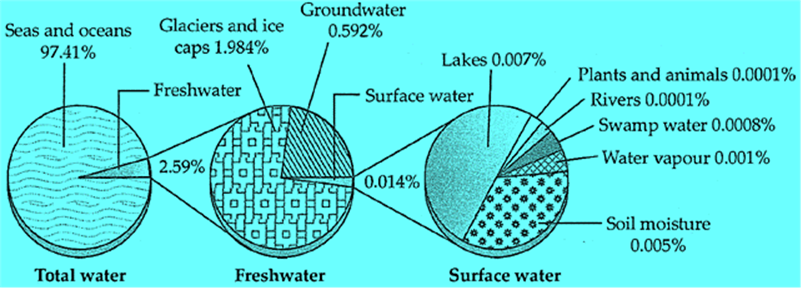
If we consider a bucket of water to be the total amount of water available on the earth, then the amount of freshwater available on the surface of the earth, in all lakes and rivers, is one-quarter of a teaspoon.
Forms (or States) of Water
Water on the earth is found in all the three states - solid, liquid and gas.
(i) In the liquid form, water is present in oceans, seas, rivers, lakes, ponds, etc.
(ii) In the solid form, water is found as ice and snow on high mountains, glaciers and at the poles.
(iii) In the gaseous form, water is present as water vapour in air.
Glaciers
A glacier is a persistent body of dense ice that is constantly moving under its own weight. It is formed when the accumulation of snow exceeds its ablation (melting and sublimation) over many years, often centuries.
Himalayas are a great water resource with a total snow cover of about 16,000 sq km.
There are more than 15,000 glaciers providing water to a number of rivers like Brahmaputra and Ganges.
Glacial ice is the largest reservoir of fresh water on earth. Many glaciers from the temperate, alpine and seasonal polar climates store water as ice during the colder seasons and release it later in the form of meltwater as warmer summer temperatures cause the glacier to melt, creating a water source that is especially important for the use of plants, animals and human beings, when other sources may be scant.
Water Cycle (hydrological cycle)
The water cycle, also known as the hydrologic cycle or the hydrological cycle, describes the continuous movement of water on, above and below the surface of the Earth.
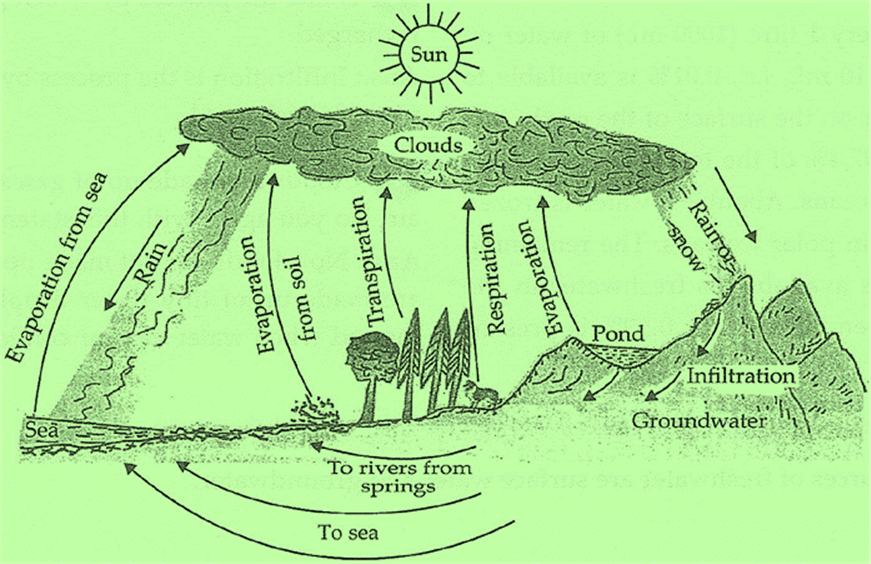
During this process, water changes its state from one phase to another, but the total number of water particles remains the same. In other words, if it were possible to collect and boil 100 g of water, it will still retain a mass of 100 gms as steam. Likewise, if 100 gms of steam is collected and condensed, the resultant water would still weight 100 gms.
Water changes its state through a variety of processes from evaporation, melting and freezing, to sublimation, condensation, and deposition. All these changes require the application of energy.
Stages of Water Cycle
There are many processes involved in the movement of water. Listed below are different stages of the water cycle.
1. Evaporation
The sun is the ultimate source of energy, and it powers most of the evaporation that occurs on earth. Evaporation generally happens when water molecules at the surface of water bodies become excited and rise into the air. These molecules with the highest kinetic energy accumulate into water vapour clouds. Evaporation usually takes place below the boiling point of water. Another process called evapotranspiration occurs when evaporation occurs through the leaves of plants. This process contributes to a large percentage of water in the atmosphere.
2. Sublimation
Sublimation occurs when snow or ice changes directly into water vapour without becoming water. It usually occurs as a result of dry winds and low humidity. Sublimation can be observed on mountain peaks, where the air pressure is quite low. The low air pressure helps to sublimate the snow into water vapour as less energy is utilised in the process. Another example of sublimation is the phase where fog bellows from dry ice. On earth, the primary source of sublimation is from the ice sheets covering the poles of the earth.
3. Condensation
The water vapour that accumulated in the atmosphere eventually cools down due to the low temperatures found at high altitudes. These vapours become tiny droplets of water and ice, eventually coming together to form clouds.
4. Precipitation
Above 0 degrees centigrade, the vapours will condense into water droplets. However, it cannot condense without dust or other impurities. Hence, water vapours attach itself on to the particle’s surface. When enough droplets merge, it falls out of the clouds and on to the ground below. This process is called precipitation (or rainfall). In particularly cold weather or extremely low air pressure, the water droplets freeze and fall as snow or hail.
5. Infiltration
Rainwater gets absorbed into the ground through the process of infiltration. The level of absorption varies based on the material the water has seeped into. For instance, rocks will retain comparatively less water than soil. Groundwater can either follows streams or rivers. But sometimes, it might just sink deeper, forming aquifers.
6. Runoff
If the water from rainfall does not form aquifers, it follows gravity, often flowing down the sides of mountains and hills; eventually forming rivers. This process is called runoff. In colder regions, icecaps form when the amount of snowfall is faster than the rate of evaporation or sublimation. The biggest icecaps on earth are found at the poles.
All the steps mentioned above occur cyclically with neither a fixed beginning nor an end.
Implications of Water Cycle
· The water cycle has a tremendous impact on the climate. For instance, the greenhouse effect will cause a rise in temperature. Without the evaporative cooling effect of the water cycle, the temperature on earth would rise drastically.
· The water cycle is also an integral part of other biogeochemical cycles.
· Water cycle affects all life processes on earth.
· The water cycle is also known the clean the air. For instance, during the process of precipitation, water vapours have to attach themselves on to particles of dust. In polluted cities, the raindrops, apart from picking up dust, also pick up water-soluble gas and pollutants as they fall from the clouds. Raindrops are also known to pick up biological agents such as bacteria and industrial soot particles and smoke.
Sources of Freshwater
The two main sources of freshwater are surface water and groundwater.
Surface water
Surface water is rainwater that has not yet seeped into the ground or gone into the sea. Rainwater is the purest form of water. Though, sometimes the first rain of the season is acidic as it accommodates the impurities present in the environment. However, the subsequent showers are of pure water. The sources of surface water are rivers, ponds, streams and lakes in which water comes from rains and melted glaciers.
Rivers and lakes are the usual sources of surface water for large cities.
Groundwater
Groundwater is the water present below the earth’s surface and is a vast resource of water. Almost 22 percent of water is below the surface land in the form of groundwater. Groundwater is important as it is used for water supply in rural and urban areas. It is also often used for municipal, industrial and agricultural use by building and operating extraction wells.
· The groundwater is more convenient and less exposed to pollution. So, it is commonly used as water supplies for the public.
· Groundwater makes up about twenty percent of the freshwater supply of the entire world’s water, including oceans and permanent ice.
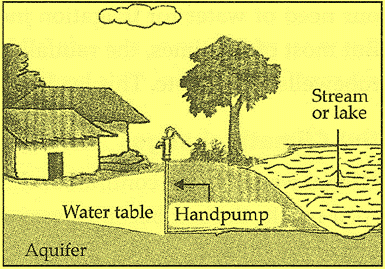
Rainwater is the main source of groundwater. The rainwater and water from other sources such as rivers and ponds seeps through the soil and fills the empty spaces and cracks deep below the ground. This process of seeping of water into the ground is called infiltration. The groundwater thus gets recharged by this process.
At places, the seeped water collects between layers of hard rocks. This is called an aquifer. Aquifers are like huge underground tanks filled with gravel and rocks from which water can be pumped out. Tubewells and handpumps are used to draw out water from aquifers to the surface of the earth.
The availability of groundwater or the level of water table depends on the rainfall. and recharge conditions of that particular area.
As groundwater passes through the soil, it gets filtered by several layers of sand and rocks. It is therefore, almost free of suspended impurities. However, it contains dissolved salts from the soil. It may also contain germs. Groundwater can be obtained by digging wells or sinking tube wells to reach the water table. Deep groundwater is usually safe for drinking.
The groundwater may run along the surface of the non-porous rock and come out of the surface at some places to form a natural spring.
Groundwater Pollution
Generally, groundwater is good for drinking. Groundwater that is polluted is less visible and difficult to clean up than lakes and rivers. Most often groundwater pollution results from the disposal of wastes improperly including household and industrial chemicals, wastewater from mines, leaking underground oil storage, oil field brine pits, garbage landfills, and sewage systems.
Prevention of groundwater pollution can be done by:
- storing rainwater
- watertight materials
- collecting leachate with drains
Porosity: It is a measure of the void spaces (pores) that exist between particles of clay, grains of sand, or pieces of gravel, in the layer. It is usually expressed as a fraction of the volume of void space divided by the total volume, and written as a percentage between 0–100%.
Permeability: It refers to the ability of water to move between these pore spaces.
Porosity and Permeability Ranges for Sediment:
|
Sediment Type |
Porosity |
Permeability |
|
Uniform size sand or gravel |
25-50% |
High |
|
Mixed size sand and gravel |
20-35% |
Medium |
|
Glacial Till |
10-20% |
Medium |
|
Silt |
35-50% |
Low |
|
Clay |
33-60% |
Low |
Groundwater Recharge
Groundwater recharge is also known as deep percolation or deep drainage. It undergoes the hydrologic process, which moves surface water to groundwater. It is a primary method where water enters an aquifer. The recharge occurs at plant roots and is often known as a flux to the water table surface.
Types of groundwater recharge:
Water Cycle: Naturally, through the water cycle .
Anthropogenic Processes: Anthropogenic process is also called artificial groundwater recharge, where rainwater and reclaimed water is routed to the subsurface.
· Unconfined aquifers are those into which water seeps from the ground surface directly above the aquifer.
· Confined aquifers are those in which an impermeable dirt/rock layer exists that prevents water from seeping into the aquifer from the ground surface located directly above.
Instead, water seeps into confined aquifers from farther away where the impermeable layer does not exist.
Depletion of Water Table
Groundwater is an important source of freshwater for us because it is constantly recharged by rainwater.
The water table does not get affected as long as we draw as much groundwater as is replenished by natural methods. However, if we use more water than can be replenished, the water table will go down. This is called depletion of the water table.
Water table is replenished by natural methods such as seepage of rainwater, water used in the fields which is not absorbed by the plants, water from the bottom of lakes and rivers, etc. However, due to many reasons, natural replenishment of water table is decreasing day-by-day.
Increase in population, industrial and agricultural activities, scanty rainfall, deforestation, decrease in effective area for seepage of water are some common factors affecting water table. These are discussed below:
(i) Increasing population
As our population increases, we need more water for drinking, washing, cooking, cleaning, etc. Moreover, increasing population creates demand for construction of houses, shops, offices, roads and pavements.
This decreases the open areas like parks and playgrounds. This, in turn, decreases the seepage of rainwater into the ground. It is because paved floor (pakka floor) does not allow water to seep in easily, whereas, water on a grass lawn seeps through in no time. Construction itself uses a lot of water - most of it being groundwater. Thus, rising population leads to an increase in consumption and at the same time, a decrease in the seepage of water into the ground.
(ii) Growing industrialisation
Almost all industries use water. As the number of industries increases, so does the consumption of water.
Most of this water is drawn from groundwater.
(iii) Agricultural activities
As population rises, so does the demand for food, causing an increase in agricultural activity. Therefore, our need of water for irrigation increases. Indian farmers depend on rainfall for irrigating their crops.
But most of the times, the rainfall is insufficient. In such cases farmers use groundwater from the wells, tubewells, canals, etc. This leads to a major downfall in the level of the water table.
(iv) Climatic changes
Global warming is a continuous threat which all of us are facing. It increases the temperature of the earth.
As a result, the soil becomes very dry and absorbs a large amount of water. This does not let water go under the ground.
(v) Deforestation
Vegetation slows down the flow of rainwater on land and increases the absorption of water by the soil.
Cutting down of trees and destroying vegetation, therefore, interferes with the natural process by which seepage takes place and the groundwater is recharged.
(vi) Insufficient rainfall
Insufficient rainfall in many parts is an important factor that results in depletion of water table.
(vii) Mismanagement of water resources
A regular supply of water is provided by a well-planned pipe system. When the civic authorities supply water through pipes, not all of it may reach the destination. A large number of water supply pipes are usually found leaking and a lot of water gushing out of the pipes. It is the responsibility of the civic authorities to prevent such wastage of precious water.
Mismanagement or wastage may take place at the level of individuals also. All of us, knowingly or unknowingly, waste water while brushing teeth, shaving, bathing, washing and during many other activities. Leaking taps is another source of huge water wastage.
Reducing Quality of Groundwater
Sometimes toxic substances get dissolved in water which may seep underground. This may result in the contamination of groundwater. Human activities are mainly the cause for the change in the quality of groundwater. Agricultural activities may add pesticides to groundwater. Industrial processes add chemicals and certain metals to groundwater. Household activities mainly add bacteria, viruses and organic chemicals to the groundwater. Even though water can be treated to get rid of contaminants, this can prove to be very costly. Therefore, we should take care that the groundwater does not get polluted.
Water Scarcity
Water is an inexhaustible, renewable natural resource. However, we still hear about shortage of water at many places. The United Nations has recommended that a minimum of 50 litres of water should be available to each of us per day for drinking, washing, cooking and cleaning. This amount is about two and a half buckets of water per person per day. However, millions of people in our country, and several other countries of the world, do not even get this minimum amount. They have to face great hardships in getting a little amount of water.
In the year 2000, the world population was 6.2 billion. The UN (United Nations) estimates that by 2050 there will be an additional 3.5 billion people with most of the growth in developing countries that already suffer water stress. Thus, water demand will increase unless there is corresponding increase in water conservation and recycling of this vital resource.
Problems faced by people due to water scarcity
(i) Crop production is affected. This may cause insufficient supply of food.
(ii) People have to walk miles to fetch water.
(iii) People have to stand in long queues to get their daily water.
(iv) People may have to buy water at high prices.
(v) People may drink dirty (contaminated) water which can cause water-borne diseases like cholera, dysentery, typhoid, etc.
Effects of water scarcity on plants
You must have seen potted plants wilting and ultimately drying up if they did not get water even for a few days. Plants need water to prepare their food by the process of photosynthesis. If water is not available to
plants, the green character of the planet shall be lost. This may mean the end of all life, for a world without
plants shall mean no food, no oxygen, not enough rain and innumerable other problems.
The problem of water scarcity is increasing day-by-day. Even in places where water scarcity is not a problem today, it might become a problem in future.
Water management
The activity of movement and control of water resources to minimize the damage to property and life and also to maximize the efficient beneficial use is known as water management.
Water management is the effective planning, distribution and use of water resources.
If the management of water is good in dams and levees, it reduces the risk of harm caused due to flooding.
With the increase in the population which has doubled to over 6 billion people from 1900, the use of water has gone up to 600%.
Water Conservation Methods
Conservation may be defined as the controlled utilisation of natural resources for the benefit of all life so that it may yield sustainable benefits to the present as well as future generations.
Wastage of water should be avoided and management of water resources should be done in all possible ways to conserve water.
Following are some of the methods to conserve water, which can be followed at individual level:
(i) Avoid leakage of water from the taps and pipes.
(ii) Do not leave the tap turned on when you brush your teeth or wash clothes.
(iii) Never throw water unnecessarily on the roads since it can be used for gardening and cleaning.
(iv) Avoid unnecessary flushing of the toilets.
(v) Use a mug and bucket instead of a shower to take bath or wash your car.
(vi) Water your lawn only when it is needed.
(vii) Use a broom instead of a hosepipe to clean the outdoors.
(viii)Install taps with reduced flow of water.
(ix) Reuse the water whenever and wherever possible.
Various other methods to conserve water which can be followed by government authorities, farmers, etc. are:
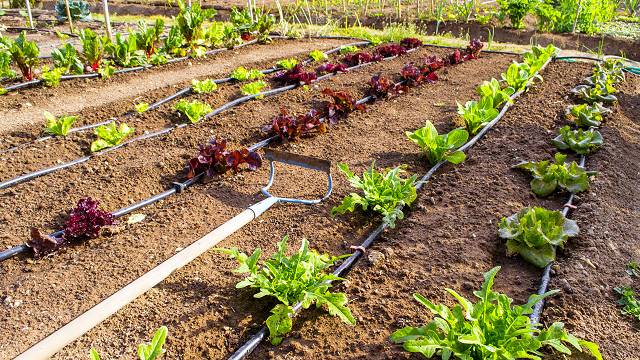
(i) Economic usage of water while irrigating the crops. Drip irrigation is the technique of watering plants by making use of narrow tubings which deliver water directly at the base of the plant. This saves water.
(ii) Recycling of water in factories and using it several times before it is disposed off.
(iii) Effective flood control, especially by building dams and reservoirs.
(iv) Soil conservation methods, such as planting trees, also increase the supply of groundwater.
(v) Treating sewage and factory wastes before disposing them off so that water sources are not polluted.
(vi) Using biodegradable fertilisers and pesticides so that groundwater is not contaminated.
Dams
Dams are the large water-storing bodies usually built by the government agencies across the rivers to regulate the flow of water. They store enormous amount of water sufficient for the irrigation of fields throughout the year. In a densely populated country like India, dams have been built across many rivers.
Some examples of famous dams and canals in India are :
(i) Bhakra dam built across the river Sutlej in the state of Punjab
(ii) Sardar Sarovar dam built on the river Narmada in 1940 in the state of Gujarat
(iii) Tehri dam on the river Ganges in Tehri (Uttranchal)
(iv) Tawa dam is a large reservoir on the Tawa river located in Hoshangabad (M.P.)
(v) Mettur dam on river Kaveri (Cauveri) in Tamil Nadu is one of the oldest dams in India, etc. Rainfall map of India.
Online Tuitions and Self-Study Courses for Grade 6 to 12 & JEE / NEET