
Q.1. Explain what makes things visible to us.
Ans: When a light ray falls on an object, some part of it gets reflected and reaches our eyes, allowing us to see the things around us.
Q.2. Name the type of lens which diverges a beam of parallel rays of light.
Ans: The lens which diverges a beam of parallel rays of light is a concave lens.
Q.3. Is the image formed by a plane mirror always upright?
Ans: Yes, the image formed by the plane mirror is always upright.
Q.4. Explain why are concave and convex mirrors called spherical mirrors.
Ans: Concave and convex mirrors are the parts of spheres whose one side is polished or silvered. Hence, they are called spherical mirrors.
Q.5. Is it possible to obtain the image on the screen when the candle is too close to the concave mirror?
Ans: No, when the candle is too close to the concave mirror, it is virtual & erect and behind the mirror.
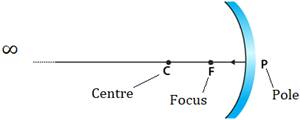
|
Position of the object |
Position of the image |
Size of the image |
Nature of the image |
|
At infinity |
At focus, F |
Highly diminished and pointed in size |
Inverted and Real |
|
Beyond C |
Between F and C |
Diminished |
Inverted and Real |
|
At C |
At C |
Same size |
Inverted and Real |
|
Between C and F |
Beyond C |
Enlarged |
Inverted and Real |
|
At F |
At infinity |
Highly enlarged |
Inverted and Real |
|
Between F and P |
Behind the mirror |
Enlarged |
Erect and virtual |
Q.6. Explain whether mirror change the direction of light.
Ans: Yes, when a ray of light is incident on the mirror surface, then the mirror changes the direction of light.
Q.7. The image formed by a lens is always virtual, erect and smaller in size for an object kept at different positions in front of it. Identify the nature of the lens.
Ans: Such types of lenses which always form virtual, erect and smaller image in spite of the different positions of an object are called concave lens.
Q.8. Observe the given figures.
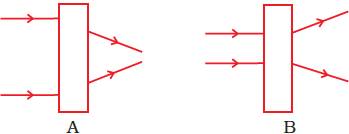
The given figures show the path of light through lenses of two different types represented by rectangular boxes A and B. What is the nature of lenses A and B?
Ans: Since, in first case light rays are converging towards a point, so the lens A will be convex and in case of lens B, light rays diverge or spread out. So, the lens B will be concave lens.
Q.9. Name the colours included in the composition of sunlight.
Ans: Sunlight consists of seven colours, i.e., violet, indigo, blue, green, yellow, orange and red (VIBGYOR).
Q.10. In the formation of a rainbow, what acts as tiny prisms?
Ans: In the formation of a rainbow, the raindrops suspended in the atmosphere act as tiny prisms.
Q.11. Can you get a real image at any distance of the object from the convex mirror?
Ans: No, we cannot get a real image for any position of an object from the mirror because convex mirror always forms virtual, erect and diminished image in spite of the position of object.
|
Position of Object |
Position of Image |
Size of Image |
Nature of Image |
|
At Infinity |
At the focus F, behind the mirror |
Highly diminished |
Virtual and Erect |
|
Between Infinity and the Pole |
Between P and F, behind the mirror |
Diminished |
Virtual and Erect |
Q.12. Explain how many reflected rays can be obtained from a single incident ray in respect of a plane mirror.
Ans: For a single incident ray, there will be only one reflected ray that can be obtained in respect of a plane mirror, because the angle of reflection will be exactly equal to angle of incidence.
Q.13. Explain why concave mirror is known as a converging mirror.
Ans: Concave mirror is known as a converging mirror because it converges (spreads out) a beam of parallel rays of light (reflecting from it) at one point.
Q.14. Name the phenomenon that is involved in the formation of image of an object by a concave mirror.
Ans: The phenomenon that is involved in the formation of image of an object by a concave mirror is “Reflection of light”.
Q.15. Mention the type of image formed on a cinema screen.
Ans: Real image is an image which is formed on a cinema screen.
Q.16. An image is formed by the actual intersection of rays and can be obtained on the screen. State whether it is real or virtual image.
Ans: It’s a real image as the image obtained on the screen is always real.
Q.17. What is a lens?
Ans: A transparent material which is bounded by both or one spherical surface is known as a lens.
Q.18. Name the phenomenon that is involved in the formation of image of an object by a convex lens.
Ans: The phenomenon that is involved in the formation of image of an object by a convex lens is “Refraction of light”.
Q.19. Give the form of energy that produces the sensation of vision.
Ans: Light energy is the form of energy which produces the sensation of vision.
Q.20. What type of mirror is used as a side mirror in a scooter? Why is this type of mirror chosen?
Ans: Convex mirror is used as a side mirror in a scooter because it can form images of objects spread over a larger area. This helps the drivers to view the traffic over a large area behind them.
Q.21. Briefly explain what we can demonstrate by rotating Newton's colour disc, very fast.
Ans: By rotating Newton's colour disc, we can demonstrate that when seven colours are mixed together, then a white colour is formed.
Q.22. Mention the name of lens which can converge the sun's rays to a point and burn a hole in the piece of paper.
Ans: Convex lens is a lens which can converge the sun's rays to a point and burn a hole in the piece of paper.
Q.23. An erect and enlarged image of an object is formed on a screen. Explain how this could be possible.
Ans: An erect and enlarged image of an object is formed only by the concave mirror or convex lens when object is inverted and placed between F and 2F.
Q.24. Explain how many types of lens are there. Explain each of them.
Ans: There are two types of lenses.
The lens which is thinner in the middle than at the edges is called a concave lens while the lens which is thicker in the middle than at the edges is called a convex lens.
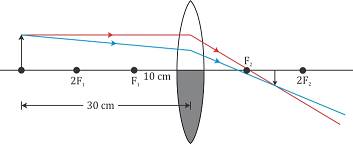
Q.25. Consider if one half of a convex lens is covered with a black paper, then state whether this lens produces a complete image of the object.
Ans: If one half of a convex lens is covered with a black paper, then yes, the convex lens will produce the complete image of the object.
Online Tuitions and Self-Study Courses for Grade 6 to 12 & JEE / NEET