
Class 7 Science
Chapter 15 – Light
Important Questions Answers Part 3
Q.1. The image formed by a plane mirror is
(a) on the surface of the mirror
(b) just in front of the mirror
(c) just behind the mirror
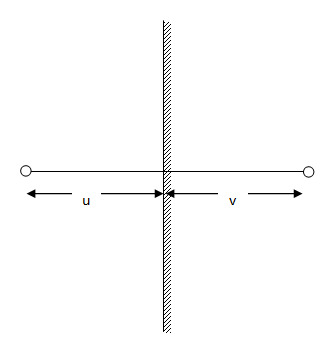
(d) as much behind the mirror as the object is in front of the mirror
Ans. (d) as much behind the mirror as the object is in front of the mirror
The object distance is equal to the image distance in the plane mirror and the nature of the image is virtual and erect; hence, the image is formed behind the mirror at a distance equal to the object distance.
Q.2. Which of the following images is real?
(a) image formed by a plane mirror
(b) image formed by a convex mirror
(c) image formed by a concave mirror with object between the mirror and focus
(d) image formed by a concave mirror with object behind the focus
Ans. (d) image formed by a concave mirror with object behind the focus
Real image is formed by a concave mirror with object behind the focus, that is beyond focus, is real.
Q.3. A spherical mirror with its reflecting surface on the outside is a
(a) plane mirror
(b) concave mirror
(c) convex mirror
(d) either concave or convex depending on which way you look at it.
Ans. (c) convex mirror
Convex mirror is a spherical mirror, which has its reflecting surface outside.
Q.4. A virtual image formed by a plane or a spherical mirror
(a) is always inverted
(b) is always erect
(c) is erect or inverted depending on the distance of the object from the mirror
(d) erect and inverted respectively
Ans. (b) is always erect
A virtual image formed by a spherical mirror or a plane mirror is always erect.
Q.5. If a concave mirror forms a real magnified image of an object, the object is located
(a) between pole and focus
(b) between focus and centre of curvature
(c) beyond centre of curvature
(d) at centre of curvature
Ans. (b) between focus and centre of curvature
Image is both magnified and real if the object is placed between the centre of curvature and the pole.
Q.6. At what position of the object does a convex lens act as a magnifying glass?
(a) between F and 2F
(b) between F and O
(c) beyond F
(d) beyond 2F
Ans. (b) between F and O
Magnifying glass is a single lens that produces a highly magnified, erect image of the object. In concave mirror, a highly magnified erect image is produced when the object is placed between F and O.
Q.7. Which of the following images can a convex lens NOT produce?
(a) real, magnified
(b) virtual, magnified
(c) erect, virtual
(d) erect, diminished
Ans. (d) erect, diminished
Convex lens cannot produce erect and diminished image.
Q.8. Band of which of these colours is not seen in a spectrum?
(a) green
(b) yellow
(c) purple
(d) red
Ans. (c) purple
Purple colour is not present in the spectrum.
Q.9. Which of the following is true for a convex mirror?
(a) It can only form virtual images.
(b) It can only form real images.
(c) It can form real or virtual images depending on the distance of the object from the mirror.
(d) It can form real or virtual images depending on the size of the object.
Ans. (a) It can only form virtual images.
A convex mirror can only produce virtual image.
Q.10. Which of the following cannot split light into its seven colours?
(a) diamond cut in a special way
(b) prism
(c) convex lens
(d) water droplets suspended in the air
Ans. (c) convex lens
A convex lens cannot split light into its seven colours.
Q.11. If you raise your right hand, your image in a plane mirror also raises its right hand. True / false?
Ans. False. Images formed in plane mirrors are laterally inverted. Hence, if we raise our right hand, the image will appear to raise its left hand in the mirror.
Q.12. The image formed by a plane mirror can be obtained on a screen. True / false?
Ans. False. The image formed by a plane mirror is virtual and erect in nature and virtual images cannot be obtained on a screen.
Q.13. The image formed by a plane mirror is as much __________ the mirror as the object is in front of it.
Ans. The image formed by a plane mirror is as much behind the mirror as the object is in front of it.
This is because object distance is equal to image distance in a plane mirror.
Q.14. A real image formed by a mirror is always inverted. True / false?
Ans. True.
Real images formed by the mirrors are always inverted.
Q.15. A convex lens _________ (converges/diverges/dos not affect) a parallel beam of light incident on it.
Ans. A convex lens converges a parallel beam of light incident on it.
Q.16. A diverging lens forms a real image of an object placed beyond F, and a virtual image of an object placed between O and F. True / false?
Ans. False.
A diverging lens always forms a virtual image irrespective of the placement of the object.
Q.17. If all rays falling on a concave mirror are parallel to the principal axis of the mirror, what happens to them after reflection from the mirror?
Ans. If a beam of rays, parallel to the principal axis falls on a concave mirror, the concave mirror converges all the rays at its focus.
Q.18. If all rays falling on a convex mirror are parallel to the principal axis of the mirror, what happens to them after reflection from the mirror?
Ans. If a beam of rays, parallel to the principal axis falls on a convex mirror, the mirror diverges all the rays away from its focus.
Q.19. Images formed by spherical mirrors are always virtual. Do you agree? Give reasons.
Ans. No, images formed by the spherical mirror can be real too. It depends on the position of the object in front of the lens. Example: Image of an object placed at the radius of curvature of a concave mirror is real in nature and can be obtained on the screen.
Q.20. It is found that as an object is moved from a great distance to the focus of a spherical mirror, the image moves away from the mirror. What kind of mirror is it − convex or concave?
Ans. It is a concave mirror. The image formed by a concave mirror starts shifting away from the focus when the object is brought nearby the focus.
Q.21. What kind or mirror will you use as a rear-view mirror in a car–convex or concave? Why?
Ans. The mirror used as a rear view mirror in a car is a convex mirror. Because convex mirror forms a diminished image of an object, so has a wider field of view. It helps the driver to have a proper view of the backside of the vehicle.
Q.22. Can light bend around objects in its path?
Ans. No, light cannot bend around the objects, as it only travels in a straight line.
Q.23. Does a plane mirror form a real image or a virtual image?
Ans. A plane mirror always forms a virtual image of an object, because the image formed by a plane mirror cannot be obtained on the screen.
Q.24. The image of which of the following letters of the alphabet will be exactly the same when seen in a plane mirror: A E I O U
Ans. The image formed by a plane mirror is laterally inverted. Out of A E I O U, the letters I, O, and U are symmetrical about a vertical axis passing through their centers. So, even if the image of these letters will be laterally inverted, they would look exactly the same.
Q.25. In a plane mirror, which is the measure of the angle of incidence − the angle between the mirror and the incident ray, or 90° minus the angle between the mirror and the incident ray?
Ans. The angle of incidence is defined as the angle between the incident ray and the normal to the mirror. The angle of the incidence can also be obtained by obtaining the angle, 90° minus the angle between the mirror and the incident ray, which is actually equal to the angle between the incident ray and the normal to the mirror.
Q.26. To which side does the reflecting surface of a convex mirror curve–inwards or outwards?
Ans. The reflecting surface of convex mirror curves outwards.
Q.27. A lens is thicker in the middle than at the edges. Can it be used to burn a piece of paper by using sunlight?
Ans. A lens which is thicker in the middle than at the edges is a converging or convex lens. It converges all the light rays coming from a distant object to its focus. As the sun is a distant object for a convex lens, so the lens will converge all the light rays coming from the sun and will focus them on the focal point of the lens. Such a lens can be used to burn a piece of paper because sunlight focussed on a single point can produce heat and can even start a fire.
Q.28. If all rays falling on a concave lens are parallel to the principal axis of the lens, what happens to them after they pass through the lens?
Ans. If a beam of light rays parallel to the principal axis falls on a concave lens, the rays diverge after reflection. When the rays are drawn backward they are seemed to meet at a point known as the focal point of the lens.
Q.29. If all rays falling on a convex lens are parallel to the principal axis of the lens, what happens to them after they pass through the lens?
Ans. If a beam of light rays parallel to the principal axis falls on a convex lens, the rays converge to a point known as the focal point of the lens.
Q.30. There is only one point on a concave or convex lens, a ray passing through which is not deviated at all. Where does this point lie and what is it called?
Ans. The point is known as the 'Pole' of the lens. It lies at the center of the lens. Rays do not deviate from their path if they pass through the pole.
Q.31. A lens is found to form both real and virtual images of an object, depending on the position of the object with respect to the lens. What kind of lens is it–convex or concave?
Ans. A convex lens forms both virtual and real images of the object, depending upon the position of the object in front of the lens.
Q.32. Sunlight consists of light of only one colour. Do you agree? Give reasons.
Ans. No, I do not agree. Sunlight appears to be a single white light but actually, it is made up of 7 constituent colours, i.e., Violet, Indigo, Blue, Green, Yellow, Orange, and Red. When the sunlight undergoes dispersion, then the seven constituent colours can be observed separately.
Q.33. Through which point of all rays parallel to the principal axis of a spherical mirror pass after reflection by the mirror?
Ans. All rays parallel to the principal axis of a spherical mirror pass through the focus after reflection by the mirror.
Q.34. Which of these mirrors converges a parallel beam of light-plane, concave or convex?
Ans. A concave mirror converges a parallel beam of light-plane.
Q.35. What kind of spherical mirror would you use if you want to see the magnified image of your face in the mirror?
Ans. We will need a concave mirror to get the magnified image of our face in the mirror.
Q.36. Which of these has smaller focal length-a thick lens or a thin lens?
Ans. Focal length of a thick lens is smaller than that of a thin lens.
Q.37. If the distance of an object from a convex lens is equal to twice the focal length of the lens, where is the image formed?
Ans. Image will be formed at twice the focal length of the lens on the opposite side.
If an object is placed at twice the focal length of the lens, it is said be placed at 2F position. In this case, the image will be formed at 2F position on the opposite side of the lens.
Q.38. Name the triangular piece of glass that splits white light into different colours.
Ans. The name of the triangular piece of glass that splits white light into different colours is prism.
Q.39. What do you mean by 'angle of incidence' of a ray of light on a plane mirror?
Ans. Angle of incidence is the angle between the incident ray and the normal to the plane mirror at the point of incidence.

In the figure, MN is the plane mirror, AO is the incident ray, O is the point of incidence, OX is the normal and ∠AOX is theangle of incidence.In the figure, MN is the plane mirror, AO is the incident ray, O is the point of incidence, OX is the normal and ∠AOX is theangle of incidence.
Q.40. What is the relationship between angle of incidence and angle of reflection in a plane mirror?
Ans. Angle of incidence is equal to the angle of reflection.

In the figure, MN is the plane mirror, ∠AOX is the angle of incidence ∠XOB is the angle of reflection.In the figure, MN is the plane mirror, ∠AOX is the angle of incidence ∠XOB is the angle of reflection.
Q.41. What is a real image?
Ans. An image that can be projected on a screen is called a real image. It is formed by the actual meeting of the rays of light from the object. Image formed by a cinema projector on the screen is an example of real image.
Q.42. What do you mean by lateral inversion?
Ans. In the image formed by a plane mirror, there is an interchange of the left and the right side. In other words, the left side of the object appears to be the right side of the image and vice versa. This property is known as the lateral inversion.

(Right hand appears as left hand.)
Q.43. A convex rear-view mirror is preferred over a plane mirror in a car. Why?
Ans. Convex mirrors are used as rear view mirror in cars because they form small images of the objects. This helps us to have a wide field of view of the objects behind the car which is not possible with plane mirror.
Q.44. A convex lens is said to have a real focus and a concave lens a virtual focus. Why?
Ans. In a convex lens, the parallel rays of light passing through the lens actually meet at the focus in front of the lens. This is why it is called real focus. But in a concave lens, the rays of light passing through the lens diverge and when these diverging rays are produced backward, they appear to meet at a point behind the lens. This point is the focus of the lens. Because the light rays do not actually meet at the focus, it is called virtual or imaginary focus.
Q.45. What is a 'spectrum'?
Ans. Ordinary white light is made of seven colours, namely violet, indigo, blue, green, yellow, orange and red. The pattern formed by these colours is called spectrum.
Online Tuitions & Self-Study Courses for Grade 6 to 12 & JEE / NEET