
Q.1. Name the scientist who discovered the magnetic effect of electric current.
Ans. The scientist who discovered the magnetic effect of electric current is Hans Christian Oersted.
Q.2. Briefly state the effects of electricity.
Ans. The three effects of electricity are
(i) Chemical effect
(ii) Heating effect
(iii) Magnetic effect
Q.3. State the property of a conducting wire is utilized in making electric fuse.
Ans. Electric fuse wire is made up of special material which has low melting point. As if high amount of current is passed, it melts to disconnect the electric circuit and prevent us from causing any damage.
Q.4. Mention the name of the two devices that work on the basis of magnetic effects of current.
Ans. The devices that work on the basis of magnetic effects of current are loudspeaker and electric bell.
Q.5. Explain why are CFLs (Compact Fluorescent Lamps) preferred over electric bulbs.
Ans. Compact fluorescent lamps are preferred over electric bulbs because electric bulbs use more power of electricity and it also losses electrical energy in the form of heat but it is not so in compact fluorescent lamps.
Q.6. Name the device used these days in place of electric fuses in electrical circuits.
Ans. The device used in these days in place of electric fuse is MCB (Miniature Circuit Breaker).
Q.7. Name the type of mark for which we should look at an electrical appliance before buying.
Ans. ISI mark is a mark for which we should look at an electrical appliance before buying.
Q.8. Briefly mention which part of the symbol of battery shows positive and negative terminals?

Ans. The positive terminal is represented by longer vertical line while negative terminal is represented by shorter vertical line.
Q.9. When does a circuit is said to be overloaded?
Ans. It is overloaded by connecting too many devices to it. When too many devices get connected, then a circuit is said to be overloaded.
Q.10. Why is an electric fuse required in all electrical appliance?
Ans. Electric fuse is required in all electrical appliances to prevent damage from excessive current flow and during short circuit.
Q.11. Give the name any two electrical appliances in which electromagnets are used.
Ans. Electric fan and electrical motor are the electrical appliances in which electromagnets are used.
Q.12. Shilpi does not have a night lamp in her room. She covered the bulb of her room with a towel in the night to get dim light. Has she taken the right step? Give one reason to justify your answer.
Ans. No, she has not taken the right step. Because due to excessive heat of bulb, the towel may burn and it also results in the wastage of electrical energy.
Q.13. If the filament of the bulb is broken, would the circuit be complete? Would the bulb still glow?
Ans. If the filament of the bulb is broken, the circuit will not be complete. So, the bulb will not glow.
Q.14. Name some electric appliances where the heating effect of the electric current is used.
Ans. Some of the electric appliances where the heating effect of the electric current is used are electric heater, geyser, micro-oven, room heater, boiler, etc.
Q.15. If the current through the coil stops flowing. Will the coil remain an electromagnet?
Ans. When the current through the coil stops flowing, the coil does not remain an electromagnet.
Q.16. State whether the bulb glows when the circuit is opened.
Ans. No, the bulb does not glow when the circuit is opened. The bulb glows only when the circuit is closed.
Q.17. What happens to the current in a circuit at the time of short circuit?
Ans. The value of the current in a circuit increases heavily at the time of short circuit.
Q.18. We should not touch the lighted bulb. Explain, why.
Ans. The lighted bulb connected to main supply should not be touched by our hand directly, as a lighted bulb can be very hot and can burn our hand as well.
Q.19. Name two electric devices for each where
(a) heating effect of current is used and
(b) magnetic effect of current is used.
Ans.
(a) Heating effect of current is used in electric heater and geyser.
(b) Magnetic effect of current is used in electric bell and cranes to lift heavy magnetic materials from one place to other.
Q.20. Why do we cover plug pinholes which are within the reach of children with cellotape or a plastic cover when not in use?
Ans. We do cover plug pinholes which are within the reach of children with cellotape or plastic cover to avoid electric shocks. If unconsciously, a child puts his finger in the electric socket, the shock may be fatal.
Q.21. Can we use the same fuse in a geyser and a television set? Explain.
Ans. No, we cannot use same fuse in a geyser and in a television set because the fuse used in every appliances has some limit to withstand the current flows through it. So, different appliances have different fuses.
Q.22. If cells are placed side by side. Then, how are the terminals of the cells connected?
Ans. If cells are placed side by side, then with the help of some connecting wires, the positive terminal of one cell is connected to the negative terminal of other to produce a combined power of all cells which can be called a battery.
Q.23. Explain how a battery can be constructed.
Ans. As we know that a battery is a combination of two or more cells and it can be constructed by placing cells property on cell holder in such a way that the positive terminal of one cell is connected to the negative terminal of other.
A piece of wire is connected to each of the two metal clips on the cell’s holder.
Q.24. Distinguish between an open circuit and a closed circuit.
Ans. Difference between an open circuit and a closed circuit
|
Open (Electric) circuit |
Closed (Electric) circuit |
|
An open electric circuit is an electric path which begins from the positive terminal of a battery or cell, gets broken at some point. |
A closed circuit is an electric path which begins from the positive terminal of a cell or battery and terminates at its negative terminal without any break. |
Q.25. Rohan made an electromagnet by winding 50 turns of wire over an iron screw. Shilpi also made an electromagnet by winding 100 turns over a similar iron screw. Which electromagnet will attract more pins? Give reason.
Ans. Since the magnetic effect directly depends on the number of turns of the coil. As, Shilpi's coil has a greater number of turns than Rohan. So, her electromagnet is stronger than Rohan.
So, electromagnet of Shilpi attracts more pins as compared to Rohan.
Q.26. Does the electric current have other effect besides heating? Name it.
Ans. Yes, electric current has other effect besides heating, i.e. magnetic effect of current.
When electric current is passed through a coil, there is a magnetic field developed around the coil or wire, if magnetic compass is placed nearby, it deflects the magnetic needle.
Q.27. Explain the following.
(a) Copper and aluminium wires are usually employed for electricity transmission. Explain the reason.
(b) Explain how does the resistance of a wire vary with its length.
(c) The tungsten is used almost exclusively for filament of electric lamp. Comment.
Ans.
(a) Due to the low resistance and strength of aluminium and coppers, both these metals are usually employed for the transmission of electricity.
(b) There is always an increase in the length of the wire with the increase in its resistance.
(c) Since tungsten has high melting point and high resistance. So, that is why, the tungsten is used exclusively for filament of electric lamp.
Q.28. If we connect more cells in the circuit, then what will happen?
Ans. If we connect more of cells in the circuit, then the nail will attract more pins. It is due to the reason that the current flowing through the wire wound on the nail will get increase which in turn will increase the strength of the electromagnet.
Q.29. Electromagnets are better than permanent magnets. Explain why.
Ans. An electromagnet can be switched OFF or switched ON as desired and this is not possible in the permanent magnets. That is why the electromagnets are better than the permanent magnets.
Q.30. If the current flows through wire, does the wire behave like a magnet?
Ans. When the current flows through any wire, a magnetic field is developed around that wire or coil and it behaves like magnet. It can be analysed by placing a magnetic compass around the wire, it will show deflection of the needle.
Q.31. If current is passed through a coil, does the pins cling to the coil?
Ans. When an electric current is passed through a coil, it gets magnetised due to phenomena of magnetic effect of current. When magnetic materials such as pins are placed near to it. It gets attracted by the coil or we can say that pins cling to the coil.
Q.32. Batteries used in tractors, trucks and inverters are also made from cells. Then why it is called a battery?
Ans. The cell is the unit of a battery. When more than one cells are combined together, it forms a battery. In trucks, tractors and inverters, cells are internally arranged and we need not to connect it externally, so we called it as batteries.
Q.33. State one measure to avoid overloading in an electrical circuit. Also mention the name given to a situation in which the live and the neutral wires accidently come in contact. Describe the role of a safety device in this situation.
Ans. Overloading can be avoided if too many appliances are not connected to a single socket. Short circuiting is a name given to a situation in which the live and the neutral wires accidently come in contact.
Electric fuse is a safety device. When a short circuit takes place or when overloading takes place, then the current becomes large and heats the fuse wire too much and thus, it gets melted and circuit breaks which prevents the damage of the wiring and electrical appliances.
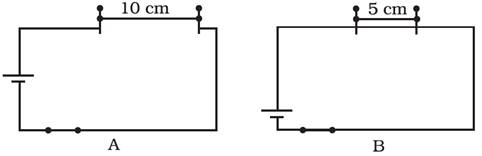
Q.34. Shilpi took a wire of length 10 cm. Rohan took a wire of 5 cm of the same material and thickness both of them connected with wires as shown in the circuit given in figure. The current flowing in both the circuits is the same.
(a) Will the heat produced in both the cases be equal? Explain.
(b) Will the heat produced be the same, if the wires taken by them are of equal lengths but of different thickness? Explain.
Ans.
(a) No, the amount of heat produced in both the wires will be different because amount of heat produced in a wire on passing electric current depends on the length of wire and here length is different for both the wires.
(b) No, the amount of heat produced in the wire of same length but different thickness cannot be same because amount of heat produced in a wire also depends on the thickness of the wire.
Q.35. Explain, what happens when live wire and neutral wire touches each other directly?
Ans. When live and neutral wire touches each other directly then it leads to short circuit in which the large amount of current flows through the household wiring and this large current may heat the wires to a dangerously high temperature and may lead to fire.
Q.36. Explain with the help of a diagram, how does the magnetic effect of electric current help in the working of an electric bell.
An electric bell works on the magnetic effect of electric current. It has an electromagnet in it.
It consists of a coil of wire wound on an iron piece.
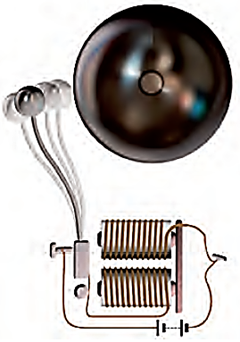
The coil acts as an electromagnet.
An iron strip (armature) with a hammer at one end is kept close to the electromagnet.
There is a contact screw near the iron strip (armature). When the iron strip (armature) is in contact with the screw, the current flows through the coil which becomes an electromagnet.
It, then, pulls the iron strip.
In the process, the hammer at the end of the strip strikes the gong of the bell to produce a sound.
When the electromagnet pulls the iron strip (armature), it also breaks the circuit.
The current through the coil stops flowing.
The coil is no longer an electromagnet.
It no longer attracts the iron strip.
The iron strip comes back to its original position and touches the contact screw again.
This completes the circuit. The current flows in the coil and the hammer strikes the gong again.
This process of 'make and break' of the electric circuit continues as long as we keep the switch pressed (closed). The armature vibrates forwards and backwards rapidly each time making the clapper strike the gong and ringing the bell.
Online Tuitions and Self-Study Courses for Grade 6 to 12 & JEE / NEET