
Class 7 Science
Chapter 13 – Motion and Time
Very Important Questions Answers Set 4
Q.1. What do you mean by 'time period' of a pendulum?
Ans: The time taken by a pendulum for one oscillation is known as its time period.
Q.2. Give an example of a periodic change related to the earth that can be used to measure time.
Ans: Our earth completes one rotation on its axis in almost 24 hours. Due to this rotation, we can see sun rise, change its position during the day and finally sun set.
The time between one sunrise and the next is called one day. This concept can be used to measure time.
Q.3. On what principle are modern electronic watches based?
Ans: Modern electronic watches are based on the vibrations of the crystals of substance 'quartz' present in it.
These crystals can vibrate very fast and at a very precise rate. These vibrations are used to measure time accurately.
Q.4. When is an object said to be in uniform motion?
Ans: A body is said to be in uniform motion if it travels in a straight line and covers equal distances in equal intervals of time.
Q.5. What is the SI system of units? Name two other systems of units.
Ans: The SI system or international system of units is the modern form of the metric system and it is used all over the world in everyday measurements.
In this system, the following standard units are used:
(1) Metre (m) for length
(2) Kilogram (kg) for mass
(3) Second (s) for time
(4) Ampere (A) for current
(5) Kelvin (K) for temperature
(6) Candela (cd) for luminescence
(7) Mole (mol) for number of atoms and molecules
Following are two other systems of units:
(1) CGS system (centimetre, gram and second)
(2) MKS system (metre, kilogram and second)
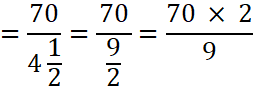
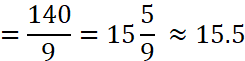
Q.6. A car travels a distance of 70 kilometres in 4½ hours. Find its speed.
Ans: Speed is given by the expression,

Q.7. A cheetah runs a distance of 200 metres in 10 seconds. What is the speed of the cheetah in
(a) m/s,
(b) km/h?
Ans:
(a)

(b)

Q.8. An aeroplane takes 7 hours to travel from New Delhi to London. If the plane travels at a uniform speed of 950 kilometres per hour, find the distance between New Delhi and London.
Ans: The expression for the speed is given by
∴

Distance = 950 km/h × 7 h = 6650 km.
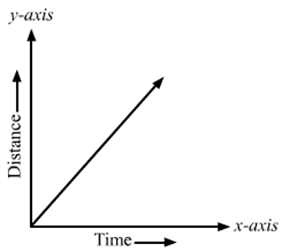
Q.9. Draw a typical distance-time graph for uniform motion.
Ans:
In uniform motion, the object covers equal distances in equal intervals of time.
Distance–time graph in this case is a straight line.
Q.10. Why do you think accurate measurements of time became possible much after accurate measurement of length and mass?
Ans: The earliest measurements made by us were length and mass. Time was measured in terms of length as distance and time.
Position of sun, moon and stars give idea of days, months and years. Later, mechanical clocks were used to measure time accurately up to minutes. These clocks are based on weights. Today, atomic clocks are used to measure time up to nanoseconds by measuring waves emitted by caesium clock.
Therefore, we think that, over the time, improvements in accuracy in measuring length and mass help in measuring time with more accuracy and precision.
Q.11. You have made a pendulum by tying a stone to a string. Its time period is 1 second. You want to reduce the time period. How will you achieve this?
Ans: The time period (T) is directly proportional to the square root of the length (L) of the pendulum.

Hence, we can reduce the time period by reducing the length of the string.
Q.12. A car travels along a circular racing track at a constant speed of 100 km/h. Does it have uniform motion?
Ans: Yes.
If a car travels in a circular path with constant speed, its motion is called uniform circular motion.
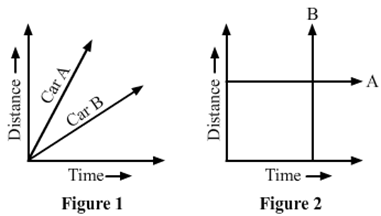
Q.13. Figure shows the distance-time graph for two racing cars A and B. Which one of them won the race?
Ans: Speed is given by the expression,

From the above equation, the speed of a car will be greater if it covers maximum distance in a given interval of time. To compare the distance, draw a line perpendicular to the time axis, as shown in the following distance–time graph.

From the graph, it is clear that for a given time t, the distance covered by car A is more than car B (i.e., car A is moving faster than car B). Therefore, car A won the race.
Q.14. The three graphs A, B and C are speed vs time graphs of three cars. (Note that these are not distance-time graphs)
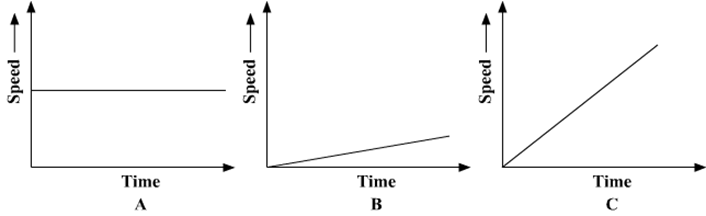
Identify the graphs from the clues, when
1. the driver lets the car pick up speed slowly.
2. the driver sometimes goes on a drive on an empty road and enjoys cruising along at the same speed.
3. the driver is a racing car driver and has just started a race.
Ans: 1. As the driver lets his car pick up speed slowly, the graph describing his motion would be graph B. Because in the graph B speed is rising slowly with increasing time.
2. As the driver drives the car with the same speed, it means speed does not change with time. Hence, the graph describing constant motion would be graph A.
3. Graph C would perfectly describe the motion of the sports car driver because he speeds up his car rapidly in a very short span of time. The same is shown in graph C.
Q.15. Draw a distance-time graph from the following data (Table 1) showing the distance covered by a racing car in fixed intervals of time. Calculate the speed of the car.
|
Time (s) |
Distance (in m) From start point |
|
0 |
0 |
|
1 |
15 |
|
2 |
30 |
|
3 |
45 |
|
4 |
60 |
|
5 |
75 |
Ans: Distance–time graph:
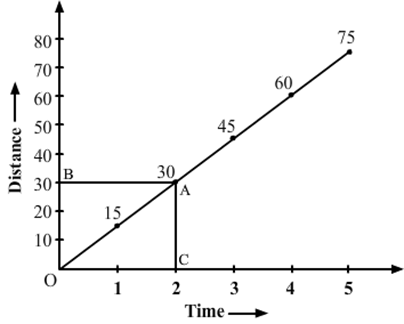
To find the speed from the graph, we take any point A on the straight line graph, then

Q.16. Draw a distance-time graph from the data given in the table showing the distance covered by a racing car. Does the car have uniform motion?
|
Time (s) |
Distance (in m) From start point |
|
0 |
0 |
|
1 |
10 |
|
2 |
25 |
|
3 |
45 |
|
4 |
65 |
|
5 |
90 |
Ans: Distance–time graph:
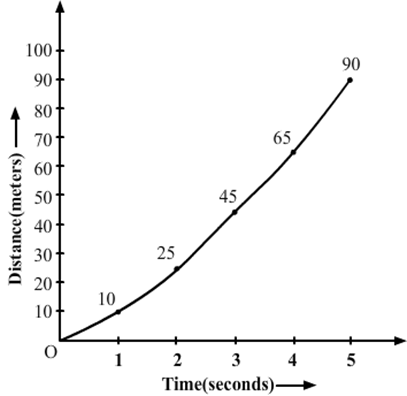
No, car does not have uniform motion. From the above graph, it is clear that the car travels unequal distances in equal intervals of time. So, it is in non-uniform motion.
Q.17. Distinguish between uniform and non-uniform motion.
Ans:
|
Uniform Motion |
Non-uniform Motion |
|
In uniform motion, the object covers equal distances in equal intervals of time. |
In non-uniform motion, the object covers unequal distances in equal intervals of time. |
|
In this motion, the speed of the object is constant. |
In this motion, the speed of the object is not constant. |
|
The distance–time graph for uniform motion of an object is a straight line. |
The distance–time graph for non-uniform motion of an object is a curve. |
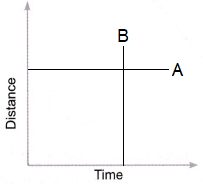
Q.18. What can you say about the speeds of the two objects A and B from the distance-time graphs in the given figure
Ans:
For object A,
The distance–time graph is a straight line parallel to the time axis. It means the object is at a fixed distance and at rest. In this case, the object has zero speed.
For object B,
The distance–time graph is perpendicular to time axis. It represents infinite speed. Practically, this is an impossible case.
Online Tuitions & Self-Study Courses for Grade 6 to 12 & JEE / NEET