
Class 7 Science
Chapter 10 – Respiration in Organisms
Very Important Questions Answers
Q.1. Which of these is true about anaerobic respiration?
(a) Oxygen is utilized
(b) Carbon dioxide is given out
(c) Amount of energy released is more than in aerobic respiration
(d) Sometimes it occurs in the human body also
Ans: (b) Carbon dioxide is given out.
In anaerobic respiration, glucose is broken down into alcohol and carbon dioxide in the absence of oxygen.
Q.2. Exchange of gases in plants takes place through the
(a) stomata
(b) roots
(c) buds
(d) entire leaf surface
Ans: (a) stomata
Stomata are tiny pores present on the surface of leaves through which gaseous exchange takes place in plants.
Q.3. During which process is energy released?
(a) external respiration
(b) internal respiration
(c) inhalation
(d) exhalation
Ans: (b) internal respiration
Internal respiration, also known as cellular respiration, uses oxygen to break down food and release energy.
Q.4. Which of these is not true?
(a) Combustion is a faster process than respiration.
(b) Combustion occurs at a higher temperature than respiration.
(c) In combustion, energy is released in several steps, whereas in respiration it is released in a single step.
(d) Combustion can occur anywhere but respiration only occurs in living cells.
Ans: (c) In combustion, energy is released in several steps, whereas in respiration, it is released in a single step.
Combustion releases energy in a single step in the form of light and heat. Whereas in respiration, energy is released in steps and is stored in the form of ATP.
Q.5. In insects, exchange of gases takes place through
(a) spiracles
(b) gills
(c) lungs
(d) stomata
Ans: (a) spiracles
Spiracles are the openings present on the bodies of insects through which exchange of gases takes place.
Q.6. Through which tubes does air enter the lungs from the windpipe?
(a) bronchi
(b) bronchioles
(c) alveoli
(d) trachea
Ans: (a) bronchi
Windpipe branches into two small tubes known as bronchi, through which the air enters the lung.
Q.7. Where in the respiratory system does oxygen from the air breathed in pass into the blood?
(a) trachea
(b) bronchi
(c) bronchioles
(d) alveoli
Ans: (d) alveoli
Oxygen from the air breathed in pass into the blood from alveoli in the lungs, which are surrounded by blood vessels.
Q.8. Which of these is not true about cellular respiration?
(a) It releases energy
(b) It occurs only during the day
(c) It utilizes oxygen and liberates carbon dioxide
(d) It occurs in all living things
Ans: (b) It occurs only during the day
Cellular respiration is not dependent on light. It occurs all the time, both day and night.
Q.9. Taking in oxygen and giving out carbon dioxide is called __________or __________ respiration.
Ans: Taking in oxygen and giving out carbon dioxide is called breathing or external respiration.
Q.10. In Amoeba, exchange of gases occurs by ________ through the cell membrane.
Ans: In Amoeba, exchange of gases occurs by diffusion through the cell membrane.
Q.11. During cellular respiration, the sugar molecules in food are _________ to form carbon dioxide and water.
Ans: During cellular respiration, the sugar molecules in food are oxidised to form carbon dioxide and water.
Q.12. Trace the path of oxygen in humans during respiration by filling in the blanks with the main organs of the respiratory system: Nostrils and nasal cavity →_________ → _________ → lungs → _________ → _________ → cells
Ans: Path of oxygen in humans during respiration:
Nostrils and nasal cavity → pharynx → trachea and bronchi → lungs → bronchioles and alveoli → blood → cells.
Q.13. The substance present in blood which transports oxygen is _________
Ans: The substance present in blood which transports oxygen is haemoglobin.
Q.14. Respiration without oxygen is called aerobic respiration. True or false?
Ans: False.
Respiration without oxygen is called anaerobic respiration.
Q.15. Exchange of gases on fishes occurs through gills. True or false?
Ans: True.
In fishes, exchange of gases occurs through gills.
Q.16. Name the pores in the stems and leaves of plants through which exchange of gases takes place.
Ans: Stomata are the pores in the stems and leaves of plants through which exchange of gases takes place.
Q.17. Respiration and breathing are the same. Do you agree? Give reasons.
Ans: No, respiration and breathing are not similar processes. Breathing is a part of respiration in which inhalation and exhalation are carried out. The respiration process, on the other hand, involves the complete oxidation of food molecules to release energy.
Q.18. Exchange of gases for respiration occurs in both plants and animals. In which of these is the rate of exchange of gases faster?
Ans: The rate of exchange of gases for respiration is faster in animals as compared to the plants. This is because animals possess a well-developed organ system for breathing but plants do not possess such developed organ system.
Q.19. Exchange of gases in animals takes place in many ways. Name three.
Ans: The gaseous exchange in animals can occur through following ways:
1. Gaseous exchange can occur through skin or cell membrane in animals such as Hydra and Amoeba.
2. Some insects such as grasshoppers exchange gases through air holes.
3. Mammals such as birds and humans perform gaseous exchange through lungs.
Q.20. In humans, the exchange of gases occurs in the lungs. In which part of the lungs does it take place?
Ans: The gaseous exchange in the lungs occurs in the alveoli. These are microscopic sac like structures that exchange gases with the blood.
Q.21. Oxygen is carried to the cells by the blood. In what form is oxygen carried in the blood?
Ans: The oxygen exchanged from the alveoli of the lungs is carried to different cells of the body in the form of oxyhaemoglobin. It is formed by the binding of oxygen to the haemoglobin of the blood.
Q.22. What process occurs during cellular respiration?
Ans: During cellular respiration, the sugar present in the food is selectively oxidized to produce water and carbon dioxide. In this process, some amount of energy is also released which is used by cells for different processes.
Q.23. Cellular respiration can occur even without oxygen. What is such respiration called?
Ans: Cellular respiration that occurs without the presence of oxygen is termed as anaerobic respiration.
Q.24. Which of these–combustion or cellular respiration–is a faster process?
Ans: Combustion is faster as compared to respiration because in respiration, food is oxidized in a step-wise manner to release energy. In combustion, all the fuel burns in a single step to release energy.
Q.25. Give one-word for 'the process of release of energy by oxidation of food'.
Ans: Cellular respiration is the process of release of energy by oxidation of food.
Q.26. Name the flap that closes the windpipe when you swallow food.
Ans: Epiglottis is the flap that closes our windpipe when we swallow food.
Q.27. Which muscular part of the body present in the chest cavity helps air to be breathed in and out?
Ans: Diaphragm is the muscular part of the body present in the chest cavity that helps air to be breathed in and out.
Q.28. What is 'oxidation'?
Ans: Oxidation is the breakdown of food (glucose) into carbon dioxide and water to release energy in the presence of oxygen.
Q.29. Why should we not overwater potted plants?
Ans: We should not over-water potted plants because water will replace the air present in the soil and roots won't be able to breathe.
Q.30. What do you mean by the 'stomatal apparatus'?
Ans: Stomatal apparatus refers to the stomata along with its nearby guard cells and other associated cells.
Q.31. What are the main organs of the respiratory system?
Ans: The main organs of the human respiratory system are nostrils, trachea, bronchi and lungs.
Q.32. What happens during cellular respiration?
Ans: During cellular respiration, the food is broken down in presence of oxygen into carbon dioxide and water to give energy.
Q.33. Why does the breathing become faster while doing exercise?
Ans: Breathing becomes faster during exercise because more oxygen is inhaled and supplied to the cells. This increases the rate of breakdown of food and gives more energy that is needed for exercise.
Q.34. What chemical reaction occurs during anaerobic respiration in yeast?
Ans: The chemical reaction that occurs during anaerobic respiration in yeast is:
Glucose  Alcohol + Carbon dioxide + Energy
Q.35. An athlete suffers from muscular cramps while running a race. How can you help him overcome the cramps?
Ans: The cramps can be overcome by massaging the affected part or having hot water bath. These methods increase the blood circulation and the supply of oxygen in the body.
Q.36. Name and explain in one sentence each, the two main processes of respiration.
Ans: The two main processes of respiration are as follows:
Breathing or external respiration: This is the process of taking in oxygen-rich air and giving out carbon dioxide-rich air.
Cellular respiration or internal respiration: This is the process of breakdown of food in the presence of oxygen into carbon dioxide and water to release energy.
Q.37. How does exchange of gases occur in the following:
(a) fish
(b) cockroach
Ans:
(a) Fish: The exchange of gases in fishes takes place through gills. Gills have large number of filaments supplied with thin blood capillaries. Water enters through the mouth and passes over the gills. Oxygen is absorbed by blood in the capillaries and carbon dioxide is given out through its walls.
(b) Cockroach: The exchange of gases takes place through spiracles. Oxygen-rich air enters the body through spiracles and reaches all parts of the body via trachea (respiratory tube). Trachea is further branched into tracheoles.
Q.38. How do the nostrils contribute to the process of breathing?
Ans: When we breathe in air, it passes through our nostrils. The slimy mucus present in it moistens the air. The inner lining of nose secretes mucus. The blood circulating in the nose makes the air warm. The mucus and hair present in the nostril catch the dirt, dust and disease-causing germs. Thus, they cannot enter respiratory system.
Q.39. Draw a labelled diagram of the apparatus you will use to show that heat is produced during respiration in seeds. Why are two flasks used in the experiment?
Ans: Two flasks are used in the experiment (one containing the germinating seeds and other containing the boiled seeds) to show that heat is produced during respiration. Respiration occurs in germinating seeds, but not in boiled seeds. The thermometer inserted in the flask containing germinating seeds shows higher temperature than the one inserted in the flask containing boiled seeds. This shows heat is produced during respiration.

Q.40. What happens to the air breathed in, once it reaches the lungs?
Ans: Once the air is breathed in, it reaches the lungs and passes in to bronchioles (small tubes). At the end of bronchioles, tiny air sacs called alveoli are present. Air from bronchioles reaches the alveoli. Alveoli are surrounded by blood vessels. Here, exchange of gases between blood and air sacs takes place. The oxygen present in the breathed air enters the blood present in blood vessels and carbon dioxide present in the blood goes out into the alveoli. Thus, exchange of gases takes place in the air once it reaches the lungs.
Q.41. How will you show that exhaled air has more carbon dioxide than inhaled air?
Ans: Carbon dioxide turns lime water milky. Based on this principle, experiment can be designed to show that exhaled air has more carbon dioxide than inhaled air.
Take two test tubes half filled with lime water.
With the help of glass tubes, clips and stoppers having two holes, set up an apparatus as shown below:
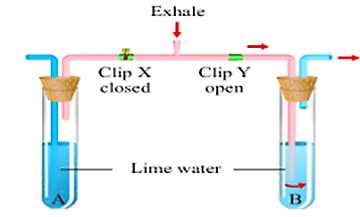
The middle rubber tube is used to breath in and out through the mouth.
Suck air through the rubber tube and open clip X and close clip Y. The inhaled air passes through the lime water present in test tube A. Now, exhale through the tube again and close clip X and open clip Y. The exhaled air passes through the lime water in test tube B.
The lime water in test tube B turns milky. This shows that exhaled air has more carbon dioxide.
Q.42. What is the difference between breathing and cellular respiration?
Ans: Differences between breathing and cellular respiration:
|
Breathing |
Cellular Respiration |
|
It is a physical process in which exchange of gases takes place. It does not involve any chemical reaction. |
It is oxidation of food, thus involves a chemical reaction. |
|
It occurs outside the cells. |
It occurs inside the cells. |
|
No energy is liberated in the process. |
Energy is liberated during the process. |
Q.43. What is anaerobic respiration? Does it occur in the human body also?
Ans: The breakdown of glucose to obtain energy in the absence of oxygen to give carbon dioxide and alcohol is termed as anaerobic respiration. Several organisms such as yeast and bacteria can live without oxygen as they carry out anaerobic respiration.
Yes, anaerobic respiration occurs in the human body also. During strenuous activities, body needs more energy but cannot get enough oxygen. Thus, anaerobic respiration occurs in the muscle cells to provide additional energy.
Q.44. Why do we sometimes suffer from muscle cramps while exercising?
Ans: Cramps occur while exercising because of accumulation of lactic acid in the muscle cells. During exercise, body needs more energy, but it cannot get more oxygen for oxidation of food and for providing energy. The additional energy in muscle cells is provided by anaerobic respiration in which partial breakdown of glucose into lactic acid takes place. This lactic acid accumulates in muscle cells and causes cramps.
Q.45. Is it wise to sleep under a tree
(a) during the day
(b) at night
Give reasons
Ans:
(a) It is wise to sleep under a tree during the day. During day, plants take up carbon dioxide for photosynthesis and give out oxygen. Humans require oxygen for respiration. Therefore, while sleeping under a tree during daytime, one gets oxygen-rich air.
(b) On the other hand, during night, plants also respire. They take up oxygen and give out carbon dioxide. Therefore, if one sleeps under a tree during night, he/she will get oxygen-deficient air.
Q.46. A person put warm water in an aquarium, thinking that the fish would be more comfortable in it. However, the fish died. What can be the reason for this?
(HINT: the solubility of a gas in water goes down as its temperature increases)
Ans: A fish needs the dissolved oxygen in water for respiration. Upon an increase in temperature, the solubility of oxygen in water decreases. The fish cannot get enough oxygen for respiration and hence dies.
Q.47. When you run, your breathing becomes faster as you need more oxygen. But why does your rate of heartbeat also increase?
Ans: Body needs more oxygen during running and oxygen is carried by blood to all the parts of the body. Heart needs to pump more blood, carrying oxygen, to all the body parts during running. In order to supply more blood, the heart rate also increases during running.
Q.48. Why do plants not need a respiratory system?
Ans: Plants have tiny pores called stomata on the surface of their leaves and stems. The exchange of gases in plants occurs through these pores. Thus, they do not need a respiratory system.
Q.49. If you hold your breath for some time and then release it, you have to breathe heavily after that. Why?
Ans: The supply of oxygen in the body is withheld if we hold our breath. Body needs oxygen for oxidation of food in order to provide energy for all other processes. Holding our breath cuts down the supply of oxygen. After releasing it, we need to breathe heavily in order to take more oxygen which is needed by our body.
Q.50. Why do you think we yawn when we are sleepy or drowsy?
Ans: When we are sleepy or drowsy, we need more energy and hence more oxygen. In order to draw more oxygen, we yawn.
Q.51. Why do mountaineers climbing high mountains carry oxygen cylinders with them?
Ans: As one goes up from plains to mountains, the amount of oxygen present in the air decreases. On mountains, one cannot get enough oxygen through the normal breathing process. Thus, mountaineers need to carry oxygen cylinders with them to get continuous supply of oxygen.
Q.52. When we run fast, we consume more oxygen. Each one of us has a maximum rate of oxygen consumption. Our bodies cannot consume more oxygen than this. A scientist conducted a study of the maximum rates of oxygen consumption per kilogram body weight in 4 athletes. He also studied how much time each of them took to run a 10 km race. The result is shown in the table.
|
Athlete |
Maximum Rate of Oxygen Consumption (mL per Kg per min) |
Time to Run 10 Km Race (Min) |
|
A1 |
65.5 |
33.2 |
|
A2 |
70.3 |
31.5 |
|
A3 |
55.8 |
38.1 |
|
A4 |
75.1 |
28.3 |
Answer these questions.
1. Is there a relationship between the maximum rate of oxygen consumption and time taken to run 10 km?
2. Can you suggest an explanation for this relationship?
Ans:
1. Yes, there is a relationship between the maximum rate of oxygen consumption and time taken to run 10 km. The one who covers the distance in shortest time requires the maximum amount of oxygen. Whereas the person who covers the distance in the longest duration of time requires minimum amount of oxygen.
2. The faster we run, more the oxygen is required by our body. The intake of oxygen is increased as constant supply of it is needed to produce energy.
Q.53. Francis saw a little girl being swept away by flood water. He immediately jumped into the water. Though the current was fast, he was able to save the girl and pulled her to safety. She had swallowed a lot of water. So, Francis gave her artificial respiration and restored her breathing.
What can you say about Francis?
Ans: Francis is a brave and smart person. He jumped immediately to save the life of the girl. He also has good presence of mind as he immediately gave the girl artificial respiration and saved her.
Q.54. Explain, with the help of a diagram, the structure of human lungs, and how exchange of gases occurs in the lungs.
Ans: Human lungs consist of small tubes, bronchioles and tiny air sacs known as alveoli (about 300 million in each lung).
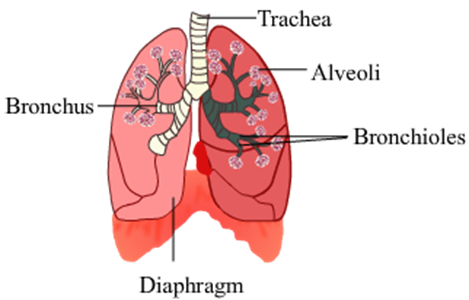
Exchange of gases in lungs:
The air breathed in reaches the air sacs that are surrounded by blood vessels. These blood vessels transfer the oxygen present in the air to the blood. The carbon dioxide present in the blood passes to the air sacs.

Q.55. How are combustion and cellular respiration similar to each other? In what ways are they different?
Ans: Combustion and cellular respiration are similar to each other because at the end of both processes heat and energy are released.
Differences between them:
|
Combustion |
Respiration |
|
It is a fast process. |
It is a slow process. |
|
It takes place only at high temperature. |
It takes place at body temperature. |
|
It can happen anywhere. |
It can take place only in living cells. |
|
It is a single-step process, and energy is released in the form of heat and light. |
It is a multi-step process, and energy is stored in the form of ATP. |
Online Tuitions & Self-Study Courses for Grade 6 to 12 & JEE / NEET