
Chapter 1 – Nutrition in Plants
High Level Questions
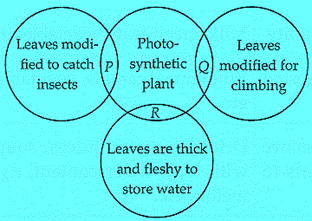
Q.1. Refer to the given Venn diagram and select the correct option.
(a) P could be pitcher plant whereas R could be Aloe.
(b) Q could be pea whereas P could be sun dew.
(c) P could be bladderwort whereas R could be Opuntia.
(d) Both (a) and (b)
Q.2. Which of the following statements support(s) the fact that the upper surface of a leaf is usually greener than the lower surface?
(i) More chlorophyll is present on the upper surface to absorb more light.
(ii) There are more stomata present on the upper surface than the lower surface.
(iii) More sugar is formed on the lower surface.
(iv) The green leaves look greener under the hot Sun.
(a) (i) only
(b) (ii) and (iii)
(c) (ii) and (iv)
(d) (iv) only
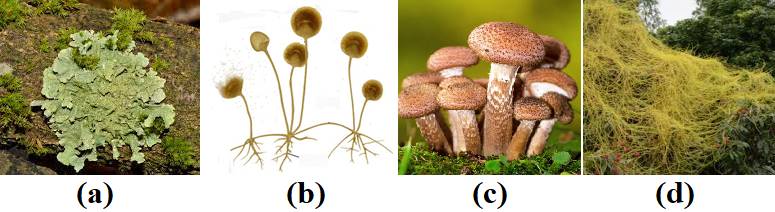
Q.3. Symbiosis is the phenomenon in which two different kinds of organisms pool together their nutritional requirements. From the following figures, which one represents such association ?
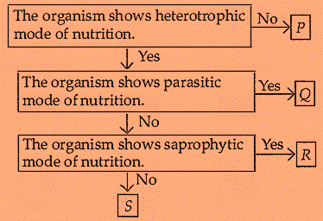
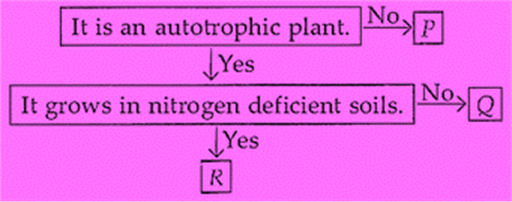
Q.4. Refer to the given flow chart and select the option that correctly identifies organisms P, Q, R and S.
Q.5. Jennifer classified plants into three groups of three members each. By mistake, she placed one incorrect member in each group. Identify this odd member and select the correct option.
Group I : Nepenthes, Rafflesia, Drosera
Group II : Cuscuta, Hydnora, Utricularia
Group III : Hibiscus, Petunia, Dionaea
(a) Drosera in group I should be interchanged with Hydnora in group II.
(b) Utricularia in group II should be interchanged with Petunia in group III.
(c) Rafflesia in group I should be interchanged with Hibiscus in group III.
(d) Utricularia in group II should be interchanged with Rafflesia in group I whereas Dionaea in group III should be replaced with Ocimum.
Q.6. Refer to the given table and choose the correct option.
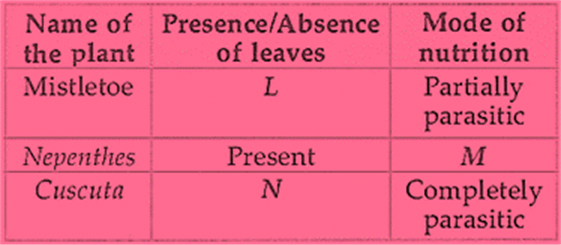
|
L |
M |
N |
|
(a) Present |
Partially heterotrophic |
Absent |
|
(b) Absent |
Partially heterotrophic |
Absent |
|
(c) Present |
Autotrophic |
Present |
|
(d) Present |
Partially parasitic |
Absent |
Q.7. Study the given flow chart carefully and select the option that correctly identifies P, Q and R.
(a) P could be any parasitic leafless plant such as mistletoe which depends on the host plant for water and minerals.
(b) R could be Dionaea which has special leaf modification to catch and digest insects.
(c) Q could be Cuscuta which is rootless photosynthetic plant.
(d) All of these
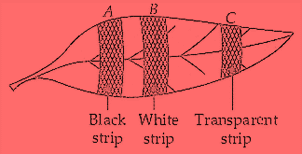
Q.8. A destarched leaf on a potted plant was covered with black A, white B and transparent C strips of paper as shown in the given figure.
After six hours of exposure to sunlight the leaf was removed from the plant and tested for starch. Which one of the following will be the correct observation?
(a) Whole leaf turned blue-black.
(b) Only B and C portions turned blue-black.
(c) Only A and B portions remained colourless and rest of the leaf turned blue-black.
(d) A, B and C portions remained colourless and rest of the leaf turned blue-black.
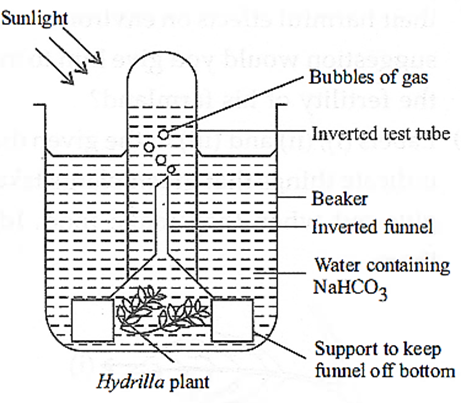
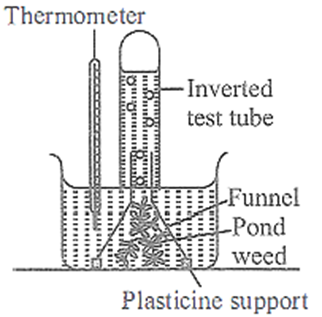
Q.9. Rahul conducted an experiment as shown here.
Which of the following statements is correct regarding this?
(a) Hydrilla plant cannot photosynthesise as CO2 is not available to the plant.
(b) NaHCO3 present in the water absorbs all CO2 dissolved in it.
(c) Sunlight cannot reach the
plant properly and hence photosynthetic rate
of the plant is affected.
(d) The bubbles produced in the water within test-tube are mainly of oxygen gas.
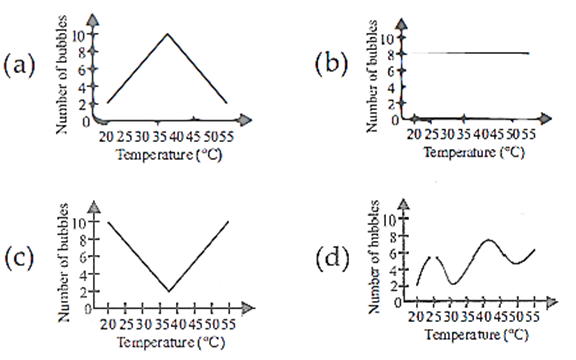
Q.10. Sarah set up an experiment in an open field as shown here to study how temperature affects the rate of photosynthesis. She left the apparatus in field from 7 am in the morning till 1 pm in afternoon and tabulated her observations which were later plotted on a graph. Which of the following graphs shows the result of her experiment?
Online Tuitions & Self-Study Courses for Grade 6 to 12 & JEE / NEET