
Ratio
The ratio is used to compare two quantities. These quantities must have the same units.
The ratio is represented by “:”, which is read as “ is to”. We can write it in the form of “fraction”.
Equivalent Ratio
The equivalent ratio is like the equivalent fractions so to find the equivalent ratio we need to write it in the form of a fraction. To find the equivalent ratio we need to multiply or divide the numerator and denominator with the same number.
Example
Find the two equivalent ratios of 3 : 14.
Solution
First multiply both numerator and denominator by 2.
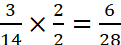
Now, we can multiply by 3
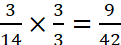
Now, we can multiply by 5
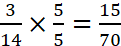
So, the three equivalent ratios of  are
are
 ,
,
 and
and
 .
.
To compare that the two ratios are equivalent or not we need to convert them in the form of a like fraction. Like fractions are the fractions with the same denominator.
Example
State whether the ratios 4 : 5 and 7 : 9 are equivalent are not?
Solution:
To check, first, we need to make their denominator same.
Converting ratios to fractions, we have  and
and  .
.
LCM of denominators 5 and 9 is 45.
Hence we need to make denominators of both fractions equal to 45.
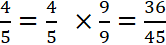
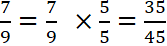
As  , hence the
ratio 4 : 5 and 7 : 9 are not equivalent ratios.
, hence the
ratio 4 : 5 and 7 : 9 are not equivalent ratios.
Proportion
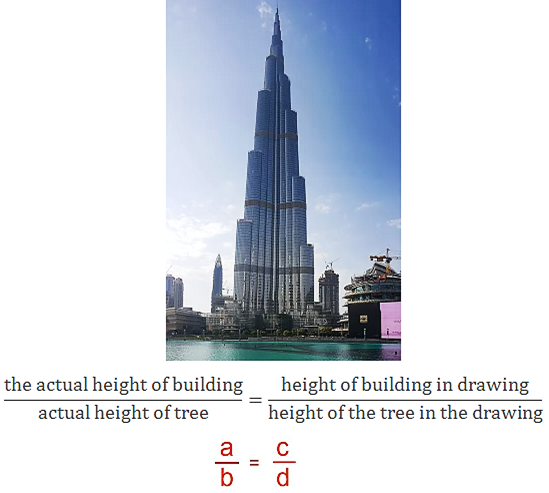
Proportion shows the equality between two ratios. If two ratios are in proportion then these must be equal.
Example
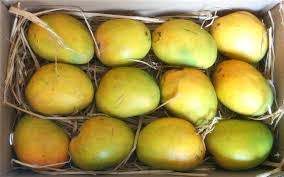
If the cost of 12 mangoes is Rs. 180 then what will be the cost of 30 strawberries.
Solution
Using Unitary Method
Cost of 12 mangoes = ₹ 180
Cost of 1 mango = ₹ 180/12
Cost of 30 mangoes = ₹ (180/12) × 30
= ₹ 450
Using proportion method
Assuming the cost of 30 mangoes = ₹ x
Then, 12 : 30 = 180 : x
i.e., 12 / 30 = 180 / x
Cross-multiplying, we get
12x = 180 × 30
x = (180 × 30)/12 = 450
Hence, cost of 30 mangoes will be ₹ 450.
Percentage
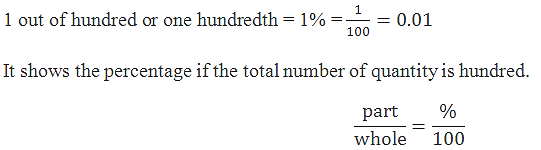
The percentage is another way of comparisons. In ratios we have to make the denominator same then only we can compare them but in percentage, we can compare by calculating the percentage of the given quantity.
The percentage is the numerator of the fraction with the 100 denominators.
Example
What is the percentage of boys and girls in the class of 100 students if the number of boys is 55 and the number of girls is 45?
Solution

Percentage if the total is not a hundred
If the total number of quantities is not hundred i.e., the denominator is not hundred then to find the percentage we need to make the denominator 100.
Example
Out of 15 students, 3 failed in mathematics. What percentage of students failed?
Solution
Unitary Method
Out of 15, the number of students who failed = 3
Hence, out of 100, the number of students
failed = 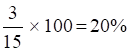
By making denominator 100
Out of 15, the number of students who failed = 3
Hence,
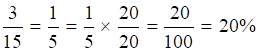
Converting fractional numbers to percentage
Fractional numbers have different denominator and to convert them into percentage we have to multiply the fraction with the 100%.
Example
Out of 32 students, 12 are girls. What is the percentage of girls?
Solution
Percentage of girls = 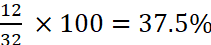
Converting decimals to percentage
To convert the decimal into a percentage, first, we need to convert the decimal into fraction then multiply it by 100%.
Example
Convert 0.65 into a percentage.
Solution
Multiply the decimal with the 100%.
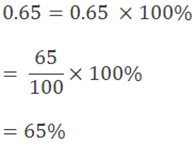
Converting Percentage to fractions or Decimals
We can reverse the above process to convert the percentage into fraction or decimal.

Parts always add to give a whole
If we know the one part of a whole then we can find the other part because all the parts together form a whole or 100%.
e.g., if there are 25% red balls, 45% blue balls and rest of the balls are green, then the green balls will be 30%.
Green balls = 100% − ( red balls + blue balls)
= 100% − ( 25% + 45% )
= 30% green balls.
Example
What percent of the given figure is shaded?

Solution:
Out of total 6 parts of the figure, 5 are shaded.
Hence, fraction will be 
Hence,
Percentage of shaded portion = fraction × 100
=  %
%
Remember:
If we say that Deepak spends 40% of his salary, then it means that he spends Rs. 40 out of every Rs. 100 of his salary.
Conversion of percentages to numbers ( i.e., “how many” )
Example
If 25% out of 60 labourers get daily wage more than ₹ 500, then how many labourers get daily wage more than ₹ 500?
Solution
The number of labourers getting more than ₹ 500 = 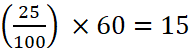 .
.
Hence, 15 labourers out of 60 get daily wage more than ₹ 500.
Conversion of Ratios to percent
Example
A prize money of ₹ 500000 is divided among 4 players, A, B, C and D, in such a way that A, B, C and D got the two parts, three parts, 1 part and four parts of profit respectively. How much money did each player get? What percent of the prize, did each player get?
Solution
The 4 players got prize in the ratio of 2 : 3 : 1 : 4, so the total of the parts is
2 + 3 + 1 + 4 = 10
For player A:
Amount of prize = 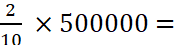 ₹
100000
₹
100000
Percentage of prize = 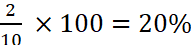
For player B:
Amount of prize = 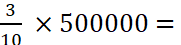 ₹
150000
₹
150000
Percentage of prize = 
For player C:
Amount of prize = 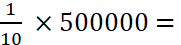 ₹
50000
₹
50000
Percentage of prize = 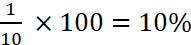
For player D:
Amount of prize = 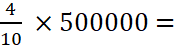 ₹
200000
₹
200000
Percentage of prize = 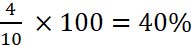
Increase or decrease as Percent
Percentage increase or
Percentage decrease = 
Example
The cost of rice increased from ₹ 100 to ₹ 120. Find the increase in percentage.
Solution
Original amount = Initial cost of rice = ₹ 100
Amount of change = increase in the cost of rice = 120 – 100 = 30.
Hence,
Percentage increase or Percentage decrease = 
= 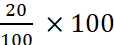 =
20%
=
20%
Cost Price
Cost price is the price at which you buy some product. It is written as CP.
Selling Price
Selling price is the price at which you sell something. It is written as SP.
These are the factors which tell us that the sale of some product is profitable or not.
|
CP < SP |
Profit |
Profit = SP – CP |
|
CP = SP |
No profit no loss |
− |
|
CP > SP |
Loss |
Loss = CP − SP |
Example
If the buying price (or CP) of a table is Rs 700 and the selling price (or SP) is Rs 820, then find the profit or loss.
Solution
As the SP is more than CP, so the seller earns the profit in the table.
Profit made = SP – CP
= Rs 820 – Rs 700
= Rs 80
Profit or loss percentage
The profit and loss can be converted into a percentage. It is always calculated on the cost price.


Example
If the cost price of a laptop is Rs.45000 and the selling price is Rs. 50000, then what is the profit or loss percentage?
Solution
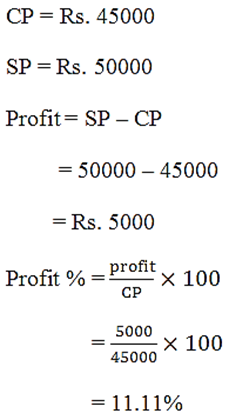
Finding SP if CP and profit or loss % is given


Example
If the cost of a TV is Rs.25000 and shopkeeper sells it at a loss % of 5% then what is the selling price of the TV?
Solution
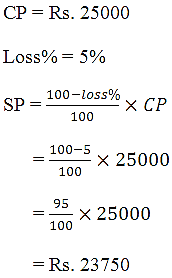
Hence, the shopkeeper sells it at the price of Rs. 23750
Finding CP if SP and profit or loss % is given?


Example
If the Selling price of a bookshelf is Rs 750 and the profit made by the seller is 10% then what is the cost price of the bookshelf?
Solution
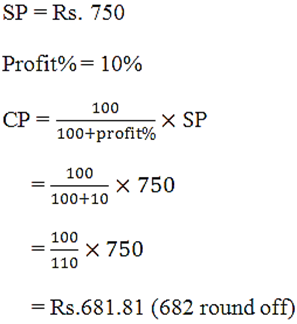
Hence the seller bought the bookshelf at the cost of Rs. 682.
Simple Interest
When we borrow some money from the bank then we have to pay some interest to the bank.
The money which we borrow is called the Principal.
The amount which we have to pay to the bank to use that money is called interest.
At the end of the year, we return the money to the bank with interest, that money is called Amount.
Amount = Principal + interest
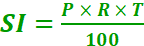
Where,
SI = Simple interest
P = Principal
R = Rate of Interest
T = time period
Example
Sunita borrows a loan of Rs 15,0000 at 15% per year as the rate of interest. Find the interest she has to pay at end of 3 years.
Solution
P = ₹ 150000, R = 15%, T = 3 years
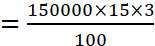

Total amount to be paid by Sunita at the end of one year = ₹ 150000 + ₹ 67500
= ₹ 217500.
Online Tuitions and Self-Study Courses for Grade 6 to 12 & JEE / NEET