
Q.1. Honeybee makes honey from
(a) Pollen
(b) Petals
(c) Nectar
(d) Bud
Q.2. Which of the following materials is not lustrous ?
(a) Gold
(b) Silver
(c) Wood
(d) Diamond
Q.3. In an activity, a teacher dissolved a small amount of solid copper sulphate in a tumbler half filled with water. Which method would you use to get back solid copper sulphate from the solution ?
(a) Decantation
(b) Evaporation
(c) Sedimentation
(d) Condensation
Q.4. Wells are fed by
(a) pond water
(b) lake water
(c) rain water
(d) ground water
Q.5. Mountaineers carry oxygen cylinders with them because
(a) there is no oxygen on high mountains.
(b) there is deficiency of oxygen on mountains at high altitude.
(c) oxygen is used for cooking.
(d) oxygen keeps them warm at low temperature.
Q.6. The correct sequence to get cloth is
(a) Fibre → fabric → yarn
(b) Fibre → yarn → fabric
(c) Fabric → yarn → fibre
(d) Yarn → fibre → fabric
Q.7. The process of ejection of harmful excess material from the body is known as:
(a) respiration
(b) excretion
(c) adaptation
(d) none of these
Q.8. Which of the following does not express a time interval ?
(a) A day
(b) A second
(c) A school period
(d) Time of the first bell in the school
Q.9. A material that allows the electricity to pass through is:
(a) conductor
(b) insulator
(c) transistor
(d) none of these
Q.10. Plants regulate their temperature by:
(a) Transpiration
(b) Respiration
(c) Photosynthesis
(d) Perspiration
Q.11. Fill in the blanks in the following sentences
(a) The process of changing water into its vapour is called ................. .
(b) The process of changing water vapour into water is called ................ .
(c) No rainfall for a year or more may lead to ............... in that region.
(d) Excessive rains may cause ............... .
Ans:
(a) evaporation
(b) condensation
(c) drought
(d) floods
Q.12. Name the two sources of natural water.
Ans: Rivers and lakes
Q.13. What is the direction of current in an electric circuit?
Ans: In an electric circuit, current flows from positive terminal to negative terminal.
Q.14. What happens when the north pole of a magnet is placed near the north pole of another magnet?
Ans: When the north pole of a magnet is placed near the north pole of another magnet then repulsion takes place.
Q.15. What happens if it does not rain for a long period?
Ans: If it does not rain for a long period, it may lead to drought.
Q.16. Name two items that are made from coconut fibre.
Ans: Rope and mat
Q.17. Dolphins and whales do not have gills yet they breathe in water. How ?
Ans: Dolphins and whales do not have gills yet they breathe in water with the help of blowholes or nostrils.
Q.18. Arrange the following lengths in their increasing magnitude:
1 meter, 1 centimetre, 1 kilometre, 1 millimetre
Ans: 1 millimetre < 1 centimetre < 1 metre < 1 kilometre
Q.19. What is sieving ? Where is it used?.
Ans: Sieving is a process which allows fine particles to pass through the holes of sieve, while the bigger impurities remain on the sieve.
It is used in flour mill in which impurities like husk and stones are removed from wheat.
Q.20. How can materials be classified on the basis of physical state?
Ans: Materials can be classified into three groups on the basis of physical state:
Solids : They have definite shape and volume. e.g., iron, ice etc.
Liquids : They have definite volume but do not have definite shape. e.g., water.
Gases : They do not have definite shape and volume. e.g., air.
Q.21. Write names of 8 useful items made from jute fibres.
Ans: Fabric, Rope, Carpet, Mattress, Cap, Hanging bag, Gunny bag, Jewellery.
Q.22. Why can a pace or a foot step not be used as a standard unit of length ?
Ans: Since the length of a pace or footstep differs for every individual, so a pace or a footstep cannot be used as a standard unit of length.
Q.23. What do we see on the ground, when sun light falls on the opaque objects ?
Ans: We see the shadows of opaque objects on the ground, when sunlight falls on these objects.
Q.24. How are lakes and ponds formed ?
Ans: Lakes and ponds are formed by the collection of rain water in low lying areas and leakage from the ground water reserves also add water to it.
Q.25. What is the composition of air ?
Ans: The composition of air is :
Nitrogen 78.09%
Oxygen 20.95%
Carbon dioxide 0.03 – 0.04%
Other gases like Traces He, H2 etc.
Q.26. What do you do with the leftover food at home ?
Ans: Left-over food at home should be dumped into compost pits so that it can be converted into manure by micro-organisms. This manure can be used in agricultural fields.
Q.27. Ekta has a rose plant in her garden. How can she increase the number of rose plants in the garden ?
Ans: Ekta can increase the number of rose plants in the garden by stem-cutting of the plants. This will lead to asexual reproduction.
Q.28. The height of a person is 1.65 m. Express it into cm and mm.
Ans: Height of the person = 1.65 m
∵ 1 m = 100 cm
and 1 m = 1000 mm
∴ 1.65 m = 1.65 × 100 cm = 165 cm
and 1.65 m = 1.65 × 1000 mm = 1650 mm
Q.29. Discuss:
(a) Is garbage disposal the responsibility only of the government?
(b) Is it possible to reduce the problems related to disposal of garbage?
Ans:
(a) No, garbage disposal is not the responsibility of the government alone. It is a collective responsibility of both the people and the government. We should reduce the garbage. We must follow 3R approaches : reduce, recycle and reuse of substances.
(b) Yes, it is possible to reduce the problems related to disposal of garbage. It can be done by using 3R’s rule : Reduce (minimise the use of things that produce wastes), Recycle (recycling of wastes to produce new products) and Reuse (reuse of things).
Q.30. Make sentences using the given set of words.
(a) 99%, oxygen, nitrogen, air, together
(b) Respiration, dissolved, animals, air, aquatic
(c) Air, wind, motion, called
Ans:
(a) Oxygen and nitrogen together make up 99% of the air.
(b) Aquatic animals use dissolved oxygen for respiration.
(c) Air in motion is called wind.
Q.31. (i) Which material is used to make a permanent magnet?'
(ii) Match Column I with Column 11 (One option of A can match with more than one option of B)
|
Column I |
Column II |
|
(a) Magnet attracts |
(i) rests along a particular direction |
|
(b) Magnet can be repelled |
(ii) iron |
|
(c) Magnet if suspended freely |
(iii) by another magnet |
|
(d) Poles of the magnet can be identified by |
(iv) iron filings |
Ans:
(i) Hard steel and alloy
(ii) (a) — (iv)
(b) — (iii)
(c) — (i)
(d) — (ii)
Q.32. (i) What is an electric switch ? What is the purpose of using it ?
(ii) Give two examples of electrical appliances where electric switch is used.
Ans:
(i) An electric switch is a device used to complete or break an electric circuit.
In ‘ON’ position, the switch allows the current to flow through the circuit. Thus, the circuit becomes a closed circuit.
In ‘OFF’ position, the switch does not allow current to flow through the circuit. Thus, the circuit becomes an open circuit.
(ii) Fan and washing machine
Q.33. You are provided with two identical metal bars. One out of two is a magnet. Suggest two ways to identify the magnet.
Ans: There are following ways to identify the magnet :
(i) By suspending the metal bars with a thread: Keep it horizontal and let it stop in any direction.
If we move it by pushing it slowly and if it returns to the same direction, it means, it is a magnet otherwise it is a simple iron bar.
(ii) By attracting iron filings: If iron filings are attracted at poles, then it is magnet otherwise it is a simple iron bar.
Q.34. How do plants and animals help each other in the exchange of gases in the atmosphere ?
Ans: Plants take in carbon dioxide and give out oxygen in the process of photosynthesis. Animals inhale this oxygen and give out carbon dioxide to the atmosphere in the process of respiration, which is again used by the plants for photosynthesis. This is how plants and animals help each other in the exchange of gases in the atmosphere.
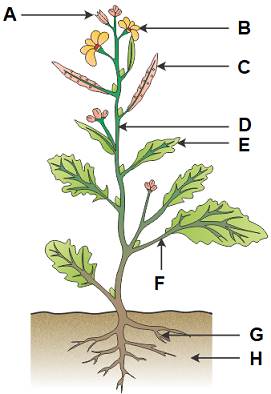
Q.35. Read the functions of parts of a plant given below and write the names of the parts whose functions are mentioned:
(a) Fixes plant to the soil
(b) Prepares starch
(c) Takes part in reproduction
(d) Supports branches and bears flowers
Ans:
(a) Root
(b) Leaf
(c) Flower
(d) Stem
Q.36. What is a battery ? Explain it with a figure.
Ans: When two or more than two electric cells are connected together in such a way that the positive terminal of one cell is connected to the negative terminal of the other, then we call it a battery. A simple connection showing the combination of two electric cells to form a battery is shown as below:

Q.37. (i) Give two examples of periodic motion.
(ii) Why could you not use an elastic measuring tape to measure distance ? What would be some of the problems you would meet in telling someone about a distance you measured with an elastic tape ?
Ans:
(i) Examples of Periodic motion:
(a) Motion of a pendulum.
(b) Motion of a needle of sewing machine. 1
(ii) Elastic substances have the property of elasticity, i.e., these can be stretched by applying some force.
So, elastic tape cannot be used to measure distance. In elastic tape measurement, measurement of same object may be different due to its stretching.
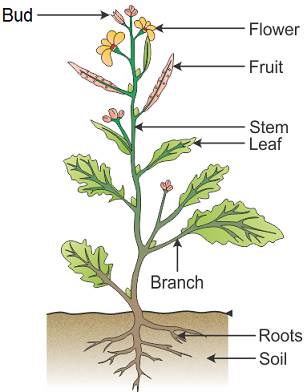
Q.38. Label the different parts of the plant given below in the figure.
Ans:
Online Tuitions & Self-Study Courses for Grade 6 to 12 & JEE / NEET