
Q.1. In which of the
following cases will evaporation of water be slowest?
(a) A tray of water kept in sunlight
(b) A kettle of water kept on a burner
(c) A glass of water kept in a room
(d) A bucket of water kept on rooftop
Q.2. A garbage collector separated the items mentioned below in the garbage into red, green and blue containers for their transfer to landfill, composting pit and recycling unit respectively.
(i) Plastic bags
(ii) Newspapers and journals
(iii) Screw and nuts
(iv) Vegetable peels
(v) Metal chips
(vi) Egg shells
Which items were transferred to which bin?
Q.3. The correct arrangement to store two magnets is
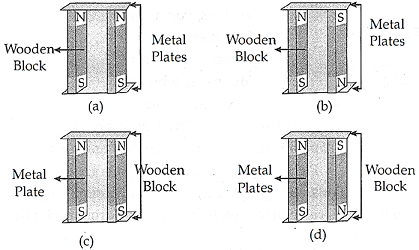
Q.4. Ravi shifted to a
desert. What changes do you expect to observe in Ravi’s urine? Ravi would
(more than 1 options can be correct)
(a) excrete small amount of urine
(b) excrete large amount of urine
(c) excrete concentrated urine
(d) excrete very dilute urine
Q.5. Which of the following organisms does not have both muscles and skeleton for movement ?
(a) Dog
(b) Snail
(c) Earthworm
(d) Human being
Q.6. Which of the things in the following list are non-living ?
Plough, Mushroom, Sewing machine, Radio, Boat, Water hyacinth, Earthworm
Q.7. Which of the
following mixtures would you be able to separate using the method of filtration
?
(a) Oil in water
(b) Cornflakes in milk
(c) Salt in water
(d) Sugar in milk
Q.8. What is used in a torch?
(a) Dry cell
(b) Secondary cell
(c) Generator
(d) Fuse
Q.9. Which of the following is a magnetic material ?
(a) Aluminium
(b) Zinc
(c) Copper
(d) Nickel
Q.10. Transpiration is a process in which plants
(a) receive water from soil
(b) absorb water vapour from air
(c) prepare food from water
(d) release water vapour
Q.11. The components of air which are harmful to living beings are
(a) nitrogen and carbon dioxide
(b) dust and water vapour
(c) dust and smoke
(d) smoke and water vapour
Q.12. What are the conditions for the formation of shadow ?
Q.13. It was observed that a pencil sharpener gets attracted by both the poles of a magnet although, its body is made up of plastic. Name a material that might have been used to make some part of it.
Q.14. Which is the most abundant gas in our atmosphere ?
Q.15. What do you understand by the segregation of garbage ?
Q.16. In a number of musical instruments, air plays an important role. Name some such instruments.
Q.17. Deepti wanted to glow a torch bulb using a cell. She could not get connecting wires. Instead, she got two strips of aluminium foil. Will she succeed ? Explain how ?
Q.18. How will you test that 'tea dust' is not adulterated with iron powder ?
Q.19. How do fish and aquatic plants survive in water ?
Q.20. Is winnowing possible in a closed room? Give reason.
Q.21. Do you think it is better to use compost instead of chemical fertilizers ? Why ?
Q.22. How do rats and snakes escape from the intense heat of the desert ?
Q.23. On a sunny day, does a bird or an aeroplane flying high in the sky cast its shadow on the ground?
Under what circumstances can we see their shadow on the ground ?
Q.24. Name the two kinds of waste that need to be separated from each other in two different waste bins.
Q.25. Name two items of waste that need to be sent to a
(a) landfill
(b) for composting.
Q.26. Write a few sentence for an imaginary situation if any of the following gases disappear from the atmosphere :
(a) oxygen
(b) nitrogen
(c) carbon dioxide
Q.27. Which of the following statements are true and which ones are false ?
(a) Water vapour is present in air only during the monsoon.
(b) Water evaporates into air from oceans, rivers and lakes but not from the soil.
(c) The process of water changing into its vapour is called evaporation.
Q.28. Consider Figures A and B.
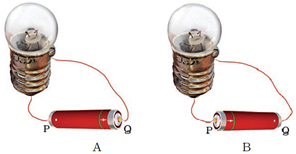
(i) What will be the direction of the current through the bulb in both the cases. (Q to P or P to Q)
(ii) Will the bulb glow in both the cases?
(iii) Does the brightness of the glowing bulb depend on the direction of current through it ?
Q.29. Read the features of plants given below :
(a) Thick waxy stem
(b) Short roots
(c) Cone shaped plants
(d) Sloping branches
(e) Small or spine-like leaves
(f) Hollow stem
Choose the type of plant for every feature given in a, b, c, d, e and f from the list given below:
Aquatic plant, Desert plant, Mountainous plant
Q.30. Which of the non-living things listed below, were once part of a living thing ?
Butter, Leather, Soil, Wool, Electric Bulb, Cooking oil, Salt, Apple, Rubber.
Q.31. Provide one word answers to the statements given below:
(a) Help in the movement of body by contraction and relaxation.
(b) Bones that join with chest bone at one end and to the backbone at the other end.
(c) Framework of bones which gives shape to our body.
Q.32. Differentiate between creepers and climbers.
Q.33. Is it possible to separate sugar mixed with wheat flour? If yes, how will you do it?
Q.34. Suggest an arrangement to store a U shaped magnet. How is this different from storing a pair of bar magnets?
Q.35. Write the main drawbacks of plastics.
Q.36. What is shadow ? Explain a simple process for shadow formation.
Online Tuitions and Self-Study Courses for Grade 6 to 12 & JEE / NEET