
Class 6 Science
Important Objective Questions Part 4
Q.1. In an electric bulb, light is produced due to glowing of
(a) the glass case of the bulb
(b) the thin filament
(c) the thick wires supporting the filament
(d) gases inside glass case of the bulb
Q.2. Identify the insulator in the following.
(a) Air
(b) Copper
(c) Human body
(d) Graphite
Q.3. What win happen when the two magnets shown below are pushed towards each other?

(a) They will heat up
(b) They will attract each other
(c) Nothing will happen
(d) They will repel each other
Q.4. The loss of water from the leaves of plants as water vapour through the stomata is called
(a) respiration
(b) evaporation
(c) transpiration
(d) translocation
Q.5. Nitrogen is needed by the plants to make
(a) fats
(b) carbohydrates
(c) minerals
(d) proteins
Q.6. The colour of dustbins in which biodegradable garbage is collected is
(a) red
(b) green
(c) yellow
(d) orange
Q.7. The important constituent of haemoglobin in the blood is
(a) calcium
(b) iron
(c) iodine
(d) phosphorus
Q.8. While preparing chapatis, your mother found that the flour to be used was mixed with wheat grains. Which out of the following is the most suitable method to separate the grains from the flour?
(a) Threshing
(b) Winnowing
(c) Sieving
(d) Filtration
Q.9. Which of the following terms constitute the female part of the flower?
(a) Sepals, petals and stamen
(b) Stigma, style and ovary
(c) Ovary, stamen and stigma
(d) Ovary, style and stamen
Q.10. The organism that does not have both muscles and skeleton for movement is
(a) dog
(b) human being
(c) earthworm
(d) snail
Q.11. Choose the set that represents only the biotic components of a habitat.
(a) Tiger, deer, grass, soil
(b) Rocks, soil, plants, air
(c) Sand, turtle, crab, rocks
(d) Aquatic plant, fish, frog, insect
Q.12. The height of a man is 1.56 m. The height is equal to
(a) 1560 mm
(b) 156 mm
(c) 15.6 mm
(d) 1560 cm
Q.13. Which part of a mustard plant is edible?
(a) Seeds and flowers
(b) Leaves and flowers
(c) Seeds and leaves
(d) Stems and roots
Q.14. The correct sequence to get cloth is
(a) fibre → fabric → yarn
(b) fibre → yarn → fabric
(c) fabric → yarn → fibre
(d) yarn → fibre → fabric
Q.15. Butter is separated from milk by the process of
(a) sedimentation
(b) filtration
(c) churning
(d) decantation
Q.16. Which of the following has fibrous root?
(a) Peas
(b) Wheat
(c) Radish
(d) Neem
Q.17. The body part used by a snake for locomotion is
(a) legs
(b) feet
(c) fins
(d) whole body
Q.18. The motion exhibited by the bullet fired from the gun is
(a) rotational motion
(b) circular motion
(c) rectilinear motion
(d) periodic motion
Q.19. Filament of a bulb is made up of
(a) aluminum
(b) chromium
(c) platinum
(d) tungsten
Q.20. The magnetic force is maximum at
(a) north pole
(b) south pole
(c) magnetic pole
(d) self demagnetisation
Q.21. Which part of the following bar magnet has the strongest pull?
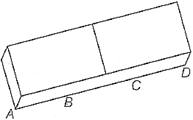
(a) A
(b) B
(c) C
(d) D
Q.22. Circulation of water between ocean and land is known as
(a) water cycle
(b) rain cycle
(c) water management
(d) water harvesting
Q.23. Envelope of air that surrounds the earth is known as
(a) biosphere
(b) hydrosphere
(c) atmosphere
(d) ecosystem
Q.24. 3R's means
(a) rotting, reduce and reuse
(b) rain, reuse and recycle
(c) recycle, rain and rotting
(d) reduce, reuse and recycle
Q.25. One of the following plants has two parts which can be eaten as food. This plant is
(a) wheat
(b) maize
(c) mustard
(d) bengal gram
Q.26. Which part of the jute plant is used for getting jute fibre?
(a) Flower
(b) Stem
(c) Fruit
(d) Leaf
Q.27. A mixture of ammonium chloride and sand is separated by
(a) evaporation
(b) decantation
(c) sublimation
(d) filtration
Q.28. Which one of the following does not have branches?
(a) Neem tree
(b) Oak tree
(c) Banyan tree
(d) Coconut tree
Q.29. Which of the following animals, the term 'slither' is associated?
(a) Snake
(b) Snail
(c) Earthworm
(d) Fish
Q.30. Which of the following modes of transport is not based on the invention of wheel?
(a) Bullock cart
(b) Boat
(c) Bicycle
(d) Bus
Q.31. An example of non-conductor of electricity is
(a) coin
(b) battery
(c) rubber glove
(d) metal spoon
Q.32. Identify the natural magnet.
(a) Magnetite
(b) Haematite
(c) Bakelite
(d) Copper
Q.33. We can use a magnet to separate
(a) rubber bands from pieces of aluminium foil
(b) pieces of copper wire from glass beads
(c) steel staples from sand
(d) steel bottle caps from iron fillings
Q.34. Which of the following is the purest form of natural water?
(a) Well water
(b) Spring water
(c) Rainwater
(d) River water
Q.35. The major constituent of the air is
(a) nitrogen
(b) oxygen
(c) carbon dioxide
(d) hydrogen
Q.36. Which of the following cannot be recycled?
(a) Book
(b) Wooden stool
(c) Mirror
(d) Tin can
Q.37. Given below is the list of edible plants.
(i) Banana (ii) Pumpkin (iii) Lady's finger (iv) Brinjal
Which pair of plants has two or more edible parts?
(a) (i) and (ii)
(b) (ii) and (iii)
(c) (iii) and (iv)
(d) (i) and (iv)
Q.38. The process of separating cotton fibres from the seeds is called
(a) knitting
(b) loading
(c) seeding
(d) ginning
Q.39. The process of conversion of water vapours into liquid is called
(a) condensation
(b) decantation
(c) sedimentation
(d) evaporation
Q.40. Plants take carbon dioxide from air through tiny openings found in the
(a) fruits
(b) leaves
(c) roots
(d) stems
Q.41. Which of the following animal moves with just one large, disc-shaped muscular foot?
(a) Earth warm
(b) Tortoise
(c) Snail
(d) Cockroach
Q.42. Length can be measured by using a
(a) clock
(b) measuring cylinder
(c) beam balance
(d) scale
Q.43. In an electric cell, the side with the metal cap is
(a) bulb
(b) positive terminal
(c) negative terminal
(d) filament
Q.44. Magnets have a shape of
(a) cylindrical
(b) ball ended
(c) horse shape
(d) all of these
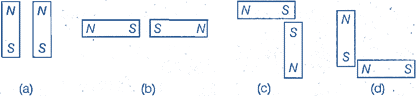
Q.45. Which pair of magnets will attract each other?
Q.46. The process of conversion of water into vapours is called
(a) transpiration
(b) evaporation
(c) condensation
(d) sublimation
Q.47. Which of the following is not the property of air?
(a) It occupies space
(b) It’s transparent
(c) It’s a solution
(d) It’s a compound
Q.48. Rotting is carried out by
(a) ants
(b) insects
(c) Amoeba
(d) microbes
Q.49. Read the names.
(I) Goat(Ill) Cockroach(II) Human beings (IV) Eagle
Which of the above animals form a pair of omnivorous?
(a) (I) and (II)
(b) (II) and (III)
(c) (Ill) and (IV)
(d) (II) and (IV)
Q.50. If a piece of fabric burns by giving the smell of charred meat, it is most likely to be made up of
(a) cotton
(b) jute
(c) silk
(d) wool
Q.51. Threshing is done by
(a) beating
(b) bullocks
(c) machines
(d) All of these
Q.52. Which of the following plants is not an herb?
(a) Sunflower
(b) Rose
(c) Mustard
(d) Radish
Q.53. The animal whose movement is termed as creeping is
(a) cockroach
(b) snake
(c) snail
(d) fish.
Q.54. Which type of motion do the vehicles on a straight road perform?
(a) Rotational motion
(b) Rectilinear motion
(c) Circular motion
(d) Periodic motion
Q.55. How many terminals are there in a dry cell?
(a) One
(b) Two
(c) Three
(d) four
Q.56. An example of magnetic substance.
(a) Iron
(b) Nickel
(c) Cobalt
(d) All of these
Q.57. Which part of the following rod magnet has the weakest pull?

(a) A
(b) B
(c) C
(d) D
Q.58. The percentage of water in potato is
(a) 88
(b) 75
(c) 90
(d) 95
Q.59. The component of air which is utilised by the plants in respiration is
(a) nitrogen
(b) carbon dioxide
(c) oxygen
(d) water vapour
Q.60. After recycling, newspaper can be made into
(a) bricks
(b) wooden plank
(c) cardboard
(d) cloth
Q.61. Fil in the blanks.
(a) Human beings eat plant products as well as animals, so they are ________.
(b) The common name of coconut fibre is ________.
(c) The motion which repeats itself after regular interval of time is called ________.
(d) The switch is a simple device which is used to ________ or _______ a circuit.
Q.62. Correct the following statements.
(a) The same type of magnetic poles are called unlike poles.
(b) Our hand is made up of two parts as palm and fingers.
(c) The length of a curved line can be measured by using a scale.
(d) The number of petals and sepals in a flower is always equal.
Q.63. (a) Read the clues and fill up the blanks given below each of them.
(i) Crows and jackals belong to the group: _ _ A V _ _ G E _ _
(ii) It is a feature that helps an organism to survive in a particular type of habitat:
_ _ A P T _ T _ _ N
(iii) Anything that occupies space and has mass: _ A _ _ E _
(b) Find the odd one out in the following groups of waste materials.
(i) Cotton, wool, silk, nylon.
(ii) Saree, kurta, turban, dhoti.
Q.64. Fill in the blanks.
(a) Human beings are __________.
(b) The process of separating cotton fibre from the seeds is called ____________.
(c) Rose plant is a __________, whereas tomato plant is an herb.
(d) Every measurement consists of a number and a ___________.
Q.65. Correct the following statements.
(a) Bees use leaves to collect nectar.
(b) There are 260 bones in the human skeleton.
(c) The outer covering of electric wires is made up of metals.
(d) Liquids change their shape and volume.
Q.66. (a) Read the clues and fill up the blanks given below each of them
(i) Region with the absence of light: _ H _ D _ W
(ii) Separating grains from its stalks: T _ R _ S _ I _ G
(iii) Increase in size and total weight of the living organism: _ _ O _ T _
(b) Find the odd one out from the following groups.
(i) Sand, wax, sugar, kerosene oil, ghee.
(ii) Sponge, wool, diamond, chalk, tomato.
Q.67. Fill in the blanks.
(a) We feel ________ when we have no food for some time.
(b) Terylene is a __________ fibre.
(c) Thick vein in the centre of leaf is called __________.
(d) _________ is used as a standard unit for measuring the length of an object.
Q.68. Correct the following statements.
(a) Sprouted seeds give energy less than, dry seeds.
(b) The joint which allows movement in all the directions is called hinge joint.
(c) Electric current can pass through a sheet of thermocol.
(d) Solids can easily change their shape or volume.
Q.69. (a) Read the clues and fill up the blanks given below each of them.
(i) Formed due to reflection by mirrors _ M _ _ E.
(ii) Deficiency of vitamin-D causes disease _ I _ K _ T _.
(iii) Setting of heavier components at bottom. _ E _ _ ME _ _ A _ _ ON
(b) Find the odd one out in the following groups
(i) Sugar, salt, sand, alcohol, alum
(ii) Glass, air, water, oil, clouds
Q.70. Fill in the blanks.
(a) Each of us should make sure not to ________ food.
(b) In villages, the cloth is woven on small scale in _________.
(c) The fine hair-like structures on the lateral roots are __________.
(d) 3250 m is equal to __________ km.
Q.71. Correct the following statements.
(a) All living organisms eat the same kind of food.
(b) The cartilages are harder than bones.
(c) Current flows from negative terminal of cell to its positive terminal.
(d) Gases cannot change their shape and volume.
Q.72. (a) Read the clues and fill up the blanks given below each of them.
(i) Object through which one cannot see at all: _ P _ Q _ E
(ii) Deficiency of vitamin C causes a disease: _ C _ R _ Y
(iii) Separating insoluble substances from a liquid: _ _ L _ R A _ _ O _
(b) Find the odd one out in the following groups
(i) Aluminium, iron, copper, silver, sand.
(ii) Brick, stone, glass, bone, cotton.
Q.73. Fill in the blanks.
(a) Tiger eats only meat, so it is a ___________.
(b) Jute is grown in ________ soil.
(c) ___________ is the lower most part of a pistil.
(d) One metre is _________ mm.
Q.74. Correct the following statements.
(a) Honey is a plant product.
(b) Man can stand straight because of the presence of muscles.
(c) In a torch, cells are joined in parallel arrangement.
(d) Oxygen gas is insoluble in water.
Q.75. (a) Read the clues and fill up the blanks given below each of them.
(i) Object through which one can see clearly: T _ _ N S _ _ R E _ T
(ii) Body building food: _ R _ T _ I _
(iii) Separating husk from grains with the help of wind: _ I _ _ O _ I _ G
(b) Find the odd one out in the following groups.
(i) Chair, bed, table, baby, cupboard.
(ii) Rose, jasmine, lotus, mushroom.
Online Tuitions & Self-Study Courses for Grade 6 to 12 & JEE / NEET