
Class 6 Science Important Questions
Chapter 15 Air Around Us
Q.1: What is the composition of air?
Ans: Air is a mixture of gases, water vapour and dust particles. Largely, it consists of
(i) Nitrogen (78%)
(ii) Oxygen (21 %)
(iii) Carbon dioxide (0.03 %)
(iv) Other gases like helium, hydrogen, etc (0.17%)
(v) Water vapour and dust particles
Q.2: Which gas in the atmosphere is essential for respiration?
Ans: Oxygen is essential for respiration.
Q.3: How will you prove that air supports burning?
Ans: We take a glass container and fix a candle on its base. Fill half the container with water. Dissolve some caustic soda (sodium hydroxide) in this water to form caustic soda solution. Also add a few drops of ink in water to colour it.
(i) We light the candle with a matchstick. Cover the burning candle by placing an inverted glass over it.
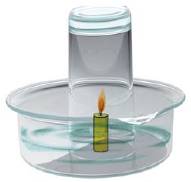
(ii) After a short time, the candle stops burning and water rises up in the glass to a certain level. The candle stops burning because all the oxygen of air present in the glass is used up by the burning candle. Oxygen is a supporter of combustion (or burning). So, when oxygen present in air contained in the glass is all used up, the burning candle gets extinguished.
(iii) When the candle burns, then oxygen of air in the glass is used up and carbon dioxide gas is formed. This carbon dioxide gas is absorbed (or dissolved) by the caustic soda solution in the container. The absorption of carbon dioxide gas by caustic soda solution creates a vacuum (low pressure) in the glass, and water rises up in the glass to fill this vacuum.
(iv) Water in the glass rises to about one-fifth part of the volume of air initially present in the glass. The volume of water risen in the glass is equal to the volume of oxygen present in the air in the glass (which was consumed during the burning of candle). From this we conclude that about one-fifth of air is oxygen.
Q.4: How will you show that air is dissolved in water?
Ans: Activity to show that freshwater contains dissolved air:
We take a tumbler/pan filled with water and keep it on a tripod stand. Heat the water slowly by using a burner. Before the water begins to boil, watch carefully at the inner surface of the tumbler/pan, tiny bubbles appear on the inner surface of the tumbler/pan. These bubbles are of the air which was dissolved in water.

If we continue heating, the water itself turns into vapour and finally begins to boil. We conclude that the air (mostly oxygen) dissolves slowly in freshwater.
When the water is warmed, the solubility of air decreases and it comes out of water in the form of bubbles. Hence, water contains dissolved air (oxygen). All the aquatic animals and plants thus survive by using this oxygen.
Q.5: Why does a lump of cotton wool shrink in Water?
Ans: Lump of cotton wool has air among gaps of cotton fibres. When dipped in water, air from these gaps is replaced by water. The cotton lump becomes heavy and also shrinks due to removal of air gaps.
Q.6: The layer of air around the earth is known as ......... .
Ans: Atmosphere.
Q.7: The component of air used by green plants to make their food is ......... .
Ans: Carbon dioxide.
Q.8: List five activities that are possible due to the presence of air.
Ans: The following activities are possible due to the presence of air:
(i) Respiration by animals.
(ii) Photosynthesis by plants.
(iii) Power generation by windmills.
(iv) Burning of fuels and substances.
(v) Scattering of seeds and pollens of plants (pollination).
(vi) Movements of sailing yachts, gliders, parachutes and aeroplanes.
Q.9: How do plants and animals help each other in the exchange of gases in the atmosphere?
Ans: There is an interdependence of plants and animals on each other for exchange of gases. Plants take carbon dioxide from the atmosphere and prepare food. This is called photosynthesis. During this process, plants give out oxygen to the atmosphere. Animals inhale this oxygen and gives out carbon dioxide to the atmosphere. Therefore, plants and animals help each other in the exchange of gases in the atmosphere.
Q.10: In a number of musical instruments, air plays an important role. Can you name some such instruments?
Ans: Air plays an important role in number of musical instruments such as flute, trumpet harmonium.
Q.11: write the name of gas in atmosphere used in the soft drink bottles.
Ans: Carbon dioxide is used in the soft drink bottles.
Q.12: Policemen use the masks for what reason?
Ans: To prevent inhalation of smoke given out by automobiles, policemen use masks.
Q.13: Oxygen and nitrogen form 99% of the air. Other 1% is constitute by which components?
Ans: 1% of air includes carbon dioxide (CO2), water vapours, helium, hydrogen, dust particles and smoke.
Q.14: We say that air is present everywhere. Have you ever seen it, what make you say so?
Ans: No, air cannot be seen but it can be felt during wind, fluttering of leaves, etc.
Q.15: Air is necessary for burning. Yes/No? Give reason for your answer.
Ans: Yes, because oxygen present in air supports burning.
Q.16: Air can be used to generate electricity. How?
Ans: Air generates electricity through windmills.
Q.17: Due to the presence of which gas, when air is passed through lime water, turns it milky?
Ans: Carbon dioxide turns lime water milky. It is a constituent of air.
Q.18: During rainfall, the spaces between soil particles are filled with water. How do then organisms of soil breathe?
Ans: Organisms present in soil come out of their holes and burrows for breathing.
Q.19: Give reason why do factories have tall chimneys.
Ans: Tall chimneys take the smoke produced by factories high up in air to reduce harmful effects on ground.
Q.20: Carbon dioxide gas is used to extinguish fire. Give reason.
Ans: Carbon dioxide does not support combustion. When sprayed on burning object, it stops the supply of oxygen and extinguishes fire.
Q.21: Why do mountaineers carry oxygen cylinders with them?
Ans: As we go up above the sea-level, the atmospheric pressure goes on decreasing and the amount of oxygen also decreases at higher altitude.
Q.22: Name the sources of carbon dioxide in air.
Ans: Respiration by animals and plants and burning of fuel.
Identify the major components of air present in the
Q.23: (a) inhaled air (b) exhaled air
Ans: (a) Oxygen (b) Carbon dioxide
Q.24: Gases are present in certain ratios in air. Can you tell the relative proportions of nitrogen and oxygen in air?
Ans: Nitrogen and oxygen are present in the ratio of 4 : 1 by volume in air.
Q.25: A gas is given to the patients having breathing problems. Which gas is it?
Ans: Oxygen.
Q.26: Make sentences using the. given set of words.
(a) 99%, oxygen, nitrogen, air, together
(b) Respiration, dissolved, animals, air, aquatic
(c) Air, wind, motion, called
Ans: The correct sentences are
(a) Oxygen and nitrogen together make up 99% of the air.
(b) Aquatic animals use dissolved air for respiration.
(c) Air in motion is called wind.
Q.27: Oxygen occupies how much part of the air?
Ans: Oxygen occupies  part of the air.
Q.28: State one biological importance of air dissolved in water.
Ans: Dissolved air helps aquatic animals for breathing.
Q.29: Oxygen is released by plants. How?
Ans: Plants release oxygen during photosynthesis.
Q.30: A place without air is called ________ . Give an example.
Ans: A place without air is called vacuum. Example space.
Q.31: Name the major part of air that does not support burning.
Ans: Nitrogen does not support burning.
During any fire incident, it is advised to
(a) wrap a towel or woollen blanket over the burning object.
(b) use a fire extinguisher to stop the fire.
Q.32: Why are these methods advised? Give reasons.
Ans: Fire or burning is supported by air. In order to stop it
(a) the towel or woollen blanket can be used, which cuts off the supply of air (oxygen) which supports burning. As the supply of oxygen is cut out, fire is eventually extinguished.
(b) a fire extinguisher contains carbon dioxide gas which does not support burning. So, when fire extinguisher is used over the area, CO2 cuts off the oxygen supply from air causing fire to extinguish.
Q.33: When an empty glass bottle is inverted and inserted into a trough filled with water, water does not enter the bottle. Specify.
Ans: Water does not enter into an inverted glass bottle because even when the bottle appears empty, it’s not. Air is present inside the bottle. All the space in the bottle is occupied by air. This air prevents the water from entering inside the bottle.
As we tilt the bottle, air present inside moves out. As air comes out, the space becomes empty allowing the entry of water. The space vacated by leaving of air is then occupied by water.
Q.34: Sara and her friend visited a garden to see some flowering plants. While returning from the garden, they observed some flowering plants on the roadside. The leaves and flowers of these roadside plants were comparatively very dull. Explain why?
Ans: The leaves and flowers of the roadside plants are very dull because the air along the roadside is polluted with air pollutants due to emissions from vehicles and industries, etc. Thus, the roadside plants had some dust and soot deposited on them. This made them appear dull.
Q.35: Air takes the shape, smell, etc from the objects, it is place in. Explain.
Ans: Air does not have a fixed shape or size of its own because it is a gaseous mixture whose particles are very loose, thus not able to form a fixed shape.
If air is blown in a balloon of round shape, it takes its shape. Similarly; air can be. enclosed in packets of chips different in shape and size.
Like water, air also has no smell. It carries the odour of whatever is present in the surroundings. We can smell a nice perfume or a bad smell because air carries the smell.
Q.36: Observe the figure given below depicting distribution of some components present in air and answer the following questions:
(a) Identify all the components.
(b) What purpose is served by component (iii)?
(c) Do the values or percentages of these components vary?

Ans:
(a) (i) Nitrogen, (ii) CO2, water vapour, other gases and dust particles, (iii) Oxygen
(b) Component (iii) is oxygen. It is used by humans and animals for respiration. It also helps in combustion/burning.
(c) Yes, the composition of air is not always exactly the same. It changes slightly from place to place.
Q.37: A transparent glass window appears hazy when not wiped off regularly. Explain the reason?
Ans: Air is present everywhere and it contains some gases, water vapours and dust particles that stick to the window surface and are visible due to the transparency of windows.
These particles attract outdoor elements like pollens, etc. which collect on glass window and together form a layer. That is why, transparent glass windows appear hazy if not wiped off regularly.
Q.38: (a) Name one process which removes carbon dioxide from air.
(b) Suggest two processes which put back carbon dioxide into air.
Ans:
(a) Photosynthesis by plants.
(b) Respiration by plants and animals and burning of fuels.
Q.39: Mention some uses of air.
Ans: Some uses of air are
(i) For respiration, all living organisms need air.
(ii) For burning of any substance, air is required.
Q.40: Write the necessary conditions for rusting of iron to take place.
Ans: Rusting of iron takes place in the presence of moisture and air, so the presence of air and water vapour in air are two necessary conditions for rusting of iron.
Q.41: Observe the given figure carefully and answer the following questions:
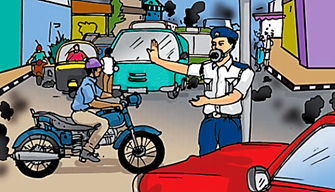
(a) What is covering the nose and mouth of the policeman?
(b) Why is he putting a cover on his nose?
(c) Comment on air quality of the place as shown in the figure.
Ans:
(a) Mask is covering the nose and mouth of the policeman.
(b) Policeman is putting a cover on his nose to save himself from dirt/polluted air.
(c) Air quality of the place is not good. It is due to the smoke and gases emitted by the automobiles along with dust particles present in the air.
Q.42: When a tightly capped bottle full of water, is kept in the open sunlight, tiny bubbles are formed all around inside the bottle. Explain the reason.
Ans: Air is dissolved in water in the form of oxygen. When water bottle is left in the open sunlight, tiny bubbles were formed all around inside the bottle because air dissolved in water starts escaping in the form of tiny bubbles due to heat from the sun.
Q.43: Nitrogen in air is important for living organisms. Explain.
Ans: Nitrogen in air is used for manufacturing food by the plants produced by nitrogen fixation of atmospheric nitrogen into nitrates which mix with the soil. The plants absorb these as their food, so it is necessary and important for living organisms.
Q.44: The gas Y is colourless and odourless having a slightly sour taste and is a minor component of air. It is moderately soluble in water. This gas neither burns nor supports burning. It rather extinguishes a burning fire. If there were no gas Y in air, there would be no animals or plants on the earth.
(a) Identify gas Y.
(b) In what percentage, gas Y is present in air?
(c) State two ways in which gas Y is added to the air.
(d) Gas Y is necessary for the existence of life. Why?
Ans: (a) Carbon dioxide (b) 0.03%
(c) (i) Respiration of living organisms.
(ii) Burning of fuels by human beings.
(d) All the food which animals eat is made from carbon dioxide gas of the air.
Q.45: Explain what makes the carbon dioxide gas present in air necessary for all living beings.
Ans: The presence of small amount of carbon dioxide gas in the atmosphere is essential for the growth and existence of living beings. The desirable proportion of carbon dioxide in the atmosphere is 0.03%. The importance of carbon dioxide in atmosphere is as follows
(i) It causes greenhouse effect, leading to the heating of the earth and its atmosphere which is essential for our survival.
(ii) It takes part in the photosynthesis process carried out by green plants to prepare food for plants and animals.
Q.46: John observed that in a dark room, through the passing beam of light from a hole in the window, tiny particles were moving in the room.
(a) What has John actually observed in the room?
(b) We breathe air regularly so how do we prevent these particles from entering our body? From where does these particles come?
(c) Does breathing through mouth a good practice?
Ans: (a) John observed the presence of dust particles in air. These particles are present at all times in air.
(b) Our nostrils contain small hair. A mucous lining covers the entire respiratory tract. The hair and mucous trap the dust particles when they enter during inhalation and push them out through sneezing. These dust particles are produced due to regular activities like cleaning and dusting of house, construction of buildings, vehicles driving, etc.
(c) No, breathing through mouth allows the entry of harmful things in our body like dust particles, microorganisms, etc as mouth has no ways to prevent their entry.
Q.47: Gauri kept some water in a beaker for heating. She observed that tiny bubbles appeared before the water started to boil. She boiled the water for about 5 minutes and filled it in a bottle upto the brim and kept the bottle airtight till cooled down to room temperature.
(a) Why did the tiny bubbles appear?
(b) Do you think tiny bubbles will appear on heating the water taken out from the bottle? Justify your answer.
Ans:
(a) Air is dissolved in water in the form of oxygen. Tiny bubbles are formed, when air present in the water escape on boiling it. So, tiny bubbles appeared due to the evolution of air dissolved in water.
(b) No, tiny bubbles will not appear as there is no dissolved air in this water.
Q.48: Define air. Name the major constituents of air. Give their volume proportions in air.
Ans: Air is a mixture of gases. The major composition of air is oxygen, nitrogen, carbon dioxide, etc. The percentage composition of constituents of air are given below:

Nitrogen: 78% Oxygen: 20.9%, Argon: 0.9%
Carbon dioxide: 0.035-0.045% Water vapour: 0.03%, dust, etc.
Q.49: During water diving, Kishore and his friends felt nauseous and had breathing difficulties.
(a) Explain the reason behind the symptoms faced by Kishore and his friends?
(b) How can one recover from this situation?
(c) Give two more special situations where same symptoms can develop?
(d) If we suffer from breathing problems in deep water. How do plants and animals living in water cope?
Ans:
(a) Kishore and his friends went deep sea diving where the level of oxygen is reduced. Due to lack of sufficient oxygen supply, problems in breathing occur.
(b) By carrying oxygen cylinders, this situation can be overcome.
(c) Two more situations include
(i) Mountain climbing.
(ii) Patients with breathing problems.
(d) Plants and animals living in the water use dissolved oxygen, i.e. oxygen gas dissolved in water for respiration through special organs or pores.
Q.50: Write a few sentences for an imaginary situation if any of the following gases disappear from the atmosphere.
(a) Oxygen (b) Nitrogen (c) Carbon dioxide
Ans: (a) There will be no life on the earth. Oxygen is vital for life. it helps in burning, respiration, photosynthesis, etc. Oxygen is basic need of all living beings.
(b) Nitrogen does not support burning. If nitrogen gas disappears from the atmosphere, things will burn very fast.
(c) Carbon dioxide is needed for photosynthesis which occurs in green plants. In its absence, plants will not be able to prepare their food and hence, there will be no life on the earth.
Q.51: Explain the following observations briefly.
(a) A firki does not rotate in a closed area.
(b) The arrow of weather cock points towards a particular direction at a particular moment.
(c) An empty glass in fact is not empty.
(d) Breathing through mouth may harm you.
Ans: (a) Motion of firki is based on the pressure/force applied by air on the blades of the firki. A firki does not rotate in a closed area because of lack of air movement.
(b) The arrow of weather cock points towards a particular direction as it shows the direction in which the air is moving at that place at a particular moment.
(c) An empty glass in fact is not empty because it is filled with air. Air is present everywhere.
(d) Breathing through mouth may harm us because we may inhale dust if present in air which is harmful.
Q.52: Humans and animals use oxygen for respiration and plants require carbon dioxide for photosynthesis. How are these two processes related?
Ans: Humans and animals use oxygen present in the environment to carry out respiration and release CO2 as a by-product of this process. Plants perform photosynthesis by using this CO2 present in the atmosphere accumulated due to activities of humans and animals. They release oxygen as their reaction by product which also gets out in the atmosphere.
Plants depend on humans and the activities performed by them like burning of fuels, etc for CO2 and humans depend on plants for a continuous oxygen supply. Thus, these two processes maintain a unique balance between O2 and CO2 concentration in our environment.
Q.53: Match the items of Column I with the items of Column II
|
Column I |
Column II |
|
(a) Weather cock |
(i) gases and fine dust particles |
|
(b) Mountaineers |
(ii) sailing yacht |
|
(c) Fine hair inside the nose |
(iii) oxygen cylinders |
|
(d) Smoke |
(iv) direction of air flow |
|
(e) Wind |
(v) prevent dust particles |
Ans: (a) → (iv), (b) → (iii), (c) → (v), (d) → (i), (e) → (ii)
****** End of Questions ******
Examium Classes
Online Tuitions and Self-Study Courses for Class 6 to 12 and JEE / NEET