
Class 6 Maths NCERT
Solutions
Chapter 9 Data
Handling
Exercise 9.1
Q.1. In a Mathematics test, the following
marks were obtained by 40 students. Arrange these marks in a table using tally
marks.
|
8 |
1 |
3 |
7 |
6 |
5 |
5 |
4 |
4 |
2 |
|
4 |
9 |
5 |
3 |
7 |
1 |
6 |
5 |
2 |
7 |
|
7 |
3 |
8 |
4 |
2 |
8 |
9 |
5 |
8 |
6 |
|
7 |
4 |
5 |
6 |
9 |
6 |
4 |
4 |
6 |
6 |
(a) Find how many students obtained marks equal to
or more than7.
(b) How many students obtained marks below 4?
Ans: Considering the marks obtained by 40 students in
the test, we can construct the table as follows.
|
Mark |
Tally Mark |
Number of
Students |
|
1 |
|
2 |
|
2 |
|
3 |
|
3 |
|
3 |
|
4 |
|
7 |
|
5 |
|
6 |
|
6 |
|
7 |
|
7 |
|
5 |
|
8 |
|
4 |
|
9 |
|
3 |


(a) The students who obtained equal to or more than
7 marks, are those who obtained 7, 8, or 9 marks.
Hence, number of students who obtained equal to or
more than 7 marks
= 5 +
4 + 3
= 12
(b) The students who obtained less than 4 marks,
are students who got 1, 2, or 3 marks.
Hence, students who obtained less than 4 marks = 2
+ 3 + 3 = 8
Q.2. Following is the choice of sweets of 30
students of Class VI.
Ladoo, Barfi, Ladoo, Jalebi, Ladoo, Rasgulla, Jalebi, Ladoo, Barfi, Rasgulla, Ladoo, Jalebi, Jalebi, Rasgulla, Ladoo, Rasgulla, Jalebi, Ladoo, Rasgulla, Laddo, Ladoo, Barfi, Rasgulla, Rasgulla, Jalebi, Rasgulla, Ladoo, Rasgulla, Jalebi, Ladoo.
(a) Arrange the names of sweets in a table using
tally marks.
(b) Which sweet is preferred by most of the
students?
Ans:
(a)
|
Sweet |
Tally Mark |
Number of Students |
|
Ladoo |
|
11 |
|
Barfi |
|
3 |
|
Jalebi |
|
7 |
|
Rasgulla |
|
9 |
|
30 |

(b) Ladoo
is the most preferred sweet as the most of the students prefer Ladoos.
Q.3. Catherine threw a dice 40 times and
noted the number appearing each time as shown below:
|
1 |
3 |
5 |
6 |
6 |
3 |
5 |
4 |
1 |
6 |
|
2 |
5 |
3 |
4 |
6 |
1 |
5 |
5 |
6 |
1 |
|
1 |
2 |
2 |
3 |
5 |
2 |
4 |
5 |
5 |
6 |
|
5 |
1 |
6 |
2 |
3 |
5 |
2 |
4 |
1 |
5 |
Make a table and enter the data using tally marks.
Find the number that appeared.
(a) The minimum number of times
(b) The maximum number of times
(c) Find those numbers that appear an equal number
of times.
Ans:
|
Number |
Tally mark |
Number of Times |
|
1 |
|
7 |
|
2 |
|
6 |
|
3 |
|
5 |
|
4 |
|
4 |
|
5 |
|
11 |
|
6 |
|
7 |

(a) The number which appeared the minimum number of
times (i.e., 4 times) is 4.
(b) The number which appeared the maximum number of
times (i.e., 11 times) is 5.
(c) 1 and 6 are the numbers which appear for the
same number of times (i.e., 7 times).
Q.4. Following pictograph shows the number
of tractors in five villages.
|
Village |
Number of Tractors |
|
Village A |
|
|
Village B |
|
|
Village C |
|
|
Village D |
|
|
Village E |
|

Observe the pictograph and answer the following
questions.
(i) Which village has the minimum number of
tractors?
(ii) Which village has the maximum number of
tractors?
(iii) How many more tractors village C has as
compared to village B.
(iv) What is the total number of tractors in all
the five villages?
Ans:
(i) Village D
has the minimum number of tractors, i.e., only 3
tractors.
(ii) Village C
has the maximum number of tractors, i.e., 8 tractors.
(iii) Number of more tractors that village C has =
8 − 5 = 3
(iv) Total number of tractors in all these villages
= 6 + 5 + 8 + 3 + 6 = 28
Q.5. The number of girl students in each
class of a co-educational middle school is depicted by the pictograph:
|
Class |
Number of Girl
Students |
|
I |
|
|
II |
|
|
III |
|
|
IV |
|
|
V |
|
|
VI |
|
|
VII |
|
|
VIII |
|


Observe this pictograph and answer the following
questions:
(a) Which class has the minimum number of girl
students?
(b) Is the number of girls in Class VI less
than the number of girls in Class V?
(c) How many girls are there in Class VII?
Ans: From the above table, it can be concluded that in
classes I, II, III, IV, V ,VI, VII, VIII, there are 24, 18, 20, 14, 10 , 16,
12, 6 girls respectively.
(a) Class VIII has
the minimum number of girls, i.e., only 6 girls.
(b) No. In class V and VI, there are 10 and
16 girls respectively. Clearly, the number of girls is more in class VI than
that in class V.
(c) There are 12 girls
in class VII.
Q.6. The sale of electric bulbs on different
days of a week is shown below:
|
Day |
Number of electric bulbs |
|
Monday |
|
|
Tuesday |
|
|
Wednesday |
|
|
Thursday |
|
|
Friday |
|
|
Saturday |
|
|
Sunday |
|

What can we conclude from the said pictograph?
Ans: From the pictograph, we get following information.
(a) Number of bulbs sold on Monday, Tuesday,
Wednesday, Thursday, Friday, Saturday, and Sunday are 12, 16, 8, 10, 14, 8, and
18 respectively.
(b) The maximum numbers of bulbs (i.e., 18) were
sold on Sunday.
(c) Equal numbers of bulbs (i.e., 8) were sold on
Wednesday and Saturday.
(d) The minimum numbers of bulbs (i.e., 8) were
sold on Wednesday and Saturday.
(e) Total bulbs sold in the week = 12 + 16 + 8 + 10
+ 14 + 8 + 18 = 86
Q.7. In a village, six fruit merchants sold
the following number of fruit baskets in a particular season:
|
Name of
fruit merchant |
Number of
fruit baskets |
|
Rahim |
|
|
Lakhanpal |
|
|
Anwar |
|
|
Martin |
|
|
Ranjit
Singh |
|
|
Joseph |
|


Observe this pictograph and answer the following
question:
(a) Which merchant sold the maximum number of
baskets?
(b) How many fruit baskets were sold by Anwar?
(c) The merchants who have sold 600 or more number
of baskets are planning to buy a godown for the next season. Can you name them?
Ans: From the above pictograph, it can be observed that
the number of fruit baskets sold by Rahim, Lakhanpal, Anwar, Martin, Ranjit
Singh, and Joseph are 400, 550, 700, 950, 800, and 450 respectively.
(a) Martin
sold the maximum number of baskets, i.e., 950.
(b) Anwar sold 700 baskets.
(c) Anwar,
Martin,
and Ranjit Singh are the three merchants who have sold
more than 600 baskets. Therefore, they are planning to buy a godown for the
next season.
Exercise 9.2
Q.1. Total number of animals in five
villages are as follows:
Village A : 80 Villages B : 120
Village C : 90 Village D : 40
Village E : 60
Prepare a pictograph of these animals using one
symbol  to represent 10 animals and answer the
following questions:
to represent 10 animals and answer the
following questions:
(a) How many symbols represent animals of village
E?
(b) Which village has the maximum number of
animals?
(c) Which village has more animals: village A or
village C?
Ans: The pictograph for the given data can be drawn as
follows.
|
Village |
Number of
animals |
|
Village A |
|
|
Village B |
|
|
Village C |
|
|
Village D |
|
|
Village E |
|


(a) 6 symbols will represent animals of
village E as there were 60 animals in this village.
(b) Village B
has the maximum number of animals i.e., 120.
(c) Village A and C have 80 and 90 animals in it.
Clearly, Village C has more animals.
Q.2. Total number of students of a school in
different years is shown in the following table
|
Year |
Number of Students |
|
1996 |
400 |
|
1998 |
535 |
|
2000 |
472 |
|
2002 |
600 |
|
2004 |
623 |
A. Prepare a pictograph of students using one
symbol  to
represent 100 students and answer the following questions:
to
represent 100 students and answer the following questions:
(a) How many symbols represent total number of
students in the year 2002?
(b) How many symbols represent total number of
students for the year 1998?
B. Prepare another pictograph of students using any
other symbol each representing 50 students. Which pictograph do you find more
informative?
Ans:
A.
|
|
|
|
1996 |
|
|
1998 |
|
|
2000 |
|
|
2002 |
|
|
2004 |
|


(a) 6 symbols
represent the total number of students in the year 2002.
(b) 5 complete and 1 incomplete symbols represent the total number of students
in the year 1998.
B. For second graph, let’s consider 50 students persymbol.
|
|
|
|
1996 |
|
|
1998 |
|
|
2000 |
|
|
2002 |
|
|
2004 |
|


Second pictograph is more informative.
Exercise 9.3
Q.1. The bar graph given alongside shows the
amount of wheat purchased by government during the year 1998-2002.
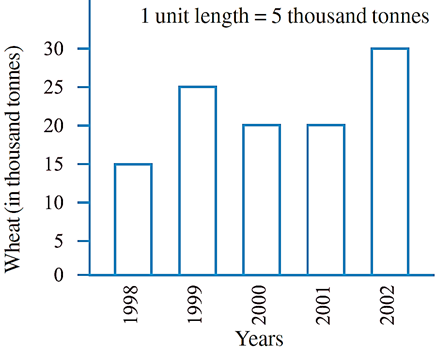
Read the bar graph and write down your
observations. In which year was
(a) the wheat production maximum?
(b) the wheat production minimum?
Ans:
(a) The wheat production was maximum in year 2002.
(b) The wheat production was minimum in year 1998.
Q.2. Observe this bar graph which is showing
the sale of shirts in a ready made
shop from Monday to Saturday.
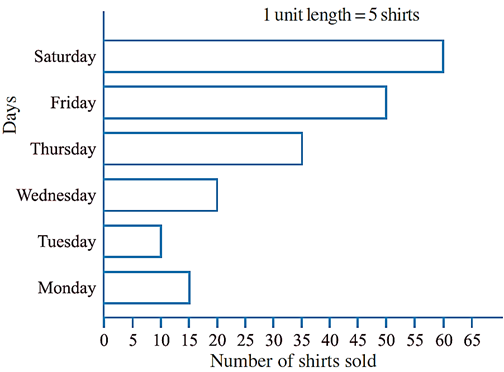
Now answer the following questions:
(a) What information does the above bar graph give?
(b) What is the scale chosen on the horizontal line
representing number of shirts?
(c) On which day was the maximum number of shirts
sold? How many shirts were sold on that day?
(d) On which day was the minimum number shirts
sold?
(e) How many shirts were sold on Thursday?
Ans:
(a) This bar graph represents the number of shirts
sold from Monday to Saturday.
(b) 1 unit = 5 shirts
(c) The number of shirts sold on Saturday
was the maximum, i.e., 60.
(d) The number of shirts sold on Tuesday
was the minimum, i.e., 10.
(e) 35 shirts were sold on Tuesday.
Q.3. Observe this bar graph which shows the
marks obtained by Aziz in half-yearly examination in different subjects.
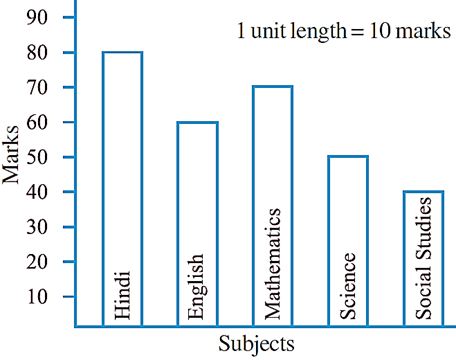
Answer the given questions.
(a) What information does the bar graph give?
(b) Name the subject in which Aziz scored maximum
marks.
(c) Name the subject in which he has scored minimum
marks.
(d) State the name of the subjects and marks
obtained in each of them.
Ans:
(a) This graph shows the marks obtained by Aziz in
different subjects.
(b) In Hindi,
Aziz scored maximum marks i.e., 80.
(c) In Social studies,
Aziz scored minimum marks i.e., 40.
(d) Hindi − 80
English – 60
Maths − 70
Science – 50
Social studies – 40
Exercise 9.4
Q.1. A survey of 120 school students was
done to find which activity they prefer to do in their free time.
|
Preferred
activity |
Number of
students |
|
Playing |
45 |
|
Reading story books |
30 |
|
Watching TV |
20 |
|
Listening to music |
10 |
|
Painting |
15 |
Draw a bar graph to illustrate the above data
taking scale of 1 unit length = 5 students.
Which activity is preferred by most of the students
other than playing?
Ans: By taking a scale of 1 unit
length = 5 students, a bar graph of the above given data can be drawn as
follows.
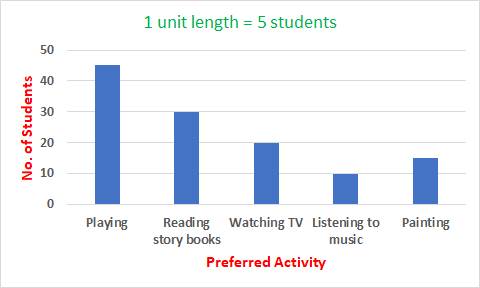
The activity that is preferred by most of the
students, other than playing, is reading story books.
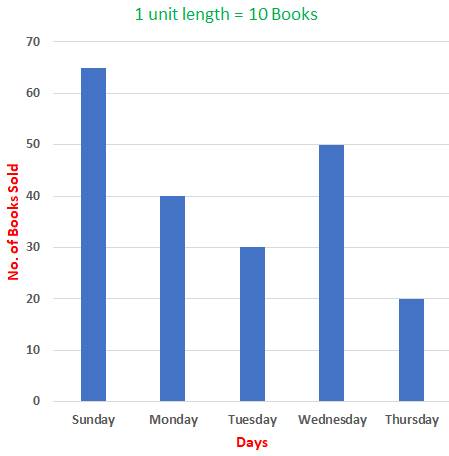
Q.2. The number of Mathematics books sold by
a shopkeeper on six consecutive days is shown below:
|
Days |
Number of
books sold |
|
Sunday |
65 |
|
Monday |
40 |
|
Tuesday |
30 |
|
Wednesday |
50 |
|
Thursday |
20 |
|
Friday |
70 |
Draw a bar graph to represent the above information
choosing the scale of your choice.
Ans: By taking a scale of 1 unit
length = 10 books, a bar graph of the above given data can be drawn as follows.
Q.3. Following table shows the number of
bicycles manufactured in a factory during the years 1998 to 2002. Illustrate
this data using a bar graph. Choose a scale of your choice.
|
Years |
Number of
bicycles manufactured |
|
1998 |
800 |
|
1999 |
600 |
|
2000 |
900 |
|
2001 |
1100 |
|
2002 |
1200 |
(a) In which
year was the maximum number of bicycles manufactured?
(b) In which year was the minimum number of
bicycles manufactured?
Ans: By taking a scale of 1 unit
length = 100 bicycles, a bar graph of the above given data can be drawn as
follows.
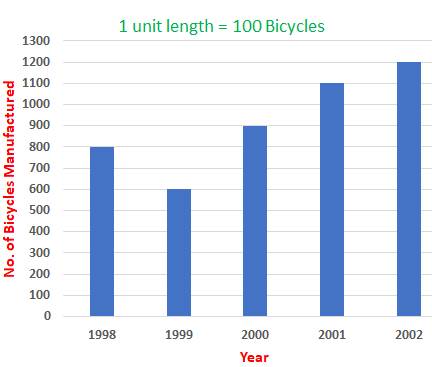
(a) The number of bicycles manufactured in 2002
was the maximum, i.e., 1200.
(b) The number of bicycles manufactured in 1999
was the minimum, i.e., 600.
Q.4. Number of persons in various age groups
in a town is given in the following table.
|
Age group |
1 −
14 |
15 −
29 |
30 – 44 |
45 −
59 |
60
−74 |
75 and
above |
|
Number of
persons |
2 lakhs |
1 lakhs 60 thousands |
1 lakh 20 thousands |
1 lakh 20 thousands |
80
thousand |
40 thousands |
Draw a bar graph to represent the above information
and answer the following questions. (take 1 unit
length = 20 thousands)
(a) Which two age groups have same population?
(b) All persons in the age group of 60 and above
are called senior citizens. How many senior citizens are there in the town?
Ans: By taking a scale of 1 unit
length = 20 thousands, a bar graph of the above given data can be drawn as
follows.
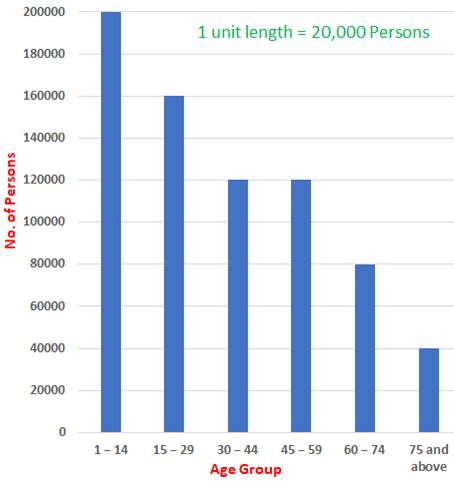
(a) 30 − 44
and 45 − 59 are the two age groups which have the
same population.
(b) It can be inferred that senior citizens are the
people who are either from age group 60 − 74 or from age group 75 and
above.
Hence, number of senior citizens
=
80,000 + 40,000
= 1
lakh 20 thousand.
End of Questions