
Class 6 Maths NCERT Solutions
Chapter 4 Basic Geometrical Ideas
Exercise 4.1
Q.1: Use the figure to name:
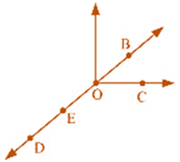
(a) Five points
(b) A line
(c) Four rays
(d) Five line segments
Ans :
(a) The five points are D, E, O, B, and C.
(b) 
(c)  ,
,  ,
,  ,
, 
(d)  ,
,  , , ,
, , , 
Q.2: Name the line given in all possible
(twelve) ways, choosing only two letters at a time from the four given.

Ans :
 ,
, ,
, ,
, ,
, ,
, ,
,  ,
, , ,
, , ,
,  ,
,
Q.3: Use the figure to name:
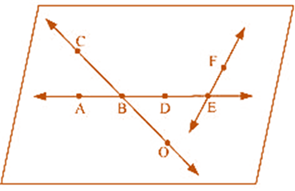
(a) Line containing point E.
(b) Line passing through A.
(c) Line on which O lies
(d) Two pairs of intersecting lines.
Ans :
(a) 
(b) 
(c)
(d) and, and ,
,
Q.4: How many lines can pass through
(a) one given point?
(b) Two given points?
Ans :
(a) Infinite number of lines can pass through a
single point.
(b) Only one line can pass through two given points.
Q.5: Draw a rough figure and label suitably
in each of the following cases:
(a) Point P lies on.
(b)  and
and  intersect at M.
(c) Line l contains E and F but
not D.
(d)  and
and  meet at O.
Ans :
(a)

(b)
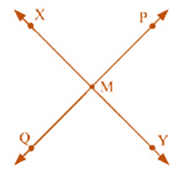
(c)
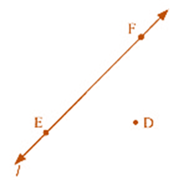
(d)
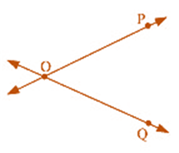
Q.6: Consider the following figure of line  . Say whether following statements are
true or false in context of the given figure.
. Say whether following statements are
true or false in context of the given figure.
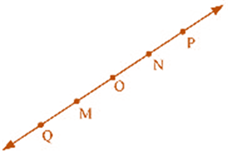
(a) Q, M, O, N, P are
points on the line .
(b) M, O, N are points on a line segment .
(c) M and N are end points of line segment .
(d) O and N are end points of line segment .
(e) M is one of the end points of line segment  .
.
(f) M is point on ray .
(g) Ray is different from ray  .
.
(h) Ray is same as ray  .
.
(i) Ray is not opposite to ray .
(j) O is not an initial point of .
(k) N is the initial point of  and
and  .
.
Ans :
(a) True
(b) True
(c) True
(d) False
(e) False
(f) False
(g) True
(h) False
(i) False
(j) False
(k) True
Exercise 4.2
Q.1: Classify the following curves as (i)
Open or (ii) Closed.
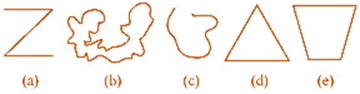
Ans :
(a) Open
(b) Closed
(c) Open
(d) Closed
(e) Closed
Q.2: Draw rough diagrams to illustrate the
following:
(a) Open curve
(b) Closed curve.
Ans :
(a) Open curve

(b) Closed curve

Q.3: Draw any polygon and shade its
interior.
Ans :

Q.4: Consider the given figure and answer
the questions:
(a) Is it a curve?
(b) Is it closed?

Ans :
(a) Yes
(b) Yes
Q.5: Illustrate, if possible, each one of
the following with a rough diagram:
(a) A closed curve that is not a polygon.
(b) An open curve made up entirely of line
segments.
(c) A polygon with two sides.
Ans :
(a)

(b)

(c) This is not possible as the polygon having the
least number of sides is a triangle, which has three sides in it.
Exercise 4.3
Q.1: Name the angles in the given figure.
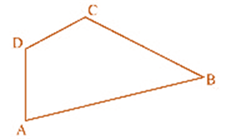
Ans :
∠BAD, ∠ADC,
∠DCB, ∠CBA
Q.2: In the given diagram, name the point
(s)
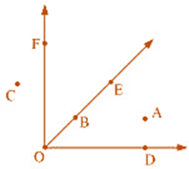
(a) In the interior of ∠DOE
(b) In the exterior of ∠EOF
(c) On ∠EOF
Ans :
(a) A
(b) C, A, D
(c) B, E, O, F
Q.3: Draw rough diagrams of two angles such
that they have
(a) One point in common.
(b) Two points in common.
(c) Three points in common.
(d) Four points in common.
(e) One ray in common.
Ans :
(a)
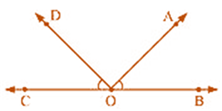
∠COD
and ∠AOB have point O in common.
(b)
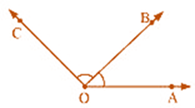
∠AOB
and ∠BOC have points O and B in common.
(c)
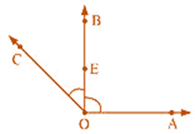
∠AOB
and ∠BOC have points O, E, B in common.
(d)
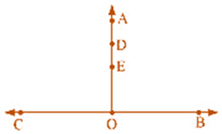
∠BOA
and ∠COA have points O, E, D, A in common.
(e)
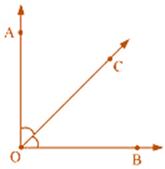
Ray  is common between ∠BOC and ∠AOC.
Exercise 4.4
Q.1: Draw a rough sketch of a triangle ABC.
Mark a point P in its interior and a point Q in its exterior. Is the point A in
its exterior or in its interior?
Ans :
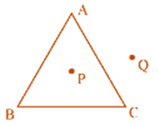
Point A lies on the given ΔABC.
Q.2:
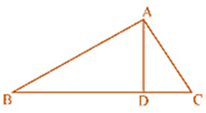
(a) Identify three triangles in the figure.
(b) Write the names of seven angles.
(c) Write the names of six line
segments.
(d) Which two triangles have ∠B as common?
Ans :
(a) ΔABC, ΔACD, ΔADB
(b) ∠ABC,
∠ADB, ∠ADC,
∠ACB, ∠BAD,
∠CAD, ∠BAC
(c) ,  ,,
,, ,
, ,
,
(d) ΔABD and ΔABC
Exercise 4.5
Q.1: Draw a rough sketch of a quadrilateral
PQRS. Draw its diagonals. Name them. Is the meeting point of the diagonals in
the interior or exterior of the quadrilateral?
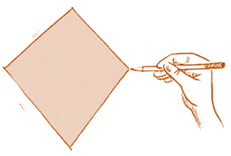
Ans :
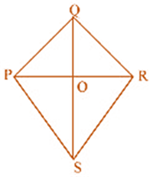
Diagonals are PR and QS. They meet at point O which
is in the interior of &mnSq1PQRS.
Q.2: Draw a rough sketch of a quadrilateral
KLMN. State,
(a) Two pairs of opposite sides,
(b) Two pairs of opposite angles,
(c) Two pairs of adjacent sides,
(d) Two pairs of adjacent angles.
Ans :
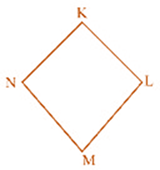
(a)  and
and ,
,
(b) ∠KLM
and ∠KNM
∠LKN
and ∠LMN
(c)  , and
, and ,
,
, and,
and, ,
,
(d) ∠K,
∠L and ∠M,
∠N
∠K,
∠N and ∠L,
∠M
Exercise 4.6
Q.1: From the figure, identify:
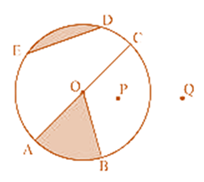
(a) The centre of circle
(b) Three radii
(c) a diameter
(d) a chord
(e) Two points in the interior
(f) a point in the exterior
(g) a sector
(h) a segment
Ans :
(a) O
(b)  ,
, ,
,
(c)
(d) 
(e) O, P
(f) Q
(g) AOB (shaded region)
(h) DE (shaded region)
Q.2:
(a) Is every diameter of a circle also a chord?
(b) Is every chord of circle also a diameter?
Ans :
(a) Yes. The diameter is the longest possible chord
of the circle.
(b) No
Q.3: Draw any circle and mark
(a) Its centre
(b) a radius
(c) a diameter
(d) a sector
(e) a segment
(f) a point in its interior
(g) a point in its exterior
(h) an arc
Ans :
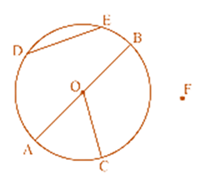
(a) O
(b)
(c)
(d) COA
(e) DE
(f) O
(g) F
(h) 
Q.4: Say true or false:
(a) Two diameters of a circle will necessarily
intersect.
(b) The centre of a circle is always in its
interior.
Ans :
(a) True. They will always intersect each other at
the centre of the circle.
(b) True
End of Questions