
Q.1. Find the rule which gives the number of matchsticks required to make
the following matchstick patterns. Use a variable to write the rule.
(a) A pattern of letter E as 
(b) A pattern of letter A as 
Q.2. Cadets are marching in a parade. There are 5 cadets in a row. What is the rule which gives the number of cadets, given the number of rows? (Use n for the number of rows.)
Q.3. If there are 50 mangoes in a box, how will you write the total number of mangoes in terms of the number of boxes? (Use b for the number of boxes.)
Q.4. The teacher distributes 5 pencils per student. Write how many pencils are needed, given the number of students. (Use s for the number of students.)
Q.5. A bird flies 1 kilometer in one minute. Write the distance covered by the bird in terms of its flying time in minutes? (Use t for flying time in minutes.)
Q.6. Radha is drawing a dot Rangoli (a beautiful pattern of lines joining dots) with chalk powder. She has 9 dots in a row. How many dots will her Rangoli have for r rows? How many dots are there if there are 8 rows? If there are 10 rows?
Q.7. Leela is Radha's younger sister. Leela is 4 years younger than Radha. Write Leela's age in terms of Radha's age? Take Radha's age to be x years.
Q.8. Mother has made laddus. She gives some laddus to guests and family members; still 5 laddus remain. If the number of laddus mother gave away is l, how many laddus did she make?
Q.9. Oranges are to be transferred from larger boxes into smaller boxes. When a large box is emptied, the oranges from it fill two smaller boxes and still 10 oranges remain outside. If the number of oranges in a small box are taken to be x, what is the number of oranges in the larger box?
Q.10. (a) Look at the following matchstick pattern of squares. The squares are not separate. Two neighbouring squares have a common matchstick. Observe the patterns and find the rule that gives the number of matchsticks in terms of the number of squares. (Hint: If you remove the vertical stick at the end, you will get a pattern of Cs.)

(b) Figure below gives a matchstick pattern of triangles. Find the general rule that gives the number of matchsticks in terms of the number of triangles.

Q.11. The side of an equilateral triangle is shown by l. Express the perimeter of the equilateral triangle using l.
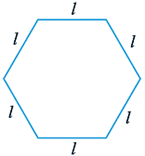
Q.12. The side of a regular hexagon is denoted by l. Express the perimeter of the hexagon using l.
(Hint: A regular hexagon has all its six sides equal in length.)
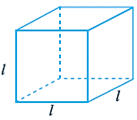
Q.13. A cube is a three-dimensional figure as shown. It has six faces and all of them are identical squares. The length of an edge of the cube is given by l. Find the formula for the total length of the edges of a cube.
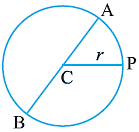
Q.14. The diameter of a circle is a line which joins two points on the circle and also passes through the centre of the circle. (In the adjoining figure AB is a diameter of the circle; C is its centre.) Express the diameter of the circle (d) in terms of its radius (r).
Q.15. To find sum of three numbers 14, 27 and 13, we can have two ways:
(a) We may first add 14 and 27 to get 41 and then add 13 to it to get the total sum 54 or
(b) We may add 27 and 13 to get 40 and then add 14 to get the sum 54.
Thus, (14 + 27) + 13 = 14 + (27 + 13).
This can be done for any three numbers. This property is known as the associativity of addition of numbers. Express this property in a general way, by using variables a, b and c.
Online Tuitions and Self-Study Courses for Grade 6 to 12 & JEE / NEET