Class 6 Maths Notes
Chapter 9 Data Handling
Data: A data is a collection of numbers, i.e., raw figures, gathered to provide some information.
Organization of Data
Raw data is difficult to read and analyse. Raw data has to be organised in such a way so that we can analyse it to obtain some useful information.
Data can be organized in a tabular form and graphical form.
In tabular form, data can be represented by using frequency distribution, the tally marks or pictograph.
Prioritizing Data
Data can be prioritized or it can be organised in a particular order according to importance.
Example: Daksh, Aariz, Vani, Rashi are friends. We can prioritize this data according to alphabetic order. Prioritising the data, the new order of names becomes Aariz, Daksh, Rashi and Vani.
Frequency is the number of times a particular value occurs in a given data.
Eg : Marks scored by different students in a class: 61, 85, 94, 53, 61, 94 …
Frequency Distribution:
|
Marks |
Frequency |
|
53 |
1 |
|
61 |
1 |
|
83 |
2 |
|
94 |
2 |
Tally marks:
Tally marks are used to show the frequency of the data.
Tally marks are represented as

Example: There are 40 players in a club. 7 players play hockey, 9 play football, 11 play cricket, 5 play tennis, and 8 play volleyball. Represent this data in the frequency distribution table.
Solution: Frequency distribution table:
|
Sport |
Number of Players (Frequency) |
Tally Marks |
|
Hockey |
7 |
|
|
Football |
9 |
|
|
Cricket |
11 |
|
|
Tennis |
5 |
|
|
Volleyball |
8 |
|


Pictograph
If we represent the data with the pictures of objects instead of numbers then it is called Pictograph. Pictures make it easy to understand the data and answer the questions related to it by just seeing it.
One  represents 10
tractors.
represents 10
tractors.
|
Village |
Number
of Tractors |
In Numbers |
|
Village A |
|
60 |
|
Village B |
|
50 |
|
Village C |
|
80 |
|
Village D |
|
30 |
|
Village E |
|
60 |

We can easily answer the questions like who has a maximum number of toys, who has the least number of toys etc.
Example:
The number of cars sold by a dealer every month is given in the pictograph.
One  represents
10 cars
represents
10 cars
|
July |
|
|
August |
|
|
September |
|
· Find the month when the highest number of cars are sold and how many?
· When the least number of cars are sold?
Solution:
In the above pictograph one car represent 10 cars.
· As there is the maximum number of cars is shown in August month hence, the highest number of cars was sold in August.
As 1 =
10 cars, hence, in August, cars sold = 6 × 10 = 60
Hence, 60 cars were sold in August.
· Least number of cars were sold in September as there are only 3 pictures of cars are shown on that day.
Bar Graph
If we use the bars of the same width with equal spacing to represent the data in which the length of the bars represent the frequency is called Bar Graph or Bar Diagram.
Example:
The bar graph given alongside shows the amount of wheat purchased by government during the year 1998-2002.
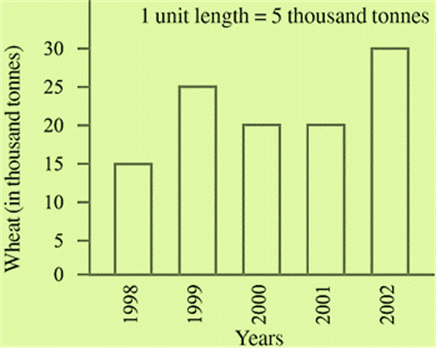
Read the bar graph and write down your observations. In which year was
(a) the wheat production maximum?
(b) the wheat production minimum?
Solution:
(a) The wheat production was maximum in year 2002.
(b) The wheat production was minimum in year 1998.
Drawing a Bar Graph
Drawing a bar graph is an interesting task, but we must choose an appropriate scale to draw the bar graph. It depends upon our own choice that what we are taking for the scale.
Example:
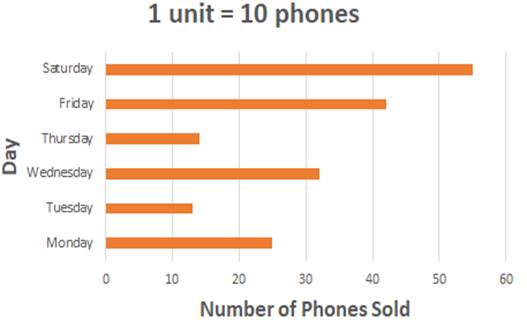
The daily sale of mobile phones in Vicky production is given below. Draw the bar graph to represent the data.
|
Days |
Monday |
Tuesday |
Wednesday |
Thursday |
Friday |
Saturday |
|
No. of phones sold |
25 |
13 |
32 |
14 |
42 |
55 |
Solution:
Steps to make a bar graph-
· Draw two lines, one horizontal and one vertical in L shape.
· Mark days on the horizontal line and no. of phones on the vertical line.
· Take a suitable scale for the number of phones and mark on the vertical line. Let 1 unit = 10 phones.
· Use the bars of equal width and draw them with the frequency given at the same distance.
The height of the bars tells the sale of the mobile phones in Vicky production.

This same bar graph can be made by interchanging the positions of the days and the number of phones.