
Point
A point is just a location marker. A point depicts the exact position of an object. It does not have any size. A point has no length, breadth or height.
Line
The word 'line' usually refers to a 'straight line'. A line has no width. It has just length. It is absolutely straight and can extend indefinitely in both directions.
There are two ways of naming a line:
(i) By putting a single small letter of the alphabet by the side of it. E.g., Line l denoted below.

(ii) By marking two points A and B near the two end points and the line is named as AB. E.g., Line AB shown below.

If a point ‘X’ lies on a line, we also say that the line passes through that point.
Line Segment
It is a part of a line having definite length. A line segment has two end points. Here AB is a line segment.

Ray
It is a part of a line that extends indefinitely in one direction from a given point.

Here, AB is a ray.
Note: AB is not same as BA.
Comparison between Line, Line Segment and Ray
|
Line |
Line Segment |
Ray |
|
No definite length |
Definite length |
No definite length |
|
No end points |
Two end points |
One end point |
|
No thickness |
No thickness |
No thickness |
Collinear Points
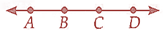
Three or more points that lie on a straight line are called collinear points. Here, points A, B, C and D are said to be collinear points.
Plane
Smooth flat surfaces are known as plane surfaces and other surfaces are known as curved surfaces.
In geometry, a plane refers to any flat and smooth surface. It has length and width but no height.
A plane is never ending flat surface which extends indefinitely in all directions. It therefore has only two dimensions, length and width, both infinitely long. It has no thickness.
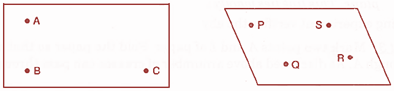
A plane is commonly named by taking three or more points on it which are not on the same line. E.g., plane ABC and plane PQRS shown below.
Intersecting Lines
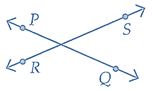
When two lines meet exactly at one point, they are called intersecting lines. The point at which the lines meet is called point of intersection. Here, PQ and RS are intersecting lines.
Perpendicular Lines
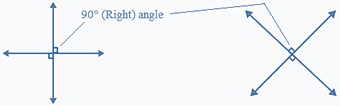
Two lines are said to be perpendicular lines if they intersect each other at right angle or at 90°.
Parallel Lines
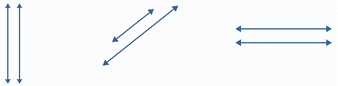
The two lines which never meet each other in the same plane are called parallel lines.
OR
If the perpendicular distance between the two lines remains same at any point, then the lines are said to be parallel lines. If two lines l and m are parallel, then we write l || m.
Curves
Any figure formed without lifting the pencil is called a curve. There are two types of curves :
1. Open Curve
Any curve whose initial and terminal point do not meet is called an open curve.

2. Closed Curve
Any curve whose initial and terminal point meet is called a closed curve.

Interior of a Curve
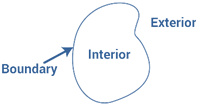
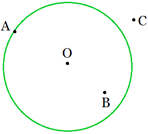
The part which is enclosed by a curve is called the interior of the curve.
Here, point B lies in the interior of the curve.
Exterior of a Curve
The part which is not enclosed by a curve is called the exterior of the curve.
Here, point C lies in the exterior of the curve.
Boundary of a Curve
The points which lie on the curve make the boundary of the curve.
Here, point A lies on the boundary of the curve.
Region of a Curve
The interior of a curve together with its boundary is called region of the curve.
Polygons
A simple closed figure entirely made up of line segments is called a polygon.
Sides of a polygon : The line segments forming the polygon.
Vertex : The meeting point of a pair of sides is called its vertex.
Diagonal : The line segment which joins the two non-adjacent vertices is called a diagonal.
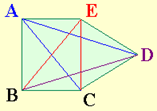
In the given figure, ABCDE is a polygon. Points A, B, C, D, and E are vertices. Line segments AC, AD, BD, BE, and CE are diagonals.
Angles
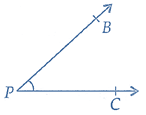
An angle is formed when two rays start from a common point. Rays forming an angle are called arms of the angle and common point is called the vertex of the angle.
Note: While writing the name of an angle, the vertex should always be written in the middle. e.g., ∠BPC represents angle P.
Interior, Exterior and Boundary of an Angle
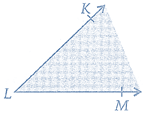
The part of the plane which lies within the arms of an angle is called interior of an angle. Here, shaded part represents interior of ∠KLM.
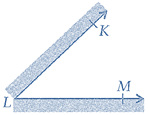
The part of the plane which lies outside the arms of an angle is called exterior of an angle. Here, shaded part represents exterior of ∠KLM.
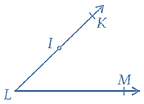
The points of the plane which lie on the arms of an angle make the boundary of the angle. Here, point I represents the point on the boundary of the angle.
Triangles
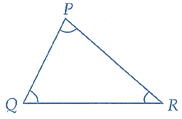
A polygon made up of three line segments is called a triangle. Triangle is the only polygon which can be drawn using least number of sides, i.e., 3 sides.
Here, PQ , QR and PR are the three sides of triangle PQR. ∠P, ∠Q and ∠R are the three angles. P, Q and R are the three vertices.
Quadrilaterals
A polygon made up of four line segments is called a quadrilateral.
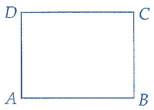
Sides of a Quadrilateral The four line segments AB, BC, CD and DA, are called the sides of the quadrilateral ABCD. There are two types of sides:
Adjacent Sides
Two sides of a quadrilateral are called adjacent sides, if they have a common end point.
For example : AD and AB is a pair of adjacent sides.
Opposite Sides
Two sides of a quadrilateral are called opposite sides, if they do not have a common end point.
For example : AD and BC is a pair of opposite sides.
Angles of a Quadrilateral
A quadrilateral has four angles. For example: ∠A, ∠B, ∠C and ∠D are four angles of quadrilateral ABCD.
There are also two types of angles :
Adjacent Angles
Two angles of a quadrilateral are said to be adjacent angles, if they have a common side.
For example : ∠A and ∠D is a pair of adjacent angles.
Opposite Angles
Two angles of a quadrilateral are said to be opposite, if they do not have any common side.
For example : ∠A and ∠C is a pair of opposite angles.
Circles
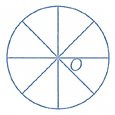
It is a simple closed curve whose each point is equidistant from a fixed point.
OR
It is the path of all the points that are equidistant from a fixed point on a given surface.
Interior of a Circle
The part which lies inside the circle is known as the interior of a circle.
Exterior of a Circle
The part which lies outside the circle is called the exterior of a circle.
Centre
The fixed point from which all the points on the circle are at equal distance is
called its centre. Here, O is the centre of the circle.
Radius
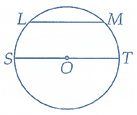
The line segment joining the centre to any point on the circle is called the radius of a circle. Here, OT and OS are the radius of the circle.
Note: The distance from any point on the circle to its centre, remains the same. We can say that all the radii of a circle measure same.
Diameter
The line segment which passes through the centre of a circle and whose end points lie on the circle, is called the diameter of a circle. The length of diameter is always twice the length of the radius of the circle. Here, ST is the diameter of the circle.
Circumference
The perimeter of a circle i.e., the length of the boundary of a circle is called its circumference.
Chord
A line segment joining any two points on the circumference of a circle is called the chord of a circle.
Here, LM is the chord of the circle.
Note : Diameter is the longest chord of any circle.
Arc
An arc is a portion of a circle. Here, LM is an arc of the circle. The bigger arc is called the major arc and the smaller arc is called the minor arc.
Sector
A region bounded by an arc and two radii joining the centre to the end points of the arc is called the sector of a circle.

Here, the sector formed by minor arc LM is called minor sector and the sector formed by major arc LM is called major sector.
Segment
A chord of a circle divides the circular region into two parts, then the two parts are said to be segments of the circle.
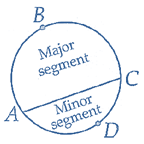
Here, ABC is the major segment and ADC is the minor segment.
Semi-circle
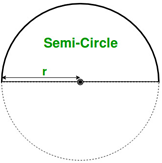
Semi-circle is half of a circle, where the circle is divided by its diameter into two equal halves.
Concentric Circles
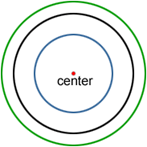
Circles having different radii but the same centre are called concentric circles.
Online Tuitions and Self-Study Courses for Grade 6 to 12 & JEE / NEET