
Ratio
· If we compare two quantities using division then it is called ratio.
· The ratio is the comparison of a quantity with respect to another quantity.
· It is denoted by “:” and is read as “is to”.
· Two quantities being compared must be in the same unit.
Example: Daren’s age is 70 years and the Graham’s age is 15 years.
⇒ The ratio of Daren’s age to Graham’s age
⇒ 
Difference between fractions and ratios
·
A
fraction describes a part of a whole and its denominator represents the total
number of parts.
Example:  means 3 part out
of 4 parts.
means 3 part out
of 4 parts.
Example: In a class, 15 people like mathematics and 20 people like science. Total number of people in society is 35.
· The ratio of the number of people liking mathematics to the total number of people = 15 : 35 i.e., 3 : 7.
· The ratio of the number of people liking science to the number of people liking mathematics is 20 : 15 i.e., 4 : 3.
The Lowest form of the Ratio
If there is no common factor of numerator and denominator except one then it is the lowest form of the ratio.
Example: Find the lowest form of the ratio 25: 100.
Solution: The common factor of 25 and 100 is 25, so divide both the numerator and denominator with 25.
Hence the lowest ratio of 25 : 100 is 1 : 4.
Same ratio in different situations
· Ratios can remain same in different situations.
Example:
1. 
2. 
Both the above ratios are equal.
Comparing quantities using ratios
· Quantities can be compared using ratios.
Example: Mintoo
worked for 8 hours and Pintoo worked for 2 hours. How many times Mintoo’s
working hours is of Pintoo’s working hours?
Solution: Working hours of Mintoo = 8 hours
⇒Working hours of Pintoo
= 2 hours
⇒The ratio of
working hours of Mintoo to Pintoo = 82 = 4.
Therefore, Mintoo works four times more than Pintoo.
Example: If there are 35 boys and 25 girls in a class, then what is the ratio of
(i) Number of boys to total students
(ii) Number of girls to total students.
Solution:
In the ratio, we want the total number of students.
Total number of students = Number of boys + Number of girls
= 35 + 25 = 60
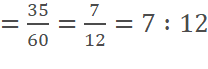
(i) Ratio of number of boys to total number of students
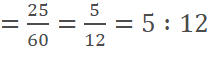
(ii) The ratio of the number of girls to the total number of students
Equivalent Ratios
When the given ratios are equal, then these ratios are called as equivalent ratios.
· Equivalent ratios can be obtained by multiplying and dividing the numerator and denominator with the same number.
· Example: Ratios 10 : 30 (= 1 : 3) and 11 : 33 (=1 : 3) are equivalent ratios.
Example: Find two
equivalent ratios of  .
.
Solution: To get the equivalent ratio we multiply both the numerator and denominator with 2.

To get another equivalent ratio we divide both the numerator and denominator with 2.

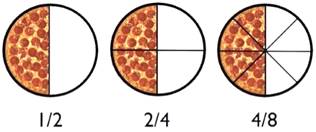
From the above figure, we can see that in all the equivalent ratios only the number of equal parts is changing but all the ratios are representing the half part of the circle only.
Proportion
If we say that two ratios are equal then it is called Proportion.

We write it as a : b : : c : d or a : b = c : d
And reads as “a is to b as c is to d”.
Example: If a man runs at a speed of 20 km in 2 hours then with the same speed would he be able to cross 40 km in 4 hours?
Solution: Here the ratio of
the distances given =  =
=  = 1 : 2
And the ratio of
the time taken by them =  = 1 : 2
Hence the four numbers are in proportion.
We can write them in proportion as 20 : 40 : : 2 : 4
And reads as “20 is to 40 as 2 is to 4”.
Unitary Method
The method in which first we find the value of one unit and then the value of required number of units is known as Unitary Method.
·
Example: Cost of
two shirts in a shop is Rs.200. What will be the cost of 5 shirts in
the shop?
Solution: Cost of 2 shirts = Rs.200
⇒Cost of 1
shirt =2002=100
⇒Cost of 5
shirts = (2002)∗5=100∗5 = Rs.500
Extreme Terms and Middle Terms of Proportion
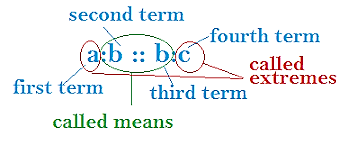
The first and the fourth term in the proportion are called extreme terms and the second and third terms are called the middle or the mean Terms.
In this statement of proportion, the four terms which we have written in order are called the Respective Terms.
Product of extreme terms = Product of middle terms
If the two ratios are not equal then these are not in proportion.
Example: Check whether the terms 30,99,20,66 are in proportion or not.
Solution: (1st method)
To check the numbers are in proportion or not we have to equate the ratios.


As both the ratios are equal so the four terms are in proportion.
30 : 99 :: 20 : 66
Solution: (2nd method)
We can check with the product of extremes and the product of means.
In the respective terms 30, 99, 20, 66
30 and 66 are the extremes.
99 and 20 are the means.
To be in proportion the product of extremes must be equal to the product of means.
30 × 66 = 1980
99 × 20 = 1980
The product of extremes = product of means
Hence, these terms are in proportion.
Example: Find the ratio 30 cm to 4 m is proportion to 25 cm to 5 m or not.
Solution:
As the unit is different so we have to convert them into the same unit.
4 m = 4 × 100 cm = 400 cm
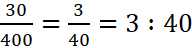
The ratio of 30 cm to 400 cm is
5 m = 5 × 100 cm = 500 cm
Ratio of 25 cm to 500 cm is
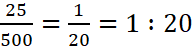
Here the two ratios are not equal so these ratios are not in proportion.
The unit must be same to compare two quantities
If we have to compare two quantities with different units then we need to convert them in the same unit .then only they can be compared using ratio.
Example: What is the ratio of the height of Gabboo and Dabboo if the height of Gabboo is 175 cm and that of Dabboo is 1.35 m?
Solution: The unit of the height of Gabboo and Dabboo is not same so convert them in the same unit.
Height of Dabboo is 1.35 m = 1.35 × 100 cm = 135 cm
The ratio of the height of Gabboo and Dabboo

Uses of ratios and proportions
Example: Suppose a man travelled 80 km in 2 hours, how much time will he take to travel 40 km?
Solution: If x is the
required time, then the proportion is
80:2::40:x.
⇒ 802∗40x ⇒ 80x=80
⇒ x=1 hour
So, the man takes one hour to complete 40 km.
Golden ratio
Two quantities are in the golden ratio if their ratio is the same as the ratio of their sum to larger of the two quantities.
If two numbers a and b are in golden
ratio, then 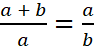 .
.
It is approximately equal to 1.618.