
Numbers
Numbers are mathematical objects representing specific value.
Numbers are used to count, measure, label and convey the magnitude of any measurable thing around us.
Comparing Numbers
Comparing numbers when the total number of digits is different
The number with greatest number of digits is the largest number by magnitude and the number with least number of digits is the smallest number.
e.g., out of 341, 56, and 3456, the largest number is 3456 (4 digits) and the smallest number is 56 (2 digits).
Comparing numbers when the total number of digits is same
The number with highest leftmost digit is the largest number.
If this digit in both the numbers is same, then the next leftmost digit is compared and so on.
e.g., out of 178, 158, 278, 358, and 258, the largest number is 358 (leftmost digit is highest, 3) and the smallest number is 158 (on comparing 178 and 158, left most digit is same, 1, hence next leftmost digit compared, i.e., 5 is less than 7, hence 158 is the smallest number).
Example:
Compare 4978 and 5643…….
Solution:
5643 is greater as the digit at the thousands place in 5643 is greater than that in 4978.
Example:
Compare 9364,8695,8402 and 7924
Solution:
9364 is the greatest as it has the greatest digit at the thousands place in all the numbers.
Whereas 7924 is the smallest as it has the smallest digit at the thousands place in all the numbers.
Example:
Compare 56321 and 56843
Solution:
Here, we will start by checking the thousands place. As the digit 5 at ten thousand place is same so we will move forward and see the thousands place. The digit 6 is also same so we will still move on further to check the hundreds place.
The digit at the hundreds place in 56843 is greater than that in 56321
Thus 56843 is greater than 56321
Arranging Numbers in Order
· If we arrange the numbers from the smallest to the greatest then it is said to be an Ascending order.
· If we arrange the numbers from the greatest to the smallest then it is said to be Descending order.
Example:
Arrange the following heights in ascending and descending order.
Solution:
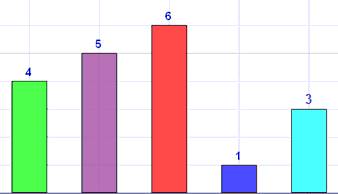
Ascending order: 1 < 3 < 4 < 5 < 6
Descending order: 6 > 5 > 4 > 3 > 1
Number Formations
Form the largest and the smallest possible numbers using 3, 8, 1, 5 without repetition.
The Largest number will be formed by arranging the given numbers in descending order – 8531
The Smallest number will be formed by arranging the given numbers in ascending order – 1358
Key Points
· If we add 1 to the greatest single digit number then we get the smallest 2-digit number
(9 + 1 = 10)
· If we add 1 to the greatest 2- digit number then we get the smallest 3-digit number
(99 + 1 = 100)
· If we add 1 to the greatest 3- digit number then we get the smallest 4-digit number
(999 + 1 = 1000)
Moving forward, all the above situations are same as adding 1 to the greatest 4-digit number is the same as the smallest 5-digit number. (9999 + 1 = 10,000), and it is known as ten thousand.
Place Value
It refers to the positional notation which defines a digit’s position.
Example:
In the number 6931, digit 1 is at ones place, 3 is at tens place, 9 is at hundreds place and 6 is at thousands place
Expanded form
It refers to expanding the number to represent the value of each digit.
Example:
6821 = 6000 + 800 + 20 + 1
= 6 × 1000 + 8 × 100 + 2 × 10 + 1 × 1
Larger Numbers
To get the larger numbers also, we will follow the same pattern.
We will get the smallest 7-digit number if we add one more to the greatest 6-digit number, which is called Ten Lakh.
Going forward if we add 1 to the greatest 7-digit number then we will get the smallest 8-digit number which is called One Crore.
Conversions
1 hundred = 10 tens
1 thousand = 10 hundreds
= 100 tens
1 lakh = 100 thousands
= 1000 hundreds
1 crore = 100 lakhs
= 10,000 thousands
Patterns
9 + 1 = 10
99 + 1 = 100
999 + 1 = 1000
9,999 + 1 = 10,000
99,999 + 1 =1,00,000
9,99,999 + 1 = 10,00,000
99,99,999 + 1 = 1,00,00,000
Reading and Writing Large Numbers
We can identify the digits in ones place, tens place and hundreds place in a number by writing them under the tables O, T and H.
Indian System of Numeration
|
Crores |
Lakhs |
||
|
Ten Crores (TC) |
Crores (C) |
Ten Lakhs (TL) |
Lakhs (L) |
|
(10, 00, 00, 000) |
(1,00,00,000) |
(10, 00, 000) |
(1,00,000) |
|
Thousands |
Ones |
|||
|
Ten Thousands (TTh) |
Thousands (Th) |
Hendreds (H) |
Tens (T) |
Ones (O) |
|
(10,000) |
(1000) |
(100) |
(10) |
(1) |
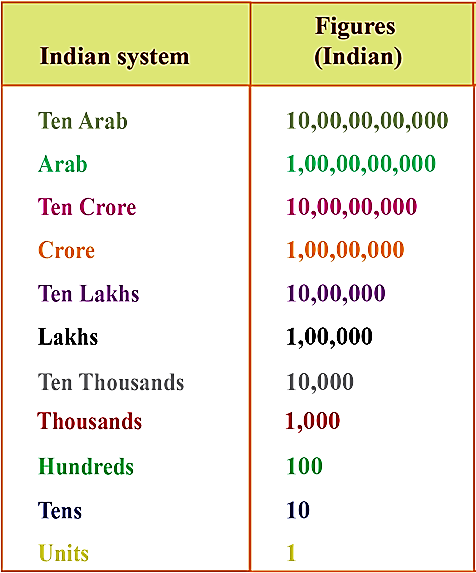
Example:
Represent the number 5,21,05,747 in place value table.
Solution:
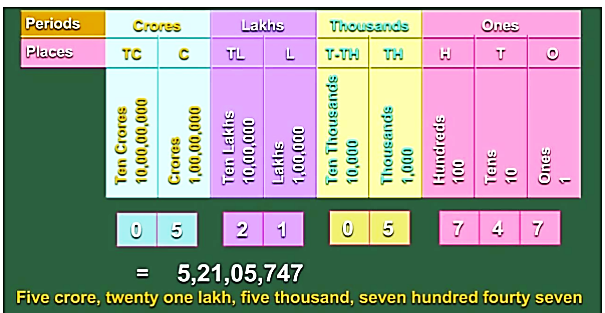
Use of Commas
We use commas in large numbers to ease reading and writing. In our Indian System of Numeration, we use ones, tens, hundreds, thousands and then lakhs and crores.
We use the first comma after hundreds place which is three digits from the right. The second comma comes after two digits i.e., five digits from the right. The third comma comes after another two digits which is seven digits from the right, e.g., 5,44,12,940
International System of Numeration
|
Millions |
Thousands |
||||
|
Hundred Million |
Ten Million |
Million |
Hundred Thousands |
Ten Thousands |
Thousands |
|
100,000,000 |
10,000,000 |
1,000,000 |
100,000 |
10,000 |
1,000 |
|
Ones |
||
|
Hundred |
Tens |
Ones |
|
100 |
10 |
1 |
Example:
Represent 341697832 in International System of Numeration and express in expanded form.
Solution:
341,697,832
Expanded form: 3 × 100,000,000 + 4 × 10,000,000 + 1 × 1,000,000 + 6 × 100,000 + 9 × 10,000 + 7 × 1,000 + 8 × 100 + 3 × 10 + 2 × 1
Conversions
10 millimeters = 1 centimeter
1 meter = 100 centimeters
= 1000 millimeters
1 kilometer = 1000 meters
1 kilogram = 1000 grams.
1 gram = 1000 milligrams
1 litre = 1000 millilitres
1 litre = 1000 millilitres
Example:
Shalini bought 336 yards of silk in yellow and 37 yards in pink. How many yards of silk did she buy?
Solution:
Yards of yellow silk = 336
Yards of pink silk = 37
Total yards of silk bought = 336 + 37
= 371
Thus, 371 yards of silk was bought by Shalini.
Example:
There are 8797 trees in a garden. 6989 are mango trees, rest are guava trees. How many guava trees are there?
Solution:
Total trees = 8797
Mango trees = 6989
Guava trees = 8797 – 6989
= 1808
Thus, there are 1808 guava trees.
Example:
There are 24 boxes and each has 56 packets of noodles inside them. How many noodle packets are there?
Solution:
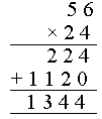
Thus, there are 1344 noodle packets.
Example:
₹ 5,876 prize money is distributed equally among 26 students. How much money will each student get?
Solution:
Total money received by 26 students = 5876
Money received by one student = 5876 ÷ 26
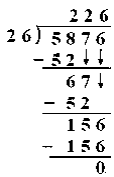
Thus, each student got ₹ 226.
Following Sections (till the end of the chapter) are not in syllabus as per CBSE Rationalised Content (2022)
Estimation
It is a rough calculation of value. We use estimations when we have to deal with large numbers and to do the quick calculations.
Estimating to the nearest tens by rounding off
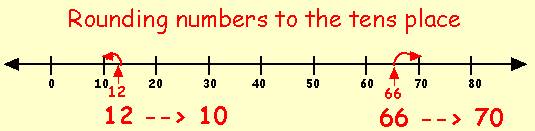
If the digit in the ones places is:
5 or higher, round tens place up
4 or lower, leave tens place as is
Example:
Estimate 66 to nearest tens digits.
Solution:
Firstly, to estimate we need to see where does the number lies.
As shown in the figure, 66 lies between 60 and 70
Secondly, we will see if it is 5 or higher.
Yes, it is higher than 5 i.e., 66
Thus, the number 66 is rounded off to 70.
Example:
Estimate 12 to nearest tens digits.
Solution:
Firstly, to estimate we need to see where does the number lies.
As shown in the figure, 12 lies between 10 and 20
Secondly, we will see if it is 5 or higher.
No, it is less than 5 i.e., 12
Thus, the number 12 is rounded off to 10.
Estimating to the nearest hundreds by rounding off
Round off the number 867 nearest to the hundreds.
It lies between 800 and 900
Now we have to check for tens place. If it is greater than 50 then we will round it off to the upper side and if it is less than 50 then we will round it off on the lower side.
It is 67, which is greater than 50 and is closer to 900.
Thus 867 is rounded off to 900
Estimating to the nearest thousands by rounding off
The Numbers from 1 to 499 are rounded off to 0 as they are nearer to 0, and the numbers from 501 to 999 are rounded off to 1000 as they are nearer to 1000
And 500 is always rounded off to 1000.
Example:
Round off the number 7690 nearest to thousands.
Solution:
It lies between 7000 and 8000
And is closer to 8000
Thus 7690 is rounded off to 8000.
Example:
Estimate: 3,210 + 12,884
Solution:
3,210 will be rounded off to 3000.
12,884 will be rounded off to 13000.
3000 + 13000
Estimated solution = 16000
Actual solution = 3,210 + 12 884
= 16,094
Example:
Estimate: 73 × 18
Solution:
73 will be rounded off to 70
18 will be rounded off to 20
70 × 20
Estimated solution = 1400
Actual solution = 73 × 18
= 1314
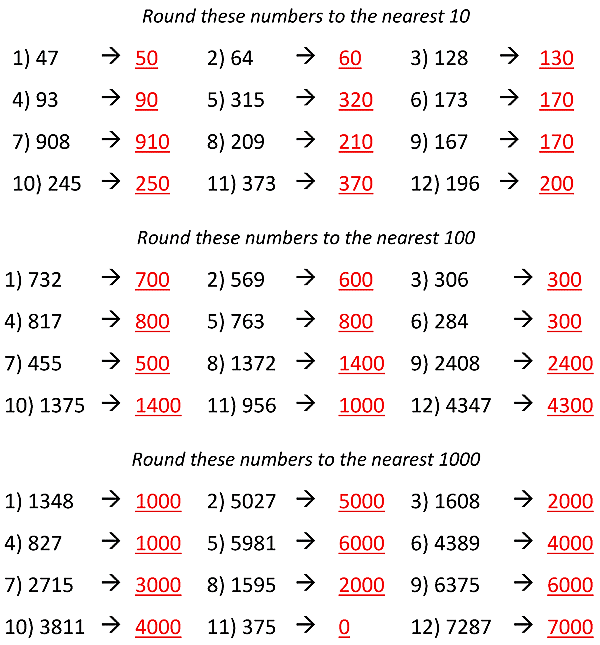
Few numbers rounded off to nearest 10, 100, 1000
Using Brackets
We use brackets to indicate that the numbers inside should be treated as a different number thus the bracket should be solved first.
For example:
8 + 2 × 5
= 8 + 10
= 18
Whereas,
(8 + 2) × 5
= 10 × 5
= 50
BODMAS
According to BODMAS rule, while solving mathematical expressions, parts inside a bracket are always computed first, followed by of (or order), then division, then multiplication, then addition and lastly subtraction.
Example:
[(8 + 1) × 2] ÷ (2 × 3) + 2 – 2 = ?
[(8 + 1) × 2] ÷ (2 × 3) + 2 – 2….{Solve everything which is inside the brackets}
= [9 × 2] ÷ 6 + 2 – 2…..{Multiplication inside brackets}
= 18 ÷ 6 + 2 – 2……{Division}
= 3 + 2 – 2……{Addition}
= 5 – 2…….{Subtraction}
= 3
Roman Numerals
Numbers in this system are represented by combinations of letters from the Latin alphabets.

Rules:
(i) If we repeat a symbol, its value will be added as many times as it occurs:
Example:
II is equal 2
XX is 20
XXX is 30.
(ii) We cannot repeat a symbol more than three times and some symbols like V, L and D can never be repeated.
(iii) If we write a symbol of lesser value to the right of a symbol of larger value then its value will be added to the value of the greater symbol.
VI = 5 + 1 = 6, XII = 10 + 2 = 12 and LXV = 50 + 10 + 5 = 65.
(iv) If we write a symbol of lesser value to the left of a symbol of larger value then its value will be subtracted from the value of the greater symbol.
IV = 5 – 1 = 4, IX = 10 – 1 = 9 XL= 50 – 10 = 40, XC = 100 – 10 = 90.
(v) The symbols V, L and D can never be subtracted so they are never written to the left of a symbol of greater value. We can subtract the symbol “I” from V and X only and the symbol X from L, M and C only.
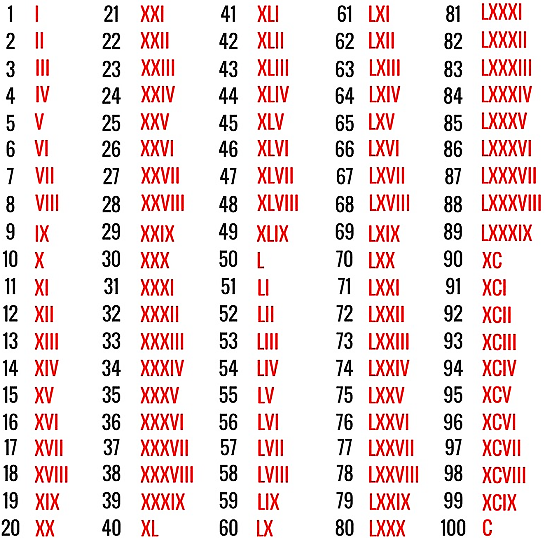
Roman Numerals for 0 to 100
Online Tuitions and Self-Study Courses for Grade 6 to 12 & JEE / NEET