
Q.1. Account for the following:
Zn, Cd and Hg are soft metals.
A.1: In Zn, Cd and Hg, all the electrons in d-subshell are paired. Hence, the metallic bonds are weak. That is why they are soft metals with low melting and boiling points.
Q.2. Give reason: Mn shows the highest oxidation state of + 7 with oxygen but with fluorine it shows the highest oxidation state of +4.
A.2: Manganese can form pπ - dπ bond with oxygen by utilising 2p-orbital of oxygen and 3d-orbital of manganese due to which it can show highest oxidation state of +7. While with fluorine it cannot form such pπ - dπ bond thus, it can show a maximum of +4 oxidation state.
Q.3. Why do transition elements show variable oxidation states? In 3d series (Se to Zn), which element shows the maximum number of oxidation states and why?
A.3: Variation in oxidation state: Transition elements can use their ns and (n – l)d orbital electrons for bond formation. Therefore, they show variable oxidation state.
For example - Sc has ns2 (n – l) d1 electronic configuration.
It utilizes two electrons from its ns subshell then its oxidation state = +2. When it utilizes both the electrons then its oxidation state= +3.
Among the 3d series manganese (Mn) exhibits the largest number of oxidation states from +2 to + 7 because it has maximum number of unpaired electrons.
Mn - [Ar] 3d5 4s2
Q.4. How would you account for the following:
Transition metals and their compounds show catalytic properties.
A.4: The transition metals and their compounds, are known for their catalytic activity. This activity is ascribed to their ability to adopt multiple oxidation states, ability to adsorb the reactant(s) and ability to form complexes. Vanadium (V) oxide (in Contact Process), finely divided iron (in Haber's Process), and nickel (in catalytic hydrogenation) are some of the examples.
Catalysis involves the formation of bonds between reactant molecules and atoms at the surface of the catalyst.
Q.5. What is meant by 'disproportionation'? Give an example of a disproportionation reaction in aqueous solution.
A.5: Disproportionation reaction involves the oxidation and reduction of the same substance. The two examples of disproportionation reaction are:
(i) Aqueous NH3 when treated with Hg2Cl2 (solid) forms mercury aminochloride disproportionally.
Hg2Cl2 + 2NH3 → Hg + Hg(NH2)Cl + NH4Cl
(ii) 2Cu+ → Cu + Cu2+
Q.6. Account for the following:
(i) Mn2+ is more stable than Fe2+ towards oxidation to +3 state.
(ii) The enthalpy of atomization is lowest for Zn in 3d series of the transition elements.
A.6: (i) Electronic configuration of Mn2+ is 3d5 which is half filled and hence stable. Therefore, third ionization enthalpy is very high, i.e., 3rd electron cannot be lost easily. In case of Fe2+, electronic configuration is 3d6. Hence it can lose one electron easily to give the stable configuration 3d5.
(ii) Zinc (Z = 30) has completely filled d-orbital (3d10) d-orbitals do not take part in interatomic bonding. Hence, metallic bonding is weak. Hence, it has very low enthalpy of atomisation (126 kJ mol–1).
Q.7. Assign a reason for each of the following observations:
(i) The transition metals (with the exception of Zn, Cd and Hg) are hard and have high melting and boiling points.
(ii) The ionisation enthalpies (first and second) in the first series of the transition elements are found to vary irregularly.
A.7: (i) As we move along transition metal series from left to right (i.e. Ti to Cu), the atomic radii decrease due to increase in nuclear charge. Hence the atomic volume decreases. At the same time, atomic mass increases. Hence, the density from titanium (Ti) to copper (Cu) increases. The atoms of transition metals have strong metallic bonds between them; thus, these have high melting and boiling points.
(ii) Irregular variation of ionisation enthalpies is mainly attributed to varying degree of stability of different 3d-configurations (e.g., d0, d5, d10 are exceptionally stable).
Q.8. Assign a reason for the following:
Both O2 and F2 stabilize high oxidation states of transition metals but the ability of oxygen to do so exceeds that of fluorine.
A.8: This is due to ability of oxygen to form multiple bonds with metals.
Q.9. Account for the following:
Zn is not considered as a transition element.
A.9: In the electronic configuration of Zn, Cd and Hg the d-orbitals are completely filled in the ground state as well as in their common oxidation state. So, they are not regarded as transition metals.
Q.10. What are the transition elements? Write two characteristics of the transition elements.
A.10: Elements which have incompletely filled d-orbitals in their ground state or in any one of their oxidation states are called transition elements.
Characteristics of transition elements:
(i) They show variable oxidation states.
(ii) They exhibit catalytic properties.
Q.11. Write down the electronic configuration of
(a) Cr3+ (b)Cu+ (c) Co2+ (d) Mn2+
A.11: (a) Cr3+ = [Ar] 3d3 (b) Cu+ = [Ar] 3d10
(c) Co2+ = [Ar] 3d7 (d) Mn2+ = [Ar] 3d5
Q.12. Write the formula of an oxoanion of chromium (Cr) in which it shows the oxidation state equal to its group number.
A.12: Oxoanion of chromium in which it shows +6 oxidation state equal to its group number is Cr2O72– (dichromate ion).
Q.13. Write the formula of an oxoanion of manganese (Mn) in which it shows the oxidation state equal to its group number.
A.13: Formula of oxoanion of manganese is MnO4–. Oxidation state of Mn in this oxoanion = +7. Group number of Mn is 7.
Q.14. How would you account for the following:
Transition metals form coloured compounds?
A.14: Due to presence of vacant d-orbitals and d-d transitions, compounds of the transition metals are generally coloured. When an electron from a lower energy d-orbital is excited to a higher energy d-orbital, the energy of excitation corresponds to the frequency which generally lies in the visible region. The colour observed corresponds to the complementary colour of the light absorbed. The frequency of the light absorbed is determined by the nature of the ligand.
Q.15. Zn2+ salts are white while Cu2+ salts are coloured. Why?
A.15: Zn2+ ion has completely filled d-subshell and no d-d transition is possible. Hence, zinc salts are white. Configuration of Cu2+ is [Ar] 3d9. It has partly filled d-subshell and hence it is coloured due to d-d transition.
Q.16. Why do transition elements show variable oxidation states?
A.16: Transition elements can use their ns and (n – 1)d orbital electrons for bond formation therefore, they show variable oxidation states. For example - Se has ns2 (n – 1)d1 electronic configuration. It utilizes two electrons from its ns subshell then its oxidation state = + 2. When it utilizes both the electrons then its oxidation state = +3.
Q.17. Assign reason for the following:
Copper (I) ion is not known in aqueous solution.
A.17: In aqueous solutions, Cu+ undergoes disproportionation to form a more stable Cu2+ ion.
2Cu+(aq) → Cu2+(aq) + Cu(s)
Cu2+ in aqueous solutions is more stable than Cu+ ion because hydration enthalpy of Cu2+ is higher than that of Cu+. It compensates the second ionisation enthalpy of Cu involved in the formation of Cu2+ ions.
Q.18. Explain giving reason:
Transition metals and their compounds generally exhibit a paramagnetic behaviour.
A.18: Transition metals and most of their compounds contain unpaired electrons in the (n – 1)d orbitals, hence show paramagnetic behaviour.
Q.19. Give reason for the following:
Cobalt (II) is very stable in aqueous solutions but gets easily oxidised in the presence of strong ligands.
A.19: The tendency to form complexes is high for Co(III) as compared to Co(II). Co2+ ions are very stable and are difficult to oxidise. Co3+ ions are less stable and are reduced by water.
In contrast many Co(II) complexes are readily oxidised to Co(III) complexes and Co(III) complexes are very stable, e.g.,
[Co(NH3)6]2+
 [Co(NH3)6]3+.
This happens because the crystal field stabilisation energy of Co(III) with a d6(t2g6) configuration is higher than for Co(II) with a d7(t2g6 eg1) arrangement.
Q.20. Assign reason for the following:
Transition metals are much harder than the alkali metals.
A.20: This is attributed to the involvement of greater number of electrons from (n – 1)d in addition to the ns electrons in the interatomic metallic bonding.
Q.21. (i) Which metal in the first transition series (3d-series) exhibits + 1 oxidation state most frequently and why?
(ii) Which of following cations are coloured in aqueous solutions and why?
Sc3+, V3+, Ti4+, Mn2+
(At. Nos. Sc = 21, V= 23, Ti = 22, Mn = 25)
A.21: (i) Copper exhibits + 1 oxidation state in its compounds. Electronic configuration of Cu in the ground state is 3d10 4s1. So, Cu can easily lose 4s1 electron to give a stable 3d10 configuration. Thus, it shows + 1 oxidation state.
(ii) Only those ions will be coloured which have partially filled d-orbitals facilitating d-d transition. Ions with d0 and d10 configuration will be colourless.
From electronic configuration of the ions, V3+(3d2) and Mn2+(3d5), are all coloured. Ti4+(3d0) and Sc3+(3d0) are colourless.
Q.22. How would you account for the following?
(i) Many of the transition elements are known to form interstitial compounds.
(ii) The metallic radii of the third (5d) series of transition metals are virtually the same as those of the corresponding group member of the second (4d) series.
A.22: (i) Transition metals form a large number of interstitial compounds because small atoms of certain non-metallic elements (H, B, C, N, etc.) get trapped in voids or vacant spaces of lattices of the transition metals. As a result of filling up of the interstitial spaces such interstitial compounds are hard and rigid.
(ii) This is due to lanthanoid contraction.
Q.23. How would you account for the following?
(i) With the same d-orbital configuration (d4) Cr2+ is a reducing agent while Mn3+ is an oxidising agent.
(ii) Most of the transition metal ions exhibit characteristic colours in aqueous solutions.
A.23: (i) Eo values for the Cr3+/Cr2+ and Mn3+/Mn2+ couples are
Cr(aq)3+ + e– → Cr(aq)2+; Eo = –0.41 V
Mn(aq)3+ + e– → Mn(aq)2+ ; Eo = +1.551 V
These Eo values indicate that Cr2+ is strongly reducing while Mn3+ is strongly oxidising.
(ii) Since, transition elements contain partially filled d-subshells. Therefore, electrons in these subshells go from lower d-subshells to higher d-subshells. This is called d-d transition. This transition takes place by absorbing energy from the visible light. The mixture of the wavelength which is not absorbed is transmitted out. This accounts for the colour of transition elements.
Q.24. How would you account for the following:
The  for copper is positive (+ 0.34 V). Copper
is the only metal in the first series of transition elements showing this
behaviour.
for copper is positive (+ 0.34 V). Copper
is the only metal in the first series of transition elements showing this
behaviour.
A.24: Electrode potential (Eo) value is the sum of three factors:
(a) Enthalpy of atomisation ∆aH for Cu(s) → Cu(g)
(b) Ionisation enthalpy ∆iH for Cu(g) → Cu2+(g)
(c) Hydration enthalpy ∆hydH for Cu2+(g) → Cu2+(aq)
In case of copper the sum of enthalpy of atomisation and ionisation enthalpy is greater than enthalpy of hydration. Therefore EoM2+/M for Cu is positive.
Q.25. Explain the following observation:
There is a general increase in density from titanium (Z = 22) to copper (Z = 29).
A.25: As we move along transition metal series from left to right (i.e., Ti to Cu), the atomic radii decrease due to increase in nuclear charge. Hence the atomic volume decreases. At the same time, atomic mass increases. Hence the density from titanium (Ti) to copper (Cu) increases.
Q.26. Explain the following observation.
There is hardly any increase in atomic size with increasing atomic numbers in a series of transition metals.
A.26: As one proceeds along a transition series, the nuclear charge increases which tends to decrease the size but the addition of electrons in the d-subshell increases the screening effect which counterbalances the effect of increased nuclear charge.
Q.27. Explain the following:
The enthalpies of atomization of transition metals are quite high.
A.27: (i) As transition metals have a large number of unpaired electrons in the d-orbitals of their atoms they have strong interatomic attraction or metallic bonds. Hence, they have high enthalpy of atomization.
Q.28. Give reason:
Se (21) is a transition element but Ca (20) is not.
A.28: Sc(21) is a transition element but Ca(20) is not because of incompletely filled 3d orbitals.
Q.29. How is the variability in oxidation states of transition elements different from that of non-transition elements? Illustrate with examples.
A.29: The variability in oxidation states of transition metals is due to the incomplete filling of d-orbitals. Their oxidation states differ from each other by unity.
For example, Fe3+ and Fe2+, Cu2+ and Cu+, etc.
In case of non-transition elements, the oxidation states normally differ by units of two. For example, Pb2+ and Pb4+, Sn2+ and Sn4+, etc. It arises due to expansion of octet and inert pair effect.
Q.30. Assign reason for the following:
Manganese exhibits the highest oxidation state of + 7 among the 3rd series of transition elements.
A.30: As manganese has maximum number of unpaired electrons (5) in 3d subshell in addition to 2 electrons in the 4s subshell, it can use the 7 electrons for bonding purpose.
Q.31. How would you account for the following:
In a transition series of metals, the metal which exhibits the greatest number of oxidation states occurs in the middle of the series.
A.31: Middle of the transition series contains greater number of unpaired electrons in (n – 1)d and ns orbitals.
Q.32. State reason for the following:
Unlike Cr3+, Mn2+, Fe3+ and the subsequent other V2+ ions of the 3d series of elements, the 4d and the 5d series metals generally do not form stable cationic species.
A.32: This is because due to lanthanoid contraction the expected increase in size does not occur hence they have very: high value of ionisation enthalpies.
Q.33. Explain giving a suitable reason for the following:
Metal-metal bonding is more frequent for the 4d and the 5d series of transition metals than that for the 3d series.
A.33: The metals of 4d and Sd-series have more frequent metal bonding in their compounds than the 3d-metals because 4d and Sd-orbitals are more exposed in space than the 3d-orbitals. So, the valence electrons are less tightly held and form metal-metal bonding more frequently.
Q.34. Explain the following observation:
Among the divalent cations in the first series of transition elements, manganese exhibits the maximum paramagnetism.
A.34: This is due to presence of maximum number of unpaired electrons in Mn2+ in (3d5)
Q.35. Account for the following:
The Eo value for the Mn3+/Mn2+ couple is much more positive than that for Cr3+/Cr2+.
A.35: Much larger third ionisation energy of Mn (where change is d5 to d4) is mainly responsible for this. This also explains that + 3 state of Mn is of little importance.
Q.36. Account for the following:
The lowest oxide of a transition metal is basic, the highest is amphoteric/acidic.
A.36: Lowest oxidation compounds of transition metals are basic due to their ability to get oxidised to higher oxidation states. Whereas, the higher oxidation state of metal and compounds gets reduced to lower ones and hence acts as acidic in nature.
e.g., MnO is basic whereas Mn2O7 is acidic.
Q.37. Give reasons:
(i) Eo value for Mn3+/Mn2+ couple is much more positive than that for Fe3+/Fe2+.
(ii) Iron has higher enthalpy of atomization than that of copper.
(iii) Sc3+ is colourless in aqueous solution whereas Ti3+ is coloured.
A.37: (i) From the relation, ∆Go = –nFEo, more positive is the value of Eo, reaction will be feasible.
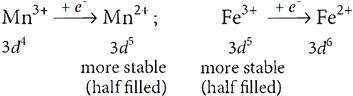
Hence, Eo value for Mn3+/Mn2+ couple is much more positive than that for Fe3+/Fe2+.
(ii) Greater the number of unpaired electrons, stronger is the metallic bond and therefore, higher is the enthalpy of atomisation. Since, iron has greater number of unpaired electrons than copper hence has higher enthalpy of atomisation.
(iii) Only those ions are coloured which have partially filled d-orbitals facilitating d-d transitions. Sc3+ has no unpaired electron but Ti3+ has one unpaired electron and hence, Ti3+ is coloured.
Q.38. Account the following:
Transition metals form large number of complex compounds.
A.38: Transition metals form a large number of complex compounds due to following reasons:
Comparatively smaller size of metal ions.
High ionic charges.
Availability of d-orbitals for bond formation.
Q.39. (i) How is the variability in oxidation states of transition metals different from that of the p-block elements?
(ii) Orange colour of Cr2O72– ion changes to yellow when treated with an alkali. Why?
A.39: (i) Variable oxidation states of transition metals arise due to incomplete filling of d-orbitals and it differs from each other by unity e.g., V(V), V(IV), V(III), V(II). In p-block elements oxidation states differ generally by a unit of two. e.g., Sn(II), Sn(IV), PCl3, PCl5, etc.
(ii) Orange colour of Cr2O72– ion changes to yellow when an alkali is added because on addition of an alkali, the concentration of H+ ions decreases and hence, the reaction proceeds in the forward direction producing yellow solution containing CrO42– ions.
Cr2O72– + 2OH– → 2CrO42– + H2O
orange yellow
Q.40. Following are the transition metal ions of 3d series:
Ti4+, V2+, Mn3+, Cr3+
(Atomic numbers: Ti = 22, V = 23, Mn = 25, Cr = 24)
Answer the following:
(i) Which ion is most stable in aqueous solution and why?
(ii) Which ion is strong oxidising agent and why?
(iii) Which ion is colourless and why?
A.40: (i) Ti4+ has highest oxidation state among the given ions. Ti4+ has stable inert gas configuration and hence, most stable in aqueous solution.
On the other hand, V2+, Mn3+, Cr3+ have unstable electronic configuration and hence, are less stable.
(ii) Due to presence of highest oxidation state of Ti, it acts as the strongest oxidising agent among the given ions.
(iii) Due to absence of unpaired electron in Ti4+, it is a colourless ion.
Electronic configuration of Ti4+ = [Ar]3d04s0
Q.41. Account for the following: Cr2+ is a strong reducing agent.
A.41: Cr2+ is reducing since its configuration is converted to d3 from d4. d3 has half-filled t2g configuration with higher stability.
Q.42.

From the given data of Eo values answer the following questions:
(i) Why is 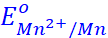 value highly negative as compared to other
elements?
value highly negative as compared to other
elements?
(ii) Which is a stronger reducing agent Cr2+ or Fe2+? Give reason.
A.42: (i) Mn2+ ion has stable half-filled (3d5) electronic configuration. Its ionisation enthalpy value is lower in comparison to hydration enthalpy. Hence EoMn2+/Mn is more negative.
(ii) Cr2+ is a stronger reducing agent than Fe2+.
Reason: 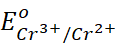 is negative (–0.41 V) whereas
 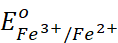 positive (+ 0. 77 V). Thus Cr2+
is easily oxidized to Cr3+ but Fe2+ cannot be easily
oxidized to Fe3+. Hence, Cr2+ is stronger reducing agent
than Fe2+.
positive (+ 0. 77 V). Thus Cr2+
is easily oxidized to Cr3+ but Fe2+ cannot be easily
oxidized to Fe3+. Hence, Cr2+ is stronger reducing agent
than Fe2+.
Q.43. Assign suitable reason for the following:
Sc3+ is colourless in aqueous solution whereas Ti3+ is coloured.
A.43: Only those ions are coloured which have partially filled d-orbitals facilitating d-d transitions. Sc3+ with 3d0 configuration is colourless while Ti3+ (3d1) is coloured.
Q.44. Give reasons for the following:
(i) Mn3+ is a good oxidising agent.
(ii) EoM2+/M values are not regular for first row transition metals (3d-series).
A.44: (i) Mn2+ is more stable due to half-filled d5 configuration and Mn3+ easily changes to Mn2+ hence, it is oxidising.
(ii) The  values are not regular which can be
explained from the irregular variation of ionisation enthalpies i.e., IE1
+ IE2 and also the sublimation enthalpies which are relatively much less
for manganese and vanadium.
values are not regular which can be
explained from the irregular variation of ionisation enthalpies i.e., IE1
+ IE2 and also the sublimation enthalpies which are relatively much less
for manganese and vanadium.
Q.45. Give reasons: d-block elements exhibit more oxidation states than f-block elements.
A.45: All transition elements except the first and the last member in each series show a large number of variable oxidation states. This is because difference of energy in the (n – 1)d and ns orbitals is very little. Hence, electrons from both the energy levels can be used for bond formation.
Q.46. How would you account for the following:
Mn (III) undergoes disproportionation reaction easily.
A.46: Mn3+ is less stable and changes to Mn2+ which is more stable due to half-filled d-orbital configuration. That is why, Mn3+ undergoes disproportionation reaction.
Q.47. How would you account for the following:
(i) The oxidising power of oxoanions are in the order VO2+ < Cr2O72– < MnO4–
(ii) The third ionization enthalpy of manganese (Z = 25) is exceptionally high.
A.47: (i) Change in Cr2O72– to Cr(III) is 3 and in MnO4– to Mn (II) is 5. Change in oxidation state is large and the stability of reduced products in V(III) < Cr(III) < Mn(II). This is why oxidising power of VO2+ < Cr2O72– < MnO4–.
(ii) Third ionization enthalpy of Mn is very high because the third electron has to be removed from the stable half-filled 3d-orbitals [Mn2+ (Z = 25) = 3d5].
Q.48. Account for the following:
Scandium (Z = 21) is regarded as a transition element but zinc (Z = 30) is not.
A.48: On the basis of incompletely filled d-orbitals:
Scandium (Z = 21), atom has incompletely filled d-orbitals (3d1) in its ground state, so it is regarded as transition element.
On the other hand, zinc (Z = 30) atom has completely filled d-orbitals (3d10) in its ground state as well as most common oxidation state of +2.
Q.49. Explain the following observations:
In general, the atomic radii of transition elements decrease with atomic number in a given series.
A.49: The atomic radii of transition elements increase with the increase in atomic number as the effective nuclear charge increases because shielding effect of d-electron small.
Q.50. The elements of 3d transition series are given as
Se Ti V Cr Mn Fe Co Ni Cu Zn
Answer the following:
(i) Write the element which shows maximum number of oxidation states. Given reason.
(ii) Which element has the highest melting point?
(iii) Which element shows only +3 oxidation state?
(iv) Which element is a strong oxidising agent in + 3 oxidation state and why?
A.50: (i) Mn shows maximum no. of oxidation states from + 2 to + 7 because Mn has maximum number of unpaired electrons in 3d sub-shell.
(ii) Cr has maximum melting point, because it has 6 unpaired electrons in the valence shell, hence it has strong interatomic interaction.
(iii) Se shows only +3 oxidation state because after losing 3 electrons, it has noble gas electronic configuration.
(iv) Mn is strong
oxidising agent in +3 oxidation state because change of Mn3+ to Mn2+
give stable half filled (d5) electronic configuration, 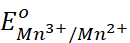 = 1.5 V.
Q.51. Complete the following equation:
2MnO4– + 6H+ + 5NO2– →
A.51: 2MnO4– + 6H+ + 5NO2– → 2Mn2+ + 5NO3– + 3H2O
Q.52. Complete the following equation:
3MnO42– + 4H+ →
A.52: 3MnO42– + 4H+ → 2MnO4– + MnO2 + 2H2O
Q.53. Complete the following equation:
MnO4– + 8H+ + 5e– →
A.53: MnO4– + 8H+ + 5e– → Mn2+ + 4H2O
Q.54. Complete the following chemical equations:
SO2 + MnO4– + H2O →
A.54: 2MnO4– + 5SO2 + 2H2O → 2Mn2+ + 5SO42– + 4H+
Q.55. Give reason:
Orange solution of potassium dichromate turns yellow on adding sodium hydroxide to it.
A.55: When the pH of the solution of potassium dichromate is decreased, the colour of the solution changes from yellow to orange due to the conversion of CrO42– ions into Cr2O72– ions.
2CrO42– + 2H+ → Cr2O72– + H2O
Yellow Orange
Q.56. Complete the following chemical equation:
Cr2O72–(aq) + H2S(g) + H+(aq) →
A.56: Cr2O72–(aq) + 3H2S(g) + 8H+(aq) → 2Cr3+(aq) + 7H2O(l) + 3S(s)
Q.57. Complete and balance the following chemical equations:
(i) Fe2+ + MnO4– + H+ →
(ii) MnO4– + H2O + I– →
A.57: (i) 5Fe2+ + MnO4– + 8H+ → Mn2+ + 4H2O + 5Fe3+
(ii) 2MnO4– + H2O + I– → 2OH– + 2MnO2 + IO3–
Q.58. Complete the following equations:
(i) 2MnO4– + 16H+ + 5S2– →
(ii) KMnO4

A.58: (i) 2MnO4– + 16H+ + 5S2– → 2Mn2+ + 8H2O + 5S
(ii) 2KMnO4  K2MnO4 +
MnO2 + O2
K2MnO4 +
MnO2 + O2
Q.59. When chromite ore FeCr2O4 is fused with NaOH in presence of air, a yellow coloured compound (A) is obtained which on acidification with dilute sulphuric acid gives a compound (B). Compound (B) on reaction with KCl forms an orange coloured crystalline compound (C).
(i) Write the formulae of the compounds (A), (B) and (C).
(ii) Write one use of compound (C).
A.59:
(i) 4FeCr2O4 + 16NaOH + 7O2 → 8Na2CrO4 + 2Fe2O3 + 8H2O
(A)
2Na2CrO4 + H2SO4 → Na2Cr2O7 + Na2SO4 + H2O
(B)
Na2Cr2O7 + 2KCl → K2Cr2O7 + 2NaCl
(C)
(ii) Potassium dichromate is used as a powerful oxidising agent in industries and for staining and tanning of leather.
Q.60. Complete the following chemical equations:
(i) 8MnO4– + 3S2O32– + H2O →
(ii) Cr2O72– + 3Sn2+ + 14H+ →
A.60: (i) 8MnO4–(aq) + 3S2O32–(aq) + H2O(l) → 8MnO2(aq) + 6SO42–(aq) + 2OH–(aq)
(ii) Cr2O72– + 3Sn2+ + 14H+ → 2Cr3+ + 3Sn4+ + 7H2O
Q.61. Complete the following equations.
(i) 2MnO2
+ 4KOH + O2 
(ii) Cr2O72– + 14H+ + 6I– →
A.61: (i) 2MnO2 + 4KOH + O2 → 2K2MnO4 + 2H2O
(ii) Cr2O72– + 14H+ + 6I– → 2Cr3+ + 3I2 + 7H2O
Q.62. Describe the preparation of potassium permanganate. How does the acidified permanganate solution react with oxalic acid? Write the ionic equations for the reaction.
A.62: Preparation of potassium permanganate:
Potassium permanganate is prepared by the fusion of MnO2 (pyrolusite) with potassium hydroxide and an oxidising agent like KNO3 to form potassium manganate which disproportionates in a neutral or acidic solution to form permanganate.
2MnO2 + 4KOH + O2 → 2K2MnO4 + 2H2O
3MnO42– + 4H+ → 2MnO4– + MnO2 + 2H2O
or,
3K2MnO4 + 4HCl → 2KMnO4 + MnO2 + 2H2O + 4KCl
2MnO42– + 16H+ + 5Cr2O72– → 2Mn2+ + 10CO2 + H2O
Q.63. Describe the oxidising action of potassium dichromate.
A.63: Potassium dichromate is a strong oxidising agent. In the presence of dilute sulphuric acid, one molecule of K2Cr2O7 gives 3 atoms of available oxygen.
Q.64. How do you prepare: Na2Cr2O7 from Na2CrO4
A.64: Sodium dichromate can be crystallised out from sodium chromate solution by acidifying it with sulphuric acid.
2Na2CrO4 + 2H+ → Na2Cr2O7 + 2Na+ +H2O
Q.65. Complete the following equations:
(i) Cr2O72– + 2OH– →
(ii) MnO4– + 4H+ + 3e– →
A.65: (i) Cr2O72– + 2OH– → 2CrO42– + H2O
(ii) MnO4– + 4H+ + 3e– → MnO2 + 2H2O
Q.66. Complete the following equations:
(i) 2MnO4– + 5S2– + 16H+ →
(ii) Cr2O72– + 2OH– →
A.66: (i) H2S → 2H+ + S2–
5S2– + 2MnO4– + 16H+ → 2Mn2+ + 8H2O + 5S
(ii) Cr2O72– + 2OH– → 2CrO42– + H2O
Q.67. Complete the following equations:
(i) 2CrO42– + 2H+ →
(ii) KMnO4

A.67: (i) 2CrO42– + 2H+ → Cr2O72– + H2O
(ii) 2KMnO4 → K2MnO4 + MnO2 + O2
Q.68. Complete the following chemical equation:
Cr2O72–(aq) + Fe2+(aq) + H+(aq) →
A.68: Cr2O72–(aq) + 14H+(aq) + 6Fe2+(aq) → 2Cr3+(aq) + 6Fe3+(aq) + 7H2O(l)
Q.69. Complete the following reaction in an aqueous medium:
MnO4– + C2O42– + H+ →
A.69: 2MnO4– + 5C2O42– + 16H+ → 2Mn2+ + 8H2O + 10CO2
Q.70. Complete the following chemical equations:
(i) Fe3+ + I– →
(ii) CrO42– + H+ →
A.70: (i) 2Fe3+ + 2I– → 2Fe2+ + I2
(ii) 2CrO42– + 2H+ → Cr2O72– + H2O
Q.71. Describe the reactions involved in the preparation of K2Cr2O7 from chromite ore.
A.71: 4FeCr2O4 + 8Na2CO3 + 7O2 → 8Na2CrO4 + 2Fe2O3 + 8CO2
2Na2CrO4 + 2H+ → Na2Cr2O7 + 2Na+ + H2O
Na2Cr2O7 + 2KCl → K2Cr2O7 + 2NaCl
Potassium dichromate is converted to chromate if pH is increased.
Cr2O72–
 CrO42–
Q.72. How does the acidified potassium permanganate solution react with iron (II) ions? Write the ionic equations for the reactions.
A.72: MnO4– + 5Fe2+ + 8H+ → Mn2+ + 5Fe3+ + 4H2O
Q.73. Complete the following chemical reaction equation:
Fe2+(aq) + MnO4–(aq) + H+(aq) →
A.73: 5Fe2+ + MnO4– + 8H+ → Mn2+ + 4H2O + 5Fe3+
Q.74. Describe the preparation of potassium permanganate from pyrolusite ore. Write balanced chemical equation for one reaction to show the oxidizing nature of potassium permanganate.
A.74: 2MnO4– + 5C2O42– + 16H+ → 2Mn2+ + 10CO2 + 8H2O
Q.75. Describe the preparation of potassium dichromate from chromite ore. What is the effect of change of pH on dichromate ion?
A.75: The yellow solution of sodium chromate is acidified with sulphuric acid to give an orange solution of sodium dichromate Na2Cr2O7 which is crystallised.
2Na2CrO4 + H2SO4 → Na2Cr2O7 + Na2SO4 +H2O
Sodium chromate Sodium dichromate
The solution of sodium dichromate is treated with potassium chloride to obtain potassium dichromate.
Na2Cr2O7 + 2 KCl → K2Cr2O7 + 2NaCl
Potassium dichromate
Q.76. What happens when acidified potassium permanganate solution reacts with ferrous sulphate solution? Write balanced chemical equations.
A.76: 5Fe2+ + MnO4– + 8H+ → Mn2+ + 4H2O + 5Fe3+
Q.77. Account for the following: Zr and Hf have almost similar atomic radii.
A.77: Due to lanthanoid contraction the elements, of 4d and Sd-series have similar atomic radii e.g., Zr = 145 pm and Hf = 144 pm.
Q.78. Name a member of the lanthanoid series which is well known to exhibit +2 oxidation state.
A.78: Europium (Eu) is well known to exhibit +2 oxidation state due to its half-filled f orbital in + 2 oxidation state.
Q.79. Name a member of the lanthanoid series which is well known to exhibit +4 oxidation state.
A.79: Lanthanoids showing +4 oxidation state are 58Ce, 59Pr, 65Tb and 66Dy.
Q.80. What are the different oxidation states exhibited by the lanthanoids?
A.80: Lanthanum and all the lanthanoids predominantly show +3 oxidation state. However, some of the lanthanoids also show +2 and +4 oxidation states in solution or in solid compounds. This irregularity arises mainly due to attainment of stable empty (4f0), half-filled (4f7) and fully filled (4f14) sub shell.
e.g. Ce4+: 4f0 Tb4+: 4f7 Eu2+: 4f7 Yb2+: 4f14
Q.81. Give reason:
There is a gradual decrease in the size of atoms with increasing atomic number in the series of lanthanoids.
A.81: As the atomic number increases, each succeeding element contains one more electron in the 4f orbital and one extra proton in the nucleus. The 4f electrons are rather ineffective in screening the outer electrons from the nucleus. As a result, there is gradual increase in the nuclear attraction for the outer electrons. Consequently, the atomic size gradually decreases. This is called lanthanoid contraction.
Q.82. What is meant by 'lanthanoid contraction'?
A.82: The steady decrease in the atomic and ionic radii (having the same charge) with increase in atomic number across the series from lanthanum to lutetium is known as lanthanoid contraction.
Q.83. Explain the following observations:
La3+ (Z = 57) and Lu3+ (Z = 71) do not show any colour in solutions.
A.83: Because they have empty 4f subshell.
Q.84. Give reason for the following:
Among the lanthanoids, Ce (III) is easily oxidised to Ce (IV).
A.84: Ce(III) has outer configuration 4f15d06s0. It easily loses an electron to acquire the configuration 4f0 and forms Ce(IV). In fact, this is the only (+IV) lanthanoid which exists in solution.
Q.85. What is lanthanoid contraction? What are its two consequences?
A.85: Lanthanoid contraction: The steady decrease in the atomic and ionic radii of lanthanoid elements with increase in atomic number is called lanthanoid contraction. It is caused due to imperfect shielding of nuclear charge by 4f-electrons. Consequences of lanthanoid contraction:
(i) The basic strength of oxides and hydroxides of lanthanoids decrease with increasing atomic number.
(ii) Atomic and ionic sizes of 4d transition series elements and Sd series elements are similar. e.g., atomic radii of zirconium (Zr) is same as that of hafnium Hf.
Q.86. Give reasons:
Actinoids show irregularities in their electronic configurations.
A.86: The irregularities in the electronic configurations of actinoids are due to extra stabilities of the f0, f7 and f14 orbitals.
Q.87. How would you account for the following:
Actinoid contraction is greater than lanthanoid contraction?
A.87: The actinoid contraction is more than lanthanoid contraction because 5f-electrons are more poorly shielded than 4f-electrons.
Q.88. Give reason for the following:
Actinoids exhibit a greater range of oxidation states than lanthanoids.
A.88: Actinoids exhibit greater range of oxidation; states than lanthanoids. This is because there is less energy difference between 5f and 6d orbitals in actinoids than the energy difference between 4f and 5d orbitals in case of lanthanoids.
Q.89. Explain giving reasons:
The chemistry of actinoids is not as smooth as that of lanthanoids.
A.89: The chemistry of actinoids is not as smooth as lanthanoid because they show greater number of oxidation states due to comparable energies of 5f, 6d and 7s orbitals.
Q.90. Write one similarity between the chemistry of lanthanoids and actinoids.
A.90: Only trends of magnetic properties and colour of lanthanoids are similar to actinoids.
Q.91. With reference to structural variability and chemical reactivity, write the differences between lanthanoids and actinoids.
A.91: Structure: All the lanthanoids are silvery white soft metals. Hardness of Lanthanoids increases with increasing atomic number. The actinoid metals are all silvery in appearance but display a variety of structures. The structural variability is due to irregularities in metallic radii which are greater than that of lanthanoids.
Chemical reactivity: Earlier members of lanthanoid series are quite reactive similar to calcium but with increasing atomic number they behave more like aluminium.
The actinoids are highly reactive in finely divided state.
Q.92. Compare the chemistry of the actinoids with that of lanthanoids with reference to
(i) electronic configuration
(ii) oxidation states
(iii) chemical reactivity.
A.92: (i) Electronic configuration: The general electronic configuration of lanthanoids is [Xe] 4f1–14 5d0–1 6s2 whereas, that of actinoids is [Rn] 5f1–14 6d0–1 7s2. Thus, lanthanoids involve the filling of 4f-orbitals whereas, actinoids involve the filling of 5f-orbitals.
(ii) Oxidation states: Lanthanoids have principal oxidation state of +3. In addition, the lanthanoids show limited oxidation states such as +2, +3 and +4 because of large energy gap between 4f and 5d subshells. On the other hand, actinoids show a large number of oxidation states because of small energy gap between Sf and 6d subshells.
(iii) Chemical reactivity:
(a) First few members of lanthanoids are quite reactive almost like calcium, whereas, actinoids are highly reactive metals especially in the finely divided state.
(b) Lanthanoids react with dilute acids to liberate H2 gas whereas actinoids react with boiling water to give a mixture of oxide and hydride.
Q.93. Why is europium (II) more stable than cerium (II)?
A.93: Europium (II) has electronic configuration [Xe]4f75d0 while cerium (II) has electronic configuration [Xe] 4f15d1. In Eu2+, 4f subshell is half filled and 5d-subshell is empty. Since half-filled and completely filled electronic configurations are more stable, Eu2+ ion is more stable than Ce2+ in which neither 4f subshell nor 5d subshell is half filled or completely filled.
Q.94. Write the electronic configuration of Ce3+ ion, and calculate the magnetic moment on the basis of 'spin-only' formula. [Atomic no. of Ce = 58]
A.94: Ce (Z = 58) = [Xe] 4f1 5d1 6s2
∴ Ce3+ = [Xe] 4f1 5d0 6s0
Therefore, it has only one unpaired electron. i.e., n = 1
∴ μ = 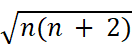 =
= 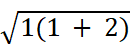 =
=  = 1.73 BM
Q.95. Name an important alloy which contains some of the lanthanoid metals. Mention its two uses.
A.95: Mischmetal is well known alloy which consists of a lanthanoid metal (about 95%), iron (about 5%) and traces of S, C, Ca, Al etc. Mischmetal is used in Mg based alloy to produce bullets shells and lighter flint.
Q.96. Write one similarity and one difference between the chemistry of lanthanoid and actinoid elements.
A.96: Similarity: The elements of both the series are electropositive in nature. They are reactive metals and act as strong reducing agents. Difference: Lanthanoids except promethium are non-radioactive elements, while all actinoids are radioactive elements.
Q.97. Chemistry of actinoids is complicated as compared to lanthanoids. Give two reasons.
A.97: Chemistry of actinoids is more complicated than lanthanoids because
(i) actinoids show greater number of oxidation states due to the comparable energies of 5f, 6d and 7s orbitals.
(ii) most of the actinoids are radioactive and the study of their chemistry in the laboratory is difficult.
Online Tuitions & Self-Study Courses for Grade 6 to 12 & JEE / NEET