
Q.1. Why do most of the transition metal ions exhibit characteristic colours in aqueous solutions?
Ans: Most of the complexes of transition elements are coloured because, transition metals have unpaired electron in d-orbitals and undergo d-d transitions by absorbing light from visible region and radiate complementary colour. The ions of transition elements absorb the radiation of a particular wavelength and the rest is reflected, imparting colour to the solution.
Q.2. Why Copper (I) ion is not known in aqueous solution?
Ans: Copper (I) compounds are unstable in aqueous solution and undergo disproportionation.
2Cu+ → Cu2+ + Cu
The stability of Cu2+(aq) rather than Cu+(aq) is due to the much more negative ∆hydH of Cu2+(aq) than Cu+, which is more than that compensates for the second ionisation enthalpy of Cu.
Q.3. Explain why Cr2+ is a strong reducing agent whereas Mn3+ is an oxidising agent.
Ans: Cr2+ is reducing as its configuration changes from d4 (Cr2+) to d3 (Cr3+), the latter having a half-filled t2g level. On the other hand, the change from Mn3+ to Mn2+ results in the half-filled (d5) configuration which has extra stability. Thus, it behaves as oxidising agent.
Q.4. Though a transition element, scandium (Z = 21) does not exhibit variable oxidation state.
Ans: Sc does not exhibit variable oxidation states because it contains only 3 electrons in its valence shell (3d1 4s2 configuration) and after losing them, it achieves inert gas configuration i.e., highest stability.
Q.5. Why Cd2+ salts are white?
Ans: Cd2+ salts are white because Cd2+ has completely filled d-orbitals (d10).
Q.6. How would you account for the following ?
(i) Many of the transition elements are known to form interstitial compounds.
(ii) The metallic radii of the third (5d) series of transition metals are virtually the same as those of the corresponding group member of the second (4d) series.
Ans: (i) Transition metals are large in size and contain lots of interstitial sites. They can trap atoms of other elements (that have small atomic size), such as H, C, N, in the interstitial sites of their crystal lattices. Hence, they are known to form interstitial compounds.
(ii) Metallic radii of third (5d) series of transition metals are virtually same as those of (4d) series because of the lanthanoid contraction. This is associated with the intervention of the 4f orbitals which are filled before the 5d series of elements starts. The filling of 4f orbitals before 5d orbitals results in a regular decrease in atomic radii, called lanthanoid contraction which compensates the expected increase in atomic size with increasing atomic numbers.
Q.7. Explain the following observations:
(i) Co2+ is easily oxidized to Co3+ in the presence of a strong Ligand.
(ii) CO is a stronger complexing reagent than NH3.
Ans: (i) The electronic configuration of Co3+ is 3d6, 4s0. So, pairing occurs in the presence of a strong ligand. Thus, there are no unpaired electrons and if is highly stable.
Co3+ : 3d6
|
|
|
|
|
|


In the presence of a strong ligand,
|
|
|
|
|
|
However, in Co2+, electronic configuration of which is 3d7, there is one unpaired electron even after pairing occurs in the presence of a strong ligand.
Co2+ : 3d7
|
|
|
|
|
|
In the presence of a strong ligand,
|
|
|
|
|
|
Hence, Co2+ is oxidised to more stable Co3+.
(ii) In comparison to NH3, CO produces strong field, which results in large splitting of d-orbitals. That's why CO is a stronger complexing reagent than NH3.
Q.8. Complete the following chemical reaction equations:
(i) Cr2O72− + I− + H+ →
(ii) MnO4− + NO2− + H+ →
Ans: (i) Cr2O72− + 6I− + 14H+ → 2Cr3+ + 7H2O + 3I2
(ii) 2MnO4− + 5NO2 + 6H+ → 2Mn2+ + 5NO3 + 3H2O
Q.9. How would you account for the following?
The EoM2+/M for copper is positive (0.34 V). Copper is the only metal in the first series of transition elements showing this behaviour.
Ans: The enthalpy of atomisation is very high for Cu but its hydration energy is very low. The high energy to transform Cu(s) to Cu2+ (aq) is not balanced by its hydration enthalpy. Thus, for this conversion Eo value is positive.
Q.10. Explain each of the following observations:
There is hardly any increase in atomic size with increasing atomic numbers in a series of transition metals.
Ans: In general atoms in a given series show progressive decrease in radius with increasing atomic number. This is because as new electron enters in a d-orbital, each time the nuclear charge increases by unity. Shielding effect of a d-electron is not effective and hence effective nuclear charge increases and ionic radius decreases.
Q.11. Assign reasons for each of the following.
Manganese exhibits the highest oxidation state of +7 among the 3d-series of transition elements.
Ans: Mn has electronic configuration [Ar] 4s2 3d5 and all the electrons in 's' as well as 'd' can take part in bond formation, therefore, it shows + 7 (highest) oxidation state.
Q.12. In a transition series of metals, why does the metal, which exhibits the greatest number of oxidation states, occurs in the middle of the series.
Ans: This is due to large number of unpaired electrons in d-orbitals in the middle of the series.
Q.13. Complete the following chemical equations
(i) MnO4−(aq) + S2O32−(aq) + H2O(l) →
(ii) Cr2O72−(aq) + Fe2+(aq) + H+(aq) →
Ans:
(i) 8MnO4−(aq) + 3S2O32−(aq) + H2O(l) → 8MnO2 + 6SO42− + 2OH−
(ii) Cr2O72−(aq) + 6Fe2+(aq) + 14H+(aq) → 2Cr3+ + 6Fe3+ + 7H2O
Q.14. State reasons for the following:
Unlike Cr3+, Mn2+, Fe3+ and the subsequent other M2+ ions of the 3d-series of elements, the 4d and the 5d-series metals generally do not form stable cationic species.
Ans: Because energy required to remove electron is more due to greater effective nuclear charge which is due to lanthanoid contraction.
Q.15. Explain giving a suitable reason for each of the following.
(i) Transition metals and their compounds are generally found to be good catalysts.
(ii) Metal-metal bonding is more frequent for the 4d and 5d-series transition metals than that for the 3d-series.
Ans: (i) Because these metals show variable oxidation states and form unstable intermediate which readily change into product.
(ii) Because less energy is required for a greater number of electrons to take part in metal-metal bonding.
Q.16. Complete the following reactions in the aqueous medium
(i) MnO4− + C2O42− + H+ →
(ii) Cr2O72− + H2S + H+ →
Ans:
(i) 2MnO4− + 5C2O42− + 16H+ → 2Mn2+ + 8H2O + 10CO2
(ii) Cr2O72−(aq) + 3H2S(g) + 8H+(aq) → 2Cr3+(aq)+ 3S + 7H2O(l)
Q.17. Complete the following chemical equations
(i) Fe3+ + I− →
(ii) CrO42− + H+ →
Ans:
(i) 2Fe3+ + 2I− → 2Fe2+ + I2
(ii) 2CrO42− + 2H+ → Cr2O72− + H2O
Q.18. Write balance chemical equations of two reactions in which KMnO4 acts as an oxidising agent in the acid medium.
Ans: Oxidising reactions of KMnO4 in acid solutions
(i) Iodine is liberated from potassium iodide
10I− + 2MnO4− + 16H+ → 2Mn2+ + 8H2O + 5I2
(ii) Fe2+ ion (green) is converted into Fe3+ (yellow).
5Fe2+ + MnO4− + 8H+ → Mn2+ + 4H2O + 5Fe3+
Q.19. Explain the following observations.
Zinc is not regarded as a transition element.
Ans: Because Zn has completely filled d-orbitals in its atomic as well as in its common oxidation states (Zn2+ state).
Q.20. Explain the following observations.
Among the divalent cations in the first series of transition elements, manganese exhibits the maximum paramagnetism.
Ans: Mn2+ has maximum number of unpaired electrons and paramagnetic nature is directly proportional to the number of unpaired electrons. Thus, it exhibits maximum paramagnetism.
Q.21. Account for the following:
Most of the transition metal ions exhibit paramagnetic behaviour.
Ans: Because transition metal ions have unpaired electrons in d-orbitals (d1 to d9).
Paramagnetism arises due to the presence of unpaired electrons.
Q.22. Account for the following.
(i) In the series Sc to Zn, the enthalpy of atomisation of zinc is the lowest.
(ii) Eo value for the Mn3+/Mn2+ couple is much more positive than that for Cr3+/Cr2+.
Ans: (i) This is because, enthalpy of atomisation depends upon the strength of bonding. In case of zinc, only metallic bonding occurs but no d-d overlapping takes place, whereas, in case of other metals of first transition series, both the metallic as well as covalent bonding involve. Thus, enthalpy of atomisation is lowest for zinc.
(ii) The comparatively high value for Mn is due to the fact that Mn2+(d5) is particularly stable whereas comparatively low value for Cr is because of the extra stability of Cr3+. Therefore, Cr3+ cannot be reduced to Cr2+.
Q.23. Describe the preparation of
(i) potassium dichromate from sodium chromate
(ii) KMnO4 from K2MnO4
Ans: (i) Sodium chromate solution is acidified with H2SO4 to obtain orange sodium dichromate.
2Na2CrO4 + 2H+ → Na2Cr2O7 + 2Na+ + H2O
Potassium dichromate crystals are obtained by the treatment of sodium dichromate solution with potassium chloride.
Na2Cr2O7 + 2KCl → K2Cr2O7 + 2NaCl
(ii) In neutral or acidic solution, K2MnO4 disproportionates to yield permanganate.
3MnO42− + 4H+ → 2MnO4− + MnO2 + 2H2O
Commercially, KMnO4 is obtained by the electrolytic oxidation of manganate (VI).
MnO42− 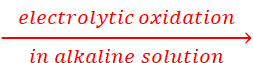 MnO4−
MnO4−
Manganate ion Permanganate ion
Q.24. Explain the following observations.
(i) The enthalpies of atomisation of transition metals are quite high
(ii) There is a close similarity in physical and chemical properties of the 4d and 5d-series of the transition elements, much more than expected on the basis of usual family relationship.
Ans: (i) Transition metals have high enthalpies of atomisation due to strong metallic bonding and additional covalent bonding.
Metallic bonding is due to their smaller size while covalent bonding is due to d-d overlapping.
(ii) Due to the lanthanoid contraction the metallic radii of the third series (5d) of transition metals are virtually the same as those of the corresponding group members of the second (4d) series. This results in close similarity in their physical and chemical properties.
Online Tuitions & Self-Study Courses for Grade 6 to 12 & JEE / NEET