
Class 12 Chemistry
Chapter 5 – Surface Chemistry
Chapter Notes
- Phenomenon of accumulation of molecules at the surface of a solid, which results into a higher concentration at the surface than in the bulk
- The substance adsorbed is called adsorbate.
- The substance on which adsorption takes place is called adsorbent.
- The phenomenon of removing adsorbate from adsorbent is called desorption.
Distinction between Adsorption and Absorption
- Adsorption:
Adsorption is a surface phenomenon of accumulation of molecules of a substance at the surface rather than in the bulk of a solid or liquid. The substance does not penetrate through the surface to the bulk of the solid or liquid. For example, when we dip a chalk stick into an ink solution, only its surface becomes coloured. If we break the chalk stick, it will be found to be white from inside.
- Absorption:
Absorption is a bulk phenomenon. In absorption, the absorbed substance gets uniformly distributed throughout the bulk of the solid or liquid.
- All the forces acting between the particles inside the adsorbent are mutually balanced. However, on the surface, the particles are not surrounded by atoms or molecules of their kind on all sides and hence, they possess unbalanced or residual attractive forces. These forces of the adsorbent are responsible for attracting the adsorbate particles on its surface.
- The extent of adsorption increases with the increase of surface area per unit mass of the adsorbent at a given temperature and pressure.
- Adsorption is an exothermic process (ΔH = negative).
- It is accompanied by decrease in entropy of the system (ΔS = negative).
o Reason − When a gas is adsorbed, the freedom of movement of its molecules becomes restricted.
- Adsorption process is spontaneous in nature (ΔG = negative).
- When ΔG = 0, state of equilibrium is attained.
1. Physical adsorption or physisorption
When the accumulation of gas on the surface of a solid occurs on account of weak van der Waal’s forces.
2. Chemical adsorption or chemisorption
When the gas molecules or atoms are held to the surface by chemical bonds. Chemical bonds may be covalent or ionic.
Comparisons of physisorption and chemisorption:
|
Physisorption |
Chemisorption |
|
Arises because of van der Waals forces |
Arises because of chemical forces |
|
Not specific in nature |
Highly specific in nature |
|
Reversible in nature |
Irreversible in nature |
|
Depends on the nature of gas More easily liquefiable gases are adsorbed readily. |
It also depends on the nature of gas. Gases which can react with adsorbent show chemisorption. |
|
Enthalpy of adsorption is low. |
Enthalpy of adsorption is high. |
|
No appreciable activation energy is required. |
Sometimes, high activation energy is required. |
|
Results into multi-molecular layers |
Results into uni-molecular layer |
|
Low temperature is favourable for adsorption. It decreases with increase of temperature. |
High temperature is favourable for adsorption. It increases with the increase of temperature. |
|
Increases with increase in surface area |
Also increases with increase in surface area |
- The plots between the extent of
adsorption
 against the pressure (P) of the gas at constant temperature (T).
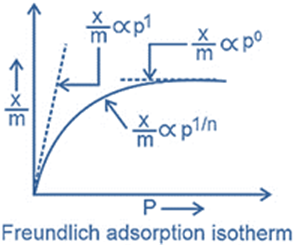
Freundlich adsorption isotherm
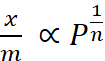
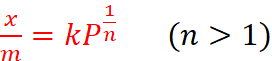
- Freundlich adsorption isotherm gives an empirical relationship between the quantity of gas adsorbed by a unit mass of solid adsorbent and pressure at a specific temperature.
- From the given plot it is clear that
at pressure Ps,
 reaches the maximum value. Ps is
called the saturation pressure. Three cases
arise from the graph.
reaches the maximum value. Ps is
called the saturation pressure. Three cases
arise from the graph.
- Case I: At low pressure
The
plot is straight and slope indicates that the pressure
is directly proportional to  .
.
i.e.,
∝ P
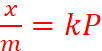 (k is a constant)
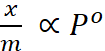
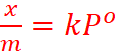
- Case II: At high pressure
When
pressure exceeds the saturated pressure, becomes independent of P values.
- Case III: At intermediate pressure
At
intermediate pressure, depends on P raised
to the powers between 0 and 1.
This relationship is known as the Freundlich adsorption isotherm.
Taking log,

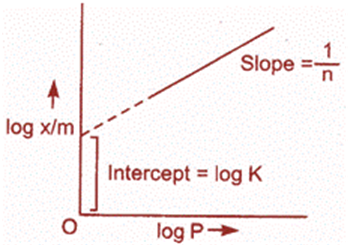
- On plotting the graph between
 and log P, a straight
line is obtained, with the slope equal to
and log P, a straight
line is obtained, with the slope equal to  and the intercept equal to log k.
Adsorption from Solution Phase
The following observations have been made in the case of adsorption from solution phase.
- With the increase in temperature, the extent of adsorption decreases.
- With an increase in the surface area of the adsorbent, the extent of adsorption increases.
- The extent of adsorption depends on the concentration of the solute in solution, and on the nature of the adsorbent and the adsorbate.
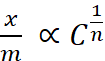
- Can be approximately described by Freundlich’s equation by using the concentration (C) of the solution instead of pressure
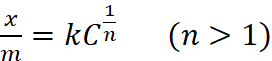
Taking log,

- On plotting the graph between and log C, a straight
line is obtained, with the slope equal to and the intercept equal to log k.
- Production of high vacuum: The traces of air can be adsorbed by charcoal from a vessel evacuated by a vacuum pump, to give a very high vacuum
- Gas mask: Used for breathing in coal mines, to adsorb poisonous gas
- Silica and aluminium gels are used as adsorbents for controlling humidity.
- A number of drugs are used for killing germs; the drugs get adsorbed on the germs.
- Used in heterogeneous catalysis.
- Used in chromatographic analysis: It is based on the phenomenon of adsorption; finds a number of applications in analytical and industrial fields
- Catalysts alter the rate of a chemical reaction, and remain chemically and quantitatively unchanged after the reaction.
- Promoters enhance the activity of a catalyst.
- Poisons decrease the activity of a catalyst.
- Homogeneous catalysis − When the reactants and the catalyst are in the same phase
- Heterogeneous catalysis −When the reactants and the catalyst are in different phases
Adsorption Theory of Heterogeneous Catalysis
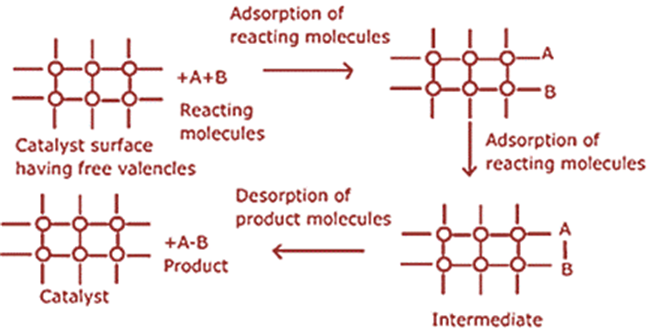
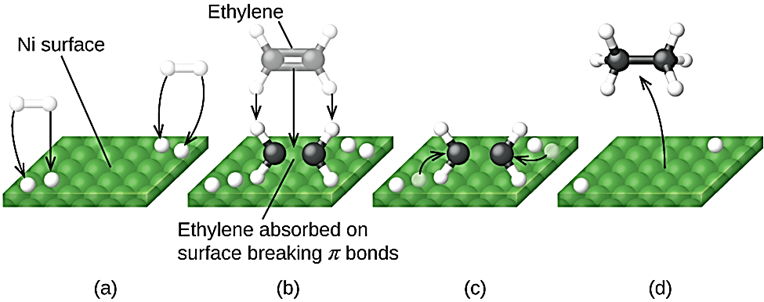
The mechanism involves the following steps:
- Diffusion of reactants to the surface of the catalyst
- Adsorption of the reactant molecules on the surface of the catalyst
- Occurrence of chemical reaction on the catalyst’s surface through the formation of an intermediate
- Desorption of reaction products from the catalyst surface (making the surface available for more reactions to occur)
- Diffusion of reaction products away from the surface of the catalyst
Important Features of Solid Catalysts
- Activity − Depends upon the strength of chemisorption to a large extent
- Selectivity − Ability to direct a reaction to yield a particular product
- The catalytic reaction that depends upon the pore structure of the catalyst and the size of the reactant and product molecules
- Zeolites are good shape-selective catalysts
Reason: They have honeycomb-like structures.
Enzymes −Complex nitrogenous compounds which are produced by living plants and animals
They catalyse numerous reactions in the bodies of animal and plants to maintain the life processes.
Example:
o Inversion of cane sugar into glucose and fructose by enzyme invertase
o Conversion of glucose into ethyl alcohol by enzyme zymase
The given table lists some enzymatic reactions.
|
Enzyme |
Source |
Enzymatic reaction |
|
Invertase |
Yeast |
Sucrose → Glucose and fructose |
|
Zymase |
Yeast |
Glucose → Ethyl alcohol and carbon dioxide |
|
Diastase |
Malt |
Starch → Maltose |
|
Maltase |
Yeast |
Maltose → Glucose |
|
Urease |
Soyabean |
Urea → Ammonia and carbon dioxide |
|
Pepsin |
Stomach |
Proteins → Peptides |
Characteristics of Enzyme Catalysis
· Highly efficient
· Highly specific in nature
· Highly active under optimum temperature
· Highly active under optimum pH
· Increase in activity in the presence of activators and co-enzymes
· Influenced by inhibitors and poisons
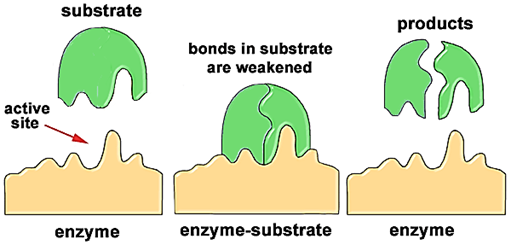
Steps involved are −
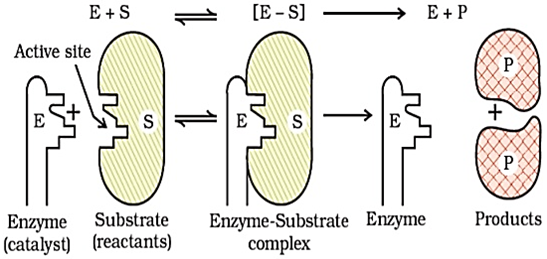
· Binding of enzyme to substrate to form an activated complex
E + S → ES#
· Decomposition of the activated complex to form products
ES# → E + P
The given figure represents the mechanism of an enzyme-catalysed reaction.
Some of the important catalytic processes are listed in the given table.
|
Process |
Catalyst |
|
|
1. |
Haber’s process for the manufacture of ammonia N2(g) + 3H2(g) → 2NH3(g) |
Finely divided iron, molybdenum as promoter; conditions: 200 bar pressure and 723−773K temperature |
|
2. |
Ostwald’s process for the manufacture of nitric acid 4NH3(g) + 5O2(g) → 4NO(g)+ 6H2O(g) 2NO(g) + O2(g) → 2NO2(g) 4NO2(g) + 2H2O(l) + O2(g)→ 4HNO3(aq) |
Platinised asbestos; temperature 573K |
|
3. |
Contact process for the manufacture of sulphuric acid 2SO2(g) + O2(g) → 2SO3(g) SO3(g) + H2SO4(aq) → H2S2O7(l) (oleum) H2S2O7(l) + H2O(l) → 2H2SO4(aq) |
Platinised asbestos or vanadium pentoxide (V2O5); temperature 673−723K |
- Heterogeneous system
- Intermediate between true solutions and suspensions
- The range of diameters of colloidal particles is between 1 and 1000 nm.
- Consists of two phases − dispersed phase and dispersion medium
Colloids are classified depending upon the following three criteria:
- Physical state of dispersed phase and dispersion medium
- Nature of interaction between dispersed phase and dispersion medium
- Type of particles of the dispersed phase
Depending Upon the physical state of Dispersed Phase and Dispersion Medium
|
Dispersed phase |
Dispersion medium |
Type of colloid |
Example |
|
Solid |
Solid |
Solid sol |
Gem stones, some coloured glasses |
|
Solid |
Liquid |
Sol |
Paints, cell fluids |
|
Solid |
Gas |
Aerosol |
Smoke, dust |
|
Liquid |
Solid |
Gel |
Cheese, butter, jellies |
|
Liquid |
Liquid |
Emulsion |
Milk, hair cream |
|
Liquid |
Gas |
Aerosol |
Fog, mist, cloud |
|
Gas |
Solid |
Solid sol |
Pumice stone, foam, rubber |
|
Gas |
Liquid |
Foam |
Froth, soap lather |
Depending Upon the Nature of Interaction between Dispersed Phase and Dispersion Medium
· Lyophilic colloids (solvent attracting)
· Also called reversible sols
· Quite stable and cannot be easily coagulated
· Lyophobic colloids (solvent repelling)
· Also called irreversible sols
· Unstable and can be easily coagulated
Depending Upon the Type of Particles of the Dispersed Phase
- Multi-molecular colloids − Species having size in the colloidal range
(diameter < 1 nm)
- Macromolecular colloids − Macromolecules (such as starch, cellulose, proteins, enzymes, etc.) in suitable solvents form solutions in which the size of the macromolecules may be in the colloidal range.
- Associated colloids (Micelles) − Some substances at low concentration behave as normal electrolytes, but at higher concentrations exhibit colloidal behaviour due to formation of aggregates. The aggregated particles are called micelles and are also known as associated colloids.
- The temperature above which the formation of micelles takes place is called Kraft temperature (Tk).
- The concentration above which the formation of micelles takes place is called critical micelle concentration (CMC).
- Chemical method − Can be prepared by chemical reactions leading to the formation of molecules, which then aggregate leading to the formation of sols




- Electrical disintegration or Bredig’s Arc method − It involves dispersion as well as condensation. Colloidal sols of metals such as gold, silver, platinum, etc. can be prepared by this method.
- Peptisation − Process of converting a precipitate into colloidal sol by shaking it with dispersion medium in presence of small amount of electrolyte (peptising agent)
Purification of Colloidal Solutions
· It is the process of removing a dissolved substance by diffusion through a suitable membrane.
· The apparatus used for this purpose is called dialyser.
· The colloidal solution is placed in a bag of suitable membrane while pure water is taken outside.
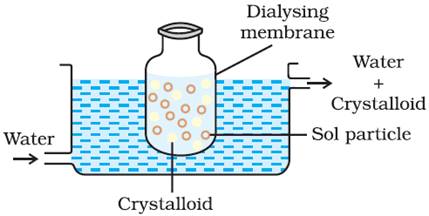
· The molecules and ions diffuse through the membrane into the outer water and pure colloidal solution is left behind.
· The process of dialysis is quite slow and can be made faster by applying an electric field.
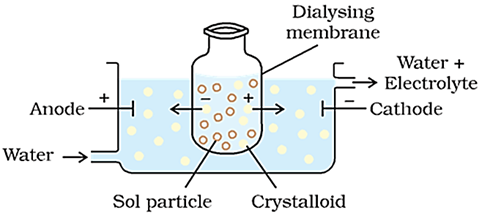
· When the electric field is applied, the ions present in the colloidal solution migrate out to the oppositely charged electrodes.
· It is the process of separating the colloidal particles from the solvent, and the soluble solutes present in the colloidal solution, by specially prepared filters.
· The filters are permeable to all substances, except the colloidal particles.
· It is a slow process and to speed it up, pressure or suction is applied.
Properties of Colloidal Solutions
· Osmotic pressure, lowering in vapour pressure, depression in freezing point and elevation in boiling point
· The values of these properties are of a small order as compared to the values shown by true solutions at the same concentrations.
· It is due to the fact that colloidal particles scatter light in all directions in space.
· The scattering of light illuminates the path of the beam of light.
· Depends on the wavelength of the light scattered by the dispersed particles
· Wavelength of light depends on the size and nature of the particles.
· Zig-zag movement of colloidal particles
· Smaller the size and lesser the viscosity, faster is the motion.
· Colloidal particles carry an electric charge.
· May either positive or negative
|
Positively charged sols |
Negatively charged sols |
|
Hydrated metallic oxides (e.g., Al2O3.xH2O, CrO3.xH2O, Fe2O3.xH2O) |
Metals (e.g., copper, silver, gold sols) |
|
Basic dye stuffs (e.g., methylene blue sol) |
Metallic sulphides (e.g., As2S3, Sb2S3, CdS sols) |
|
Haemoglobin (blood) |
Acid dye stuffs (e.g., eosin, congo red sols) |
|
Oxides (e.g., TiO2 sol) |
Sols of starch, gum, gelatine, clay, charcoal, etc. |
· Movement of colloidal particles under applied electric potential
· Electro osmosis: Movement of dispersion medium through the membrane, in an applied electric field
Process of settling of colloidal particles
Ways to Carry Out Coagulation of Sol
· By electrophoresis
· By mixing two oppositely charged sols
· By boiling
· By persistent dialysis
· By addition of electrolytes
Greater the valence of the flocculating ion added, the greater is its power to cause precipitation.
- Colloids in which both the dispersed phase and dispersion medium are liquids
- There are two types −
· Oil dispersed in water (O/W type)
· Water dispersed in oil (W/O type)
- Emulsifying agent: The third component used for stabilising an emulsion
- Emulsification: Process of making an emulsion
- Blue colour of sky: Dust particles along with water suspended in air scatter blue light.
- Food particles such as milk, butter, fruit juices are all colloids.
- Fog, mist and rain are also colloids.
- Blood: A colloidal solution of an albuminoid substance
- River water: A colloidal solution of clay
- Fertile soils are colloidal in nature, in which humus acts as a protective colloid.
- Purification of drinking water: Water obtained from natural resources often contains suspended impurities. Alum is added to coagulate the suspended impurities.
- Medicines: Most medicines are colloidal in nature. E.g., Milk of magnesia (an emulsion)
- In the cleansing action of soaps and detergents
- Photographic plates or films are prepared by coating an emulsion of the light sensitive AgBr in gelatine, over glass plates or celluloid films.
- Paints, inks, rubber, graphite lubricants, etc., are all colloidal solutions.
- Rubber industry: Rubber is obtained by the coagulation of latex, which is a colloidal solution of rubber particles.
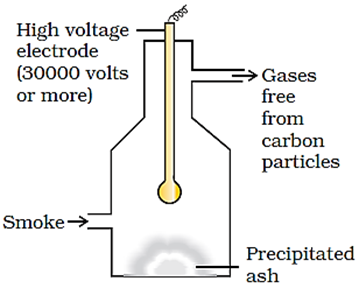
- Electrical precipitation of smoke:
- Smoke is a colloidal solution of solid particles (carbon, dust, arsenic compounds, etc.).
- Smoke can be electrically precipitated by using the Cottrell precipitator.
Online & Classroom Coaching for Grade 6 to 12 & JEE / NEET