
Q.1. In van der Waals’ equation of state for non-ideal gas, the term that accounts for intermolecular force is
(a) 
(b) 
(c) 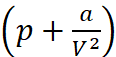
(d) 
Q.2. Maximum deviation from ideal gas is expected from
(a) H2(g)
(b) N2(g)
(c) CH4(g)
(d) NH3(g)
Q.3. The correction factor ‘a’ to the ideal gas equation corresponds to
(a) electric field present between the gas molecules
(b) volume of the gas molecules
(c) density of the gas molecules
(d) forces of attraction between the gas molecules
Q.4. Given van der Waals’ constant of NH3 , H2 , O2 and CO2 are respectively 4.17, 0.244, 1.36 and 3.59. Which one of the following gases is most easily liquefied?
(a) O2
(b) H2
(c) NH3
(d) CO2
Q.5. Which among the following gases can be liquefied easily?
(a) Chlorine
(b) Nitrogen
(c) Oxygen
(d) Hydrogen
Q.6. What happens, when benzene is treated with
(i) Br2 in presence of anhyd. AlCl3?
(ii) conc. H2SO4 at 330 K?
(iii) chloroethane and anhyd. AlCl3?
Q.7. What is the effect of reducing volume on the following system?
2C(s) + O2(g) ⇌ 2CO(g)
(ii) Under what conditions, KC = Kp for a gaseous reaction?
(iii) Explain why p-xylene has higher melting point than the corresponding ortho or meta-isomers.
Q.8. Account for the following
(a) Graphite is used as lubricant.
(b) Diamond is used as an abrasive.
Q.9. Write the resonance structures of CO32− and HCO3− .
Q.10. Consider the compounds, BCl3 and CCl4. How will they behave with water?
Q.11. Why carbon has no tendency to form complex compounds?
Q.12. How will you convert benzene into
(i) p-nitrobromobenzene
(ii) m-nitrochlorobenzene
(iii) p-nitrotoluene
(iv) acetophenone?
Q.13. At a certain temperature and total pressure of 105 Pa, iodine vapour contains 40% by volume of I-atoms. Calculate Kp for the equilibrium.
Q.14. Suggest the name of a Lewis acid other than anhydrous aluminium chloride which can be used during ethylation of benzene.
Q.15. Like CO, why its analog of SiO is not stable?
Q.16. PbO2 is a stronger oxidising agent than SnO2 .
Q.17. Kp for the reaction,
N2(g) + 3H2(g) → 2NH3(g)
at 400°C is 1.64 ×10⁴ atm−2. Find KC , also calculate ∆G° using ∆G° using Kp and KC values and interpret the difference. [Ans. ∆G = 3479 J mol−1]
Q.18. On the basis of the equation. pH = −log[H+], the pH of 10−8 mol dm−3 solution of HCl should be 8. However, it is observed to be less than 7.0 ? Explain the reason.
Q.19. Predict in which of the following, entropy increases/decreases.
(a) A liquid crystallises into a solid.
(b) Temperature of a crystalline solid is raised from 0 K to 115 K.
(c) 2NaHCO3(s ) → Na2CO3(s) + CO2(g) + H2O(g)
(d) H2(g) → 2H(g)
Q.20. The enthalpy of atomisation for the reaction,
CH4(g) → C(g) + 4H(g) is 1665 kJ mol−1. What is the bond energy of C−H bond ? [Ans. 416.25 kJmol−1]
Q.21. Determine the value of ∆H and ∆U for the reversible isothermal evaporation of 90.0 g of water at 100°C. Assume that water vapour behave as an ideal gas and heat of evaporation of water is 540 cal (R = 2.0 cal mol−1 K−1).
[Ans. ∆H = 44870 cal]
Q.22. Carbon monoxide is allowed to expand isothermally and reversibly from10 m3 to 20 m3 at 300 K and work obtained is 4.754 kJ. Calculate the number of moles of carbon monoxide. [Ans. n = 2.75 mol]
Q.23. Establish a relationship between ∆H and ∆U in Haber’s process of synthesis of ammonia assuming that gaseous reactants and products are ideal.
Q.24. Standard vaporisation enthalpy of benzene at boiling point is 30.8 kJ mol−1. For how long would 100W electric heater have to operate in order to vaporise a 100g sample at that temperature? (power = energy/time and 1 W = 1 J s−1)
[Ans. Time = 6.6 min]
Q.25. Complete the following reactions.
(a) O22− + H2O →
(b) O2− + H2O →
Q.26. What is the structure of BeCl2 molecule in gaseous and solid state?
Q.27. Arrange the alkaline earth metal carbonates in the decreasing order of thermal stability.
Q.28. Write IUPAC names of the following compounds.
(a) CH3CH=C(CH3)2
(b) CH2=CH−C≡C−CH3
Q.29. Hydrocarbon A (molecular formula is C5H8) gave a white precipitate with ammoniacal silver nitrate. Oxidation of A with hot alkaline KMnO4 gave 2-methyl propanoic acid. What is the structural formula of A?
Q.30. What happens when 2-bromobutane is being treated with KOH (alcoholic)?
Q.31. Write the Lewis structure of O2− ion and find out oxidation state of each oxygen atom? What is the average oxidation state of oxygen in this ion?
Q.32. Why is Li2CO3 decomposed at a lower temperature whereas Na2CO3 at higher temperature?
Q.33. Write the formulae of
(a) Albite
(b) Chile saltpetre
Q.34. Arrange the following set of compounds in order of their decreasing relative reactivity with an electrophile, E+.
(a) Chlorobenzene, 2, 4-dinitrochlorobenzene, p-nitrochlorobenzene
(b) Toluene, p-H3C−C6H4−NO2 ,p-O2N−C6H4−NO2
Also explain your answer.
Q.35. Which of the two trans-but-2-ene or trans-pent-2-ene is non-polar?
Q.36. Explain, why alkynes are less reactive than alkenes toward addition of Br2.
Online Tuitions & Self-Study Courses for Grade 6 to 12 & JEE / NEET