
States of Matter (Gases and Liquids)
Study Notes
Intermolecular Forces
Attractive and repulsive forces between interacting particles (atoms and molecules)
Do not include ionic and covalent bonds
Attractive intermolecular forces are known as van der Waals forces.
Dispersion Forces or London Forces
Forces of attraction between two temporary dipoles
Occur between atoms or non-polar molecules
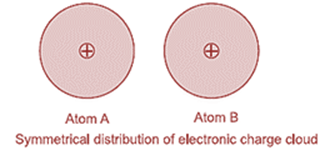
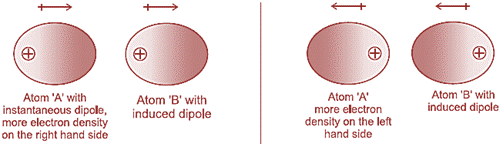
Atoms or non-polar molecules have no dipole moment as they are electrically symmetrical. However, for some reason, momentarily an atom or non-polar molecule becomes electrically unsymmetrical. As a result, instantaneous dipole is developed on that atom for a very short time. This instantaneous dipole induces dipole on another atom close to it.
E ∝  ,
where E = Interaction energy
,
where E = Interaction energy
r = Distance between two interacting particles
Occur only at short distances (~500 pm)
Depend on the polarisability of the particle
Forces between molecules possessing permanent dipole
London force < Dipole-dipole force < Ion-ion force
Increase with decrease in distance
For stationary polar molecules, Interaction energy
E ∝ 
And for rotating polar molecules,
E ∝
r = Distance between the polar molecules
For polar molecules,
Total intermolecular forces = Dipole-dipole forces + London forces
Dipole-dipole interaction between two HCl molecules

Special case of dipole-dipole interaction
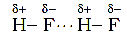
Force between hydrogen attached to an electronegative atom of one molecule and an electronegative atom of different molecule
Limited to electronegative atoms N, O, and F (sometimes Cl also)
Formation of hydrogen bond:
Forces between polar molecules and non-polar molecules
Occur because polar molecule induces dipole on non-polar molecule

Depends upon the dipole moment present in the permanent dipole and the polarisability of the non-polar molecule.
E ∝ , where E = Interaction energy
r = Distance between the two molecules
Intermolecular forces between polar and non-polar molecules
= London forces + Dipole-induced dipole forces
Repulsive Forces
Increase with decrease in distance
Due to this reason, solids are harder to compress than liquids, and liquids are harder to compress than gases.
Thermal Energy
Energy of a body resulting from atomic and molecular motion
Measure of average kinetic energy of particles of matter
Directly proportional to temperature
Intermolecular Forces vs. Thermal Interaction
Intermolecular forces −−− hold molecules together
Thermal interactions −−− keep molecules apart
Intermolecular forces and thermal energy balance each other to different extent resulting in the three states of matter (solid, liquid, and gas).
Relation between pressure (p) and volume (V)
Statement − At constant temperature, the pressure of a fixed amount (number of moles, n) of a gas is inversely proportional to its volume.
Mathematically,
 (at
constant T and n)
(at
constant T and n)
 (where
k1 is proportionality constant)
(where
k1 is proportionality constant)

From the above equation, it is found that at constant temperature, the product of pressure and volume of a fixed amount of a gas is constant.
The value of k1 depends upon
amount of the gas
temperature of the gas
units of p and V
Graphical representation of constant temperature
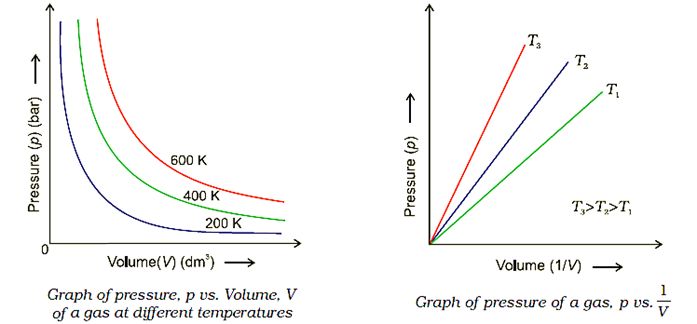
Each line is called isotherm (at constant temperature plot).
If at constant temperature,
V1 = Volume of a gas at pressure p1
V2 = Volume of the same gas at pressure p2
Then,
p1V1 = p2V2 = Constant

We know that, relationship between density (d) and pressure (p):

Where, m = Mass of a gas
V = Volume of the gas



From the above equation, it is known that density is proportional to the pressure of a fixed amount of a gas.
Relation between temperature (T) and volume (V)
Statement − At constant pressure, the volume of a fixed amount of a gas is directly proportional to its absolute temperature.
Mathematically,

 , where k2 = Proportionality constant
The value of k2 depends upon
pressure of the gas
amount of the gas
unit of volume
Graphical representation
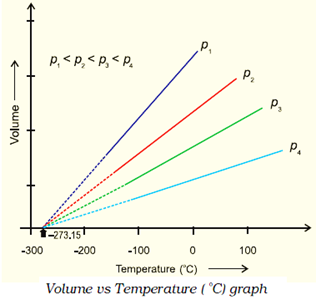
Straight lines, interception on zero volume at 273.15 °C
Each line is called isobar (constant pressure plot).
Derivation
For each degree rise in temperature, volume of a gas
increases by  of
the original volume of the gas at 0°C.
of
the original volume of the gas at 0°C.
Suppose, V0 = Volume of a gas at 0 °C
Vt = Volume of the same gas at t °C
Then,
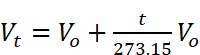
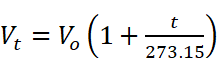
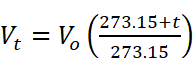 ………
(i)
………
(i)
According to Kelvin temperature scale (also called absolute temperature scale or thermodynamic scale),
T = 273.15 + t
T0 = 273.15
From equation (i), we obtain
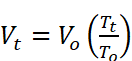

Or, we can write


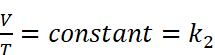

Relation between pressure and temperature
Statement − At constant volume, the pressure of a fixed amount of a gas is directly proportional to the temperature.
Mathematically,
p ∝ T
Þ
 = constant
= k3
= constant
= k3
Graphical representation at constant volume
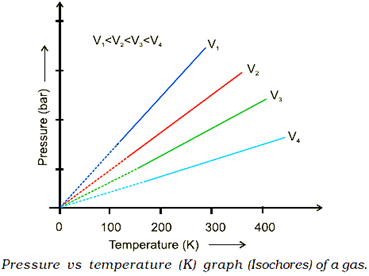
Each line is called isochore (constant volume plot).
If at constant volume,
p1 = Pressure of a gas at T1
p2 = Pressure of the same gas at T2
Then,

Relation between volume (V) and amount of substance (number of moles n)
Statement − Under the same conditions of temperature and pressure, equal volumes of all gases contain equal number of molecules.
That is, at constant temperature and pressure, the volume of a gas depends upon the amount (number of mole n) of the gas.
Mathematically,
V ∝ n
V = k4n
Where, k4 = Proportionality constant
Avogadro constant = Number of molecules present in one mole of a gas = 6.022 × 10²³
At STP (273.15 K and 1 bar), molar volume of an ideal gas is 22.7 L mol−1.
If m = Mass of a gas
M = Molar mass of the gas
Then,

Therefore, 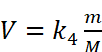 (Since V = k4
n)
(Since V = k4
n)
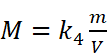

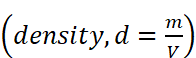
From the above equation, it can be concluded that at a given temperature and pressure, density of a gas is directly proportional to its molar mass.
Ideal Gas
The gas which strictly follows Boyle’s law, Charles’ law and Avogadro law
The intermolecular forces are assumed to be absent between the molecules of an ideal gas.
Under a certain specific condition (when the intermolecular forces are negligible), real gases follow the above laws.
Equation obtained by the combination of Boyle’s law, Charles’ law and Avogadro law
Boyle’s law: V ∝  …(At
constant T and n)
…(At
constant T and n)
Charles’ law: V ∝ T …(At constant p and n)
Avogadro law: V ∝ n …(At constant p and T)
By combining the above three laws, we have


pV = nRT …….(i)
R = Proportionality constant, known as Universal Gas Constant
Equation (i) is called ideal gas equation.
At STP, for one mole of a gas, R = 8.314 J K−1 mol−1
Or, R = 8.20578 × 10⁻² L atm K−1 mol−1
It is also called the equation of state
Reason: It relates between four variables and describes the state of a gas.
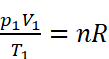
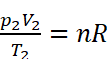
If the temperature, volume and pressure of a fixed amount of a gas vary from T1, V1 and p1 to T2, V2 and p2, then we have
 ………
(ii)
………
(ii)
 ………
(iii)
………
(iii)
From equations (ii) and (iii), we have
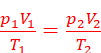 ……… (iv)
Equation (iv) is called combined gas law.
Relation between density and molar mass of a gaseous substance:
pV = nRT
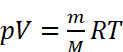

 (Where, Density, )

Dalton’s Law of Partial Pressures
Partial pressure: Pressure exerted by the individual gases in a mixture
Statement: At constant temperature, the total pressure exerted by a mixture of two or more non-reacting gases, enclosed in a definite volume, is equal to the sum of the partial pressures of the individual gases.
Mathematically,
ptotal = p1 + p2 + p3 + ……….. (At constant T and V)
Where, ptotal = Total pressure exerted by the mixture
p1 + p2 + p3, ... = Partial pressures of the individual gases
pdry gas = ptotal − Aqueous tension
Where, pdry gas = Pressure of dry gas
ptotal = Total pressure
Aqueous tension: Pressure exerted by saturated water vapour
Partial pressure in terms of mole fraction:
Suppose three gases are enclosed in a vessel of volume, V at temperature, T and exert partial pressures, p1, p2 and p3 respectively. Then, we have

Where, n1, n2, n3 = Number of moles of the gases
Now, ptotal = p1 + p2 + p3
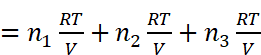
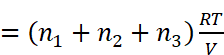
By dividing p1 by ptotal, we have
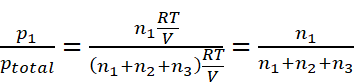
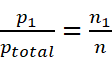 (as
n = n1 + n2 + n3)
(as
n = n1 + n2 + n3)
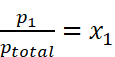
 (x1 is
the mole fraction of the first gas)
(x1 is
the mole fraction of the first gas)
General equation
pi = xi ptotal
pi = Partial pressure of ith gas, xi = Mole fraction of ith gas
Kinetic Molecular Theory of Gases
The kinetic theory explains the macroscopic properties of gases, such as temperature, pressure and volume, considering their molecular composition and motion.
A gas consists of very small particles, atoms and molecules, which move in a random motion.
These particles have the same mass.
There is no force of attraction between these particles.
The volume of the particles is negligible compared to the total volume of the gas.
Collision of the gas particles takes place either with other particles or with the wall of the container.
The average kinetic energy of gas particles depends only on the temperature of the system. The total kinetic energy of gas particles remains constant.
Pressure of the gas arises due to the collision of its molecules with the wall of the container.
Average speed of molecules, 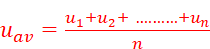
Mean of square of speeds, 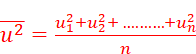
Root mean square speed, 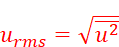

Maxwell Distribution of Molecular Velocity
Gas is a collection of tiny particles that are separated from each other by a large empty space; these particles move rapidly in a random motion in all directions. Because of this motion, molecules frequently collide with one another as well as with the wall of the container, thereby resulting in the change in their velocity and direction. Although the molecules in a given sample do not have the same velocity, the distribution of velocities remains constant at a particular temperature.
Important features of Maxwell's distribution curve:
The fraction of molecules having very high or very low
molecular speeds is very small. Most number of molecules have speed near to the
most probable speed,  .
.
The total area under the curve remains constant at different temperatures; it is the measure of the total number of molecules possessing a particular velocity.
The distribution of molecules is also dependent on the molecular mass of a gas. At constant temperature, a gas with higher molecular mass shows a narrow distribution of speeds compared to that shown by a low-molecular-weight gas.
Maxwell Distribution of Molecular Velocity
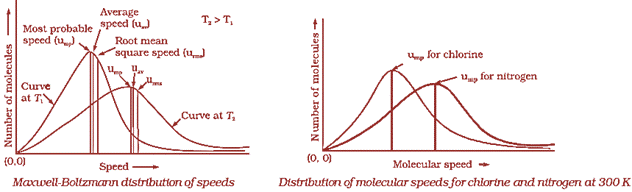
The maximum in the curve represents speed possessed by
maximum number of molecules. This speed is called most probable speed, .
The fraction of molecules with speeds greater than the minimum increases with the increase in speed, reaches to the maximum value and then starts to decrease.
At constant temperature, the fraction of molecules having a certain speed remains the same, even though the molecules change their speeds continuously because of collisions.
Real gases deviate from ideal gas behaviour
According to Boyle’s law, at constant temperature, pV of a gas is constant, and the pV vs p graph is a straight line parallel to the x-axis at all pressures. But real gases do not behave like this.
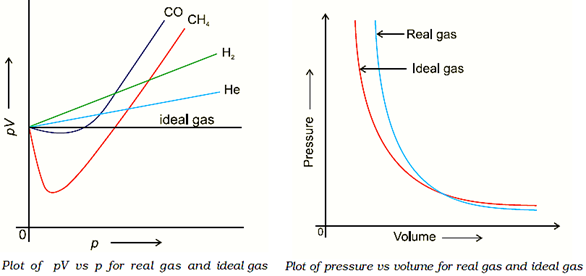
Reasons for deviation from the ideal gas behaviour − The two postulates of the kinetic theory which do not hold good:
There is no force of attraction and repulsion between the molecules of a gas.
Volume of the molecules of a gas is negligibly small in comparison to the space occupied by the gas.
Real gas deviates from ideal gas behaviour as there are forces of attraction and repulsion between the molecules of a gas. At high pressure, while striking the walls of a container, the molecules of a gas are dragged back by other molecules due to the existing force of attraction; therefore, the pressure exerted by the gas is lower than the pressure exerted by an ideal gas.
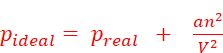
Observed Correction
pressure term
Where,
n = Number of moles of real gas
V = Volume of the gas
a = van der Waals constant, whose value depends upon the nature of the gas
Real gas deviates from ideal gas behaviour as the volume occupied by the gas molecules becomes significant. This is because the movement of the gas particles is restricted to the volume (V − nb), instead of V. Here, nb is the approximate total volume of the molecules themselves, excluding the spaces between them.
This means, Videal = Vreal − nb
Therefore, the ideal gas equation pV = nRT can be rewritten as
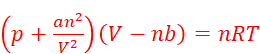
This equation is called Van der Waals equation.
It is the measure of the magnitude of attractive forces between the molecules of a gas.
Unit: atm L2 mol−2 or bar L2 mol−2
Larger the value of ‘a’, larger will be the intermolecular force of attraction.
It is independent of pressure and temperature.
It is the measure of the effective size of gas molecules.
Unit: L mol−1
Real gases behave like ideal gas under certain specific conditions when the intermolecular forces are negligible.
When pressure approaches zero, real gases behave like ideal gas.
When the volume of a gas is so large that the volume occupied by the molecules is negligible, the gas shows ideal gas behaviour.
It is the measure of deviation from ideal behaviour.

Or

For ideal gas, Z = 1
At low pressure, Z ≈ 1
At high pressure, Z > 1
At intermediate pressure, Z < 1
Boyle temperature or Boyle point:
The temperature at which a real gas shows ideal gas behaviour over an appreciable range of pressure
Depends upon the nature of the gas
Above Boyle point − positive deviation from ideal behaviour
Below Boyle point − negative deviation from ideal behaviour
At low pressure and high temperature, gases behave ideally.
A gas can be liquefied by increasing its pressure and decreasing its temperature.
Critical temperature (Tc) − the temperature at which a gas can be liquefied
Critical pressure (pc) − the pressure of a gas at critical temperature
Critical volume (Vc) − the volume of 1 mole of a gas at critical temperature
Isotherm of carbon dioxide is shown in the figure.
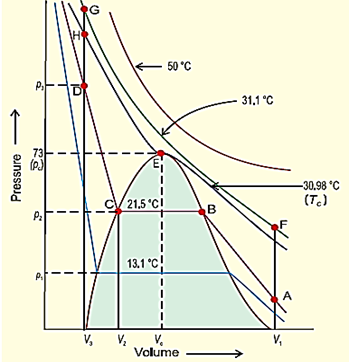
Critical temperature, critical pressure and critical volume are called critical constants.
Intermolecular forces are stronger than those in gaseous state
Liquids have definite volume.
Reason: Molecules do not separate due to intermolecular force of attraction.
Liquids can flow.
Reason: Molecules can freely move past one another.
Physical Property of Liquid − Vapour Pressure
Equilibrium vapour pressure or saturated vapour pressure: Vapour pressure in the state of equilibrium between liquid phase and vapour phase
Boiling point:
The temperature at which the vapour pressure of a liquid is equal to the external pressure
Normal boiling point − Boiling point at 1 atm pressure
Standard boiling point − Boiling point at 1 bar pressure
The standard boiling point of a liquid is slightly lower than its normal boiling point.
Reason − 1 atm pressure is slightly greater than 1 bar pressure.
Example − Water has a normal boiling point of 100°C (373 K) and a standard boiling point of 99.6 °C (372.6 K).
The boiling point of a liquid is lower at high altitudes than at sea level.
Reason − Atmospheric pressure is lower at high altitudes than at sea level.
This means that the boiling point of a liquid can be varied by changing the pressure over the liquid.
Force acting per unit length perpendicular to the line drawn on the surface of liquid
Denoted by Greek letter γ (gamma). Unit = Nm−1
Reason for surface tension − A molecule in the bulk of liquid does not experience any net force as it experiences equal intermolecular forces from all the sides. However, there are no intermolecular forces above a molecule on the surface of liquid. Therefore, a molecule on the surface of liquid experiences net attractive force towards the interior of the liquid.
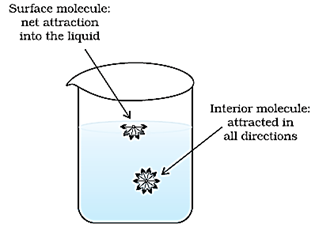
As a result of surface tension, liquid tends to minimize their surface area.
Surface energy
Energy required to increase the surface area of the liquid by one unit. Unit = J m−2
Liquid droplets are spherical because sphere has minimum surface area and liquids tend to have minimum surface area due to surface tension.
Surface tension causes capillary action.
Dependence of surface tension:
The attractive forces between the molecules increase with increase in attractive force.
The intermolecular forces decrease with the increase in temperature because with the increase in temperature, kinetic energy of particles increases and hence, effectiveness of intermolecular attraction decreases.
Resistance of flow
Stronger the intermolecular forces, higher is the viscosity.
Laminar flow
Type of flow which involves a regular velocity gradation in passing from one layer to the next
For a given layer in a flowing liquid, the layer above it accelerates its flow while the layer below it retards its flow.
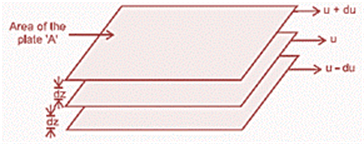
Velocity gradient  (change
in velocity with distance)
(change
in velocity with distance)
Where, dz = Distance
du = Change in velocity
We can write,
F ∝ A
Where, F = Force required to maintain the flow of layers
A = Area of contact
And, 
Therefore, 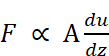
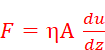
Where, η = Proportionality constant known as coefficient of viscosity
Viscosity coefficient
Force when velocity gradient is unit and the area of contact is unit area
SI unit = Ns m−2
1 Ns m−2 = 1 Pa S = 1 kg m−1 s−1
CGS unit = poise
1 poise = 1 g cm−1 s−1 = 10−1 kg m−1 s−1
Greater the viscosity, more slowly the liquid flows.
Glass is an extremely viscous liquid.
With increase in temperature, viscosity of liquids decreases.
Reason − With increase in temperature, kinetic energy of molecule increases and therefore, it is easier to overcome the intermolecular forces to slip past one another between the layers.
Online Tuitions & Self-Study Courses for Grade 6 to 12 & JEE / NEET