
Chapter 2 – Structure of Atom
Practice Questions Set 1
Q.1. What are nucleons?
Q.2. Atomic number of sulphur is 16 and that of oxygen is 8. Calculate the total number of protons in a sulphite ion.
Q.3. How many electrons and protons are present in the anion of Li3N?
Q.4. Why do many elements have fractional atomic masses?
Q.5. Calculate the number of electrons which will together weigh one gram.
[Ans. 1.09 × 1027 electrons]
Q.6. Calculate the mass of one mole of electrons.
[Ans. 5.48 × 10⁻⁴ g]
Q.7. Calculate the charge of one mole of electrons.
[Ans. 9.6488 × 10⁴ C]
Q.8. An element has atomic number 11 and the mass number 23. How many numbers of neutrons, protons and electrons does it have?
Q.9. The number of electrons, protons and neutrons in a species are equal to 18, 16 and 16 respectively. Assign the proper symbol to the species.
Q.10. How many electrons are present in NO3?
Q.11. Name the element whose isotope has mass number 14 and having 8 neutrons.
Q.12. Out of X–rays, infra–red, visible rays and microwaves, which has largest frequency?
Q.13. Why Bohr's orbits are called energy levels?
Q.14. Which series of lines of the hydrogen spectrum lies in the visible region?
Q.15. According to Bohr's model, En of each stationary state is given by the expression:
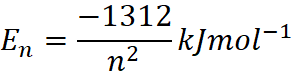
What does 'n' stand for?
Q.16. What is the value of Bohr's radius for the first orbit of hydrogen atom?
Q.17. Why is energy of electron negative?
Q.18. Which series of hydrogen spectrum lies in (i) visible region and (ii) UV region?
Q.19. What is meant by quantization of energy?
Q.20. When electrons from various energy levels fall to first energy level in hydrogen, name the series of spectral lines.
Q.21. Name two phenomena that indicate the dual nature of electrons.
Q.22. How does change in velocity of a moving particle alter the wavelength of the particle?
Q.23. What is uncertain in 'uncertainty principle'?
Q.24. Why cannot the motion of an electron around the nucleus be determined accurately?
Q.25. Why did Heisenberg replace the concept of definite orbits by the concept of probability?
Online Tuitions & Self-Study Courses for Grade 6 to 12 & JEE / NEET