
Class 11 Chemistry
Important Questions Answers
Q.1. Give reasons:
(i) Alkali metals when dissolved in liquid ammonia give blue colour.
(ii) Beryllium and Magnesium do not impart colour to the flame while other members of the group do. Explain.
A.1: (i) When alkali metals are dissolved in liquid ammonia, a deep blue conducting solution is obtained. The reaction may be represented as follows:
M + (x + y)NH3 → [M(NH3)x]+ + e–(NH3)y
The solution is blue due to the presence of ammoniated electrons which absorb energy in the visible region of light.
(ii) Be and Mg due to their small size and high ionization energy, possess high excitation energy and do not absorb energy from visible region and do not radiate complementary colour hence do not impart colour to the flame.
Q.2. Why are group 1 elements called alkali metals?
A.2: It is because their hydroxides are soluble bases called alkalies. Secondly their ashes are alkaline in nature.
Q.3. Why do alkali metals have low ionisation enthalpy?
A.3: It is due to largest atomic size, they can lose electrons easily.
Q.4. Alkali and alkaline earth metals cannot be obtained by chemical reduction, why?
A.4: Alkali and alkaline earth metals are good reducing agents, hence they cannot be obtained by chemical reduction.
Q.5. Why group 2 elements (Mg and Ca) are harder and denser than group 1 elements?
A.5: They have strong metallic bonds due to smaller size and have more number of valence electrons.
Q.6. Why is potassium more reactive than sodium?
A.6: K has lower ionisation enthalpy than Na due to bigger atomic size, therefore, it is more reactive.
Q.7. Name the alkali metal which shows diagonal relationship with magnesium.
A.7: Lithium shows diagonal relationship with magnesium.
Q.8. Why do alkali metals impart colour to the flame?
A.8: Alkali metals are largest in size in their respective periods and hence have low ionisation enthalpies. Their valence electrons easily absorb energy from the flame and are excited to higher energy levels. When these electrons return to the ground state, the absorbed energy is emitted, which falls in the visible region, imparting colour.
Q.9. Show by a chemical reaction that Na2O is a basic oxide.
A.9: As Na2O reacts with HCL (acid) resulting in NaCl and H2O, it behaves as a base.
Na2O(s) + 2HCl(aq) → 2NaCl(s) + H2O(l)
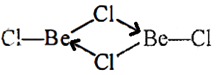
Q.10. Draw the structure of BeCl2 in vapour phase.
A.10: BeCl2 have bridged structure in vapour phase.
Q.11. Why are alkali metals strong reducing agents?
A.11: It is because of low ionisation enthalpy. They can lose electrons easily, that is why they are strong reducing agents.
Q.12. Why are alkali metals used' in photoelectric cells?
A.12: They have low ionisation enthalpy and can lose electrons when light falls on them, that is why they are used in photoelectric cells.
Q.13. Why do alkali metals have low melting and boiling points?
A.13: It is due to weak metallic bonds, due to bigger atomic size that is why they have low melting and boiling points.
Q.14. Why do alkali metals have low density?
A.14: Due to weak metallic bonds and large atomic size, their density is low.
Q.15. Why are alkali metals soft?
A.15: They are soft metals due to less force of attraction between positively charged kernels and valence electrons cloud and due to large atomic size, i.e., weak metallic bond.
Q.16. Potassium carbonate cannot be prepared by Solvay's process. Why?
A.16: It is because KHCO3 is highly soluble in water and cannot be precipitated.
Q.17. Why do alkali metals not occur in free state?
A.17: They are highly reactive; therefore, they occur in combined state, e.g., oxides and hydroxides.
Q.18. Why is first ionisation energy of alkali metals lower than those of alkaline earth metals?
A.18: Alkali metals have bigger atomic size, therefore, they have lower first I.E. than group 2 elements.
Q.19. Why is second ionisation energy of alkali metals higher than alkaline earth metals?
A.19: Alkali metals acquire, noble gas configuration after losing I electron, therefore their second ionisation energy is higher than alkaline earth metals.
Q.20. What happens when K bums in air? Give chemical equation.
A.20: K + O2 → KO2, potassium superoxide will be formed.
Q.21. Arrange the following in order of their increasing covalent character:
MCl, MBr, MF, MI (where M is alkali metal.)
A.21: MF < MCl < MBr < MI, lesser the difference in electronegativity, more will be covalent character.
Q.22. When is a cation highly polarising? Which alkali metal has highest polarising power?
A.22: Smaller the cation, higher the charge, high will be the polarising power. Li+ has highest polarising power in group I due to smallest size.
Q.23. Why is it that on being heated in excess supply of air K, Rb and Cs form superoxides in preference to oxides and peroxides?
A.23: K, Rb and Cs are more reactive therefore, they form superoxides in preference to oxides and peroxides. K+, Rb+ and Cs+ ions are large cations and superoxide ion O2 is also large. Larger cations stabilize larger anions, therefore, they form superoxides.
Q.24. What happens when KO2 reacts with water? Give balanced chemical equation.
A.24:

Q.25. Why does Be resemble Al?
A.25: Be resembles Al because charge over radius ratio is similar, i.e., they have similar polarizing power.
Q.26. The second ionization enthalpy of Ca is higher than first and yet calcium forms CaCl2 and not CaCl, why?
A.26: The hydration energy of Ca2+ overcomes the second ionisation energy of Ca, that is why Ca forms CaCl2 and not CaCl. Ca+ is not stable.
Q.27. Name the metal which floats on water without apparent reaction.
A.27: Beryllium
Q.28. Why is BeCl2 soluble in organic solvents?
A.28: BeCl2 is covalent, therefore, soluble in organic solvents.
Q.29. Which of the alkali metal is having least melting point?
(a) Na (b) K (c) Rb (d) Cs
A.29: (d) It is due to weak metallic bonds due to larger atomic size.
Q.30. Which one of the following alkali metals gives hydrated salts?
(a) Li (b) Na (c) K (d) Cs
A.30: (a) Li+ is smallest therefore it has highest hydration energy.
Q.31. Which one of the alkaline earth metal carbonates is thermally the most stable?
(a) MgCO3 (b) CaCO3 (c) SrCO3 (d) BaCO3
A.31: (d) It is due to high lattice energy.
Q.32. Find out the oxidation state of sodium in Na2O2.
A.32: 2x - 2 = 0 => 2x = +2 => x = +1.
Oxidation state of all alkali metals is always +1.
Q.33. Arrange the following in order of property mentioned against each:
(i) BeCl2, MgCl2, CaCl2, BaCl2 [Increasing ionic character]
(ii) Mg(OH)2, Ca(OH)2, Ba(OH)2, Sr(OH)2 [Increasing solubility in water]
A.33: (i) BeCl2 < MgCl2 < CaCl2 < BaCl2
(ii) Mg(OH)2 < Ca(OH)2 < Sr(OH)2 < Ba(OH)2
Q.34. Compare the alkali metals and alkaline earth metals with respect to:
(i) ionization enthalpy.
(ii) basicity of oxides.
A.34: (i) Ionization enthalpy of alkaline earth metals is higher than alkali metals due to higher nuclear charge of alkaline earth metals.
(ii) Oxides of metals dissolve in water to form respective hydroxides. Metal-OH bond in alkali metals gets easily ionize' due to low ionization enthalpy of alkali metals. Hence, alkali metals oxides are more- basic than the corresponding alkaline earth metals.
Q.35. Give a brief account on the following:
(i) KO2 is paramagnetic in nature.
(ii) Sodium is stored under kerosene oil.
A.35: (i) In KO2, O2–, superoxide ion is present. O2– ion has one unpaired electron in its antibonding molecular orbital;. Hence, it is paramagnetic in nature.
(ii) Sodium is stored in kerosene oil because in air, sodium is easily oxidised to oxide which may dissolve in the moisture to form hydroxide.
Q.36. Write balanced equations for the reactions between:
(i) Na2O2 and water. (ii) Na2O and CO2.
A.36: (i) Na2O2 + 2H2O → 2NaOH + H2O2
(ii) Na2O + CO2 → Na2CO3
Q.37. Write two points of similarity in properties of Beryllium and Aluminium.
A.37: Two points of similarity between Beryllium (Be) and Aluminium (Al) are:
(i) Both metals have tendency to form covalent compounds for example, both BeCl2 and AlCl3 are covalent and are soluble in organic solvents.
(ii) Both metals dissolve in strong alkalies to form soluble complexes, beryllates [Be(OH)4]2– and aluminates [Al(OH)4]–.
Q.38. Account for the following:
(i) Potassium carbonate cannot be prepared by Solvay's process.
(ii) CO2 turns the lime water milky. On passing CO2 in excess, milkiness disappears.
A.38: (i) One of the steps in Solvay's process for manufacture of Na2CO3 is
NaCl(aq) + NH3(g) + CO2(g) + H2O(l) → NaHCO3(aq) + NH4Cl(aq)
A similar step during preparation of K2CO3 would be
KCl(aq) + NH3(g) + CO2(g) + H2O(l) → KHCO3(aq) + NH4Cl(aq)
Potassium carbonate cannot be prepared by Solvay's process because KHCO3 (Potassium bicarbonate) is fairly soluble in water. Thus, when CO2 is passed through ammoniated brine, NaHCO3 gets precipitated while KHCO3 does not get precipitated when CO2 is passed through an ammoniated solution of KCl.
(ii) CO2 turns lime water milky due to the formation of white precipitate of CaCO3.
Ca(OH)2 + CO2 → CaCO3↓ + H2O
Lime water Milkiness
On passing CO2 in excess soluble calcium bicarbonate is formed and milkiness disappears.
CaCO3 + CO2 + H2O → Ca(HCO3)2
(Soluble)
Q.39. What happens when (i) magnesium is burnt in air (ii) quick lime is heated with silica?
A.39: (i) 2Mg(s) + O2(g) → 2MgO(s)
(ii) CaO(s) + SiO2(s) → CaSiO3(s)
Quick lime Silica Calcium silicate
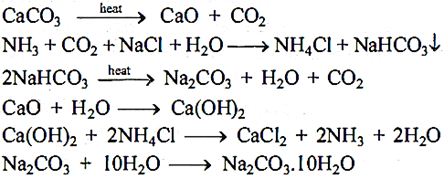
Q.40. Give the reactions involved in the Solvay's process for the preparation of sodium carbonate.
A.40: Solvay's process reactions:
Q.41. Give reasons:
(i) Beryllium and magnesium do not give colour to flame whereas other alkaline earth metals do so. Why?
(ii) Lithium Iodide, LiI is more soluble than KI in ethanol.
A.41: (i) Be and Mg have high ionisation energy, they do not absorb light from visible region for excitation of electron. Therefore, do not radiate complimentary colour and do not impart colour to the flame.
(ii) LiI is covalent compound. Therefore, it is more soluble in ethanol than KI which is ionic compound, and is less soluble in ethanol.
Q.42. Comment on each of the following observations:
(i) The mobilities of the alkali metal ions in aqueous solution are
Li+ < Na+ < K+ < Rb+ < Cs+
(ii) Lithium is the only alkali metal to form a nitride directly.
A.42: (i) Li+ < Na+ < K+ < Rb+ < Cs+
Smaller the size of ion, more it will be easily hydrated. Li+ is smallest therefore more hydrated hence it has least ionic mobility in aqueous solution whereas Cs+ being large in size, is least hydrated. So, its mobility is highest.
(ii) 'Li' is smallest in size and has maximum polarising power. That is why it can form a nitride directly.
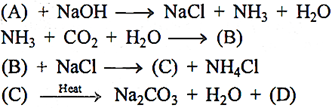
Q.43. Identity (A), (B), (C) and (D) and give their chemical formulae.
A.43:

Thus 'A’ is ammonium chloride.

Thus 'B' is ammonium bicarbonate.

Thus 'C' is sodium bicarbonate.

Thus 'D' is carbon dioxide.
Q.44.
(i) List two properties showing similarity between Lithium and Magnesium.
(ii) State as to why a solution of Na2CO3 is alkaline in nature?
A.44:
(i) (a) Both Li and Mg are harder than other members of their respective groups.
(b) Both react slowly with water.
(ii) A solution of sodium carbonate is alkaline because carbonate part of sodium carbonate gets hydrolysed by water as per the following reaction to furnish OH– (hydroxyl ions).

It is a salt of weak acid and strong base, therefore, alkaline in nature.
Q.45. Explain:
(i) Why are alkali metals not found in nature?
(ii) Beryllium sulphate (BeSO4) is soluble in water but Barium sulphate (BaSO4) is insoluble in water.
A.45: (i) Alkali metals being highly reactive do not occur in free state in nature.
(ii) Because hydration energy of BeSO4 is higher than its lattice energy while the lattice energy of BaSO4 is higher than its hydration energy. This is because a larger anion makes a stable lattice with larger cation.
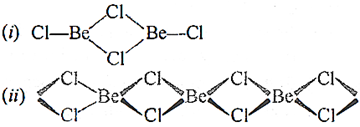
Q.46. Draw the structures of:
(i) BeCl2 (Vapour) (ii) BeCl2 (Solid)
A.46:
Q.47. What happens when:
(i) Mg is burnt in air?
(ii) Cl2(g) reacts with slaked lime? Write chemical equations for the reactions involved.
A.47:

Q.48. Explain the following:
(i) Al cannot be used for storing NaOH.
(ii) A piece of Mg continues to burn in SO2.
A.48: (i) Al reacts with NaOH to form sodium meta aluminate. Therefore, NaOH cannot be stored in aluminium container.
(ii) Burning Mg decomposes SO2 into S and O2. Oxygen helps in burning Mg.
2Mg + 2SO2 → 2MgO + 2S + O2
Q.49. (i) Why does Al dissolve both in acidic and basic solutions?
(ii) Why do we add gypsum in final stages of preparation of cement?
A.49: (i) Aluminium is amphoteric in nature, therefore, it can dissolve in both HCl and NaOH solutions.
2Al + 6HCl → 2AlCl3 + 3H2
2Al + 2NaOH + 2H2O → 2NaAlO2 + 3H2
Sodium meta
aluminate
(ii) Gypsum is added to regulate its setting time. If it is not added, the cement mixed with water sets into hard mass very quickly. Therefore, gypsum is added to delay and regulate setting time of cement.
Q.50. The hydroxides and carbonates of sodium and potassium are easily soluble in water whereas the corresponding salts of magnesium and calcium are sparingly soluble in water. Explain.
A.50: The hydroxides and carbonates of K and Na are soluble in water because hydration energy dominates over lattice energy whereas hydroxides and carbonates of Ca and Mg are sparingly soluble because hydration energy is less than lattice energy.
Q.51. What is the mixture of CaCN2 and carbon called? How is it prepared? Give its uses.
A.51: It is called Nitrolim. It is prepared by heating CaC2 with N2 at high temperature.
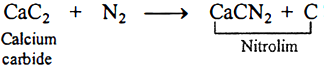
It is used as fertilizer.
Q.52. Convert limestone to calcium carbide.
A.52:
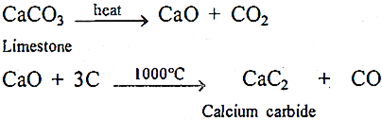
Q.53. Why is MgSO4 soluble in water whereas BaSO4 is insoluble in water?
A.53: MgSO4 is soluble in water because hydration energy is more than lattice energy, whereas BaSO4 is insoluble in water because lattice energy is more than hydration energy.
Q.54. Which metal is present in chlorophyll? How does this metal react with N2?
A.54: Mg is present in chlorophyll. Mg reacts with N2 to form magnesium nitride.
3Mg + N2 → Mg3N2
(Magnesium nitride)
Q.55. Name an alkali metal carbonate which is thermally unstable and why? Give its decomposition reaction.
A.55: Li2CO3 is thermally unstable because it is covalent. It decomposes to form Li2O and CO2.

Q.56. Why are ionic hydrides of only alkali metals and alkaline earth metals known? Give two examples.
A.56: Alkali metals and alkaline earth metals are most electropositive due to low ionisation energy or enthalpy therefore, they can form ionic hydrides, e.g., NaH, KH and CaH2.
Q.57. Which one of the alkaline earth metal carbonates is thermally most and least stable and why?
A.57: BaCO3 is thermally most stable due to greater ionic character and high lattice energy whereas BeCO3 is thermally least stable because it is covalent and has less lattice energy.
Q.58. Which out of Li, Na, K, Be, Mg, Ca has lowest ionisation enthalpy and why?
A.58: K has lowest ionisation energy due to larger atomic. size among these elements. The force of attraction between valence electron and nucleus is less, therefore, it can lose electron easily.
Q.59. Which alkali metal ion forms largest hydrated ion in aqueous solution and why?
A.59: Li+ forms largest hydrated cations because it has highest hydration energy. It has smallest size therefore, it is most hydrated.
Q.60. Why does BeCl2 react with water to give acidic solution? Give chemical reaction.
A.60: BeCl2 is covalent, therefore, it gets hydrolysed to form Be(OH)2 and HCl. HCl, being strong acid, solution is acidic in nature.
BeCl2 + 2H2O → Be(OH)2 + 2HCl
Q.61. Why are alkali metals always univalent? Why are they good reducing agents?
A.61: Alkali metals have largest atomic size, they can lose electrons easily therefore, they are good reducing agents. Secondly, they have low standard reduction potential. They are always univalent because after losing one electron, they acquire nearest noble gas configuration.
Q.62.
Heat of
hydration of Na+ (size 102 pm) = –397 kJ mol–1 whereas Ca2+
(size 100 pm)
= –1650 kJ mol–1. Explain the difference.
A.62: Ca2+ is smaller in size than Na+ and also it has higher charge, therefore, its hydration energy is more than that of Na+.
Q.63. What are the common physical and chemical features of alkali metals?
A.63: Physical Properties:
(i) They are soft metals. (ii) The have low melting and boiling points.
Chemical Properties:
(i) They are highly reactive. (ii) They show +I oxidation state.
Q.64. Discuss the general characteristics and gradation in properties of alkaline earth metals.
A.64: (i) Atomic size goes on increasing down the group.
(ii) Ionisation enthalpy goes on decreasing down the group.
(iii) They are harder than alkali metals.
(iv) They are less electropositive than alkali metals but electropositive cha
Q.65. Why are alkali metals not found in nature?
A.65: Alkali metals are highly reactive, and combine with other substances to form compounds.
Q.66. Explain why sodium is less reactive than potassium.
A.66: It is because K has lower ionisation energy than Na, that is why Na is less reactive than K.
Q.67.
Compare the
alkali metals and alkaline earth metals with respect to
(i) ionisation enthalpy (ii) basicity of oxides and (iii) solubility of
hydroxides.
A.67: (i) Ionisation enthalpy of alkali metals is lower than alkaline earth metals.
(ii) Basicity of oxides of alkali metals is more than that of alkaline earth metals.
(iii) Solubility of hydroxides of group I is more than that of group 2 elements due to lower ionisation enthalpy and more electropositive character.
Q.68. In what ways lithium shows similarities to magnesium in its chemical behaviour?
A.68: (i) Both react with N2 to form nitrides.
(ii) Both react with O2 to form monoxides.
(iii) Both predominantly form covalent compounds.
(iv) Both can form complex compounds.
Q.69. Explain why alkali and alkaline earth metals cannot be obtained by chemical reduction.
A.69: It is because they are strong reducing agents and highly electropositive, therefore, can be obtained only by electrolytic reduction.
Q.70. Why are potassium and caesium, rather than lithium used in photoelectric cells?
A.70: They have lower ionisation energy as compared to Li. Therefore, they can lose electron easily and preferred in photoelectric cells.
Q.71. When an alkali metal dissolves in liquid ammonia the solution can acquire different colours. Explain the reasons for this type of colour change.
A.71: Alkali metals dissolve in liquid ammonia giving deep blue solutions which are conducting in nature.

The blue colour of the solution is due to ammoniated electron which absorbs energy in the visible region of light and imparts blue colour. The solutions are paramagnetic and slowly liberate hydrogen gas resulting in formation of amide.

Where 'am' denotes solution in ammonia. In concentrated solution, the blue colour changes to bronze colour and becomes diamagnetic.
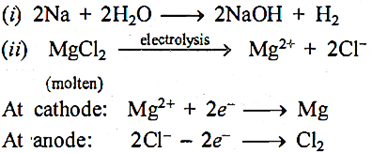
Q.72. What happens when:
(i) Sodium metal is dropped in water (ii) MgCl2 is electrolysed
A.72:
Q.73. Arrange BaSO4, SrSO4, and CaSO4 in increasing order of solubility in water. Explain the reason for this arrangement.
A.73: BaSO4 < SrSO4 < CaSO4
It is because lattice energy decreases whereas hydration energy increases from Ba to Ca.
Q.74. Write four properties illustrating diagonal relationship between Lithium and Magnesium.
A.74: (i) Both form monoxides on reaction with O2. (ii) Both form nitrides with N2.
(iii) Both form complex compounds. (iv) Both form covalent compounds.
Q.75. Lithium hydride can be used to prepare other useful hydrides. Beryllium hydride is one of them. Suggest a route for the preparation of beryllium hydride starting from lithium hydride. Write chemical equations involved in the process.
A.75: 8LiH + 2AlCl3 → 2LiAlH4 + 6LiCl
2BeCl2 + LiAlH4 → 2BeH2 + AlCl3 + LiCl
Q.76. An element of group 2 forms covalent oxide which is amphoteric in nature and dissolves in water to give an amphoteric hydroxide. Identify the element and write chemical reactions of the hydroxide of the element with an alkali and an acid.
A.76: The element is Be. Its covalent oxide is BeO which is amphoteric in nature. It dissolves in water to form Be(OH)2 which is amphoteric.
Be(OH)2 + 2HCl → BeCl2 + 2H2O
Be(OH)2 + 2NaOH → Na2[Be(OH)4]
soluble
Q.77. What happens when:
(i) sodium metal is dropped in water?
(ii) sodium metal is heated in free supply of air?
(iii) sodium peroxide dissolves in water?
A.77: (i) Sodium hydroxide and hydrogen gas will be formed which will catch fire.
2Na(s) + 2H2O(l) → 2NaOH(aq) + H2(g)
(ii) Sodium peroxide is formed.
2Na + O2 → Na2O2
(iii) Sodium hydroxide and hydrogen peroxide are formed.
Na2O2 + 2H2O → 2NaOH + H2O2
Q.78. (i) Write two uses of Plaster of Paris.
(ii) What happens when chlorine reacts with slaked lime?
A.78: (i) (a) It is used for making chalks, moulding and casting.
(b) It is used for plastering fractured bones.
(ii) Bleaching powder is obtained.
2Ca(OH)2 + 2Cl2 → CaCl2 + Ca(OCl)2 + 2H2O
Slaked lime Bleaching Water
powder
Q.79. Comment on each of the following observations:
(i) The mobilities of alkali metal ions in aqueous solution are
Li+ < Na+ < K+ < Rb+ < Cs+
(ii) Lithium is the only metal to form nitride directly
(iii) BaO is soluble but BaSO4 is insoluble in water.
A.79: (i) Li+ has highest charge density and therefore gets maximum hydrated, due to which size of hydrated Li+ is largest and the mobility is minimum. As the hydration energy of these alkali metal ions decreases down the group, the size of hydrated ions decreases and mobility increases. Cs+ is least hydrated and has maximum mobility.
(ii) Lithium and magnesium follow diagonal relationship and so lithium like magnesium forms nitride while other alkali metals do not.

(iii) Size of O2- ion is smaller than SO42–. Since a bigger anion stabilizes a bigger cation more than a smaller anion stabilising a bigger cation, hence the lattice energy of BaO is much smaller than BaSO4 and BaO is soluble as hydration energy is more than lattice energy but BaSO4 (as hydration energy is less than lattice energy) is insoluble in water.
Q.80. Write chemical equations only, involved in the preparation of each of the following:
(i) Plaster of Paris (ii) Quick lime (iii) Slaked lime
Also write any one use of each.
A.80:
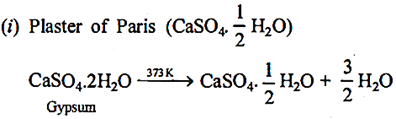
Use: (i) Used for immobilising the affected bone during bone fracture or sprain.
(ii) Making statues.
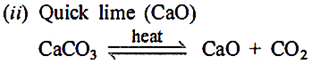
Use: Primary material for manufacture of cement.

Use: Used in whitewash.
Q.81. Why is Li2CO3 decomposed at a lower temperature whereas Na2CO3 at higher temperature?
A.81: It is because Li2CO3 is covalent compound whereas Na2CO3 is an ionic compound. Lattice energy of Na2CO3 is higher than that of Li2CO3.
Online Tuitions & Self-Study Courses for Grade 6 to 12 & JEE / NEET