
Class 11 Chemistry
Final Question Answer Set
Assertion Reason Questions
General Instructions:
In following questions, a statement of assertion followed by a statement of reason is given. Choose the correct answer out of the following choices:
(a) Assertion and reason both are correct statements and reason is correct explanation for assertion.
(b) Assertion and reason both are correct statements but reason is not correct explanation for assertion.
(c) Assertion is correct statement but reason is wrong statement.
(d) Assertion is wrong statement but reason is correct statement.
Q.1. Assertion: CsI is highly soluble in water.
Reason: CsI has smaller hydration enthalpy of its two ions.
Ans(d). CsI is less soluble in water because it has smaller hydration enthalpy of its two ions.
Q.2. Assertion: Increasing order of covalent character among alkali metal halides is:
Fluoride < chloride < bromide < iodide
Reason: Higher the electronegativity difference between metal and halogen, greater is the covalent character of alkali metal halides.
Ans: (c). Lesser the electronegativity difference between metal and halogen, greater is the covalent character of alkali metal halides.
Q.3. Assertion: The alkali metal halides possess high melting points.
Reason: These halides have less negative enthalpies of formation.
Ans: (c). The alkali metal halides possess high melting points because these halides have high negative enthalpies of formation. It is also due to the fact that alkali metals are more electropositive and halogens are most electronegative. Consequently, alkali metal halides are the most ionic compounds.
Q.4. Assertion: The melting and boiling points of alkali metal halides decrease from F− to I−.
Reason: For a given metal, ∆fHo always become less negative from fluoride to iodide.
Ans: (a). The trend of melting and boiling points of alkali metal halides is :
Fluoride > chloride > bromide > iodide
It is because for a given metal, ∆fHo, always become less negative from fluoride to iodide.
Q.5. Assertion: LiF is less soluble in water.
Reason: LiF possesses low lattice enthalpy.
Ans: (c). LiF is less soluble in water due to its high lattice enthalpy.
Q.6. Assertion: (A): The atomic mass of most of the elements are fractional.
Reason: (R): Most of the elements occur as mixture of isotopes in nature.
Ans: (a). The atomic masses of most of the elements are fractional because most of the elements occur as mixture of isotopes in nature. Their atomic masses are the average relative atomic masses of the isotopes, which depend on their abundance.
Q.7. Assertion: (A): Some metals like platinum and palladium, can be used as storage media for hydrogen.
Reason: (R): Platinum and palladium can absorb large volumes of hydrogen.
Ans: (a). Pt and Pd can be used as storage media for hydrogen because they can absorb large volumes of hydrocarbon.
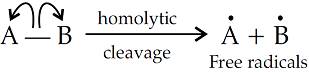
Q.8. Assertion: (A): Free radicals are obtained by means of homolytic cleavage.
Reason: (R): In homolytic cleavage, each of the atoms acquires one of the bonding electrons.
Ans: (a).
Q.9. Assertion: (A): Cycloalkanes are isomeric with alkenes.
Reason: (R): Their general formula is same i.e., CnH2n.
Ans: (a). Cycloalkanes are isomeric with alkanes because both have same general formula i.e., CnH2n.
Q.10. Assertion: (A): The ionization enthalpy of hydrogen is higher than that of sodium.
Reason: (R): The size of hydrogen is smaller than sodium.
Ans: (a). The ionization enthalpy of hydrogen is higher than that of sodium because of smaller size of hydrogen than of sodium.
Q.11. Assertion: (A): Reaction proceeds forward when Qc < Kc.
Reason: (R): In this case, change in free energy will be positive.
Ans: (c). A reaction proceeds forward when Qc < Kc.
∆G = ∆Go + RT ln Qc
∆G = – RT ln Kc + RT ln Qc
∆G = RT ln 
If Qc < Kc, then ∆G will be negative, for the reaction to proceed in the forward direction.
Q.12. Assertion: Staggered from least stable than the eclipsed form.
Reason: Staggered form has the least torsional strain.
Ans: (d). Staggered form is more stable than the eclipsed form because of least torsional strain in staggered form.
Q.13. Assertion: Alkane are saturated hydrocarbons.
Reason: Alkanes contain carbon−carbon sigma bonds.
Ans: (a). Alkanes are saturated hydrocarbons because they contain C—C single bonds.
Q.14. Assertion: In alkanes, there is free rotation about C−C single bond.
Reason: Electron distribution of the sigma molecular orbital is symmetrical around the internuclear axis of the C−C bond.
Ans: (a). In alkanes, there is free rotation about C—C single bond because electron distribution of the sigma molecular orbital is symmetrical around the internuclear axis of the C—C bond.
Q.15. Assertion: There are different spatial arrangements of atoms of alkanes in space which change into one another.
Reason: It is due to free rotation about C−C single bond.
Ans: (a). There are different spatial arrangement of atoms of alkanes in space which can change into one another because of free rotation about C—C single bond.
Q.16. Assertion: The rotation around a C−C single bond is not completely free which is hindered by a small energy barrier of 1−20 KJ mol−1.
Reason: It is due to strong repulsive interaction between the adjacent bonds.
Ans: (c). The rotation around a carbon−carbon single bound is not completely free because weak repulsive interaction between the adjacent bonds.
Q.17. Assertion: (A): A liquid crystallises into solid. The sign of entropy change for this reaction is negative.
Reason: (R): Entropy decreases as solid is a less ordered state.
Ans: (c). The sign of entropy changes for crystallization of liquid into solid is negative because solid is a more ordered state.
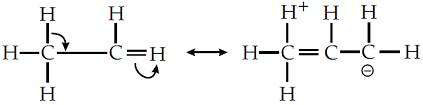
Q.18. Assertion: (A): Alkyl groups act as electron donors when attached to a π-system.
Reason: (R): It is due to hyperconjugation.
Ans: (a). In hyper conjugation, the sigma electrons of the C—H bond of an alkyl group are delocalized which is attached to an unsaturated system. e.g.,
Q.19. Assertion: (A) : Bohr's orbits are called energy levels.
Reason: (R) : They are associated with fixed amount of energy.
Ans: (a).
Q.20. Assertion: (A): π bond is stronger than σ bond.
Reason: (R): The extent of overlapping in σ bond is greater than in π-bond.
Ans: (d). Sigma bond is stronger than π bond because the extent of overlapping in sigma bond is greater than in π bond.
Q.21. Assertion: (A): The line spectrum of an element is known as finger prints of its atom.
Reason: (R): Each element has a unique line emission spectrum.
Ans: (a). The line spectrum is of greater interest in the study of electronic structure. Each element has a unique line emission spectrum. The characteristics in atomic spectra can be sued in chemical analysis to identify unknown atoms in the same ways as finger print are used to identify people.
Q.22. Assertion: (A): HNO3 acts as oxidizing agent while HNO2 can act both as reducing and oxidizing agent.
Reason: (R): HNO3 forms nascent oxygen while HNO2 does not form nascent oxygen.
Ans: (b). Maximum oxidation number of N is +5 because it has five electrons in its valence shell.
Minimum oxidation number of N is –3 because it can accept 3 more electrons to get noble gas configuration.
Since, oxidation number of N in HNO3 is maximum, so, it can only decrease. Hence, HNO3 can act as an oxidizing agent.
Since, oxidation number of N in HNO2 is +3. Hence, it can increase by losing electrons or can decrease by accepting electrons. Hence, HNO2 can act both as reducing and oxidizing agent.
Q.23. Assertion: The greater the s character of hybrid orbitals, the greater is the electronegativity.
Reason: The change in hybridization influences the electronegativity of carbon.
Ans: (a). The greater the s-character of hybrid orbital, the greater is the electronegativity.
Q.24. Assertion: The sp hybrid orbital is closer to its nucleus.
Reason: The sp hybrid orbital has less s character.
Ans: (c). The sp hybrid orbital has more s character.
Q.25. Assertion: The shape of methane molecule is tetrahedral.
Reason: It possesses sp2 hybridization.
Ans: (c). The shape of methane (CH4) molecule is tetrahedral as it possesses sp3 hybridization.
Q.26. Assertion: The sp hybrid orbitals form shorter and stronger bonds than the sp3 hybrid orbital.
Reason: The sp hybrid orbital contains more s character.
Ans: (a). Since the sp hybrid orbital contains more s character (50%) than the sp3 hybrid orbital (s character = 25%), so the sp hybrid orbital forms shorter and stronger bonds than the sp3 hybrid orbital.
Q.27. Assertion: The length and enthalpy of the bonds formed by sp2 hybrid orbital are intermediate between sp and sp3 hybrid orbitals.
Reason: The sp2 hybrid orbital has more s character than sp3 hybrid orbital.
Ans: (b). The sp2 hybrid orbital is intermediate in s character between sp2 and sp3 hybrid orbitals.
Q.28. Assertion: (A): BF3 does not contain proton but still acts as an acid.
Reason: (R): It is an electron deficient species.
Ans: (a). BF3 does not contain proton (H+) but still acts as an acid because it is an electron deficient species. It acts as Lewis acid.
Q.29. Assertion: (A): Acetylene is acidic but it does not react with sodium hydroxide.
Reason: (R): It is a very weak acid.
Ans: (a). Since acetylene is very weak acid (Ka = 10–25) So, it does not react with sodium hydroxide.
Q.30. Assertion: (A): The completely filled and half-filled sub−shells are stable.
Reason: (R): It is due to symmetrical distribution of electrons.
Ans: (a). The completely filled and half-filled sub-shells are stable because of symmetrical distribution of electrons.
Q.31. Assertion: (A): Ionic compounds are soluble in water.
Reason: (R): These compounds are non−polar in nature.
Ans: (c). Ionic compounds are soluble in water because these compounds are polar in nature.
Q.32. Assertion: (A): Dipole moment of CH3F is greater than that of CH3Cl.
Reason: The C−F bond length in CH3F is smaller than C−Cl bond length in CH3Cl.
Ans: (d). Dipole moment of CH3Cl is greater than that of CH3F. It is due to smaller C—F bond length in CH3F than C—Cl bond length in CH3Cl. The charge separation in C—F bond is more than in C—Cl bond as fluorine being more electronegative than chlorine. The bond length has greater effect than the charge separation. Hence, the dipole moment of CH3Cl is greater than that of CH3F.
Q.33. Assertion: (A): A reaction A + B → C + D + q is found to have entropy change. The reaction is possible at higher temperature.
Reason: (R): The reaction is exothermic and possess entropy change.
Ans: (d). A + B → C + D + q
This reaction is possible at any temperature because the reaction is exothermic (∆H < 0) and has ∆S > 0 and both these factors favour spontaneity. So, it is feasible at any temperature.
Q.34. Assertion: Alkanes are almost non-polar molecules.
Reason: It is due to covalent nature of C − C and C − H bonds.
Ans: (a). Alkanes are almost non-polar molecules because of covalent nature of C—C and C—H bonds present in them and also due to very little difference of electronegativity between C and H atoms.
Q.35. Assertion: Higher Alkanes are hydrophobic in nature.
Reason: It is due to non-polar nature of alkanes.
Ans: (a). Higher alkanes are hydrophobic in nature because of non-polar nature of alkanes.
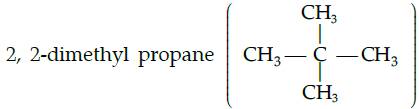
Q.36. Assertion: The boiling point of pentane is higher than 2, 2-dimethylpropane.
Reason: In branched chains of alkanes, week inter-molecular forces take place between spherical molecules.
Ans: (a). 2, 2-Dimethylpropane is branched chain alkane, due to branching, its molecule attains spherical shape and possess weak intermolecular forces.
Q.37. Assertion: The boiling point of alkanes increases with increases in molecular mass.
Reason: Intermolecular van der Waals forces decrease with increase of the molecular mass.
Ans: (c). Intermolecular van der Waals forces increase with increase of molecular mass of alkanes.
Q.38. Assertion: The alkanes having C1 to C4 are liquids.
Reason: They possess week van der Waals forces.
Ans: (d). The alkanes having C1 to C4 are gases because they possess week van der Waals forces.
Q.39. Assertion: (A): An aqueous solution of aluminium chloride shows pH less than 7.
Reason: (R): It gives week acid in water.
Ans: (An aqueous solution of aluminium chloride shows pH less than 7 because it gives weak base (aluminium hydroxide) and strong acid (hydrochloric acid) in water.).


Q.40. Assertion: (A): Heisenberg's uncertainty principle can be applied to a stationary electron.
Reason: (R): Velocity of stationary electron is zero. So, its position cannot be measured accurately.
Ans: (d). Heisenberg's uncertainty principle cannot be applied to a stationary electron because its velocity is zero due to which its position cannot be measured accurately.
Q.41. Assertion: (A): Molality is preferred over molarity of a solution.
Reason: (R): Molarity of solution changes with temperature while molality of a solution does not change with temperature.
Ans: (a). It is because molarity of a solution changes with temperature while molality of a solution does not change with temperature.
Q.42. Assertion: (A): Hydrogen spectrum consists of a large number of lines.
Reason: (R): Different possible transitions are observed in hydrogen spectrum.
Ans: (a). Large number of lines are there in hydrogen spectrum because different possible transitions can be observed which leads to large number of spectral lines.
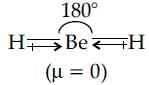
Q.43. Assertion: (A): BeH2 molecule has a zero dipole moment although the Be-H bonds are polar.
Reason: (R): Two equal bond dipoles point in same directions.
Ans: (c). In BeH2 molecules, the two equal bond dipoles point in opposite direction and cancel the effect of each other. Hence, BeH2 molecule has a zero dipole moment (μ = 0).
Q.44. Assertion: (A): Hydrogen shows resemblance with alkali metals of Group 1.
Reason: (R): Hydrogen behaves as a metal.
Ans: (c). Hydrogen shows resemblance with alkali metals of Group 1 because it has ns1 configuration and it has a tendency to form H+ ion like that of alkali metals.
Q.45. Assertion: Beryllium is not considered as an alkaline earth metal.
Reason: Its oxide and hydroxide show amphoteric behaviour.
Ans: (a). Beryllium is not considered as an alkaline earth metal because its oxide and hydroxides show amphoteric behaviour i.e., acidic as well as alkaline.
Q.46. Assertion: Lithium and beryllium exhibit some properties like other members of the respective group.
Reason: Both these elements exhibit anomalous behaviour.
Ans: (d). Li and Be exhibit some properties which are different to other member of the respective group as they exhibit anomalous behaviour.
Q.47. Assertion: Group 1 and 2 belong to the p−block of the Periodic Table.
Reason: s−orbital of the elements of these groups can accommodate only 2 electrons.
Ans: (d)
Q.48. Assertion: Group 1 elements are collectively called alkali metals
Reason: These elements form hydroxides on reaction with water which are strongly alkaline in nature.
Ans: (a). Group 1 elements are collectively called alkali metals because their hydroxides are strongly alkaline in nature.
Q.49. Assertion: Group 2 elements except Be are collectively called alkaline earth metals.
Reason: Their oxides and hydroxides are amphoteric in nature.
Ans: (c). Group 2 elements except Be are collectively called alkaline earth metals because their oxides and hydroxides are alkaline in nature.
Q.50. Assertion: (A) The intensity of red colour decreases when oxalic acid is added to a solution containing iron (III) nitrate and potassium thiocyanate.
Reason: (R) Oxalic acid reacts with Fe3+ ions to form a stable complex ion [Fe(C2O4)3]3−.
Ans: (a). When oxalic acid is added to a solution containing iron nitrate and potassium thiocyanate, oxalic acid reacts with Fe3+ ions to form a stable complex ion [Fe(C2O4)3]3–, thus, decreasing the concentration of free Fe3+ ions which in turn decreases the intensity of red colour.
Q.51. Assertion: (A) Molality of the solution is affected by temperature.
Reason: (R) Mass remains unchanged with temperature.
Ans: (d). Molality of the solution is not affected by temperature because mass remains unchanged with temperature.
Q.52. Assertion: (A) Ionization enthalpy of nitrogen is more than that of oxygen.
Reason: (R) Nitrogen has completely filled p−orbital.
Ans: (c). 7N = 1s2, 2s2, 2px1, 2py1, 2pz1
8O = 1s2, 2s2, 2px2, 2py1, 2pz1
Nitrogen has half-filled p-orbital which are more stable than incompletely filled p-orbitals of oxygen. So, ionization enthalpy of nitrogen is more than that of oxygen.
Q.53. Assertion: (A) The electronic energies in an atom are quantized.
Reason: (R) The lines are obtained in line spectrum due to electronic transitions between the energy levels, which correspond to definite wavelengths.
Ans: (a). In line spectrum, the lines are obtained due to electronic transitions between the energy levels, which correspond to definite wavelength. So, the electrons in these levels have fixed energy i.e., quantized values.
Q.54. 14. Assertion: (A) When the added electron goes to the smaller n = 3 quantum level, the electron−electron repulsion is much less.
Reason: (R) The added electron occupies a smaller region of space.
Ans: (c). It is because of the fact that the added electron occupies a larger region of space.
Q.55. Assertion: (A) A piece of magnesium ribbon continues to burn in 502.
Reason: (R) The reaction is highly endothermic.
Ans: (c). Magnesium is a strong reducing agent. It reduces SO2 to sulphur. The reaction is highly exothermic so a piece of magnesium ribbon continues to burn in SO2.
2Mg + SO2 → 2MgO + S + heat
Online Tuitions & Self−Study Courses for Grade 6 to 12 & JEE / NEET