
An opposing force comes into play between the surface of contact of two bodies, when one body moves over the surface of other and hence, opposes the relative motion of the moving object. This opposing force is called force of friction.
Frictional force acts on a body moving over the other body which opposes their relative motion.
Thus, the direction of force of friction is always opposite to the direction of motion of moving body.
Activity 1: To observe opposing force.
Place a book on the table. Now, push the book gently towards right. We will observe that the book moves towards right and finally stops after covering some distance. Thus, an opposing force acts on the book towards left which brings the book to rest.
Now, give a push to the book towards left. We will notice that the book moves towards left and finally stops after covering some distance. Hence, an opposing force acts on the book towards right which brings it to rest.
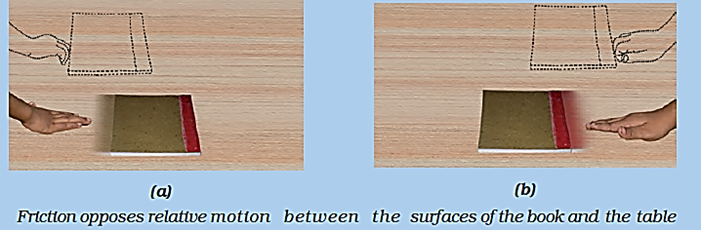
So, in the above activity, we can see that when the force is acting towards left, the friction is towards right and when the force is acting towards right, the friction is towards left. Hence, we come to the conclusion that the force of friction always acts in a direction opposite to the direction of motion of object.
Force of friction between two surfaces depends on the two factors:
1. Friction Depends on the Nature of Two Surfaces.
The force of friction is not same for all the surfaces. It depends on the roughness or smoothness of surfaces in contact. When the contact surfaces are smooth then the friction is very less. As the roughness increases, the friction also increases. Let us perform some activity to understand the dependence of friction on the nature of surfaces.
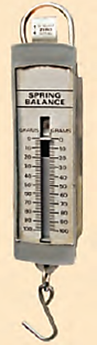
Spring Balance
It is the device which is used for measuring the force acting on an object. It consists of a coiled spring which gets stretched when a force is applied to it. Stretching of the spring is measured by a pointer moving on a graduated scale. The reading on the scale gives the magnitude of the force.
Activity 2: To observe dependence of friction on the nature of two surfaces.
Firstly, set up an inclined plane on a smooth floor or on the table by placing a wooden board supported by a book as shown in the figure given below. Put a mark A on the inclined plane with the help of a pen.
Let a pencil cell move down from this point. Note the distance covered by pencil cell on the table.
Now, put a piece of cloth over the table. Make sure that there are no wrinkles in the cloth. Repeat the above activity again on the cloth spread of table.
Note down the horizontal distance covered by the pencil cell. Here, we find that the distance covered by pencil cell is less than the distance covered in first case.
Again, repeat the activity by spreading a thin layer of sand over the table. Here, we find that the distance covered by the pencil cell is very less.
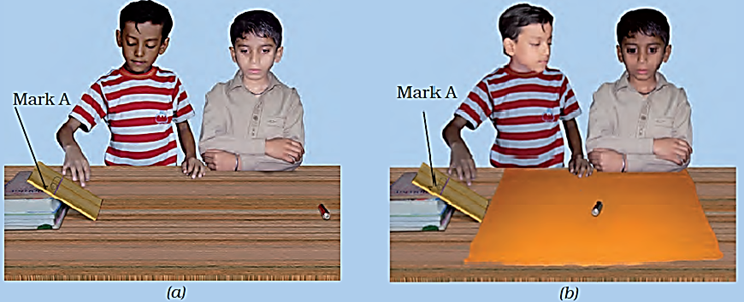
From the above activity, we conclude that, the distance covered by pencil cell is different on different surfaces. Thus, the friction depends on the nature of the two surfaces in contact.
2. Friction Depends on the Force with Which Two Surfaces are Pressed Together
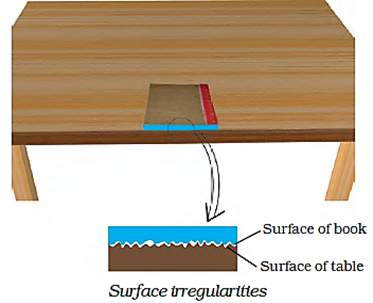
Friction is caused by interlocking of irregularities on the two surfaces in contact. Even those surfaces which appear very smooth, have a large number of minute irregularities on them.
When two surfaces of objects are pressed together, then friction increases. This is because pressing together of two surfaces with greater force will increase the interlocking of irregularities.
The force required to overcome friction at the instant an object starts moving from rest is a measure of static friction. Static friction is more powerful than other, frictions, e.g. consider a boy pushes a heavy box but the box does not move. He then applies more force on the box and the box just tends to start moving. At that instant, the frictional force between the floor and the box is the static friction.
When one body slides over the surface of other, the resistance to its motion is called sliding friction. The force required to keep the object moving with the same speed is a measure of sliding friction. If we apply more pushing force on a box; the box will start sliding on the surface and the friction between the surfaces is called sliding friction.
Sliding friction is smaller than static friction but greater than rolling friction.
The force of friction which comes into play, when a body rolls over the surface of another body is called rolling friction, e.g. when a wheel rolls over a road, the rolling friction comes into play. The direction of rolling friction is opposite to the direction of turning of wheels. The rolling friction is less than the sliding friction.
The force of friction plays an important role in our day-to-day activities. Sometimes, friction is useful while in some cases, friction is harmful.
(i) We walk easily on the ground due to friction: To take a step forward during walking, we usually lift one foot off the ground and push the ground backwards with other foot. Hence, a force of friction acts in the opposite direction, i.e. in forward direction which prevents our foot from slipping backwards. Thus, friction enables us to walk easily on the ground.
(ii) Friction enables us to fix the nail into the wall: When we hammer a nail into the wall, the nail is held tightly with the wall. The force of friction between nail and wall holds the nail tightly in the wall. Thus, we are able to fix nails in the wall or wood due to friction.
(iii) We can light a matchstick due to friction: When we rub a matchstick with the matchbox, then the friction between them produces heat which burns the chemical of matchstick. So, the matchstick catches fire and starts burning. Hence, due to friction the matchstick lights up.
(iv) The brakes slow down or stop moving bicycle due to friction: If we press the brake lever to apply brakes to the running bicycle, then the brake pads rub the rims of bicycle wheels. The friction between brake pad and the rim slows down the motion of bicycle.
(v) We can write with our pen due to friction: The teacher writes by rubbing the chalk-piece on the blackboard due to friction.
(vi) We can hold tumbler in our hand because there is a friction between tumbler and our hand.
(vii) Friction enables a person to climb a tree or pole. A ladder is leaned against a wall due to friction.
(viii) Due to friction, a belt drives machines in the factories.
(ix) Friction enables tyres to move forward.
(i) Wear and tear of soles of our shoes due to friction: While walking on the road, there is a friction between the soles of our shoes and the road. Due to which the soles rub against the road and the tiny pieces of soles keep on breaking off slowly. Thus, the soles of shoes wear out gradually.
(ii) Wears of steps of staircases in foot over-bridges take place due to friction: When a number of people use the staircase daily, the friction between soles of their shoes and stone steps wears away hard stones very slowly. Thus, we see worn out steps of foot over-bridges at railway stations.
(iii) Heat produces due to friction: When we rub our hands together quickly for few seconds, they become warm because friction between the hands produces heat. Similarly, when we operate a mixer and a grinder for few minutes, its jar becomes hot due to friction. Also, when the moving parts of machine rub together maximum, heat is produced due to friction. This heat may damage the machine gradually.
(iv) The efficiency of machines gets reduced due to friction: In order to run a machine, some energy is supplied to it. Due to friction between the parts of machine, some of the energy is wasted in the form of heat. This reduces the efficiency of machines.
Methods of Increasing Friction
(i) The soles of shoes are made up of grooves to increase friction. A long and shallow cut or depression in the surface of hard material is called groove. In the soles of our shoes, sometimes we see that some grooves are made, these grooves increase the friction with the ground and the shoes get a better grip even on a slippery ground.
(ii) The tyres of vehicles are made up of treads to increase friction. A series of patterns made into the surface of tyre is called tread. When a ground is wet, then the friction between ground and tyres of vehicle reduces. So, the tyres are designed with treads which provide a better grip with the ground.
(iii) Kabaddi players usually rub their hands with dry soil to increase friction and to get a better grip on their opponent. Gymnasts apply some coarse substance on their hands to increase friction for better grip.
(i) With the help of polishing the surface: We sprinkle fine powder on the carrom board and then we polish its surface to make it smooth so that the striker slides easily on the surface.
(ii) By applying lubricants (like grease or oil) to the rubbing surfaces: The substances which reduce friction are called lubricants, e.g. oil, grease, etc.
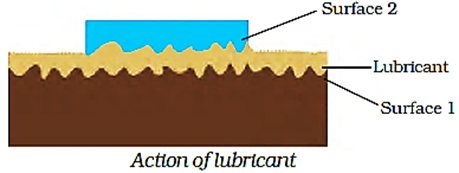
When the oil, grease or graphite is applied between the moving part of a machine, a thin layer is formed there and moving surfaces do not directly rub against each other. Interlocking of irregularities is avoided to a great extent, thus reducing friction, and the movement becomes easier.
When a few drops of oil are poured on the hinges of a door, the friction is reduced and the door turns easily.
In some machines, it may not be advisable to use oil as lubricant.
An air cushion between the moving parts is used to reduce friction, e.g. the frictional drag from the sea on hovercraft is reduced by cushion of compressed air. Friction can never be entirely eliminated, so we can only reduce the friction. No surface is perfectly smooth as some irregularities are always present there.
In our daily routine, we usually see some object's like attaches and other bags fitted with rollers. Even a child can pull a heavy luggage fitted with rollers. Because the sliding friction is converted into rolling friction which gives less resistance to the motion of luggage.
Activity 3: To show that rolling friction is less than sliding friction.
Choose few pencils which are cylindrical in shape. Place them parallel to each other on a table. Place a thick book over it. Now; give a little push to the book. We see that the pencils rolling as the book moves. Here, we find easier to move the book in this way than to slide it.
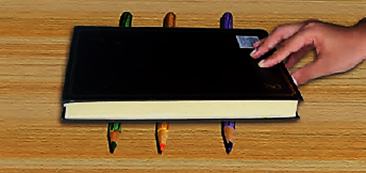
From the above activity, we conclude that the friction can be reduced by attaching wheels to move the objects. It is always easier to roll, than to slide a body over another. Thus, wheel is one of the greatest inventions of the mankind.
Ball Bearing
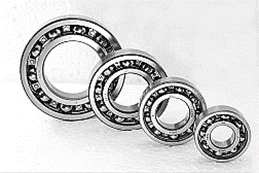
These are designed to make moving parts of machines to roll over each other. It consists of metal balls fitted in between metal rings.
In bicycle, motorbike, etc. the ball bearing is inserted between the hub of wheel and the axle. When the wheel revolves, the balls of ball bearing roll and reduce friction. Hence, the wheel rolls smoothly over the axle.
Those substances which can flow easily are called fluids. Liquids and gases can flow easily so they are fluids. Fluids do not have definite shape. There is a friction whenever an object moves through a fluid. It is called fluid friction.
Air is very light and thin, yet it exerts a frictional force on object moving through it. Similarly, water and other liquids also exert force of friction when objects move through them. We conclude that air and water exert force of friction on objects moving through it. Hence, fluid exerts force of friction on objects moving through it. The frictional force exerted by fluids is also called drag.
The frictional force (or drag) exerted by fluid on an object moving through it depends on
(i) speed of object with respect to fluid
(ii) size of object
(iii) shape of object
(iv) nature of fluid (viscosity)
Higher the speed of an object moving through a fluid, greater will be the fluid friction (or drag).
Larger the size of an object moving through a fluid, greater will be the drag acting on it.
The streamlined shape objects face less fluid friction while moving through a fluid.
Higher the viscosity (or thickness) of fluid, greater will be the frictional force acting on the fluid.
Disadvantages of Fluid Friction
Fluid friction reduces the speed of objects moving through the fluids.
In this process, the object loses some of their energy which decreases their efficiency, e.g. when a car is running on the road, then it loses some of its energy in overcoming the friction of air which opposes its motion.
Methods of Reducing Fluid Friction
A body shape that offers a small resistance to the flow of fluid around it, is called streamlined. The fluid friction can be decreased by giving streamlined shape to the objects which move through fluids. When an object having streamlined body shape moves very fast, then the fluid can flow past the moving object smoothly, reducing the fluid friction.
Cars are built with streamlined body shape which reduces air resistance.
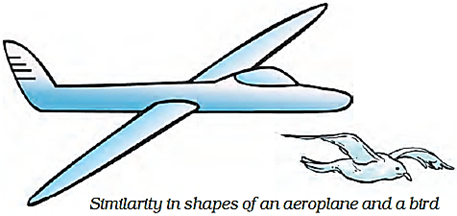
An aeroplane has streamlined shape to reduce friction. The shape of an aeroplane is similar to that of a bird in flight. In the figure, we can see that both the bird and aeroplane have a streamlined shape in the middle and two wings and a tail.
Fishes are streamlined by nature due to which they move easily in the water.
The objects like speedboats, ships and submarines are also built with streamline shape to reduce frictional force of water and make them move easily through water.
Online Tuitions & Self-Study Courses for Grade 6 to 12 & JEE / NEET