
Class 7 Science
Chapter 15 – Light
Important Questions Answers Part 4
Q.1. What does a convex lens form a virtual image? Is the virtual image bigger of smaller than the object?
Ans. A convex lens forms a virtual image when the object is placed between the optical centre and the focus of the lens.
The virtual image formed by a convex lens is bigger than the object.
Q.2. Draw a labelled diagram of an experiment to show rectilinear propagation of light.
Ans.
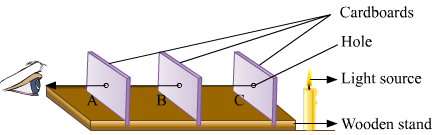
Let us take three rectangular pieces of cardboard A, B, and C and make holes in them at the same horizontal level. With the help of a wooden stand as shown in the diagram, we make them stand parallel to each other with holes in the same straight line. We place a source of light, for example, a candle at the other side of cardboard C and adjust the cardboard pieces such that the light is visible through the hole at A. Now, we move the cardboard B in such a way that the hole no more stays in the same straight line with A and C.
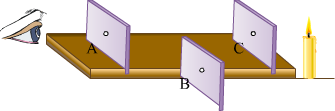
We will find that when the hole on B is moved away from the straight line, the light will not be visible from A’s end. This proves that light moves in a straight line.
Q.3. What are the characteristics of the image formed by a plane mirror?
Ans. Following are the characteristics of the image formed by a plane mirror:
i) Images are virtual and erect: This means that the images are formed at the backside of the mirror and the images are erect.
ii) Images are laterally inverted: In the image formed by a plane mirror, there is an interchange of left and right side.
iii) Images are of the same size of the object.
iv) The image appears to be as much as behind the mirror as the object in front of it.
Q.4. State three uses of concave mirrors.
Ans. Following are the uses of a concave mirror:
1) Use in trapping solar energy: Since concave mirror can gather light and heat and direct the rays to focus, the focus becomes very hot. This property of the concave lens can be used to collect sun’s heat and this heat can be converted to electricity.
2) Use as shaving mirror: Since concave mirrors can produce magnified images of the object when object is placed between pole and focus, this property can be used for making shaving mirrors to prevent cuts and have a better view while shaving.
3) Use in reflecting telescopes: Telescopes are used to study distant stars. Some form of telescopes known as reflecting telescopes uses concave mirror to gather light from distant stars, galaxies, etc, and produce magnified images that help astronomers and scientists to study the structure of the universe.
4) Use as dentist’s mirror: Dentists use small hand held concave mirror to produce a magnified image of the teeth and gum.
5) Use in reflectors: When a source of light is placed at the focus of a concave mirror, the rays become parallel after getting reflected from the mirror and this allows a powerful beam of light to be focused to a long distance. So, concave mirrors are used as reflectors in headlights of cars, torches etc.
Q.5. Explain the difference between real and virtual images.
Ans. Following are the differences between real and virtual images:
|
Real Image |
Virtual Image |
|
i) Real images are formed when rays of light actually meet each other at a point. |
i) Virtual images are formed when rays of light appear to be coming from the image which does not actually exist. |
|
ii) Real images being actual intersection of rays can be projected on a screen. |
ii) Virtual images being non-existent cannot be projected on a screen. |
|
iii) Real images are inverted. |
iii)Virtual images are erect. |
Q.6. State the position and nature of the image formed by a concave mirror for the following positions of the object:
(a) between O and F
(b) between F and C
(c) beyond C
Ans.
(a) Between O and F: Position of the image is behind the mirror; nature of the image is virtual, erect and highly magnified.
(b) Between F and C: Position of the image is beyond C; nature of the image is real, inverted and magnified.
(c) Beyond C: Position of the image is between C and F; nature of the image is real, inverted and diminished.
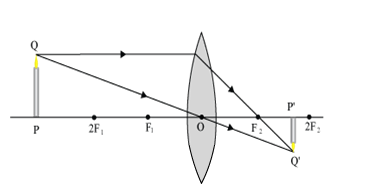
Q.7. State the position and nature of the image formed by a convex lens for the following positions of the object:
(a) between O and F
(b) between F and 2F
(c) at 2F
Ans.
(a) between O and F: Position of the image is on the same side as the object; nature of the image is virtual, erect and highly magnified.
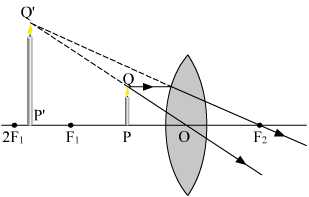
(b) between F and 2F: Position of the image is beyond 2F; nature of the image is real, inverted and magnified.
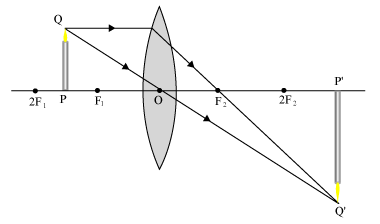
(c) at 2F: Position of the image is at 2F on the opposite side of the object; nature of the image is real, inverted and of the same size as the object.
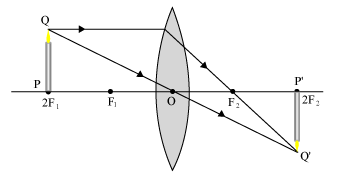
(d) beyond 2F: Position of the image is between F and 2F on the opposite side of the object. The nature of the image is real, inverted and diminished.
Q.8. Explain the following with the help of a ray diagram, in relation to the two main types of spherical lenses:
(a) principal focus
(b) focal length
Ans. Spherical lenses are mainly of two types: convex lens and concave lens.
(a) Principal focus:
Convex lens: In a convex lens, the parallel rays of light passing through the lens actually meet at a point in front of the lens known as focus. In the following figure, F is the focus.

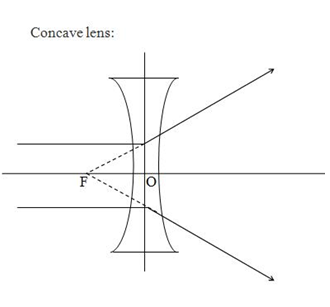
Concave lens: In a concave lens, the rays of light passing through the lens diverge and when these diverging rays are produced backward, they appear to meet at a point behind the lens. The point is called the focus of concave lens. In the following figure, F is the focus.
(b) Focal length
Convex lens:
Focal length of a convex lens is the distance between the focus F and the optical centre O. In the figure, OF is the focal length. The focal length is on the right side in a convex lens.
Concave lens:
Focal length of a concave lens is the distance between the focus F and the optical centre O. In the figure, FO is the focal length. The focal length is on the left side in a convex lens.
Q.9. Explain the set-up used by Newton to obtain a spectrum.
Ans. Sir Isaac Newton showed that when a thin ray of light passed through a triangular piece of glass known as prism, the light split into seven colours called spectrum. He allowed a thin beam of light to fall on a prism kept in a dark room. After passing through the prism, the light split into seven different colours, namely violet, indigo, blue, green, yellow, orange and red, collectively known as spectrum.
Q.10. What will be the difference in the size of the image (of the same object) formed by a small and a large plane mirror?
Ans. There will be no difference in the size of the image. This is because in a plane mirror, size of the image is equal to the size of the object. Since the size of the image does not depend upon the size of the mirror, the image size will remain the same whether it is formed by a small or a large mirror.
Q.11. How many images do you think will be formed if an object is kept between two plane mirrors parallel to each other?
Ans. Infinite number of images will be formed if an object is kept between two plane mirrors parallel to each other.
This happens because rays of light from the object will fall infinite number of times on the mirror by getting reflected from the two mirrors and each time it is reflected back, images are formed. Thus, infinite number of images of the object is formed.
Q.12. The illustration shows an object O in front of a plane mirror.

Which one of the light rays shown appears to come from the image of O?
Ans.

If we trace all the rays coming out of the surface of the mirror in the backward direction, we can see only ray 1 appears to come from the image 'I' of the object 'O'. As shown in the figure.
Q.13. Mary saw a few children using a mirror to shine bright sunlight on the eyes of a street dog. They laughed at the discomfort of the dog. Were they doing the right thing? What value were they not showing?
Ans. No, they were not doing the right thing. To harm an animal in any way is morally wrong. So, the children were not showing morality while they were discomforting a street dog.
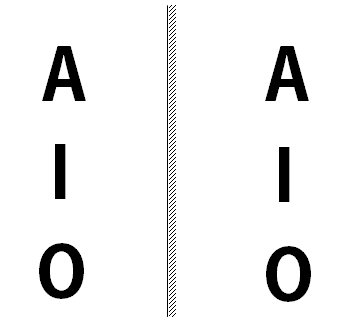
Q.14. Identify three letters of the English alphabet or of your mother tongue whose mirror images are exactly the same as the letters.
Ans. Three letters of the English alphabet whose mirror images are exactly the same as the letters are A, O and I.
Q.15. Car rear view mirrors carry a warning message that 'objects in the rear-view mirror are closer than they appear'. Why do you think this is so?
Ans. Car rear view mirrors are convex mirrors. In a convex mirror, the image of an object appears small, therefore, our brain recognises the size of the image and tries to calculate the distance of the actual object on this basis. As we know, objects far away appear smaller, therefore, when we see smaller images of the objects in the mirror, our brain thinks that the objects are far away than they actually are. In other words, 'objects in the rear-view mirror are closer than they appear'.
Q.16. A concave mirror is said to have a real focus whereas a convex mirror is said to have a virtual focus. apply the same logic to concave and convex lenses and say which of them has a real focus and which has a virtual focus.
Ans. The logic behind the first case is not applicable in the second case. This is because in the first case, the mirror works on the principle of reflection of light, whereas in the second case, the lens works on the principle of bending of light.
The correct logic is that converging systems have a real focus while diverging systems have a virtual focus.
In the first case, a concave mirror acts as a converging instrument. Therefore, it has a real focus. On the other hand, a convex mirror acts as a diverging instrument. Therefore, it has a virtual focus.
In the second case, a convex lens acts as a converging instrument. Therefore, it has a real focus. On the other hand, concave lens acts as a diverging instrument. Therefore, it has a virtual focus.
Q.17. Two different materials-glass and diamond-are used to make convex lenses of the same thickness. We know that diamond can bend light more than glass. Which lens will have a greater focal length?
Ans. The glass lens will have a greater focal length than the diamond lens.
Diamond being able to bend light rays more, a lens made of diamond will make rays of light passing through it, meet at a point nearer than a lens made of glass. Thus, focal length of a diamond lens will be smaller than that of a glass lens.
Q.18. In which mirror are all normals at the surface parallel to each other - plane or spherical?
Ans. Normals at the surface are parallel to each other in plane mirrors.
This is because perpendiculars on the same plane are parallel.
Online Tuitions & Self-Study Courses for Grade 6 to 12 & JEE / NEET