
Class 7 Science
Chapter 9 – Soil
Chapter Notes
Introduction to Soil
Soil is one of the most important natural resources. It is the uppermost layer of earth's crust which is blackish-brown in colour.
Soil Teeming with Life
The soil is inseparable part of our life. Soil contains air, water and countless living organisms like fungi, bacteria, insects (like ants and beetles), earthworms, rodents, moles and plant roots. Some organisms are too small that they cannot be seen by naked eyes (e.g. fungi and bacteria).
An important soil organism is earthworm, it is visible only in the rainy season. It increases the fertility of soil.
An analysis of different soil samples is summarised in table given below:
|
Soil source |
Plants |
Animals |
Any other observations |
|
Garden soil |
Grasses and roots |
Ants, earthworms, termites and beetles |
Concrete |
|
Soil from roadside |
Dry roots |
Ants and termites |
Concrete, plastic bags and glass Particles |
|
Soil from the construction area |
No plants |
Ants |
Gravels, plastic articles, polythene bags, sand |
|
Soil from agricultural land |
Grass roots and plant roots |
Earthworms, millipedes, centipedes, fungi and bacteria |
Concretes, glass materials and manure (cow dung) |
|
Soil from river side |
Dry grasses, hays and humus |
Millipedes, centipedes, and lichens |
Glass particles, concrete, plastic articles, and polythene bags |
Soil Formation
Soil is formed by breaking down of rocks by the action of wind, water or climate by the process called weathering.
It is a very slow process and takes hundreds of years to produce a few centimeters of soil.
Weathering is the breaking down of huge pieces of rocks into smaller pieces by the action of natural forces such as water, glaciers, wind, roots of plants, etc.
The nature of any soil depends upon the rocks from which it has been formed and the type of vegetation that grows in it. Weathering can be categorized into three types - physical (or mechanical) weathering, chemical weathering and biological weathering.
Physical weathering
In physical weathering, rocks break down into finer particles over a period of time under the influence of processes such as freezing and thawing, wetting and drying, and shrinking and swelling.
Physical weathering wears down rocks into smaller particles that have the same composition as that of parent material. Freezing and thawing takes place in cold or mountainous regions. When it rains, water enters the fractures or cracks in the rocks. Water accumulated inside the fractures or cracks of rocks and becomes solidified to ice during winter season. When water freezes to ice, its volume increases and the pressure generated from this results in cracking of the rocks from inside. The ice melts during summers. These repeated freeze-thaw cycles crack the rock from inside and eventually break them down.
Physical weathering also takes place in areas experiencing extreme temperatures. Heating due to relatively high temperature causes rocks to expand at daytime and cooling during much lower temperature at night results in contraction. The constant expansion and contraction of the rocks may result in pieces being broken off.
Chemical weathering
Chemical weathering is the decomposition of rocks through a series of chemical processes. In this type of weathering, the rock's chemical structure is changed, e.g., when water dissolves certain minerals in a rock, there occurs a change in chemical structure of the rock. Chemical weathering results in the formation of soil that is different from the original rock (or parent rock). It is more common in warmer areas with high humidity. In warm and humid climates, high temperature causes chemical weathering to occur.
Biological weathering
Biological weathering is caused by living organisms, mostly plants and some microorganisms. The roots of plants grow deep into rock cracks in search of water and nutrients. In the process, they widen and extend the cracks resulting in breakdown of rocks. Also, lichens (symbiotic association of algae and fungi) growing on the surface of rocks very slowly decompose the rocks by secreting certain acids.
Composition of Soil
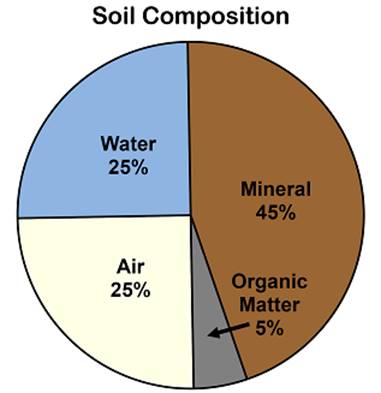
Soil consists of five components -mineral matter, organic matter, soil moisture (or soil water), soil air and living organisms. The approximate proportion of different components is as follows:
(i) Mineral matter: 45%
(ii) Organic matter: 5%
(iii) Soil moisture (or water): 25%
(iv) Soil air: 25%
(v) Soil organisms: variable
Soil Profile
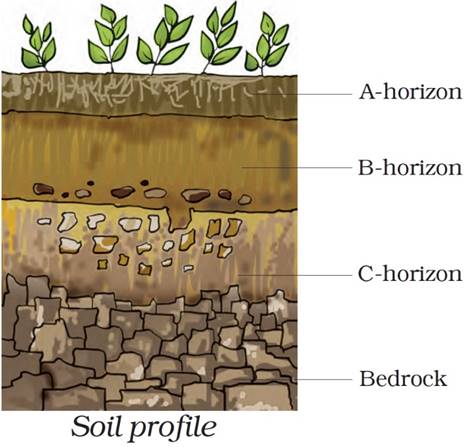
Soil profile is a vertical section through different layers of the soil.
Activity to show that garden soil has different solid components.
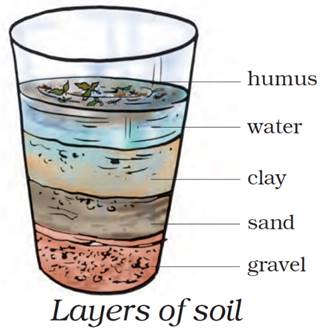
Dig the garden soil with the help of trowel to some depth. Take a handful of garden soil (from some depth) and put it in the glass tumbler and fill the tumbler with water. Stir it well with a stick to dissolve the soil. Let it stand undisturbed for some time. We observe that the particles of different sizes in the soil separate out to form different layers in the beaker.
The heaviest particle or the layer of gravel settles in the bottom. Above this layer lies, the layer of sand particles followed by silt and clay. There are some dead rotting leaves which float on the water surface. These are lighter than water and are referred to as humus.
Soil profile consists of different layers of soil which are called horizon. Each horizon differs in texture, colour, depth and chemical composition.
Different horizons of the soil are discussed further.
1. A-Horizon or Top soil
It is the uppermost layer of soil and is usually dark in colour because of the presence of minerals and humus in it. It provides the nutrients in plants, since the roots of most plants are confined to this layer. Humus is the dark brown coloured layer which consists of dead, rotting remains of plants and animals.
Humus helps in making the topsoil porous. This layer is generally soft and retains more water in it. This layer provides shelter for many living organisms like earthworm, rodents, moles and beetles.
2. B-Horizon or Subsoil
This layer of soil lies just below the topsoil. It is made up of slightly bigger rock particles than that of the topsoil. It does not have much humus and is lighter in colour than topsoil. It is somewhat harder and more compact than the topsoil. This layer is less fertile than topsoil and contains few living organisms. Subsoil is rich in minerals and iron oxides.
3. C-Horizon or Substratum
The layer of soil which lies just below the subsoil is called C-horizon. It consists of small pieces of broken rocks with cracks and crevices, formed by the weathering of bedrock or parent rock.
4. Bedrock or Parent Rock
Below the C-horizon unweathered solid rock is found which is called as bedrock. It is non-porous and can produce the soil over a long period of time. Rainwater gets collected over it to form water table.
This layer is hard enough and is difficult to dig with a spade.
Soil Types
The weathering of rocks produces small particles of various materials, these include sand and clay. The relative amount of sand and clay depends upon the rock from which the particles were formed. The rock particles present in soil are of different sizes and chemical compositions. On the basis of sizes, the rock particles present in soil can be divided mainly into four major groups:
(i) Clay These are formed by the smallest rock particles. These are so small that we cannot see a single clay particle and it feels smooth.
(ii) Silt These are made up of somewhat bigger rock particle than clay. It is not so smooth as clay. Silts are found deposited at river beds. Floods deposit the silt from rivers in the field.
(iii) Sand These are made up of larger particles enough than that of silt and can be easily seen. These are coarse to touch due to their larger size.
(iv) Gravel These are the largest sized rock particles that are present in soil. These are the tiny stones that are present in topsoil in very small quantity.
The soil in different geographical areas contains different proportions of sand, clay and silt in them. It also contains small amount of humus in them.
Depending upon its composition, a soil can be classified as sandy soil, clayey soil and loamy soil. The size of the particles in the soil influences its properties.
(a) Sandy soil
This soil mainly contains large-sized sand particles. Clay and silt are present in very small amounts. It is found in deserts. The characteristics of sandy soil are as follows:
(i) The space between sand particles is quite large and is filled by air. Sandy soil is therefore, well-aerated.
(ii) Due to large spaces between the sand particles, the water drains out quickly. Hence, sandy soil cannot hold much water. Therefore, it tends to be light and dry. This is a disadvantage of sandy soil.
(iii) Sandy soil can be ploughed easily.
(iv) Sandy soil cannot hold nutrients.
(v) Sandy soil is not much suitable for growth of plant as plant roots cannot hold on to this soil. However, there are some plants that are able to grow in sandy soil by penetrating their roots deep through the sand to the subsoil.
(b) Clayey soil
This soil mainly contains very fine clay particles. Sand and silt are present in traces. The characteristics of clayey soil are as follows:
(i) Since the particle size is quite small, they are compactly arranged. Because of this very little air can be trapped in clayey soil.
(ii) Clayey soil can hold much water. Water drains out very slowly through clayey soil. This can however lead to water logging which can damage the crops. Clayey soil tends to be heavy and holds more water than sandy soil.
(iii) Clayey soil is difficult to plough and plants root cannot push through it. Hence, this type of soil is also not good for growing plants.
(iv) Plants, bacteria and other soil organisms cannot breathe inside clayey soil and hence cannot grow in it.
(v) Clayey soil is most suitable for making pots (matkas, surahis), toys, statues, etc.
(c) Loamy soil
It is the best topsoil for growing most plants. It is a perfect mixture of sand, clay and silt particles. It has about the same amount of sand and silt, along with smaller amount of clay. It has high humus content.
The characteristics of loamy soil are as follows:
(i) It has the right water holding capacity.
(ii) It can hold sufficient air for the growth of plants because of the presence of adequate air spaces between the particles.
(iii) It can be ploughed easily.
(iv) It can hold necessary nutrients required for the growth of plants.
Activity to test the texture of different types of soils
Collect the samples of clayey, loamy and sandy soil. Take a fistful of soil from clayey soil. Remove pebbles, rocks or grasses from it. Add water in the soil and knead the soil in such a way that it may form a ball but should not be sticky. Now, roll this ball into a cylinder and form a ring from it. Now do the same procedure with loamy and sand soil.
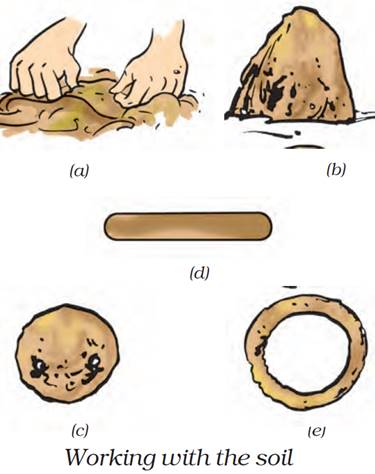
We observe that the clayey soil is smooth and sticky. it can be given any shape like cylinder, ball or ring easily and also do not crumble. Therefore, most of the toys, pots and statues are made from the clayey soil.
The sandy soil is gritty and loose, therefore do not form ball and falls apart when rubbed between the finger.
Loamy soil is smooth, partially gritty and sticky. The ball can be made from it but it crumbles easily.
Properties of Soil
Soil possesses various properties like:
(i) It contains air.
(ii) It can hold water or moisture.
(iii) It can absorb or soak water.
(iv) It allows water to pass down through it.
Major functions of the soil are:
(i) It supports plant growth by holding the roots firmly and supplying water and nutrients to the plants.
(ii) It acts as a natural habitat for many organisms like earthworm, fungi, bacteria, ants, etc.
(iii) It is also essential for agriculture which provides us food, clothing and shelter for all.
(iv) It supplies water and nutrients to plants.
Percolation Rate of Water in Soil
Soil is porous, i.e. it has tiny pores in it. When water is poured over it, then some water gets absorbed in the soil and rest passes down the soil. The process of passing down water slowly through the soil is called percolation of water. Percolation rate is the amount of water (in mL) that is percolated through the soil in unit time, i.e. in minutes.
The percolation rate differs in different soil types.
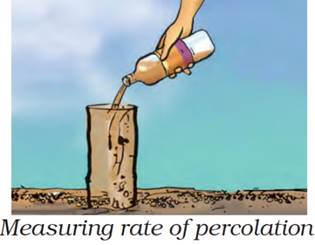
Activity to show percolation rate of water in soil
Take three bottles of same size or PVC pipes having same diameter. Cut the top and bottom of the bottle.
Now dig the soil to a depth of about 2 cm in ground at three different places.
Place one end of each bottle in the dug up ground and hold it vertically. Now take a measuring cylinder with the reading of 200 ml. Fill it with water upto 200 ml and pour it in the first bottle slowly from the top end.
Calculate the time it takes for the entire water to percolate into the soil.
Perform the similar action in next two places. We will observe that all the water poured in the pipe will percolate down through the soil leaving the bottles empty. Be careful that water should not spill over or run down on the outside of the pipe while pouring.
The rate of percolation can be calculated by using the following formula:

For example, if water in bottle 'A' percolates in 40 min, in 'B', it percolates in
25 min in bottle. While in bottle 'C ', it percolates in 20 min, then the percolation
rate (mL/min) will be calculated as follows:
For bottle A,

For bottle B,

For bottle C,

Percolation rate is highest in sandy soil because it is very loose. On the other
hand, clayey soil is very compact and therefore has lowest rate of percolation.
The rainwater moves or reaches to well faster and in greater amount from sandy soil.
Since, clayey soil can retain water in them. These are best soil to grow paddy because paddy requires standing water in fields. The kutcha (unpaved) road due to percolation of water becomes dry after rain while pakka road does not.
Water Logging
When the rainwater or surface water gets collected on a place, it is called water logging.
Clayey soil can absorb and retain a lot of water; therefore, water logging occurs in these soils.
In marshy areas, the soil is always water logged. Water logged soil cannot hold air for roots to breathe and plants cannot grow well in water logged soil.
Moisture in Soil
The soil contains some water in it which is called soil moisture.
Usually, moisture is present as a thin film around the soil particles. This moisture is absorbed by the roots of plants. Thus, the moisture content of soil is very important for the growth of crops.
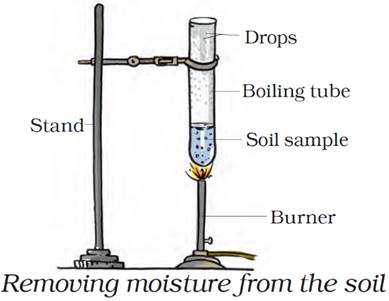
Activity to determine the reason of shimmering of air above the soil on hot summer day.
Take a boiling tube and fill it with two spoonful of soil sample in it.
Heat it on flame and observe it.
We will observe that on heating the soil, water droplets appear on the walls of test tubes. The soil contains moisture content which evaporates and moves up. When these condense, they adhere on the wall of the test tube.
Similarly, on a hot summer day, the vapour comes out of the soil and air above the soil seems to shimmer, i e. shining with a slightly shaking light.
When we compare the heated soil with the soil which is not heated, we will observe that the soil (which is not heated) is heavier than the soil (which is heated), because the moisture content is evaporated from the soil on heating making it light.
Absorption of Water by Soil
Soil contains moisture in it but it can still absorb or soak a lot of water. But soil has the limit to absorb water in it.
The ability or capacity of the soil to absorb a limit of water is called absorption percentage. It can be calculated as follows:

Different types of soil can absorb water to different extent, i.e. some absorbs more water while other absorbs less water. When we talk about the percentage of water absorbed by the soil, it means the mass of water absorbed by 100 g of soil.
Water Retention
The ability of soil to hold water is called water retention. The space between soil particles, is called pores provide the passage for gases and moisture within the soil.
The ability of soil to retain water is strongly related to the particle size. Water molecules hold more lightly to the fine particles of the clayey soil than the coarser particle of a sandy soil.
Activity to observe the absorption rate of water in soil.
Take a plastic funnel and a filter paper. Fold the filter paper and place it in a plastic funnel. Now keep the funnel (with filter paper) in a beaker. Take some dry powdered soil and weigh it on a balance.
Note the mass of the soil taken. Now pour this weighed soil into the filter paper fixed in a tunnel.
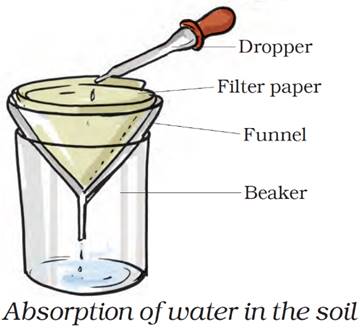
Take a measuring cylinder and fill it with water. Note the initial volume of water in the measuring cylinder. Take water from measuring cylinder with the help of a dropper and pour it drop by drop on the soil kept in the funnel. Be careful that water should not fall at one spot on the soil but should be poured uniformly all over the soil. Keep pouring water till it starts dripping from the lower end of the funnel. Soil absorbing water Dripping of water from funnel shows that the soil taken on the filter paper has absorbed the maximum amount of water. Note the final volume of water that is left unused in the measuring cylinder.
By subtracting the amount of water left in the measuring cylinder from the amount of initial volume of water taken in the measuring cylinder. We will get the volume of water absorbed by the soil which was taken on filter paper in the funnel. The difference in two reading gives the amount of water retained by the soil. The calculation can be done as follows:
Suppose, the mass of the soil taken = 50 g
Let the initial volume of water U = 100 mL
and final volume of water V = 60 mL
Therefore, the volume of water absorbed by the soil = (U − V) mL = (100 − 60) mL = 40 mL
and weight of the water absorbed by the soil = (U − V) g = (100 − 60) g = 40 g
Therefore,

When we perform this activity with different soil samples, we will see that.
(i) Sandy soil will absorb less water and allows more water to percolate.
(ii) Clayey soil will absorb more water but allow less water to percolate.
(iii) Sandy soil will absorb less water than clayey soil because of the large spaces between the soil particles.
The area where, there is a lot of clay in the soil, stagnant water collects above the soil whenever it rains.
Water held between soil particles by capillary force is called capillary water.
Water that passes through the spaces between the soil particles due to gravitational forces is called gravitational water.
Soil and Crops
Different types of soil are found in different parts of India. Soil is mainly affected by wind, rainfall, temperature, light and humidity. Some climatic factors also affect the soil profile and bring changes in the soil structure. The plants that grow on the surface of earth are called vegetation. It includes green grass, herbs, shrubs, bushes, crop plants and trees.
|
Types of soil |
Crop grown |
|
Clayey soil |
Wheat, gram and paddy |
|
Loamy soil |
Lentil, tomatoes, corn and oats |
|
Sandy-loam soil |
Potatoes, cotton, cereal, rye |
Vegetation is mostly in the fertile topsoil of the earth and covers the soil like a green sheet spread on the surface of the earth.
The component of soil along with various climatic factors determine the type of vegetation in a particular region.
(i) Clayey and loamy soils are both suitable for growing cereals like wheat and gram. Such soils are good at retaining water.
(ii) For paddy, soils rich in clay and organic matter and having a good capacity to retain water are ideal.
(iii) For lentils (masoor) and other pulses, loamy soils which drain water easily, are required.
(iv) For cotton, sandy-loam or loam, which drain water easily and can hold plenty of air, are more suitable.
(v) Crops such as wheat are grown in the fine clayey soils because they are rich in humus and are very fertile.
How Potter works with Soil
(i) Firstly, potter brings the black soil from piece of barren land.
(ii) Dry soil is then placed in a large tank and cleaned of pebbles and other impurities etc.
(iii) The soil is then soaked for around 8 hours. This soil is kneaded after mixing burnt horse dung.
(iv) This kneaded soil is then placed on the wheel and appropriate shape is given to make different types of pots. The final shape of the material is given with hands.
(v) The pots are then kept for drying for three days. These items are baked at high temperature after drying in air and then coloured.
Other Types of Soil in India
Six different types of soil are found in India.
(i) Alluvial soil : It is formed by the deposition of sediments by rivers. It is rich in humus and is very fertile. This soil is found in Great Northern plain, lower valleys of Narmada and Tapti and Northern Gujarat.
(ii) Black soil : This soil is made up of volcanic rocks and lava-flow. It is concentrated over Deccan Lava tract which includes parts of Maharashtra, Chhattisgarh, Madhya Pradesh, Gujarat, Andhra Pradesh and Tamil Nadu. It consists of lime, iron, magnesium and also potash but lacks phosphorus, nitrogen and organic matter.
(iii) Red soil : This soil is derived from weathering of ancient metamorphic rocks of Deccan Plateau. Its redness is due to iron composition. When iron content is lower, it is yellow or brown. It covers almost the whole of Tamil Nadu, Andhra Pradesh, Chhattisgarh, Karnataka, Maharashtra and parts of Orissa.
(iv) Laterite soil : This soil is formed due to intense leaching and is well developed on the summits of hills and uplands. It is commonly found in Kerala, Tamil Nadu, Maharashtra, Chhattisgarh and hilly areas of Orissa and Assam.
(v) Mountain soil : This soil is formed as a result of the accumulation of organic matter derived from forest growth. It is found in Himalayan region and varies in different regions according to altitude.
(vi) Desert soil : In the desert regions of Rajasthan, soils are not well developed. As evaporation is in excess of rainfall, the soil has a high salt content and saline layer forms a hard crust. These soils are generally sandy and deficient in organic matter.
Soil Erosion
The removal of land surface by water wind or ice is known as erosion. The topsoil is very fertile and in the absence of it, the plants cannot grow. In the absence of plants, soil becomes loose. As the plant roots bind to the soil. Soil erosion is mainly caused by the large scale cutting of forest trees and plants. This process of cutting down of trees is called deforestation. Erosion of soil is more severe in the areas of little or no surface vegetation like desert or barren land. Therefore, cutting of trees and deforestation must be prevented. The effects of soil erosion are, famines, flood desertification and damage or spoilage of environment.
Causes of soil erosion
The main causes of soil erosion are deforestation, overgrazing, floods, forest fires, etc. These are discussed below:
(i) Deforestation-Deforestation refers to the cutting down of trees. Soil erosion is more severe in areas of little or no surface vegetation, such as deserts or bare lands. This is because of the reason that the plant roots firmly bind the soil particles and prevent soil erosion. In the absence of plants, soil becomes loose and can be easily carried away by wind and flowing river water. Therefore, cutting of trees should be prevented and efforts should be made to increase the forest cover.
(ii) Overgrazing-When cattle are allowed to graze on the same land for a long period of time, they eat up most of the plants of that land. This removes the vegetation cover from the topsoil. This bare topsoil can be easily carried away by rain or wind leading to soil erosion.
(iii) Floods-Floods are the natural cause of soil erosion. Flowing river water washes away the top fertile layer of soil from the land and leaves it barren.
(iv) Forest fires-Forest fires destroy the plant cover of an area and lead to soil erosion.
Prevention of soil erosion
Process of preventing loss of precious topsoil due to erosion is called soil conservation. Few methods by which soil erosion can be prevented or minimized are as follows:
(i) Afforestation : Afforestation refers to the establishment of a forest by planting of trees in an area where there was no forest. Roots of the plants hold the soil particles firmly, so by planting trees we can help in controlling soil erosion.
(ii) Terrace farming : It is done in hilly areas. It consists of building a series of steps like benches. Each step slows down the flow of water, thereby reducing soil erosion.
(iii) Contour farming : It is a practice of farming in hilly areas in which the crops are cultivated along the contour of the land. Even in the heavy rain, the runoff is checked by the plants growing along the contour.
(iv) Preventing overgrazing: Soil erosion can be checked by preventing the cattle from overgrazing in an area.
Soil Pollution
Soil contamination or soil pollution is the addition of unwanted substances into the soil by human activities. The unwanted substances can be polythene bags, plastics, chemicals, pesticides, fertilizers, etc.
It is typically caused by industrial activity, agricultural chemicals, or improper disposal of waste. Various factors which contribute to soil pollution are listed below:
(i) Acid rain
(ii) Deforestation
(iii) Industrial accidents
(iv) Oil and fuel dumping
(v) Electronic waste
(vi) Agricultural practices, such as application of pesticides, herbicides and fertilizers
(vii) Intensive farming
(viii) Nuclear wastes
(ix) Landfill and illegal dumping
(x) Drainage of contaminated surface water into the soil
Health effects of soil pollution
(i) Contaminated or polluted soil directly affects human health through direct contact with soil or via inhalation of soil contaminants which have vaporized. Greater threats are posed by the infiltration of soil contamination into groundwater aquifers used for human consumption
(ii) Health consequences from exposure to soil contamination vary greatly depending on the type of pollutant. Chronic exposure to chromium, lead and other metals, petroleum, solvents, and many pesticide and herbicide formulations can cause cancer and other chronic health conditions.
Prevention of soil pollution
Soil pollution can be prevented in following ways:
(i) Waste products and chemicals should be treated before they are released into the soil.
(ii) The use of pesticides, chemical fertilizers, insecticides, etc., should be minimized.
(iii) There should be a ban on polythene bags and plastics.
(iv) The trash should not be directly thrown on ground, roads, gardens, etc., rather it should be thrown into dustbins.
Online Tuitions & Self-Study Courses for Grade 6 to 12 & JEE / NEET