
Chapter 15 – Some Natural Phenomena
Study Notes
In this chapter following two natural phenomena have been discussed:
· Lightning
· Earthquakes
Sparks occur when the electricity transmission wires become loose and touch each other due to wind flow. Sometimes, sparking takes place when a plug is loose in the socket. Lightning is also an electric spark but on a huge scale.
The sparks in sky are called lightning which are caused by accumulation of electric charges in the rain clouds.
When amber (a kind of resin) is rubbed with fur, it attracts light objects such as hair. If we take off woolen or polyester clothes in the dark place, then we see a spark and listen a cracking sound. An American scientist Benjamin Franklin in 1752, showed that lightning and the sparks from clothes are essentially the same phenomena.
When we rub a plastic comb or scale on dry hair, then we observe that the comb/scale can attract very small piece of papers.
Activity 1: To understand the nature of electric charges
Let’s take a ball-pen refill and rub it vigorously with a piece of polythene.
Now, bring it close to a piece of paper and ensure that the rubbed part of refill should not be touched by our hand.
We notice that the refill attracts the tiny piece of papers.
From the above activity, we can conclude that when the plastic refill rubbed with polythene, then it starts acquiring a small electric charge.
In the same manner, when a plastic comb is rubbed with dry hair, then it acquires a small charge. These objects are called charged object.
Polythene and hair also acquire some charge so they are also charged objects.
|
Objects rubbed |
Materials used for rubbing |
|
Refill |
Polythene, woollen cloth |
|
Balloon |
Polythene, woollen cloth, dry hair |
|
Steel spoon |
Polythene, woollen cloth |
|
Ball pen |
Hair |
|
Coin |
Woollen clothes |
|
Eraser |
Wool |
Types of Charges and their Interaction
There are two types of electric charges, positive and negative. The charge developed on a glass rod when rubbed with silk cloth is positive charge and the charge acquired by silk cloth is negative charge.
Activity 2: To show that like charges repel each other.
Hold two balloons and inflate them.
Hang them in such a way that they do not touch each other.
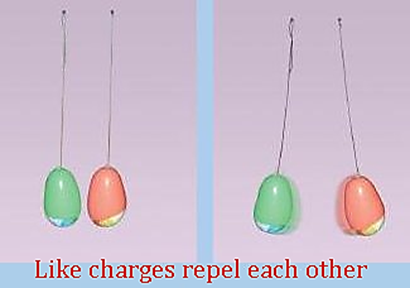
Rub both the balloons with woollen clothes and release them.
We notice that the two balloons move apart as if they are pushing away each other.
Since balloons are made up of same material, they acquire similar charge after rubbing with woollen clothes, and they repel each other.
Activity 3: To show that like charges repel each other and unlike charges attract each other
(i) Take two used ball pen refills and rub one refill with a piece of polythene in order to charge.
Now, place this charged refill in a clean glass beaker and rub the other ball pen refill with a piece of polythene to make it charge.
Slowly, bring this charged refill near the first charged refill placed in the beaker.
We notice that both the refills move away from each other.
(ii) Now, gently rub a refill and put it in a glass tumbler as before.
Bring an inflated charged balloon near the refill and start observing it.
We notice that the charged refill moves towards the charged balloon.
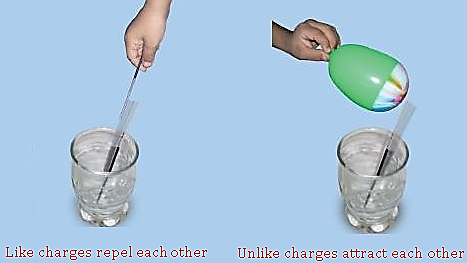
From the above activities, we can conclude that:
(i) The two bodies attract each other, if one body has positive charge and other has negative charge.
(ii) The two bodies repel each other, if both the bodies have positive charges.
(iii) Also, the two bodies repel each other, if both the bodies have negative charges.
It is seen that if a charged glass rod is brought near a charged plastic straw, then there is an attraction between both of them. Here, the glass rod having positive charge, so the plastic straw must have negative charge on it.
The electrical charges generated by rubbing are static and they do not move themselves.
If charges move, then they constitute electric current.
The current in a circuit is nothing but a motion of charges.
In order to test whether an object is carrying charge or not a device, called electroscope is used. It consists of closely placed two metallic foils or strips and when both the strips are charged with similar charges, then they repel each other and become wide open.
Activity 4: The activity explains the working of electroscope clearly
Let’s choose an empty jam bottle (glass bottle) and take a piece of cardboard slightly bigger in size than the mouth of the bottle.
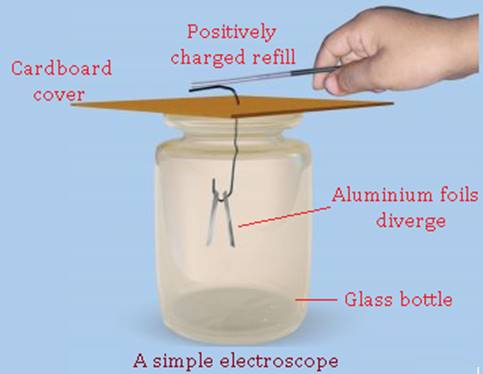
Pierce a hole in it so that a metal paper clip can be inserted.
Now, cut two strips of aluminium foil (leaves) about 4 cm × 1 cm each. Hang them on the paper clip as shown in the figure alongside.
Now fix the paper clip in the cardboard lid so that it gets perpendicular to it as shown in the figure.
Now, charge a refill and make it touch with the end of the paper clip.
We will observe that the two aluminium leaves move away from each other.
Gently, touch the other charged bodies with the ends of paper clip. Here, we find no differences in the working of foil strips.
From the above activity, we can conclude that a charged body will cause the aluminium leaves to diverge.
Greater the amount of electric charge on a body, greater the aluminium leaves will diverge.
The aluminium foil strips receive the same charge from the charged refill via the paper clip.
The paper clip is a metal which is good conductor of electricity. Hence, the aluminium leaves get charged with similar charges.
As similar charges repel each other, the two aluminium leaves repel each other and diverge.
Thus, electric charge can be transferred from a charged body to another body through a metal conductor.
Detection of Charge with Electroscope
In order to detect the electric charge on a body, we touch the metal top of electroscope with the body and notice the aluminium leaves.
(i) The body is electrically charged, when the leaves diverge out.
(ii) The body is electrically uncharged, when the leaves do not diverge.
It is the process of transferring an electric charge from a charged object to the earth.
In an electroscope, if we touch the top end of paper clip gently with our hand, we will observe a change in the foil strip. They come back to their original state.
Now, repeat charging of foil strips and touching the paper clip with hand. Every time, we will observe that the foil strips collapse as soon as we touch the paper clip with hand.
When we touch the paper clip with our hand, then the electric charge present on the charged strips flows to the earth through our body. Here we can say that the foil strips are discharged.
Earthing is provided in buildings to protect us from electrical shocks due to any leakage of electrical current.
When a body losses charge to the earth or any other body, then it is called discharge.
During the development of thunderstorm, there is always an upward movement of air while the water droplets move downward. These vigorous movements cause separation of charges. Therefore, the top of the cloud becomes positively charged while the bottom of the cloud becomes negatively charged.
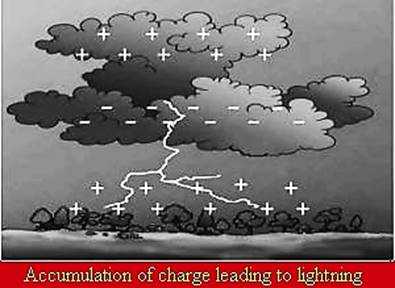
If the quantity of opposite electric charges on the top and bottom of storm cloud becomes very large, then the air which is normally a poor conductor of electricity will remain no longer able to resist their flow.
Therefore, the electric charges start flowing with high speed.
When both the positive and negative charges of cloud meet, then they produce an intense spark of electricity. Here, we observe this electric spark as a flash of lightning in the sky.
The air in the sky expands rapidly and produces a loud sound which is known as thunder. This process is also called an electric discharge.
The process of electric discharge can occur between two or more clouds or between clouds and the earth.
Lightning strike could destroy life and property. Therefore, it is necessary to take measures to protect ourselves.
The damage caused to buildings and other tall structures by lightning can be prevented by installing lightning conductor on them.
Lightning Safeties outside the House
(i) During thundering and lightning, scooters are not safe. So, during lightning we have to leave such vehicle and take shelter.
(ii) During thunderstorms, we should avoid carrying an umbrella over our head. It is due to reason that lightning may strike the top end of the metal rod of umbrella and harm us.
(iii) If we are in forest, then we should take shelter under shorter trees as a short tree is less likely to be hit by lightning.
(iv) If in case, no shelter is available and we are in an open field, then kindly stay away from poles and other metal objects and do not lie on the ground. Instead, squat low on the ground. Place hands on the knees with head between the hands because this position will make us the smallest target to be struck.
Lightning Safeties inside the House
(i) Any contact with telephone cords, electrical wires and metal pipes should be avoided during a thunderstorm.
(ii) Mobile phones and cordless phones should be use.
(iii) Bathing should be avoided during thunderstorms, in order to avoid contact with running water.
(iv) Even the electrical appliances like computers, TVs, etc., should be unplugged. Electrical lights can remain on. They do not cause any harm.
A house or a building is a safe place. If you are travelling by car or by bus, you are safe inside with windows and doors of the vehicle shut.
A device which is used to protect buildings from the effects of lightning is known as lightning conductor. It is made up of a thick strip of metal.
The top end of lightning conductor is pointed which is fixed at the highest point of the building.
From the top of building; the thick metal strips run along the outer wall of the building to the ground and the lower end of metal strip is joined to the metal plate which is buried deep in the earth.
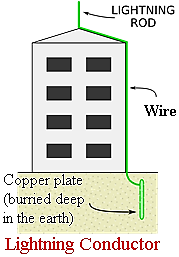
It provides an easy route for transfer of electric charge to the ground.
If lightning strikes it, then it will hit the top of lightning conductor instead of building.
The electric energy of lightning which passes through the metal strip gets discharged safely in the ground through the buried metal plate.
The metal columns used during construction, electrical wires and water pipes made of metal in the buildings conduct electricity. So, do not try to touch them during thunderstorm.
Earthquake is a destructive natural phenomenon which cannot be predicted in advance.
A major earthquake can cause damage to life and property on huge scale.
A major earthquake occurred in India on 26th January, 2001 in Bhuj district of Gujarat. After some years, another major earthquake occurred in India on 8th October, 2005 in Uri and Tangdhar towns of North Kashmir.
Physical Meaning of Earthquake
A sudden shaking or trembling of the earth which lasts for a very short time is an earthquake.
This phenomenon occurs at any time all over the world. Major earthquakes are much less frequent but on the same side they are very dangerous. They can cause an immense damage to buildings, bridges, dams and people.
There are many other natural phenomena which can be caused by earthquake. These phenomena are floods, tsunamis and landslides. A major tsunami occurred in the Indian ocean on 26th December 2004. All the coastal areas around the ocean suffered a large amount of losses.
Tsunami is a type of earthquake under the ocean floor which generates powerful sea waves.
These kinds of waves travel across the ocean at speed upto about 1000 km/h and can be 30 m or more high. Tsunami occurs in a frequent manner in the Pacific Ocean.
On 26th December, 2004 tsunami was generated by an earthquake along Indonesia.
When a volcano erupts or a meteor hits the earth or an underground explosion is carried out, then these tremors on the earth can be caused.
The earth consists of three layers:
(i) Core: The innermost part of the earth is called its core. It is made up of iron and the outer core is made up of molten iron and inner-core is made up of solid iron. Core is extremely hot.
(ii) Mantle: The central region of the earth is called mantle which is the middle layer existed between core and crust. Mantle is mostly made up of solid rocks. The heat coming from the core of earth warm the mantle.
(iii) Crust: The outermost layer of the earth is called crust. It is made up of lighter rocks than that of mantle. It is thicker where there is land (continents) and thinner under the oceans.
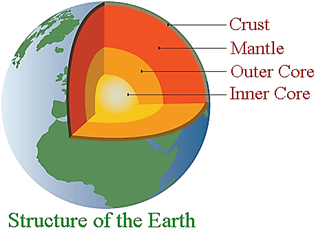
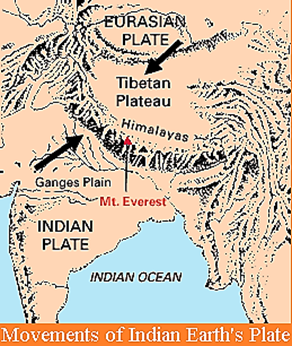
As the outermost layer of the earth is fragmented, due to which the earth crust is divided into many plates. The plate of earth near continent is called continental plate and the plate under ocean is called oceanic plate. Both the plates are in continuous motion due to convection current taken from mantle. If these plates brush past one another or collide with one another, then they cause disturbance in the earth's crust.
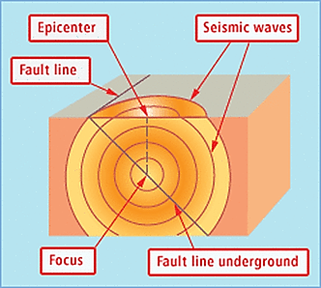
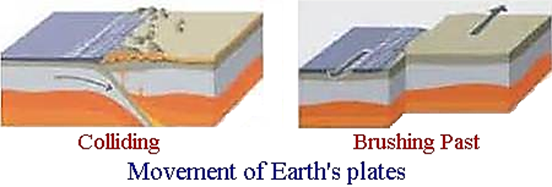
This is the disturbance that shows up as an earthquake on the earth surface.
As, earthquakes are caused by the movement of plates, the boundaries of the plates are the weak zones where earthquakes are more likely to occur. These weak zones are also known as seismic or fault zones. In India, Kashmir, Western and Central Himalayas, the whole of North-East, Rarin of Kutch, Rajasthan and the Indo-Gangetic Plain are the most threatened areas.
Richter scale is used to measure the intensity of an earthquake. On this scale, a series of numbers from 1 to 12 are written which are used to express the power of earthquakes.
The earthquake having magnitude (intensity) more than 7 on the Richter scale are destructive earthquakes. Both Bhuj (Gujarat) and Uri (Kashmir)earthquakes had magnitude greater than 7.5. There were huge losses of life and properties in these two major earthquakes.
The Richter scale is not linear which means that an earthquake of magnitude 2 on Richter scale is not two times as strong as an earthquake of magnitude 1. On this scale, infact an earthquake of magnitude 2 is ten times greater or stronger than that of magnitude 1. Also, an earthquake of magnitude 6 is 100 times stronger than that of magnitude 4 on Richter scale.
The seismic waves are those waves which are produced by tremors on the earth surface.
These waves are recorded by an instrument called the seismograph. This instrument is simply a vibrating rod, or a pendulum which starts vibrating when tremors occur.
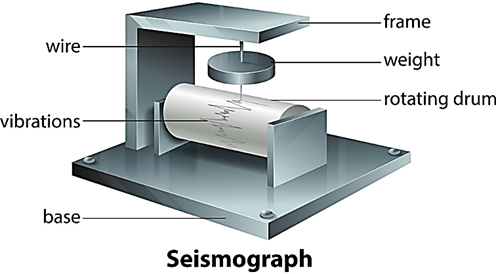
A pen is attached to the vibrating system and this pen records the seismic waves on a paper which moves under it. By studying these waves, scientists can construct a complete map of the earthquake. They can also calculate its power to assess destruction.
Protections Against Earthquake
Some of the precautions which can be taken, are as follows:
(i) Earthquake proof houses should be constructed by using modern building technology. for which, we should consult a qualified architects and structural engineers.
(ii) In highly seismic areas, the mud or timber should be used for building houses as these are better than heavy material which keep roofs as light as possible so that of the structure falls due to earthquake, the damage will not be too much.
(iii) There should be the tight fixation of cupboards and shelves to the wall, so that they do not fall while shaking occurs.
(iv) The heavy mirrors, photo frames, water heaters, etc. should be mounted to the wall at low levels so that in the event of an earthquake, they do not fall on the people.
Precautions to be taken at home
(i) Try to get a shelter under a table and stay there till the shaking stops.
(ii) Make yourself to stay away from tall and heavy objects as they may fall on you.
(iii) It you are on bed, then do not get up. Immediately, protect your head with a pillow.
Precautions to be taken outside home
(i) Observe a clear spot away from buildings, trees and overhead power lines. Go to the ground.
(ii) If in a car or bus, do not come out. The car should be driven slowly to a clear spot.
Online Tuitions & Self-Study Courses for Grade 6 to 12 & JEE / NEET