
• The ratio of a number a
to another number b (where, b ≠ 0) is a fraction  and it is written as a : b. In the
ratio a : b, the first term a is called antecedent
and the second term b is called consequent.
and it is written as a : b. In the
ratio a : b, the first term a is called antecedent
and the second term b is called consequent.
• Percent means parts per hundred.
• In terms of Fraction,
Percent = Fraction × 100
• In terms of Ratio,
Percent = Ratio × 100
• In terms of Decimal,
Percent = Decimal × 100
• Steps to find the percentage of a number:
· Obtain the number, say x.
· Obtain the required per cent, say P%.
· Multiply x by P and divide by 100 to obtain the required P% of x.

• Discount is a reduction given on Marked Price (MP).
Discount = Marked Price (MP) – Sale Price (SP)
[For calculating discount per cent, we use marked price or list price as the base.]
Rate of discount
= Discount% = 


• Cost Price (CP): The amount paid to purchase an article or the price at which an article is made is known as cost price.
• Selling Price (SP): The price at which an article is sold is known as selling price.
• Profit: If the selling price of an article is greater than the cost price, then the difference between the selling price and cost price is called profit.
If SP > CP i.e. in case of profit,
(i) Profit = SP – CP
(ii)  or
or 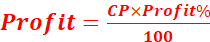
(iii)  or
or 
• Loss: If the selling price of an article is less than the cost price, then the difference between the cost price and the selling. price is called loss.
If CP > SP i.e. in case of loss:


Overall gain = Combined SP – Combined CP
Overall loss = Combined CP – Combined SP
• Sales Tax/Value Added Tax/GST
On purchasing an item, we pay Sales Tax (ST). This sales tax is charged by the government on the sale on an item. It is collected by the shopkeeper from the customer and given to the government. Sales tax is applicable on selling-price of an item and is ·added to the value of the bill.
Hence, it is charged on the selling price of an article.
∴ Sales Tax = Tax% of bill amount
Customers pay VAT/GST to the shopkeeper. Government collects it from the shopkeeper. So, it cannot be a part of his profit.
• Simple Interest (SI)
When the interest is paid to the lender regularly every year or half year on the same principal, we call it as simple interest. In other words, interest is said to be simple, if it is calculated on the original principal throughout the loan period.
If P is the principal of money borrowed, R is the rate of interest per annum and T is the time period for which the money is borrowed, then the simple interest is given by

• Compound Interest (CI)
If the borrower and the lender agree to fix up a certain interval of time (say, a year or a half year or a quarter of a year, etc.), so that the amount at the end of an interval becomes the principal for the next interval, then the total interest over all the intervals calculated in this way is called the compound interest.
Also, CI = Amount – Principal
• Rate Compounded Annually
Amount, when interest is compounded annually  , where P is principal, R is rate of interest, n is time period.
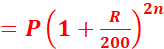
• Rate Compounded Half-yearly (Semi-annually)
Amount, when interest is compounded Half-yearly
 , where P is principal,
  is half-yearly rate of interest, 2n is number of half years.
• General formula to calculate Compounded amount
Let P be the principal and the rate of interest be R% per annum. If the interest is compounded k times in a year, then the amount A and the compound interest at the end of n years are given by

And 
• Amount and CI when Rate of interest is not same
Let P be the principal and the rate of interest be R1% for first year, R2% for second year, R3% for third year and so on and in last, Rn% for the nth year. Then, the amount A and the compound interest at the end of n years are given by


• Population Growth and Depreciation Formulae
· Let P be the population of a city or a town at the beginning of a certain year. If the constant rate of growth is R% per annum, then
Population after n year
= 
· Let P be the population of a city or a town at the beginning of a certain year. If the population grows at the rate of R1% during first year and R2% during second year, then
Population after 2 year
= 
· Let P be the population of a city or a town at the beginning of a certain year. If the constant rate of decrease in population is R% per annum, then
Population after n year
= 
Online Tuitions & Self-Study Courses for Grade 6 to 12 & JEE / NEET