
Chapter 10 – Life Processes in Plants
Very Important Questions Answers – Set 1
1. Fill in the blanks:
i) The components essential for our body are called ____________.
ii) We obtain nutrients through ______________
iii) Carbohydrates, _______________ and fats are important nutrients
iv) ____________ can make their own food from simple nutrients.
v) All animals are directly or indirectly _____________ on plants for food.
Ans:
i) Nutrients
ii) food
iii) proteins
iv) plants/autotrophs
v)depend
2. State whether true or false. If false correct the statement by changing the underlined word.
a) Animals are the only organisms that can prepare their own food using simple substances from the surroundings.
Ans: False. Plants are the only organisms that can prepare their own food using simple substances from the surroundings.
b) The intake of food by an organism is called nutrition.
Ans: True
c) Stomata absorb sunlight for photosynthesis.
Ans: False. Chlorophyll absorb sunlight for photosynthesis
d) Insectivorous plants are autotrophic.
Ans: False. Insectivorous plants are partially heterotrophic.
e) Starch on reacting with iodine solution turns brown in colour.
Ans: False. Starch on reacting with iodine turns blue-black in colour.
3. Define the following terms:
a) Nutrition
Ans: Nutrition is the process by which an organism obtains and digests food so as to get the nutrients in simple and soluble forms.
b) Autotrophs
Ans: Autotrophs are organisms that can make their own food using simple molecules like carbon dioxide and water from the environment with the help of sunlight and chlorophyll.
c) Photosynthesis
Ans: The process by which organisms synthesise food from simple inorganic molecules like carbon dioxide by using the energy from sunlight with the help of pigment chlorophyll.
d) Host
Ans. The organism which contains the parasite in a parasitic relationship. The host supports and provides food for the parasite. The host is negatively affected by this relationship.
e) Parasite
Ans: The organism that depends on the host for its nutrition and survival. The parasite cannot survive without the host and in this relationship causes harm to the host.
4. What are stomata? Explain their function.
Ans: Stomata are tiny pores on the underside of the leaf surface that are surrounded by guard cells. Their functions are to exchange gases by diffusion for photosynthesis and respiration and to cause transpiration by evaporation of water from the leaf surface.
5. How is sunlight used by the plant for photosynthesis?
Ans: Sunlight is the energy source for photosynthesis. It is trapped by the green pigment chlorophyll that is present in the leaves and all green parts pf the plants. The chlorophyll is present in organelles called chloroplasts. Most of the chlorophyll is present in the leaves and therefore leaves are the major site for trapping sunlight to convert it to chemical energy.
6. Why are some plants insectivorous? Give examples.
Ans: Plants need nutrient in addition to carbohydrates like nitrogen. Some plants fulfil their nitrogen requirements by digesting insects. The insectivorous plants trap insects within modified structures of leaf or flower. The digestive enzymes break down the insect body and release the nutrients into the plant. Examples of insectivorous plants are Pitcher plant, Venus Fly trap, etc.
7. Explain saprotrophic mode of nutrition with an example.
Ans: Saprotrophic mode of nutrition involves partial digestion of substrate outside the body and then absorbing the digested material into the body. In saprotrophic mode of nutrition, the organism releases digestive enzymes into the substrate. This causes partial digestion of the substrate. The partially digested substrate is then absorbed by the organism. This mode of nutrition is seen is some detritivores such as fungi.
8. What is symbiosis? Explain with help of an example.
Ans: Symbiosis is a mutually beneficial relationship between two organisms. In this relationship both organisms are equally benefitted and neither organism is harmed or adversely affected by the other. For example, lichen is a symbiotic association between algae and fungi. In this the algal partner provides nutrition through photosynthesis whereas the fungal partner provides shelter and support.
9. Explain how photosynthesis occurs in plants.
Ans: Photosynthesis is the process by which solar energy is converted to chemical energy by the green plants. In this process simple inorganic molecules like carbon dioxide and water are used to synthesise organic food like starch. The reaction requires energy from sunlight. Sunlight is trapped by the pigment chlorophyll present in the leaves. The raw materials for photosynthesis are carbon dioxide and water. Carbon dioxide is absorbed from the atmosphere whereas water is absorbed from the soil. The energy from sunlight converts carbon dioxide and water to starch and oxygen. Starch is used as food by plants and other animals whereas the oxygen is released into the atmosphere. The overall reaction of photosynthesis can be represented as follows:

10. How are nutrients replenished in soil naturally? How can the nutrients be replenished artificially?
Ans: Plants use nutrients from the soil and therefore nutrients in the soil get depleted. Plants cannot directly use nitrogen gas from the atmosphere. Some bacteria can convert nitrogen from the atmosphere to soluble compounds that can be used by the plants. Rhizobium is an example of a nitrogen fixing bacterium. It lives in symbiotic association with the roots of leguminous plants. Therefore, by its action the nitrogen content is replenished in the soil. Using leguminous plants after cereal crops in the soil therefore replenishes nitrogen in the soil naturally.
Artificially nutrients can be replenished by the use of fertilizers and manure.
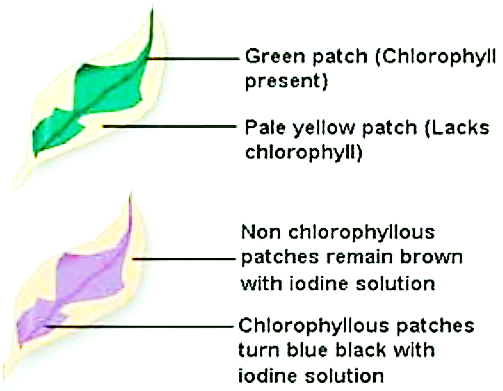
11. How can we demonstrate that chlorophyll is necessary for photosynthesis?
Ans: Importance of chlorophyll can be demonstrated by using a variegated leaf. The outline of the leaf is traced on a paper and the green areas are marked before the start of the experiment. The leaf is placed in sunlight for few hours to allow photosynthesis. The leaf is then decolourized by boiling in alcohol. To this iodine solution is added. It can be observed that the green areas of the leaf turn blue-black in response to iodine solution indicating the presence of starch. Thus, it can be seen that photosynthesis occurs in the green areas of the variegated leaf showing that chlorophyll is important for photosynthesis.
12. How do plants obtain nutrients other than carbohydrates?
Ans: Plats synthesise carbohydrates using energy from sunlight to convert carbon dioxide and water to starch. The other nutrients are however obtained directly from soil. Nitrogen is absorbed as soluble nitrogen compounds from the soil. The nitrogen compounds are present in the soil due to the action of nitrogen fixing bacteria like Rhizobium that live in symbiotic association with roots of leguminous plants. Nitrogen compounds can be replenished by the addition of fertilizers and manure to the soil. Some plants like the pitcher plant and Venus flytrap fulfil their nitrogen requirements by insects. In this case the insects are trapped and digested by plant parts and the nutrients are released into the plant body.
Online Tuitions & Self-Study Courses for Grade 6 to 12 & JEE / NEET